The nervous system
 Studied by 0 people
 Call Kai
 Learn
Learn Practice Test
 Spaced Repetition
 Match
Match Flashcards
 Knowt Play
1/8

There's no tags or description
Looks like no tags are added yet.
Name | Mastery | Learn | Test | Matching | Spaced |
|---|
No study sessions yet.
9 Terms
Division of the nervous system
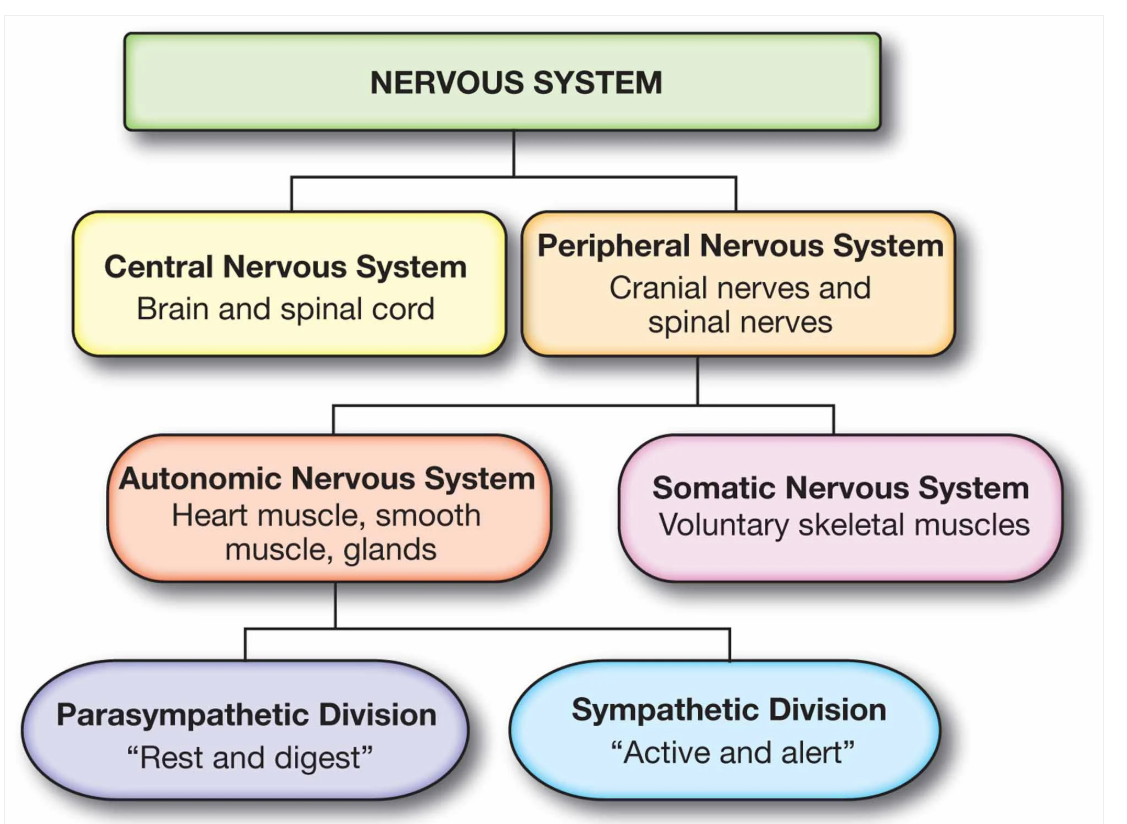
What is the peripheral system
The communication lines that links the CNS to rest of the body. Components are all nerves that the brain (cranial nerve 12 pairs) and spinal cord (spinal nerve 31 pairs).
Somatic and Autonomic nervous system part of peripheral
somatic- Voluntary, control skeletal muscle and processes external sensory into such as touch and light.
Autonomic- involuntery, regulates automatic life sustaining function e.g heart rate, digestion, breathing.
Sympathetic and parasympathetic part of Autonomic system
sympathetic- fight or flight. Prepares the body for immediate vigorous activity or stress. Increases heart rate and dilates pupils.
Parasympathetic- Rest and digest. Promotes maintenance function and inhabits digestion, conserves energy. Decreases heart rate, constricts pupils. Stimulates digestion.
Function of nervous system
Communication Network: Transmits rapid electrical and chemical signals (nerve impulses) throughout the body.
Sensory Input: Gathers information from your senses (sight, sound, touch, etc.) and internal body receptors.
Integration: Processes and interprets sensory information, making decisions and storing memories.
Motor Output: Sends signals to muscles and glands to initiate actions, like movement or hormone release.
Control & Coordination: Manages all bodily functions, including voluntary actions (walking, talking) and involuntary ones (digestion, heart rate, breathing).
Higher Functions: Responsible for thought, learning, emotions, consciousness, and maintaining balance (homeostasis).
How it Works
Sensory Neurons: detect stimuli (e.g., touching a hot stove).
Signals: travel along nerves to the spinal cord and brain (integration center).
The Brain: processes the input and decides on a response.
Motor Neurons: carry commands from the brain back to muscles, causing you to pull your hand away (response)
The central nervous system
It is an integration (process and coordinates) and control centre. The components includes:
Brain- responsible for high function like thoughts, emotion, memory and coordinating complex moves.
Spinal cord- long cylinder of nervous tissue that extends from brainstem. Main communication pathways between the brain and rest of the body, and control reflex action without the brain.
The CNS is protected by skull, vertebral coloum and 3 layer membrane (Dura, Arachnoid, Pia mater) called meninges, which are cushioned by cerebrospinal fluid(CSF) it is shock absorber and provides nutrients and removes waste.
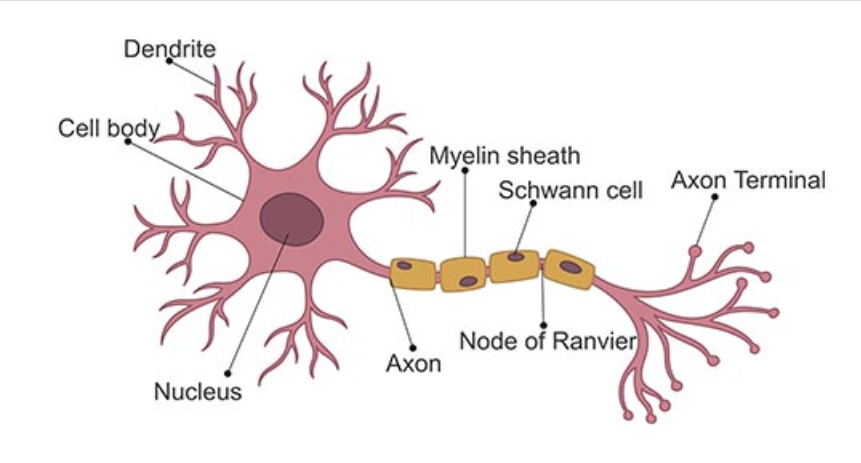
The nerve cell
A nerve cell, or neuron, is a cell that transmits information throughout the body via electrical signals and chemical messengers, enabling functions like thinking, moving, and feeling. Neurons have a unique structure with a cell body, dendrites to receive signals, and a long axon to send signals to other cells, allowing them to form complex communication networks.
Key Parts of a Neuron
Cell Body (Soma): has a nucleus and controls the cell's activities.
Dendrites: Branched extensions that receive nerve impulses from other neurons.
Axon: A single, long fiber that carries impulses away from the cell body, often covered by a fatty myelin sheath for faster transmission.
Synapses: Tiny gaps where neurons connect to pass signals to other neurons or muscles, using chemical messengers called neurotransmitters.
How They Work
Neurons generate and conduct electrical impulses, also called action potentials, to transmit information rapidly.
They can be very long, allowing signals to travel across large distances, like from your brain to your toes.
Their branched connections (dendrites and axon terminals) form intricate circuits, acting as information highways in the brain and body.
Types of Neurons
Neurons come in various shapes and sizes, specialized for different roles, such as sensory neurons (detecting stimuli) or motor neurons (controlling muscles
What is myelin sheath?
Fatty insulating layers surrounding many axons. Increases speed of impulse transmissions.
What is synapse?
The junction where the axon terminal of one neuron meets another cell. Signals are transmitted across synapses using neurotransmitters.