ESCI 203 Geologic Time
 Call Kai
 Learn
Learn Practice Test
 Spaced Repetition
 Match
Match Flashcards
 Knowt Play
1/26

There's no tags or description
Looks like no tags are added yet.
Name | Mastery | Learn | Test | Matching | Spaced | Call with Kai | Chat |
|---|
No analytics yet
Send a link to your students to track their progress
27 Terms
All geologic time categories in order of descending length.
Eon, era, period, epoch, age
List all eons from oldest to newest.
Hadean, Archean, Proterozoic, Phanerozoic
List all eras from oldest to newest.
Paleozoic, Mesozoic, Cenozoic.
Periods in the Paleozoic era from oldest to newest
Cambrian, Ordovician, Silurian, Devonian, Carboniferous (Mississippian and Pennsylvanian), Permian
Periods in Mesozoic era from oldest to newest
Triassic, Jurassic, Cretaceous
Periods in Cenozoic era from oldest to newest
Tertiary (Paleogene, Neogene), Quaternary
Precambrian
Hadean, Archean, Proterozoic
Permian epochs (oldest-newest)
Cisuralian, Guadalupian, Lopingian
Cretaceous epochs
Early and Late
Jurassic epochs
Early, middle, late
Triassic epochs
Early, middle, late
For what is the Phanerozoic named?
It’s named for phaneros (visible) and -zoic (life); it is the geologic layer with fossil records.
What does Ma stand for?
Millions of years (from present)
What does it mean for a fossil to be dated 113 m.y.r?
The fossil is 113 million years old (from present)
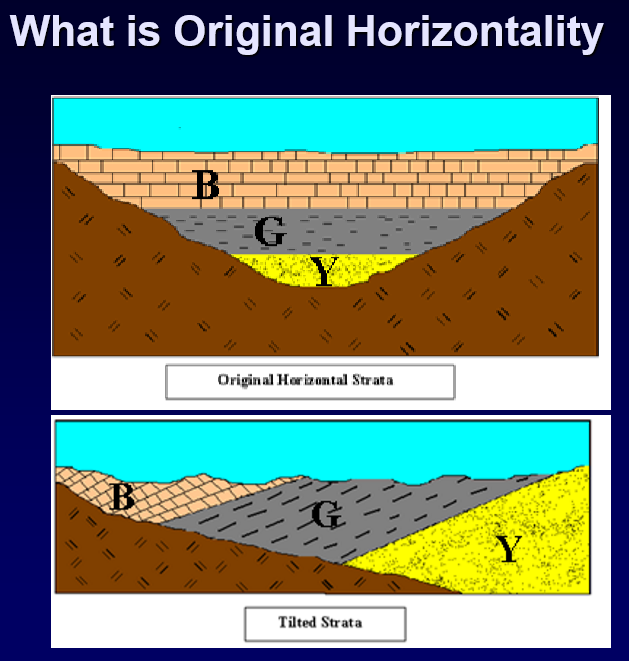
Principle of Original Horizontality
Layers of sediment are always originally deposited horizontally.
Law of Superposition
In any succession of strata not disturbed or overturned, younger layers lie above older layers.
Does the principle of original horizontality still hold true?
Not necessarily; tilted strata exist. However, the principle is still analytically useful.
Principle of Lateral Continuity
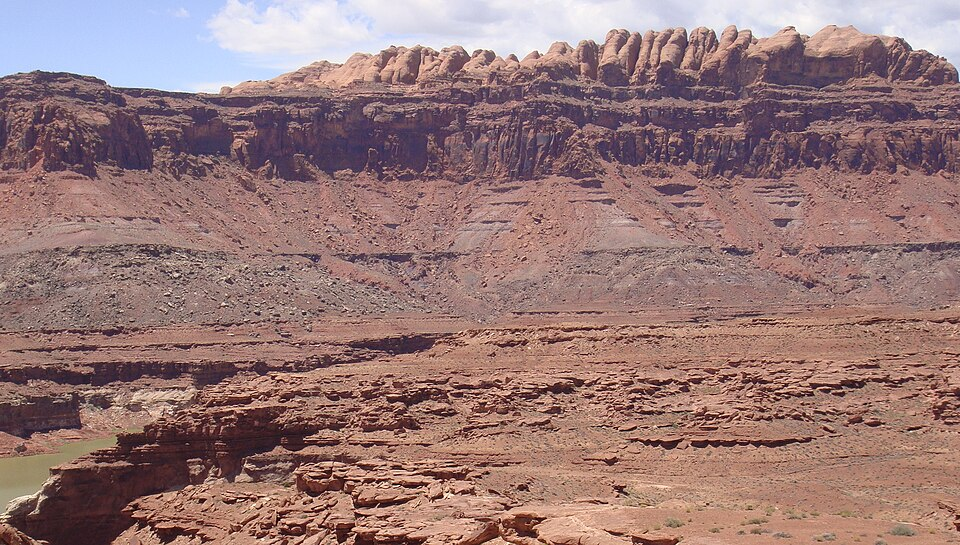
Layers of rocks are laterally continuous.
What does the Principle of Lateral Continuity tell us?
Layers of rocks that are separated by erosional features but that are otherwise similar can be assumed to be originally laterally continuous.
How do we determine the end of a sedimentary basin?
Abrupt changes in rock type or thinning.
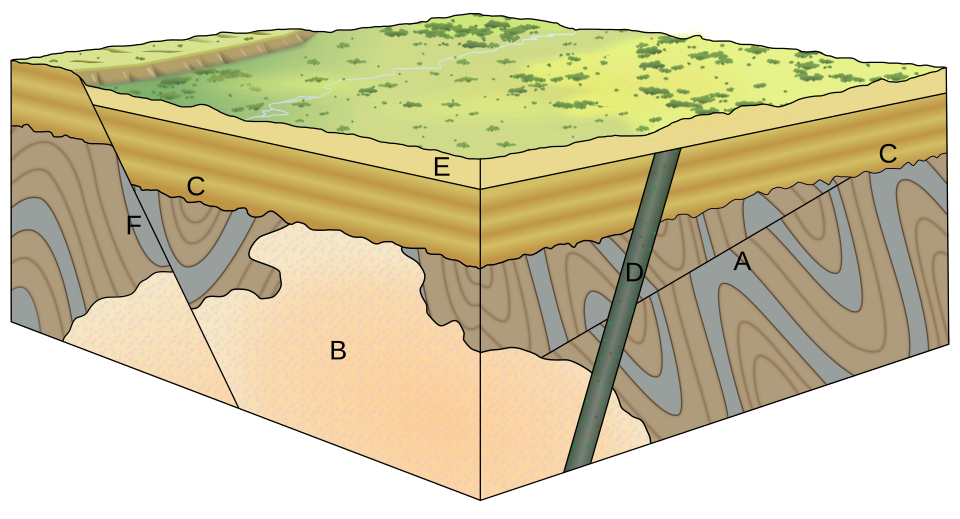
Principle of Cross-Cutting Relationships
A rock that cuts across another rock must be the younger of the two.
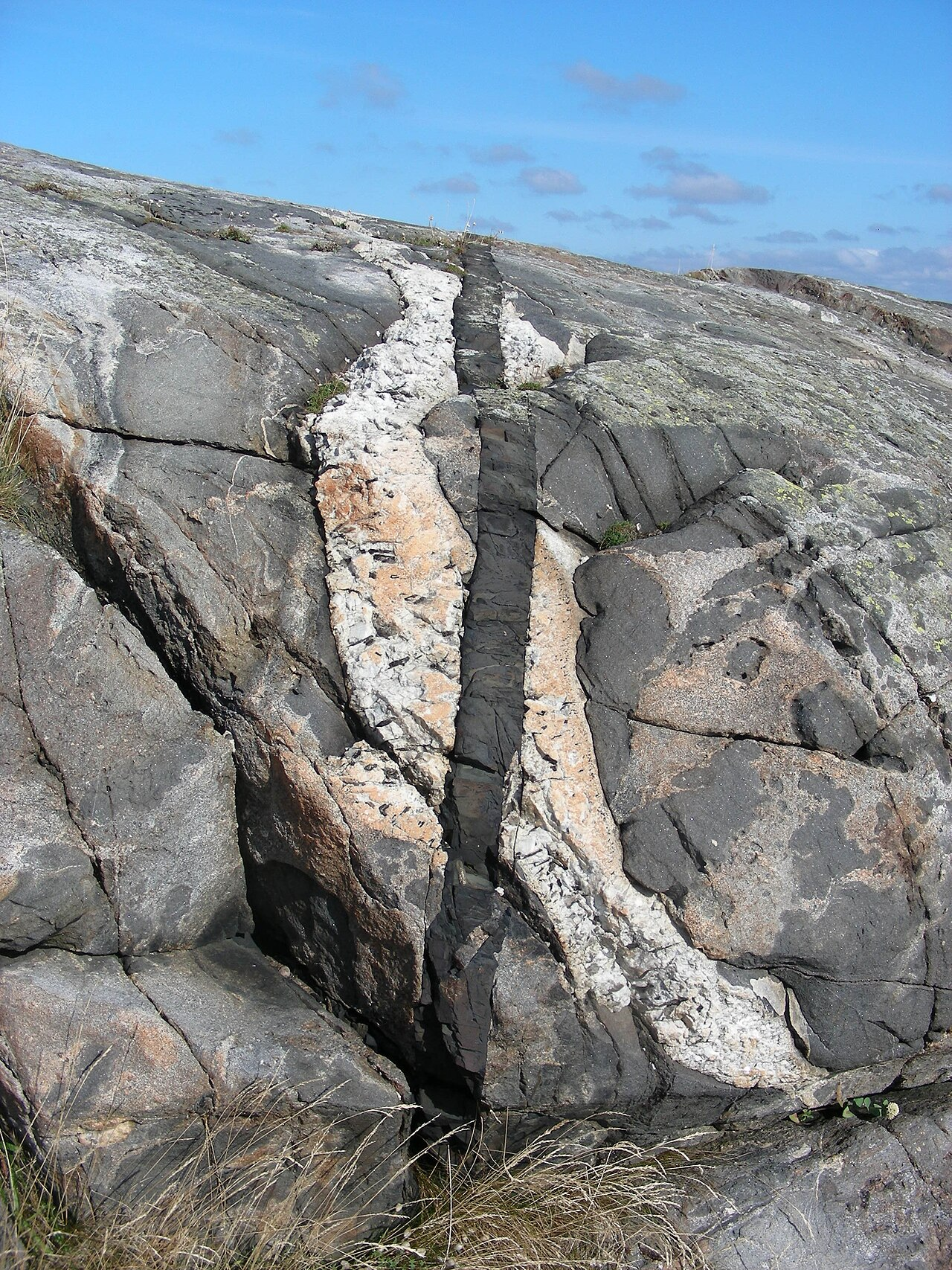
What forms cross-cutting relationships?
Faults or fractures, intrusion, unconformities/erosion, animal activity or plant growth (paleontological), erosion caused by water flow or impact craters (geomorphological)
Law of Included Fragments
Clasts (fragments) in a rock are older than the rock itself.
Xenolith
A piece of rock trapped in igneous rock. Infrequently found in sedimentary rocks.
Principle of Faunal Succession
Fossils go from oldest (deepest) to newest (closest to surface), and fossils with large chronological gaps between them will never be found in the same strata.
Process of xenolith/xenocryst formation
Xenoliths/crysts are pulled from magma as it travels through the crust; if they melt they lose their unique properties, and can become metamorphic if exposed to enough temperature and pressure.
Xenoliths vs. Xenocrysts
Xenoliths are rocks, xenocrysts are crystals.