Thyroid malignancy
 Call Kai
 Learn
Learn Practice Test
 Spaced Repetition
 Match
Match Flashcards
 Knowt Play
1/46

There's no tags or description
Looks like no tags are added yet.
Name | Mastery | Learn | Test | Matching | Spaced | Call with Kai | Chat |
|---|
No analytics yet
Send a link to your students to track their progress
47 Terms
Most primary thyroid cancers originate in the …
Parafollicular cells
Risk factors of thyroid malignancy
History of MENS syndrome, head and neck irradiation and family Hx of thyroid cancer
Signs and symptoms overall of thyroid malignancy
Palpable firm neck mass, enlarged cervical lymph nodes, hoarseness, voice changes or cough, trouble swallowing or breathing
Most common and most curable thyroid cancer
Papillary
Strong indicators of thyroid malignancy
Absent halo sign, microcalcifications and intra-nodular flow patterns
Microcalcifications are also known as
Psammoma bodies
Color in malignant nodules
Central and perinodular hypervascualrity
Papillary cancer
75-90%
More common in women
Painless neck lump
Slow growing
Usually a solitary nodule
Treated with thyroid lobectomy and hormone therapy
USA papillary cancer
Heterogeneous, hypoechoic solid mass
May see microcalcifications (psammoma bodies)
Associated with enlarged cervical lymph nodes due to mets
Hypervascularity in most cases
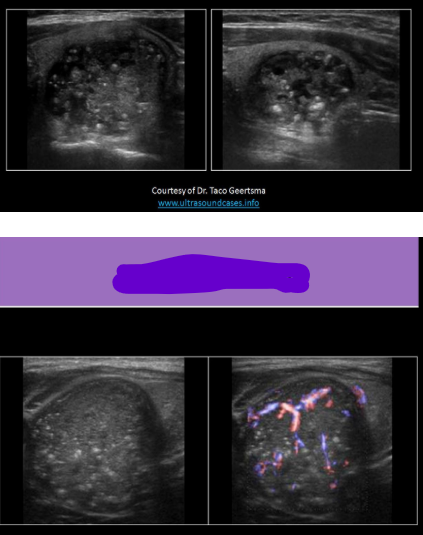
Papillary carcinoma
Follicular cancer
Rare thyroid malignancies
Frequency increases with age
More common in women
Usually solitary mass
Slow growing
Follicular cancer USA
May be similar appearance to benign adenoma but can demonstrate irregular margins
Thickened halo
Chaotic arrangement of internal blood vessels
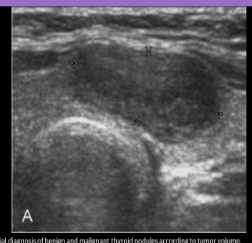
Follicular cancer
Adenocarcinoma
Rare thyroid malignancy
Moderately aggressive
Medullary cancer
Hard bulky mass
Usually found in 5th and 6th decades
Sipple syndrome - medullary cancer + parathyroid cancer + pheochromocytoma
Associated with MEN syndrome
Secretes calcitonin
Most commonly bilateral and/or multicentric
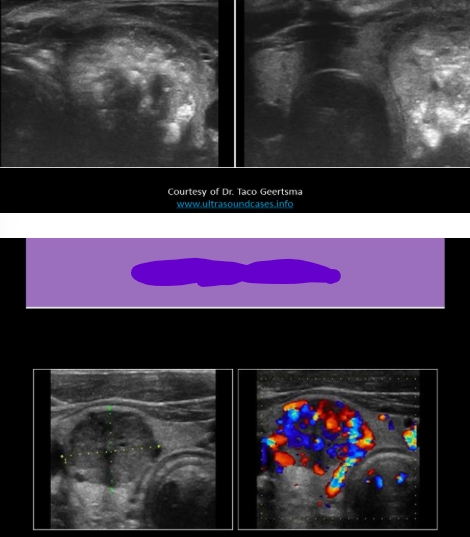
Medullary carcinoma
Hurthle cell carcinoma
10-12% thyroid malignancies
Slow growing
Giant and Spindle Cell Carcinoma is also known as
Anaplastic cancer
Giant and Spindle Cell Carcinoma
10% thyroid malignancies
Very aggessive
Most lethal type thyroid malignancy
Hard, fixed mass with rapid growth
Usually invades surrounding neck structures
Can cause death by compression of trachea or infiltration into trachea occluding airway
USA Giant and Spindle Cell Carcinoma
Usually hypoechoic with ill-defined borders
Neck muscle and/or blood vessel invasion
Encases blood vessels
Compresses trachea
Mets to thyroid
Melanoma, breast, renal and lung cancer are most common primary cancers
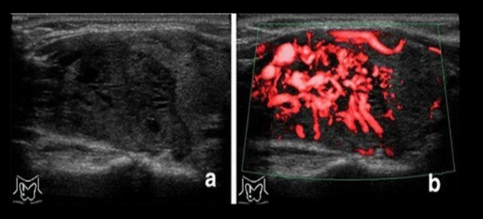
Mets to thyroid
Antibody levels that are monitored in thyroidectomy pts
Thyroglobulin and thyroglobulin antibody levels
Increasing thyroglobulin levels and thyroglobulin antibody levels in a post-surgical pt can indicate
Recurrance
If a pt had a complete thyroidectomy there should be no _________ present in the blood
Thyroglobulin
Normal lymph node USA
Ovoid in shape
No posterior enhancement
Hyperechoic hilum with hypoechoic cortex
Abnormal lymph node USA
Round shape
Plump anechoic cortex causes decreased visualization of the central hilum
Local hilum with color
Posterior enhancement is present in structures posterior to abnormal nodules with significant fluid accumulation
Scanning lymph
Begin in the upper neck with the submental, submandibular, parotid and jugulodigastric regions then angle posteriorly as you move down
Pt position for scanning lymph nodes
Pt neck supine, neck extended and rotated toward the contralateral side
What thyroid levels are most commonly affected by tumor recurrence?
III and IV
Sonopalpation
Deep palpation of the mass with the transducer may produce focal pain, which may radiate along the nerve pathway
Level I
Under the jaw
Level II
Base of the skull to hyoid bone
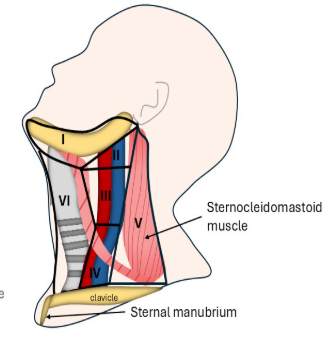
Level III
Hyoid bone to cricoid cartilage
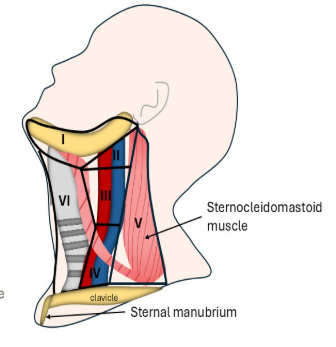
Level IV
From cricoid cartilage to clavicle
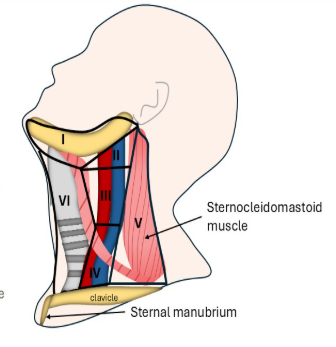
Level V
Adjacent to sternocleidomastoid muscle
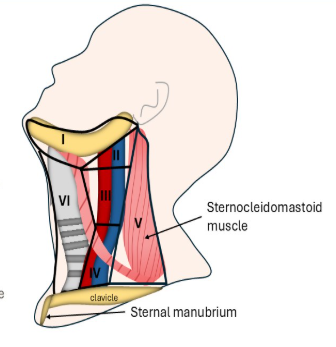
Level VI
Hyoid bone to manubrium
Level VII
Inferior to clavicle
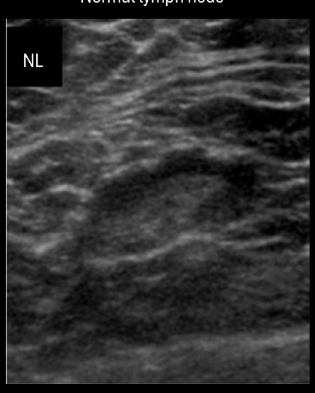
Normal lymph node
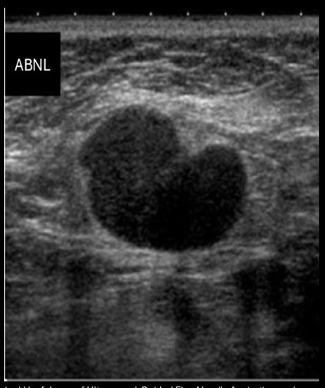
Abnormal lymph node
After thyroidectomy due to cancer, why are serial neck ultrasound exams performed annually on these pts
To evaluate the cervical lymph nodes
Psammoma bodies are commonly seen in what type of thyroid cancer?
Papillary
What type of thyroid malignancy appears similar to a benign adenoma, but has irregular borders?
Follicular
What type of thyroid cancer is associated with MEN syndrome
Medullary
What hormone is secreted by a medullary carcinoma mass?
Calcitonin
Most aggressive and lethal type of thyroid cancer
Anaplastic/Giant cell
Lymph nodes located adjacent to which of the following structures should be evaluated in a post-thyroidectomy pt?
Sternocleidomastoid muscle, CCA, and IJV