Unit 2 Cell Biology 12/26
 Studied by 0 people
 Call Kai
 Learn
Learn Practice Test
 Spaced Repetition
 Match
Match Flashcards
 Knowt Play
1/147

There's no tags or description
Looks like no tags are added yet.
Name | Mastery | Learn | Test | Matching | Spaced |
|---|
No study sessions yet.
148 Terms
A classmate proposes that mitochondria and chloroplasts should be classified in the endomembrane system. Argue against the proposal.
Mitochondria and chloroplasts should not be classified as part of the endomembrane system because they do not participate in vesicle trafficking, possess their own DNA and ribosomes due to an endosymbiotic origin, replicate independently by binary fission, and have membranes that are not derived from the ER.
Describe how cilia and flagella bend.
Cilia and flagella bend when dynein motor proteins use ATP to slide adjacent microtubule doublets against each other, and because the doublets are anchored by cross-linking proteins, this sliding is converted into a bending motion.
Kinesins “walk” toward the plus end of microtubules, while dyneins “walk” toward the minus end. Explain which of these molecular motors would transport a vesicle from the center of a mammalian cell toward the periphery.
A vesicle moving from the center of a mammalian cell toward the periphery would be transported by kinesin, because microtubule plus ends are oriented toward the cell periphery and kinesins walk toward the plus end.
In what way are the cells of plants and animals structurally different from single-celled eukaryotes?
Plant and animal cells are structurally different from single-celled eukaryotes in that they are specialized for multicellular organization, possessing cell junctions and extracellular matrix interactions (and, in plants, rigid cell walls and plasmodesmata) that enable coordinated function rather than independent survival.
Nonliving cell walls isolate plant cells from one another. Still, most of the plant can be considered to be one living continuum. Explain.
Although plant cell walls are nonliving and separate individual cells, the plant functions as a living continuum because neighboring cells are connected by plasmodesmata that allow direct cytoplasmic communication and transport of molecules and signals throughout the plant.
The polypeptide chain that makes up a tight junction weaves back and forth through the membrane four times, with two extracellular loops and one loop plus short C-terminal and N-terminal tails in the cytoplasm. What would you predict about the amino acid sequence of the tight junction protein?
The tight junction protein would be predicted to have multiple hydrophobic stretches of amino acids corresponding to the four transmembrane regions, hydrophilic sequences forming extracellular and cytoplasmic loops, and short cytoplasmic N- and C-terminal tails enriched in polar or charged residues.
Colpidium colpoda is a unicellular protist that lives in fresh water, eats bacteria, and moves by cilia (see Figure 7.23b). Describe how the parts of this cell work together in the functioning of C. colpoda, including as many organelles and other cell structures as you can.
In Colpidium colpoda, coordinated cellular function arises as cilia beat in synchronized waves to propel the cell through freshwater and sweep bacteria into the oral groove, where food vacuoles form by endocytosis and then fuse with lysosomes for enzymatic digestion, while mitochondria supply ATP for ciliary motion and metabolism, ribosomes and the endoplasmic reticulum synthesize proteins, the Golgi apparatus modifies and sorts them, contractile vacuoles regulate osmotic balance by expelling excess water, the plasma membrane controls exchange with the environment, and the nucleus directs gene expression to maintain all cellular activities.
Some membrane proteins diffuse faster in the plasma membrane when the cytoskeleton or the extracellular matrix is artificially removed than when cells are unperturbed. Explain why.
Some membrane proteins diffuse faster when the cytoskeleton or extracellular matrix is removed because these structures normally anchor or corral membrane proteins through attachments and barriers, restricting their lateral movement within the fluid mosaic of the plasma membrane.
What property allows O2 and CO2 to cross a lipid bilayer without the aid of membrane proteins?
O₂ and CO₂ can cross a lipid bilayer without membrane proteins because they are small, nonpolar molecules that dissolve readily in the hydrophobic interior of the membrane.
Why is a transport protein needed to move many water molecules rapidly across a membrane?
A transport protein is needed to move many water molecules rapidly across a membrane because, although water is small, its polarity limits its diffusion through the hydrophobic lipid bilayer, making channel proteins like aquaporins necessary for fast, efficient transport.
Aquaporins exclude passage of hydronium ions (H3O+), but some aquaporins allow passage of glycerol, a three-carbon alcohol, as well as H2O. Since H3O+ is closer in size to water than glycerol is, yet cannot pass through, what might be the basis of this selectivity?
Aquaporins exclude H₃O⁺ despite its small size because the channel’s structure and charge distribution disrupt proton hopping and repel positively charged ions, whereas glycerol, though larger, is uncharged and can fit and pass through aquaporins with a wider, chemically compatible pore.
To manipulate yeast cells experimentally, their cell walls are sometimes digested. Which type of solution should be used to preserve the cells without cell walls? Explain.
An isotonic solution should be used because, without cell walls, yeast cells would otherwise gain or lose water by osmosis and burst or shrink, whereas an isotonic environment maintains equal solute concentration and preserves cell integrity.
If a Paramecium swims from a hypotonic to an isotonic environment, will its contractile vacuole become more active or less? Why?
The contractile vacuole will become less active because moving from a hypotonic to an isotonic environment reduces osmotic water influx into the cell, decreasing the need to expel excess water.
Na+/K+ pumps help nerve cells establish a voltage across their plasma membranes. Do these pumps use ATP or produce ATP? Explain.
Na⁺/K⁺ pumps use ATP because they actively transport Na⁺ and K⁺ ions against their electrochemical gradients, and this energy-consuming process establishes and maintains the membrane voltage in nerve cells.
Explain why the Na+/K+ pump would not be considered a cotransporter.
The Na⁺/K⁺ pump is not considered a cotransporter because it uses ATP directly to move Na⁺ and K⁺ ions in opposite directions against their gradients rather than using the downhill movement of one solute to drive the transport of another.
Given the internal environment of a lysosome, what transport protein might you expect to see in its membrane?
You would expect to find a proton (H⁺) pump, specifically a V-type H⁺-ATPase, in the lysosomal membrane because it actively transports protons into the lysosome to maintain its acidic internal environment.
As a cell grows, its plasma membrane expands. Does this involve endocytosis or exocytosis? Explain.
Plasma membrane expansion during cell growth involves exocytosis, because vesicles fuse with the plasma membrane and add new lipid and membrane proteins to its surface.
Animal cells make an extracellular matrix (ECM). Describe the cellular pathway of synthesis and deposition of an ECM glycoprotein.
An ECM glycoprotein is synthesized on ribosomes bound to the rough ER, enters the ER lumen where it begins folding and modification, is transported in vesicles to the Golgi apparatus for further glycosylation and sorting, and is then delivered by secretory vesicles that fuse with the plasma membrane via exocytosis, releasing the glycoprotein into the extracellular space where it becomes incorporated into the extracellular matrix.
Explain how signaling is involved in ensuring that yeast cells fuse only with cells of the opposite mating type.
Yeast cells ensure fusion only with the opposite mating type through signaling by mating factors that bind specifically to receptors on cells of the opposite type, triggering a signal transduction pathway that induces cell cycle arrest, directional growth, and fusion only between compatible partners.
How do distantly placed cells in a multicellular organism communicate?
Distantly placed cells in a multicellular organism communicate through long-distance signaling in which hormones or other signaling molecules are released into the circulatory system and travel to target cells with the appropriate receptors.
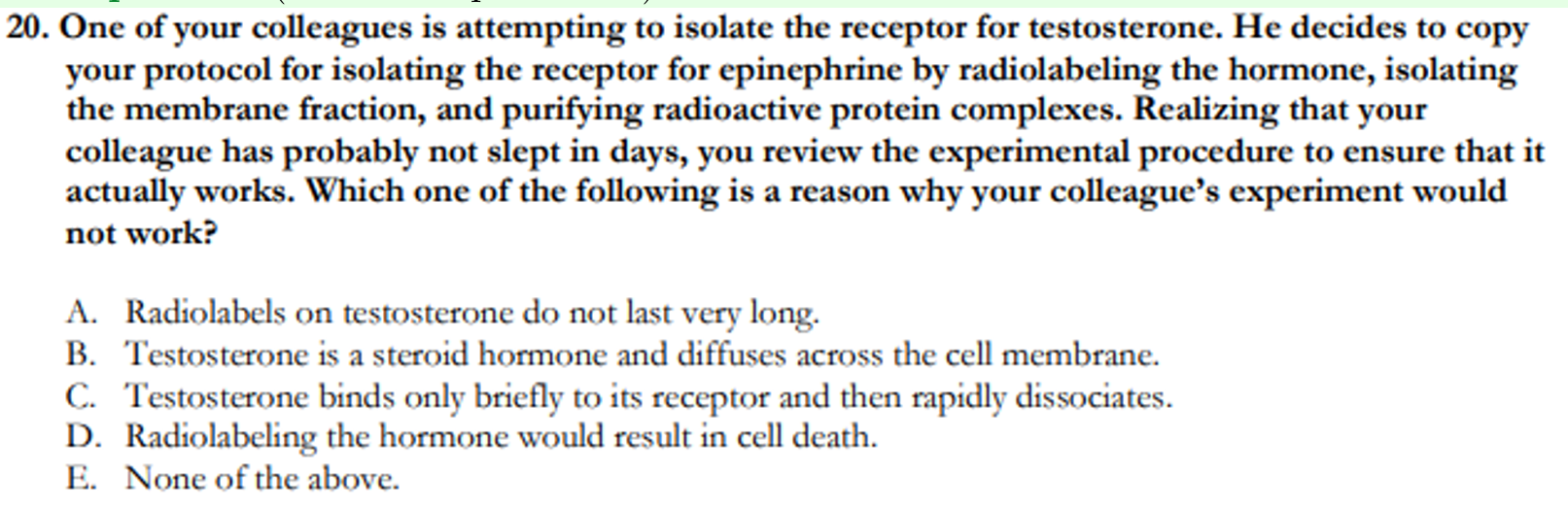
If epinephrine were mixed with glycogen phosphorylase and glycogen in a cell-free mixture in a test tube, would glucose 1-phosphate be generated? Why or why not?
No glucose 1-phosphate would be generated because epinephrine acts through cell-surface receptors and an intracellular signaling cascade to activate glycogen phosphorylase, and in a cell-free mixture lacking receptors, second messengers, and kinases, the enzyme would not be activated.
Nerve growth factor (NGF) is a water-soluble signaling molecule. Would you expect the receptor for NGF to be intracellular or in the plasma membrane? Explain.
You would expect the NGF receptor to be in the plasma membrane because NGF is water-soluble and cannot cross the hydrophobic lipid bilayer, so it must bind to a cell-surface receptor to initiate signaling.
What would happen if the ligand binding to a ligand-gated ion channel did not dissociate from the channel?
If the ligand did not dissociate from a ligand-gated ion channel, the channel would remain persistently open or closed (depending on the ligand’s effect), causing continuous ion flow or blockage and disrupting normal cellular signaling and homeostasis.
How is ligand binding similar to the process of allosteric regulation of enzymes?
Ligand binding is similar to allosteric regulation because in both cases a molecule binds to a specific site on a protein, causing a conformational change that alters the protein’s activity.
What is a protein kinase, and what is its role in a signal transduction pathway?
A protein kinase is an enzyme that transfers a phosphate group from ATP to a target protein, and its role in a signal transduction pathway is to relay and amplify the signal by phosphorylating downstream proteins to alter their activity.
For the purpose of signaling, what is the advantage of having a low concentration of calcium in the cytosol?
Having a low concentration of Ca²⁺ in the cytosol allows small increases in calcium to serve as a clear, rapid, and highly sensitive signal that can quickly trigger specific cellular responses.
If you exposed a cell to a ligand that binds to a receptor and activates phospholipase C, predict the effect the IP3-gated calcium channel would have on Ca2+ concentration in the cytosol.
If you exposed a cell to a ligand that binds to a receptor and activates phospholipase C, predict the effect the IP3-gated calcium channel would have on Ca2+ concentration in the cytosol.
How can a target cell’s response to a single hormone molecule result in a response that affects a million other molecules?
A target cell’s response to a single hormone molecule can affect a million other molecules through signal amplification, in which each step of a signal transduction cascade activates many downstream proteins or second messengers, multiplying the original signal.
If two cells have different scaffolding proteins, explain how they might behave differently in response to the same signaling molecule.
Cells with different scaffolding proteins can respond differently to the same signaling molecule because scaffolds organize distinct sets of signaling components, directing the signal into different pathways and producing different cellular responses.
Some human diseases are associated with mal functioning protein phosphatases. How would such proteins affect signaling pathways?
Malfunctioning protein phosphatases would disrupt signaling pathways by preventing proper dephosphorylation of signaling proteins, causing signals to remain abnormally active or improperly terminated.
Epinephrine affects heart muscle cells by causing them to mobilize glucose, contract faster, and increase heart rate. The muscle cells around lungs and airways, on the other hand, have the opposite response to epinephrine: They relax, allowing more air to be breathed in. What might explain why respiratory (breathing-related) muscle cells can respond so differently from heart muscle cells?
Respiratory muscle cells respond differently from heart muscle cells to epinephrine because they express different epinephrine receptor subtypes and downstream signaling pathways, causing the same hormone to trigger distinct cellular responses in different tissues.
Give an example of apoptosis during embryonic development and explain its function in the developing embryo.
An example of apoptosis during embryonic development is the programmed cell death between developing fingers and toes, which functions to remove excess cells and separate the digits to form distinct fingers and toes.
If apoptosis occurred when it should not, what types of protein defects might be the cause? What types could result in apoptosis not occurring when it should?
Apoptosis occurring when it should not result from defects that overactivated pro-apoptotic proteins or signaling pathways (such as constitutively active caspases or faulty survival signals), whereas failure of apoptosis when it should occur could result from defects in pro-apoptotic proteins, death receptors, caspases, or from overactive anti-apoptotic proteins that block the pathway.




Cell
The basic unit of structure and function of life. All organisms—unicellular or multicellular—are composed of cells, which carry out metabolism, growth, response, and reproduction.
USABO framing: Cells are treated as thermodynamically open systems maintaining non-equilibrium states.
Domains of Life
Life is classified into Bacteria, Archaea, and Eukarya. All cells share core features but differ in complexity and compartmentalization.
Plasma Membrane
A selectively permeable lipid bilayer that separates the intracellular environment from the extracellular environment. Rich in lipids and proteins.
Key USABO idea: Selectivity is based on chemical properties, not size alone.
Cytosol
A gel-like aqueous matrix where metabolic reactions occur and organelles are suspended. The cytosol is a reducing environment, making disulfide bonds rare inside the cytoplasm.
Cytoplasm
The cytosol plus all organelles. This distinction matters in questions comparing intracellular environments.
Ribosomes
Macromolecular complexes responsible for protein synthesis using mRNA templates.
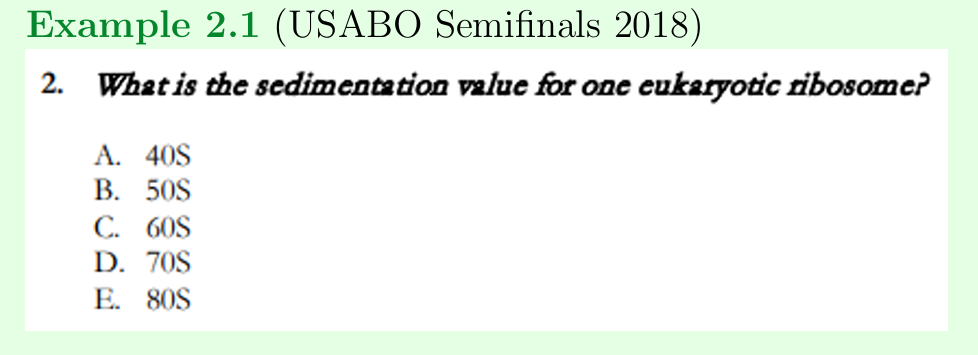
• Prokaryotes: 70S (30S + 50S)
• Eukaryotes: 80S (40S + 60S)
USABO trap: Sedimentation coefficients are not additive.
Nucleus
The information center of the cell containing DNA. Surrounded by a double membrane (nuclear envelope) perforated with nuclear pores for regulated transport.
Nuclear Lamina
A meshwork of intermediate filaments lining the nuclear envelope that maintains nuclear shape and organizes chromatin.
Nucleolus
A nuclear region enriched in rRNA genes, responsible for ribosomal RNA synthesis and ribosome subunit assembly.
Endomembrane System
A coordinated network of membranes involved in protein and lipid synthesis, modification, transport, and secretion.
Includes:
• Nuclear envelope
• Endoplasmic reticulum
• Golgi apparatus
• Lysosomes
• Vesicles
• Plasma membrane
Endoplasmic Reticulum (ER)
A continuous membrane system composed of tubules and cisternae, enclosing the lumen, which is chemically distinct from the cytosol.
Smooth ER
Functions in:
• Lipid synthesis
• Detoxification
• Calcium ion storage (e.g. sarcoplasmic reticulum)
Rough ER
Studded with ribosomes. Synthesizes:
• Secretory proteins
• Membrane proteins
• Membrane phospholipids
Transport Vesicles
Membrane-bound carriers that move materials between organelles.
Golgi Apparatus
The sorting and shipping center of the cell. Structurally polarized:
• Cis face: receives vesicles from ER
• Trans face: dispatches vesicles to final destinations
Cisternal Maturation Model
Golgi cisternae are dynamic, forming at the cis face and maturing toward the trans face.
Vesicular Transport Model
Golgi cisternae are stable, and cargo is moved via vesicles between cisternae.
COPII Vesicles
Transport proteins from ER to Golgi (anterograde).
COPI Vesicles
Transport proteins from Golgi back to ER (retrograde).
Clathrin-Coated Vesicles
Transport proteins from Golgi to plasma membrane or endosomes. Characterized by a triskelion protein coat.
Lysosome
An acidic (pH ~4.5) organelle containing hydrolytic enzymes for macromolecule degradation and organelle recycling. Found only in animal cells.
Peroxisome
Contains oxidative enzymes, including catalase, to detoxify hydrogen peroxide.
Glyoxysome
A specialized peroxisome in plant seeds that converts lipids to carbohydrates during germination.
Vacuole
A large vesicle with storage and regulatory roles.
Food Vacuole
Stores ingested material; often fuses with lysosomes.
Contractile Vacuole
Expels excess water in freshwater protists to prevent lysis.
Central Vacuole
A massive plant cell vacuole that maintains turgor pressure and stores ions and water.
Vesicle Fusion
Membrane fusion mediated by SNARE proteins.
v-SNARE (R-SNARE)
Located on vesicles; contains arginine.
t-SNARE (Q-SNARE)
Located on target membranes; contains glutamine.
cis-SNARE Complex
Formed after vesicle fusion when v- and t-SNAREs bind.
Endosymbiotic Theory
Mitochondria and chloroplasts originated from free-living prokaryotes engulfed by ancestral eukaryotic cells.
Evidence:
• Double membranes
• Circular DNA
• Ribosomes
• Independent replication
Mitochondrion
Site of cellular respiration and ATP production.
• Outer membrane
• Intermembrane space
• Inner membrane with cristae
• Matrix
Cristae
Infoldings of the inner mitochondrial membrane that increase surface area for ATP synthesis.
Chloroplast
Site of photosynthesis in plants and some protists.
Thylakoids
Flattened membrane sacs arranged in stacks where light reactions occur.
Stroma
Fluid-filled region surrounding thylakoids where Calvin cycle occurs.
Plastids
A family of plant organelles.
• Chromoplasts: pigment storage
• Leucoplasts: storage (amyloplasts = starch, elaioplasts = lipids)
• Proplastids: plastid precursors
Diffusion
Net movement of molecules down their concentration gradient due to random motion.
Simple Diffusion
Passive movement of small, nonpolar molecules across the membrane (e.g. O₂, CO₂).
Osmosis
Diffusion of water across a semi-permeable membrane from high free water concentration to low.
Osmolarity
Total solute concentration of a solution.
Hypertonic
Higher solute concentration than the cell → water leaves cell.
Hypotonic
Lower solute concentration than the cell → water enters cell.
Isotonic
Equal solute concentrations → no net water movement.
Turgor Pressure
Pressure of water pushing against the plant cell wall; essential for plant rigidity.
Plasmolysis
Shrinkage of the plasma membrane away from the cell wall due to water loss.
Facilitated Diffusion
Passive transport via transport proteins.
Channel Proteins
Form hydrophilic tunnels (e.g. aquaporins).
Carrier Proteins
Undergo conformational changes (e.g. GLUT transporters).
Active Transport
Movement against concentration gradient using energy.
Primary Active Transport
Direct use of ATP.
Na⁺/K⁺ Pump
Moves 3 Na⁺ out / 2 K⁺ in. Maintains membrane potential.
Secondary Active Transport
Uses gradients generated by primary transport.
Symport
Two substances move in the same direction.
Antiport
Two substances move in opposite directions.
Endocytosis
Bulk transport via membrane invagination.
Receptor-Mediated Endocytosis
Specific uptake initiated by ligand–receptor binding.
Pinocytosis
Nonspecific uptake of fluids.
Phagocytosis
Uptake of large particles (e.g. bacteria).
Cytoskeleton
A dynamic network of protein filaments providing structure, transport, and motility.
Dynamic Instability
Rapid growth and shrinkage of filaments, faster at the plus (+) end.
Microtubules
Hollow rods made of α- and β-tubulin.
Functions:
• Vesicle transport
• Cell division
• Cilia and flagella structure
9+2 Arrangement
Microtubule structure of motile cilia and flagella.