Tema 5, la zona de la baja mesopotamia: del periodo paleobabilonico al fin del II millenio
 Call Kai
 Learn
Learn Practice Test
 Spaced Repetition
 Match
Match Flashcards
 Knowt Play
1/8

There's no tags or description
Looks like no tags are added yet.
Name | Mastery | Learn | Test | Matching | Spaced | Call with Kai | Chat |
|---|
No analytics yet
Send a link to your students to track their progress
9 Terms
Contendios:
1. EL PERIODO PALEOBABILÓNICO
1.1. LA ÉPOCA DE ISIN-LARSA
1.1.1. El predominio de Isin
1.1.2. La hegemonía de Larsa
1. 2. LA I DINASTÍA DE BABILONIA O IMPERIO PALEOBABILÓNICO
1.2.1. La creación de un nuevo “imperio” mesopotámico
1.2.2. El código de Hammurabi
1.2.3. La organización socio-económica
1.2.4. El fin de la I dinastía de Babilonia
2. LA BABILONIA CASITA
3. LOS ÚLTIMOS SIGLOS DEL II MILENIO Y LA II DINASTÍA DE ISIN
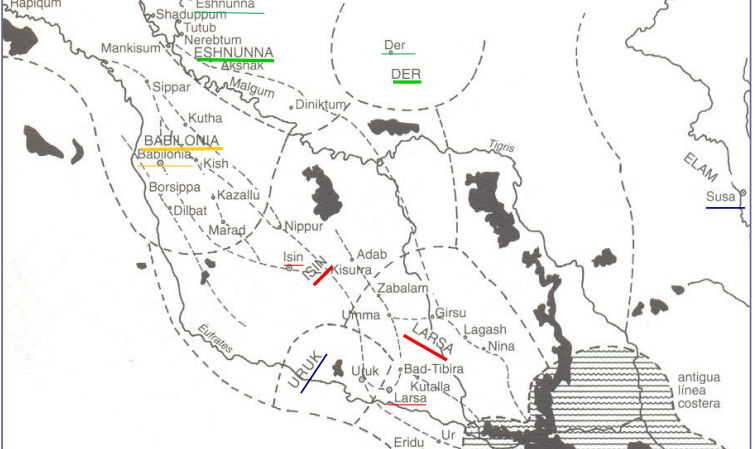
La Baja Mesopotamia en el periodo de Isin-Larsa
1.1.1. El predominio de Isin
1.1.2. La hegemonía de Larsa
1.1.1
Final de Ur III -
Tras Ur III: El último rey de Ur III, Ibbi-Sin (hacia 2026-2004), se enfrentó no sólo a la continua expansión de las tribus de pastores, sino también a rebeliones en el corazón del territorio sumerio.
Gracias a una combinación de diplomacia y acción militar consiguió mantener una paz precaria, hasta que finalmente su política de asegurarse apoyo mediante alianzas a corto plazo con provincias cada vez más poderosas fracasó. La situación puede entreverse a partir de una serie de cartas que el rey intercambió con un tal Ishbi-Erra, anterior gobernador de Mari, vasallo y funcionario de Ur, que gozaba de gran influencia en Babilonia Media.
Cuando la capital sufrió una grave carencia de alimentos, IshbiErra se sirvió de los envíos de grano para hacerse con el control de la ciudad. Formó alianzas con Nippur e Isin, logrando que ambas se enfrentaran; se asoció con otros enemigos de Ur y finalmente se hizo con el control de los restos del imperio de Ur III y fundó una nueva dinastía en Isin.
La ciudad de Ur fue devastada y destruida, pero no por los amorreos o las tropas de Ishbi-Erra, sino por los habitantes de Elam y Shimashki, provincias de Irán occidental que Ur había anexionado y sometido a una prolongada opresión. La destrucción fue absoluta y devastadora.
Las lamentaciones por la destrucción de Ur»
El poema evoca el sufrimiento de la ciudad, sus dioses y su gente, así como los efectos de tal destrucción en el país. Todo ello suele expresarse en frases negativas, como si representara una discontinuidad del estado habitual:
El poema concluye con una serie de decretos positivos o bendiciones y, a diferencia de las maldiciones iniciales, proclama el regreso a un estado de prosperidad:
Como señala el traductor de este poema, el texto se escribió para mostrar la continuidad entre el Estado de Ur y la siguiente dinastía de Isin creada por el ex-gobernador de Ur Ishbi-Erra, aunque el gobierno de Isin nunca se mencione explícitamente.
Los grandes dioses, en especial Enlil, pueden otorgar poder político y prosperidad a la ciudad de su elección, así como retirar dicho apoyo sin ningún motivo aparente. Ahora, según implica el poema, ha llegado el turno de Isin y su triunfo sobre Ur es una señal de que los dioses aprueban el cambio.
. El predominio de Isin
La moderna histiografia reconstruye el paso de la din. Ur III al periodo de Isin y Larsa bajo el signo de cambio, sin embargo como se allude en el poema los protoagonistas viviar o intentaron vivir bajo el signo de la continuidad
This effort was pursued especially by the kings of Isin, who presented themselves as the heirs of the kings of Ur. These kings took over the deification, titulature and ambitions of the kings of Ur and created a king list promoting a direct succession from the dynasty of Ur to that of Isin.
Apart from this sense of continuity, which was promulgated for political reasons, the two periods were actually linked by a profound structural continuity in terms of demography, technology and economy. Due to the radical changes taking place in the surrounding regions in this phase, this continuity was even more significant
On a political level, this essentially stable system was structured in a significantly different way. During Ibbi-Sin’s reign, imperial control over the surrounding regions broke down. As a result, an increasing number of autonomous centres began to appear.
This facilitated the rise of about a dozen of independent States competing with each other. While Isin took over a large portion of the inheritance of the Third Dynasty of Ur, further south Larsa and Uruk remained independent. In the north, Babylon also became an independent centre, eventually conquering other autonomous centres, most importantly Kish.
In the Diyala region, Eshnunna was independent, as was Der, located close to the Elam border.
Large sacred areas such as the ones of Ur or Nippur continued to be imposing complexes, despite the fact that the two cities struggled to maintain their pre-eminence. The political role of Ur was by now lost forever. Likewise, the religious role of Nippur lost the support of previous kings (as in the Akkadian period)
As a result, the temple complexes of other emerging centres began to acquire considerable prestige, from the Ebabbar of Larsa to the ‘cloister’ of the nadı¯tu of Sippar
Apart from some marginal and relatively modest exceptions, Isin initially managed to take over a large part of the legacy of Ur. However, this was only within the centre of the former empire. In the periphery, Mari, Ashur and Elam were already completely independent regional powers. Ishme-Dagan, third successor of Ishbi-Erra, tried to expand his rule to the north, but was defeated by Kish. As a result, some cities of his reign were destroyed, Nippur in particular, as attested from a ‘lamentation’ similar to the ‘Lamentation over the Destruction of Ur
Ishme-Dagan was succeeded by Lipit-Ishtar, who managed to keep Nippur and the southern cities of Ur, Uruk and Eridu under his control. He also ‘established justice’, not only through exemptions and remissions of debts, but also through the creation of a law code (just like Ur-Nammu before him). This law code was aimed at providing a better structure for the implementation of justice, celebrating the exemplary fairness with which justice was administered in his reign (Text 11.1). However, the dynasty founded by Ishbi-Erra disappeared soon after. Lipit-Ishtar was expelled and a new dynasty rose to power in Isin.
La hegemonía de Larsa
While Isin moved from being the heir of the Third Dynasty of Ur back to a city-state, Larsa moved in the opposite direction, moving away from its position as city-state clenched between Isin and Elam. Gungunum began his rise to power in Larsa at the end of the twentieth century, taking Ur and Lagash from Isin and Susa from Elam. He took on the title of ‘king of Sumer and Akkad’, the standard title of the kings of Ur, and led a couple of campaigns against Bashime (located on the Iranian coast facing the Persian Gulf) and Anshan (modern Fars, located in the hinterland of Bashime)
Gungunum’s successor Abi-sare managed to oppose the ambitions of the new dynasty of Isin, which was trying to reconquer the cities in the south of Mesopotamia. Abi-sare’s successor Sumu-El campaigned in the north, possibly in connection with some hydric projects aimed at channelling the water from the Euphrates to Larsa. Having bypassed Isin, he conquered Nippur (where he was deified) and defeated Kazallu and Kish, thus turning Larsa into a hegemonic power west of the Tigris.
Isin miraculously remained independent, though clenched between Larsa in the south and Kish (and, later on, Babylon) in the north and even tried to reconquer Nippur.
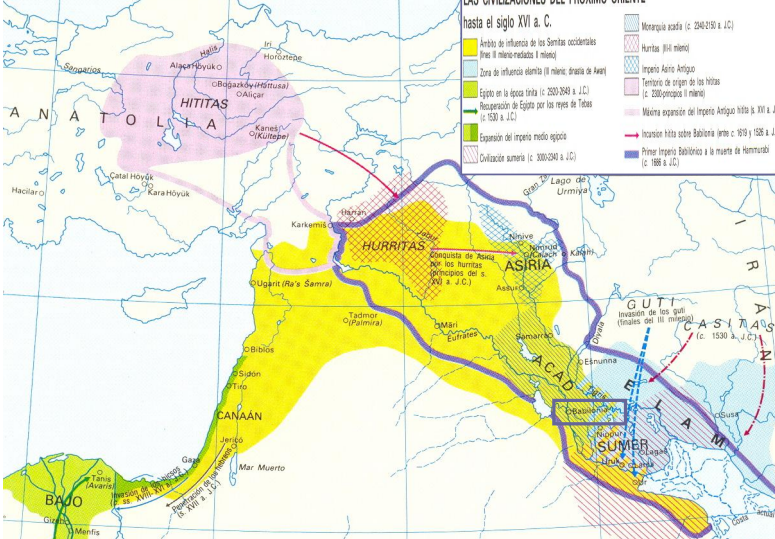
LAS CIVILIZACIONES DEL PRÓXIMO ORIENTE hasta el siglo XVI a. C.
Cronologias
Civilizaciones:
BABILONIOS
IMP. PALEOBABILÓNICO HAMMURABI (1792-1750)
XVI-XII Babilonia casita
Principados autónomos
ASIRIOS
(XIV - XVIII) SHAMSI-ADAD
XIV-XI IMPERIO MEDIO
Decadencia (arameos)
HURRITAS
XVI-XIII REINO DE MITANNI
HITITAS
½ XVII-1400 REINO ANTIGUO
decadencia (coincides with reino de Mittani)
1400-1200 REINO NUEVO Ó IMPERIO HITITA
Pueblos del mar
ELAMITAS
PALEOELAMITA
MEDIOELAMITA
Cronologia:
Isin y Larsa (c.2000 - 1735)
Fundación de la dinastía de Larsa (c.2025)
Fundación de la dinastía de Isín (c.2017)
Comienzo del reinado de Ishme-Dagán en Isín (c.1953)
Comienzo del reinado de Lipit-Ishtar en Isín (c.1934)
Comienzos de la expansión de Larsa con Gungunum (c.1932)
Derrota de Lipi-Ishtar por Gungunum (c.1925)
Imperio Paleobabilonico (c.1894 - 1595)
Fundación de la dinastía de Babilonia (c.1894)
Incursión elemita contra Larsa (c.1835)
Subida al trono de Shamshi-Adad I en Asiria (c.1813)
Comienzo del reinado de Sin-mubalit en Babilonia (c.1812)
Comienzos del reinado de Hammurabi de Babilonia (c.1792)
Hammurabi conquista Uruk e Isín (c.1786)
Victoria de Hammurabi sobre Eshnunna, Malgium, Elam, y Subartu (c.1764)
Hammurabi conquista Larsa (c.1763)
Victoria de Hammurabi sobre Eshnunna, Subartu y Gutium (c.1762)
Hammurabi conquista y destruye Mari (c.1759)
Conquista de Eshnunna (c.1756)
Primer ataque kasita en el reinado de Samsu-Iluna (c.1737)
Final de la insurreción de Larsa, Uruk, Ur y Eshnunna (c.1730)
Insurrección e independencia del País del Mar (c.1.725?)
Conquista kasita de Hana (c.1.700)
Babilonia y Asiria
Augum II rey de Karduniash (c.1571)
Tratado fronterizo entre Burbaburiash I y Puzur Asur III (c.1530)
Ofensiva Babilónica contra el País del Mar y reconquista de Sumer (c.1460)
Kurigalzu I rey de Karduniash (c.1400)
Subida al trono de Burnaburiahs II en Karduniash (c.1359)
Intervención de Assur-ubalit en el conflicto dinástico (c.1332)
de Karduniash
Comienzo del reinado de Assur-uballit I (c.1363)
Comienzo del reinado de Adad-Ninari I (c.1305)
Comienzo del reinado de Salmanasar I (c.1273)
Conquista de Babilonia por Tukulti-Ninurta I (c.1235)
Restauración kasita en Babilonia (c.1218)
Conquista elemita de Babilonia (c.1157)
Instauración de la II Dinastía de Isín (c.1154)
Campaña elemita de Nabucodonosor I (c.1134)
Comienzo del reinado de Tiglat Pilaser I en ASiria (c.1114)
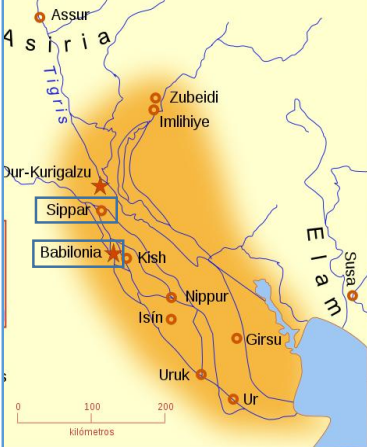
LA I DINASTÍA DE BABILONIA Ó IMPERIO PALEOBABILÓNICO (1894-1595)
The regions surrounding Mesopotamia, from Elam to Mari, were often in competition over the conquest of the ‘dimorphic’ region of Upper Mesopotamia, through constant military expeditions and sudden political changes. Meanwhile, Lower Mesopotamia experienced a different type of political unification, which was marked by a gradual consolidation of power in smaller areas, brought about internally rather than through conquest from outside.
(Paleobabilonios, Paleoasirios, Mari contemporary)
Eventually, these areas were united under a single rule. However, at the beginning of the phase considered in this chapter (around 1820 bc), Lower Mesopotamia was still divided into the kingdoms of Babylon, Isin, Larsa and Uruk
The two most powerful states were Larsa in the south and Babylon in the north. This situation brought the rulers of Babylon to establish diplomatic ties with Uruk.
An initial unification of Lower Mesopotamia came with the reign of Rim-Sin of Larsa, a ruler gifted with exceptional political talent Only with Rim-Sin did Larsa begin its expansion, which we can track down through the many dating formulas of his very long reign.
In his fourteenth regnal year, Rim-Sin defeated Uruk and its ally Isin, both supported by Babylon. He also destroyed and conquered Der (in the twentieth year of his reign), Uruk (in the twenty-first year of his reign) and Isin (in his thirtieth regnal year). The conquest of Isin was considered such a prestigious achievement that all the following dating formulas refer to this event
At this stage, Rim-Sin controlled the whole of Sumer. Despite this, he continued to be surrounded by belligerent neighbours (Elam, Eshnunna and Babylon), which were effectively cutting Larsa out from the diplomatic interactions and manoeuvres of the Mari Age.
In the year after the conquest of Isin, Hammurabi was enthroned in the city of Babylon. He was to become a much fiercer rival of Rim-Sin than his father Sin-muballit. Rim-Sin, who must have been relatively old at this point, found the second half of his reign marked by the rise of Babylon, although Hammurabi himself was threatened on multiple fronts.
This was because Babylon was clenched between the kingdoms of Larsa in the south and Assyria in the north. Both powers, however, were ruled by successful, yet elderly, kings.
In the first years of his rule, Hammurabi was particularly engaged in the south. In his seventh regnal year, he took Isin and Uruk away from Rim-Sin, who saw his kingdom being significantly reduced on a territorial level and subordinated to Babylon on a political one. Having secured the south and gained the support of Rim-Sin, now forced to be a subordinate ally, Hammurabi had the opportunity to play an active role in the events of the Mari Age. Consequently, he took advantage of Shamshi-Adad’s death to rise as the main player in the entire region
Shamshi-Adad (paleo-assyrian king)
For around twenty years (1785–1765 bc), the situation remained relatively flexible, though the balance of power always lay between Hammurabi in Babylon and the strong presence of Ibal-pi-El in Eshnunna.
Only towards the end of his reign did Hammurabi see the effects of his gradual rise (Figure 14.1). Within five years, he conquered Larsa (in the thirty-first year of his rule), Eshnunna (in the thirty-second year), and defeated Mari (in his thirty-third year on the throne)
Towards the end of his reign, he fought wars against Assyria (in the thirty-seventh and thirty-eighth years of his reign)
Hammurabi’s unification of Mesopotamia was limited both in terms of time and space. First, the unification was short-lived. Hammurabi’s success came towards the end of his reign and his successors did not manage to prevent the breakdown of his kingdom. Moreover, Hammurabi did not hold solid control over all of his conquered territories. A large portion of them had been part of the expansionistic and military tendencies of the Mari Age.
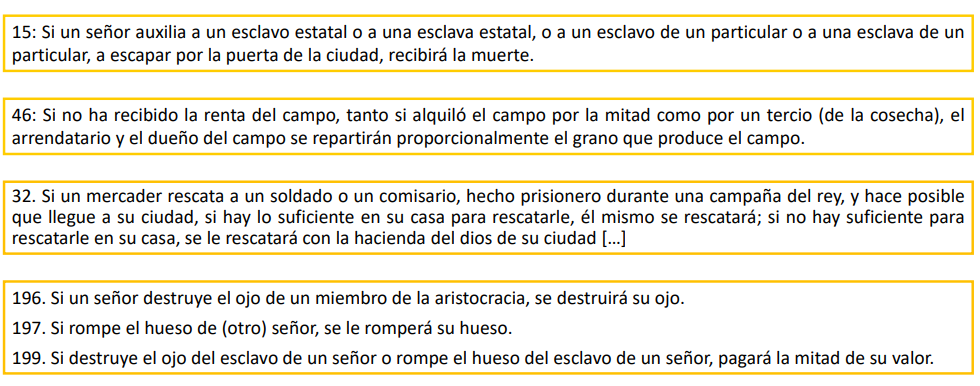
Social- political organisation Babilonios
Despite the general rise of the private sector in the economic and socio-political activities of the Old Babylonian period, the kingdoms of Rim-Sin of Larsa and Hammurabi of Babylon led to a visible consolidation of the role of the state. This was a direct consequence of the care these strong rulers took in organising their kingdoms. They both displayed an ability to influence their kingdoms’ social structure. This is particularly true when compared to previous phases, marked by instability and political fragmentation
The numerous wars and territorial conquests leading to the unification of Mesopotamia led to a significant increase in the allocation of lands to soldiers and veterans in the conquered regions. From the correspondence of Hammurabi with two of his functionaries, Shamash-hasir in Larsa and Sin-iddinam in Sippar, we know of the problems and procedures surrounding the allocation of lands to Babylonian soldiers (Figure 14.2).
The king was able to follow individual cases in person, sometimes imposing his own decision over the suggestions of his functionaries. These letters inform us about this process, which was clearly related to the system of personal appeals of subjects to their king, combined with a mixture of abuses and favouritism. The new allocations took place within an ambiguous but highly complex administrative structure, within which there were considerable difficulties in distinguishing between lands personally assigned in exchange for a service to the palace, and those owned by families for generations
Religion y NADĪTU DE SIPPAR
Similar que Ningul, mujer do Nanna, gingal in Nippur, a residencia y lugar de culto de una sola sacerdotisa, la entu, y su personal, e.g. Enheuduanna
We know, however, that Hammurabi’s reign was a period of significant religious reforms. Firstly, the unification of the region effectively removed the pre-eminence of the local cities’ pantheons. In fact, the Amorites preferred different types of deities, in particular those of an astral nature, such as Shamash, Ishtar and Adad. This preference eventually pushed the more chthonic Sumerian deities into a secondary role. The cities of the north therefore established their local deities on a regional level: Marduk for Babylon, Nabu for Borsippa, Nergal for Kutha and Shamash for Sippar. In terms of personal religion, the most popular deity seems to have been Shamash, a significant representation of the yearning for justice that characterised Babylonian society at the time.
LAS NADITU DE SHAMASH EN SIPPAR
A continuación examinaremos con más detenimiento el gagum y sus habitantes, las mujeres naditu.
En el gagum habitaban muchas mujeres, por lo general de las familias más prósperas de la ciudad y entre ellas, al menos, una princesa. Estas mujeres, conocidas como raditu, tenían que mantenerse con los beneficios de sus propiedades privadas
Participaban activamente en la economía de la ciudad, invirtiendo en grandes y pequeños negocios. La palabra naditum significa «barbecho» o «tabú», lo que muestra la especial identidad sexual de estas mujeres: se las consideraba apartadas de los habituales roles femeninos, pero cómo se manifestaba tal distinción variaba según la época y el lugar.
En Sippar las nadítu no podían casarse, mientras que el matrimonio estaba permitido para las que se dedicaban al culto de Marduk en Babilonia.** Las de Ninurta en Nippur eran también célibes, pero parece que no vivían en un gagum.”? Una característica importante era que no estaba permitido que las naditu tuviesen hijos; si esto suponía virginidad y castidad de por vida es otra cuestión.
La pena de muerte con la que el Código de Hammurabi amenaza a la naditu que frecuente tabernas, el lugar habitual para mantener contactos sexuales ocasionales, se ha interpretado como indicio de la prohibición de su sexualidad.
Otra desviación de la norma impuesta a su género era que las naditu controlaban su parte de la propiedad paterna. Mientras que otras mujeres de la época transmitían su herencia al marido al desposarse, la naditu podía administrar su herencia a voluntad.
Supuestamente debía reintegrarla (con los dividendos acumulados) a la familia paterna, pero los documentos muestran que tales convenciones podían evitarse mediante la adopción de una joven que la sucediese como raditu y la cuidara durante la vejez. Todas las naditu procedían de familias acomodadas; algunas eran hijas de reyes y gobernantes locales y no se requería que fuesen naturales de Sippar. Parece ser que tener una hija que sirviera a los dioses en un gagum se consideraba muy prestigioso; era frecuente que las familias destinasen a una de sus hijas para tal función al nacer.
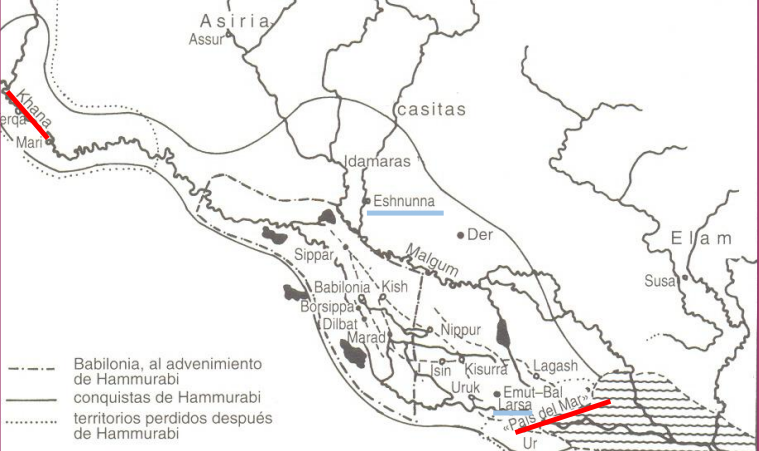
El fin de la Babilonia en tiempos de las I dinastía
Neither Larsa nor Eshnunna ever fully accepted their loss of independence. Consequently, Hammurabi’s successor, Samsu-iluna, was heavily engaged in curbing their revolts (Table 14.1). In Larsa, a Rim-Sin II, son of Warad-Sin and nephew of Rim-Sin I, became king. In Eshnunnna, an Iluni, who bore the title of governor and thus was formally dependent on the kings of Babylonia, tried to break free from royal control.
Samsu-iluna easily overcame and successfully curbed the first of these rebellions. Meanwhile, the rebellion of the far south led to the unification of the area under Iluma-Ilum, a king defined in the king lists and later accounts as the founder of the dynasty ruling the Sealand (in the far south of Mesopotamia). He therefore prevented Babylonia from having any access to the sea. Even the rebellion of Eshnunna lasted for a long time, until the capture and execution of its leader.
Samsu-iluna boasts of having demolished the walls of Isin (which was therefore also in rebellion) and of all the fortresses in the Diyala Valley. Then, he boasts of having worked on the walls of Uruk, Sippar and Kish. He also claims that he restored the fortresses of Eshnunna and of a new city, Dur-Samsu-iluna (the ancient Tutub, modern Khafajah) after his victories and established a line of fortresses in the south of Babyloni
However, a new threat was looming from the Zagros. The ninth year of Samsu-iluna’s reign is dated after a victory over the Kassites, a mountain community that was beginning to put pressure on the alluvial plain
The long and busy reign of Samsu-iluna was followed by the three reigns of Abi-eshuh, Ammi-ditana and Ammi-saduqa, though information on their military activities are still lacking
We know that Abi-eshuh fought again against the Sealand. Eventually, however, the Babylonian kings did not have the resources to regain control over the whole of their land. Lower Mesopotamia therefore remained divided between the Sealand in the south and the kingdom of Babylonia in the centre and the north. The kings of Hana controlled the Middle Euphrates and the kings of Assyria the Middle Tigris
Towards the end of the century, grave dangers were coming from the north, with the Hittite expeditions against Yamhad. The city was destroyed by the Hittite king Mursili.
A later text on the return of the statue of Marduk to Babylon attests that the Hittites had ‘deported’ it to Hana, where it remained until a Kassite king of Babylon recovered it. It is therefore possible that the Hittites had waged war against Babylon under Hana’s solicitation to resolve the old issues between Hana and Babylonia. Subsequently, the Hittites left the booty, or part of it, at Hana. They then returned to Hatti without taking advantage of the victory, at least politically
The conquest of Babylon and the sack of Marduk’s temple was a deadly blow for the Babylonian dynasty. The Hittites had left, but the reign of Samsu-ditana was now falling apart. The Kassites took immediate advantage of this situation. There is evidence of their presence in Babylonia and Hana both as a group, due to their military pressures, and individually. We do not know how they took control over Babylonia, but it is possible that they did so through a military attack
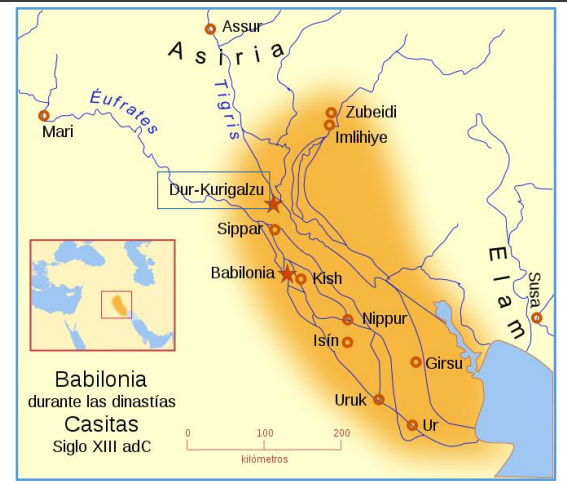
LA BABILONIA CASITA (1595-1155 –ó 1026-)
Following Mursili I’s expedition in Babylonia, Samsu-ditana continued to rule for a few years over a reduced and devastated kingdom. This situation paved the way for the rise of the Kassites, who had already attempted some military expeditions in Babylonia during the reign of Samsu-iluna. Unfortunately, we do not possess any information about the way in which a Kassite dynasty managed to establish itself on the Babylonian throne. Later chronicles would report that the dynastic sequence of Kassite kings had begun with some individuals (Gandash, Agum I and Kashtiliash I) that remain unattested in Babylonia.
However, a later source attests that 24 years after Marduk’s statue was ‘exiled’ to Hana at the hands of the Hittites, the Kassite king, Agum II, successfully brought it back to Babylon. Both the dynastic sequence of the kings of Hana and the epigraphic and archaeological evidence from Terqa suddenly stop at the beginning of the sixteenth century bc.
Therefore, it is possible to deduce that Agum II, one of the first Kassite kings of Babylon, had destroyed Terqa. In this way, the king put an end to the kingdom of Hana, and brought back to Babylon the booty and the statue of Marduk. The Babylonian kings would continue to hold an theoretical supremacy over the Middle Euphrates, especially in the Suhu area (immediately south of Hana), despite the subsequent Assyrian interest in the area.
Similarly, the Kassites managed to keep a hold of the Sealand, thus unifying Lower Mesopotamia under their authority. Ulam-Buriash and Agum III (whose distinction from Agum II is still under debate) defeated the last kings of the Sealand and proclaimed themselves kings of that region. The royal titles of the Kassite kings still attest their control over their original land and the foothills between the Zagros and the Tigris (Padan and Arman).
The Babylonian kingdom, which was called Karduniash in Kassite, was now a relatively vast territory, worthy of being considered a ‘great kingdom’ in the Late Bronze Age international system. To the north, we have some attestations on a number of conflicts with Assyria. As a result of these clashes, several treaties were signed between Burna-Buriash I and Puzur-Ashur III, and between Karaindash and Ashur-bel-nisheshu
The official entrance of the Kassites in the long-distance diplomatic network of the time took place during the reign of Kara-indash. According to some retrospective mentions found in the Amarna cor364 365 Kassite Babylonia respondence, Kara-indash was the first Babylonian ruler to establish relations with Egypt. Amenhotep II (a contemporary of Kara-indash) states that after his conquests in Syria, even the king of Shanhara (the Egyptian name for Babylon) sent him gifts
At the time, Babylonia suffered greatly from the divide existing between its long-standing tradition and its limited opportunities for expansion.This was due both to its distance from the heart of inter-dynastic relations, now located further west, and its reduced power. Having lost its former central role, Babylonia was now a marginal and almost secondary state compared to the other great powers of the time.
The revival of Ashur-uballit’s Assyria marked the beginning of a difficult phase for the Kassite kings. Burna-buriash, unable to obtain an Egyptian princess, gladly accepted the Assyrian king’s daughter, Muballitat-Sherua, as daughter-in-law. However, when a palace revolt eliminated her son once he had become king, the Assyrian ruler attacked Babylon. He then placed the infant Kurigalzu II (‘the little one’), another son or nephew of Muballitat-Sherua, on the throne. However, once of age, Kurigalzu felt closer to his Kassite lineage, being the son of Kara-hardash, than his Assyrian one on his mother’s side. Therefore, he fought against the Assyrians in the battle of Sugagu (whose outcome remains uncertain), just as he had fought against the Elamites, successfully reaching Susa.
Assyria remained the biggest problem for the Kassites, especially in the area east of the Tigris. The Assyrians managed to defeat the Kassite Nazi-Marutash under the leadership of Adad-nirari I. This victory only allowed a minimal shift of the border between the two kingdoms, which still maintained control over their own territories. Following the conventions of the time, the alternating victories of one kingdom or the other led to the establishment of several treaties defining the border, and the composition of heroic poems.
The latter were aimed at celebrating within one’s own kingdom the king’s successes. When Kashtiliash IV took advantage of Tukulti-Ninurta I’s coronation to move the border further north, he clearly outraged the wrong enemy. The reaction of the young Assyrian king was incredibly determined and aggressive: he not only defeated Kashtiliash in the battlefield, captured him and brought him back to Ashur, but also reached Babylon and conquered it. 366 Kassite Babylonia The Assyrian rule in Babylon lasted for seven years. Tukulti-Ninurta held the nominal title of king, while he delegated control of the area to his trustees.
After this phase, the Kassite dynasty quickly began to collapse. First, the Assyrian king Ashur-dan successfully attacked Babylonia. Then, the Elamite Shutruk-Nahhunte conquered and plundered the eastern and northern Babylonian cities (Eshnunna, Sippar, Akkad and Dur-Kurigalzu). He brought a large booty back to Susa, including some ancient monuments kept in the Babylonian temples. The Elamite king then left his son, Kutir-Nahhunte, to rule northern Babylonia alongside the residual Kassite power that was still surviving in the south. A few years later, Kutir-Nahhunte delivered the final blow to the Kassite dynasty, conquering Babylon and deporting the prestigious statue of Marduk to Susa, together with the statue of Nanaya from the sanctuary of Uruk. In this way, the Kassite dynasty endeded
LOS ÚLTIMOS SIGLOS DEL II MILENIO Y LA II DINASTÍA DE ISIN
El vacío que dejaron los reyes casitas fue pronto ocupado por un gobernante de la segunda dinastía de Isin, establecida en el sur de Mesopotamia en el siglo XI1. La primera acción de Nabucodonosor 1 (1126-1105) tras hacerse con el trono de Babilonia fue embarcarse en una campaña militar contra Elam que le permitió recuperar las estatuas robadas, lo que además de levantar en gran medida la moral de los babilonios, sirvió para legitimar su reinado
También aprovechó su victoria declarando a Marduk no sólo dios tutelar de la ciudad de Babilonia, sino también dios supremo del panteón babilónico: hasta entonces Marduk había sido únicamente el hijo de Ea, con un papel comparativamente menor en la jerarquía general de deidades mesopotámicas; Enlil de Nippur había seguido siendo la deidad principal durante el período casita.'
Parece ser que Nabucodonosor era un gran manipulador de la opinión pública y, para asegurarse un lugar en la historia de Mesopotamia, encargó un gran número de obras literarias, en su mayoría dedicadas a glorificar su éxito contra Elam o a demostrar la grandeza de Marduk.** Deseaba vivamente que se le considerase un monarca estricto y tradicional; adoptó los antiguos títulos reales (como «rey de Sumer y Akkad») y nombró a su hija entu, sacerdotisa del dios-luna en Ur.”
Así, la ciudad de Babilonia se convirtió de nuevo en capital, ya que los reyes casitas a partir de Kurigalzu (principios del siglo XIV) habían gobernado desde una nueva fundación más septentrional, Dur-Kurigalzu, que se hallaba dentro de las principales áreas de los asentamientos casitas, cerca de la actual Bagdad.
Hacia finales del reinado de Nabucodonosor, la situación económica y política se había deteriorado seriamente. El hambre y los disturbios civiles eran generalizados, como resultado de la destrucción de las cosechas y de las obras de irrigación. La situación se describe en un extenso texto literario conocido como la Epopeya de Erra,” del que se conservan copias del primer milenio, procedentes en su mayoría de colecciones de Asur y Nínive.
La incertidumbre fundamental del período que la Epopeya de Erra describe de forma tan elocuente se refleja en la cambiante fortuna del reinado de Nabucodonosor 1. Sus esfuerzos para extender el territorio de Babilonia se vieron frustrados por las represalias asirias, que llevaron a la destrucción de varias ciudades mesopotámicas, como Sippar o Babilonia. Las relaciones con Asiria siguieron siendo tensas, a pesar de que existían períodos de colaboración
Con la expansión del Estado septentrional en el siglo 1X, Babilonia perdió su independencia ante su más poderoso vecino, que controlaba rápidamente cualquier indicio de resistencia y rebelión. La represalia más drástica por una tentativa de independencia fue la campaña de Senaquerib contra Marduk-apla-iddina II, que culminó con el saqueo de Babilonia en el año 689, También influyeron las incursiones de tribus semíticas occidentales, como los arameos del norte y los caldeos del sur.
Al principio, como en ocasiones previas en que pueblos nómadas empezaban a infiltrarse en regiones de Mesopotamia, el efecto fue principalmente perjudicial, ya que los recién llegados, no sedentarios y socialmente diferenciados, luchaban por las tierras y los pastos a expensas de la población ya asentada, lo que provocaba el abandono de los asentamientos rurales, hasta que los recién llegados se adaptaban de forma gradual y se desarrollaba cierto equilibrio.
En el norte, donde el clima y la situación geográfica eran más aptos para el pastoreo, los arameos se mantuvieron más ajenos al contacto y la asimilación; en Asiria su aculturación fue más rápida. Los caldeos, que ocuparon las regiones del Éufrates meridional, en los alrededores de Ur y las marismas del golfo Pérsico, adoptaron antes un estilo de vida sedentario, puesto que aquí las condiciones para continuar el pastoreo de subsistencia eran menos favorables. Estas tribus reconocían un ancestro común y estaban lideradas por sheiks; algunos de éstos, sobre todo entre los caldeos, se hicieron muy poderosos y desempeñaron un papel decisivo en la lucha por la independencia de Babilonia.” El más famoso de ellos fue el jefe de los bit-yakin, conocido por su nombre babilónico como Mardukapla-iddina II, que se convertiría en enemigo jurado de Sargón y Senaquerib,