Dietary Macronutrients and their Roles. I. Carbohydrates
 Call Kai
 Learn
Learn Practice Test
 Spaced Repetition
 Match
Match Flashcards
 Knowt Play
1/32

There's no tags or description
Looks like no tags are added yet.
Name | Mastery | Learn | Test | Matching | Spaced | Call with Kai | Chat |
|---|
No analytics yet
Send a link to your students to track their progress
33 Terms
Which nutrients must the diet supply?
Essential amino acids
Essential fatty acids
Minerals
Vitamins and water
Essential amino acids
histidine, isoleucine, leucine, lysine, methionine, phenylalanine, threonine, tryptophan, valine

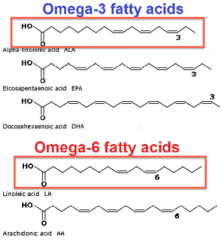
Essential Fatty Acids
Linoleic acid (n-6)
α-Linolenic acid (n-3)
Arachidonic acid
Minerals
Calcium · Iron · Zinc
Iodine · Magnesium
Phosphorus · Sodium
Potassium · Selenium
Vitamins
13 vitamins:
fat-soluble A, D, E, K
water-soluble B group, C
Water: 2-3 litres a day
why is there no essential Carbohydrate?
there is no essential carbohydrate, because the body can make glucose from amino acids and glycerol.
Classification of dietary carbohydrates
SUGARS
OLIGOSACCHARIDES
POLYSACCHARIDES
Sugars
monosaccharides (Glucose, fructose, glactose) and disaccharidesm (sucrose, lactose, maltose) and Sugar alcohols (polyols) (sorbitol)
Oligosaccharides
α-Glucans — digestible, Non-α-glucans (NDO) → act as prebiotics
Polysaccharides
Starch (amylose + amylopectin), Non-starch polysaccharides (cellulose, pectins, gums
→ the dietary fibre fraction_
corn syrup
Thick, sweet syrup, made from cornstarch.
high fructose corn syrup
A sweetener made by processing corn syrup to increase the level of fructose. It is used extensively as a sweetener in processed foods and soft drinks.
Sugar alcohols (polyols)
sorbitol, mannitol, xylitol (gum) absorbs more slowly than sugar, not calorie free.
Replace sucrose in sugar-free
products; about 2.4 kcal/g.
and cause diarrhoea.
Free sugars
all monosaccharides and disaccharides added to food by the manufacturer, cook, or consumer, plus sugars naturally present in honey, syrups, and fruit juices
Oligosaccharides
α-Glucans — digestible
Non-α-glucans — not digestible
α-Glucans
Linked by α-1,4 and α-1,6 bonds (easily catablised)
Maltodextrins from corn or wheat starch.
Non α-glucans
Raffinose, stachyose, and inulin.
Found in peas, beans, and lentils.
Reach the colon intact and act as PREBIOTICS
Starch — resistant and modified
It behaves like fibre: little effect on blood
glucose, about 2 kcal/g, a good prebiotic
modified starch
a starch that has been chemically or physically modified to create unique functional characteristics
Dietary Fiber
nondigestible carbohydrates and lignin that are intact in plants
Cellulose
long straight chains
insoluble — adds bulk
Hemicellulose
xylose and arabinose
partly soluble
Pectin
galacturonic acid
soluble—forms gels
plant based gelatine
Plant gums
e.g. gum arabic
soluble — thickener
Why fiber matters?
Improves Digestion: Insoluble fiber adds bulk to your stool and helps food pass smoothly through your gut to prevent constipation.
Feeds Gut Bacteria: Soluble fiber acts as food for the good bacteria in your large intestine, supporting a healthy microbiome and reducing gut inflammation.
Lowers Cholesterol: Soluble fiber binds to cholesterol in your digestive tract, helping your body get rid of it and lowering your risk of heart disease.
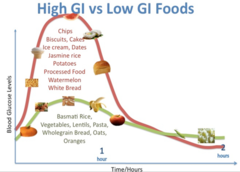
GLYCEMIC CARBOHYDRATE
• Sugars — mono- and disaccharides
• Maltodextrins and other α-glucans
• Digestible starch
digested and absorbed in the small intestine
NON-GLYCAEMIC CARBOHYDRATE
• Non-digestible oligosaccharides
• Non-starch polysaccharides (fibre)
• Resistant starch
passes undigested into the large intestine
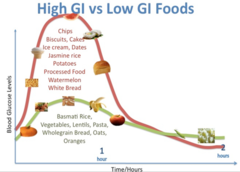
Glycemic Index (GI)
a ranking of foods according to their potential for raising blood glucose relative to a standard food such as glucose
Glycemic Load (GL)
Similar to glycemic index but takes into account the amount of food (carbohydrate) eaten.
Glycemic load = GI × the amount of carbohydrate actually eaten.
The protein-sparing action of carbohydrate
consuming enough carbohydrate so that protein is not used to make glucose
lactose intolerance
impaired ability to digest lactose due to reduced amounts of the enzyme lactase.
Diagnosis: lactose tolerance test (blood glucose fails to rise) or hydrogen breath test.
Lactase Persistence
continuation of lactase production beyond early childhood that allows a person to digest milk and dairy products
Lactose non-persistence
Develops during adulthood when lactase activity declines.