Intro and Membrane Transport
 Call Kai
 Learn
Learn Practice Test
 Spaced Repetition
 Match
Match Flashcards
 Knowt Play
1/43

There's no tags or description
Looks like no tags are added yet.
Name | Mastery | Learn | Test | Matching | Spaced | Call with Kai | Chat |
|---|
No analytics yet
Send a link to your students to track their progress
44 Terms
What is genetic diversity?
An inheritable difference based on genes that affects fitness
What is a phenotypic plasticity?
Phenotype differences based on environment within a lifetime; changes in phenotype based on environment
What is acclimation?
adjust/adapt within a lab
What is acclimatization?
adjust/adapt within nature
What is a mechanistic explanation?
the mechanism by which a function is accomplished
describes the biophysical/biochemical steps that brings about a particular cellular or organismal response
ex. hemoglobin carries O2 to bring O2 to cells for cellular respiration
What is the teleological explanation?
describes WHY a certain cellular or organismal response is desirable, but doesn’t give the mechanism that produces the response
ex. blood circulates O2 to get O2 to cells for aerobic repsiration
What is homeostasis?
maintenance of the internal environment within limits conducive to proper function
NOT a properly constant internal environment
What external changes can affect homeostasis?
water availability
salinity
food availability
temperature
O2 availability
pH
How is homeostasis maintained?
sense and detect changes in the internal and external environment (sensory physiology) via nervous system
integrate a system-wide response to these changes, which requires communication between cells and tissues via nervous and endocrine system
can lead to physical activity and other responses (ex. muscles, metabolism, feelings, etc.)
How does positive feedback affect homeostasis?
drives system farther from original set point; perpetuates change
What is a feed forward mechanism?
body anticipates future disturbance and prepares in a way that reduces the disturbance when it occurs
counteracts disturbance before it occurs
ex. salivate when food comes, bracing for impact
What is a temperature conformer?
internal env matches external
poikolotherm
What is a termperature regulator?
internal env does not change with external environment
homeotherm
What do enzymes do?
regulate metabolism
facilitate/speed up naturally occurring reactions
lower activation energy of a reaction (do not affect thermodynamics)
How can enzymes be regulated?
covalent modifications
proteolytic cleavage
association with other polypetides
allosteric regulation
Describe enzyme regulation via covalent modification
adding or removing a chemical via a covalent bond
ex. phosphorylation
Describe enzyme regulation via proteolytic cleavagte
regulates enzymes by cutting peptide bonds in the enzyem
ex. zymogens
ex. trypsinogen → trypsin
Describe enzyme regulation via association with other polypeptides
enzyme regulated by binding another protein or protein subunit
can change enzyme’s shape or inhibit/activate its activity
enzyme does not have to chemically modfiied
ex. cyclin-dependent kinase
Describe enzyme regulation via allosteric regulation
molecule binds to enzyme at allosteric site
allosteric activator increases enzyme activity
allosteric inhibitor decreases enzyme activity
ex. feedback inhibition
What is activation energy in regards to enzymes?
Energy required to get a reaction going
enzymes lower activation energy in both directions but DO NOT change delta G
What is negative feedback in regards to enzymes?
product of reaction inhibits enzymes earlier in pathways
maintains homeostasis

Describe enzyme kinetics, including what happens at low/high concs, and Vmax and Km
describes how fast an enzyme-catalyzed reaction occurs and how reaction rate changes with different amounts of substrate
at low substrate conc, adding more substrate causes the reaction rate to increase because more enzyme active sites are being occupied
at high substrate conc, enzymes become saturated, meaning essentially all active sites are occupied, so adding more substrate no longer greatly increases the reaction rate
Vmax = fastest possible reaction rate, saturation point
Km = substrate concentration at which the reaction rate is ½ Vmax; measure of enzyme affinity for substrate

What is Vmax?
fastest possible reaction rate, saturation point
What is Km? What does a high and low Km indicate?
Km = substrate concentration at which the reaction rate is ½ Vmax; measure of enzyme affinity for substrate
low Km = enzyme has high affinity, needs less substrate
high Km = enzyme has low affinity, needs more substrate
When [substrate] is significantly less than [enzyme], what does increasing the substrate conc. do to the rate (v)?
increases V linearly
When [substrate] is approximately equal to [enzyme], what does increasing the substrate conc. do to the rate (v)?
increases V slightly
When [substrate] is significantly more than [enzyme], what does increasing the substrate conc. do to the rate (v)?
stays at or goes to Vmax
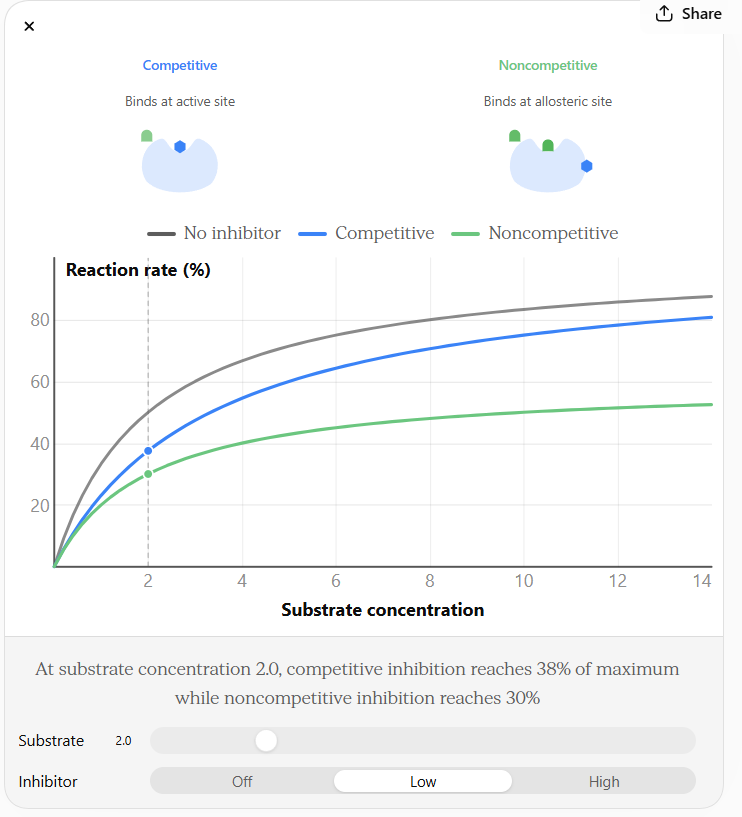
What is competitive Inhibition and how does it affect the enzyme kinetics graph?
enzyme regulation where inibitor competes with substrate for enzyme activate site
takes more substrate to reach Vmax
can be overcome by increasing substrate concentration
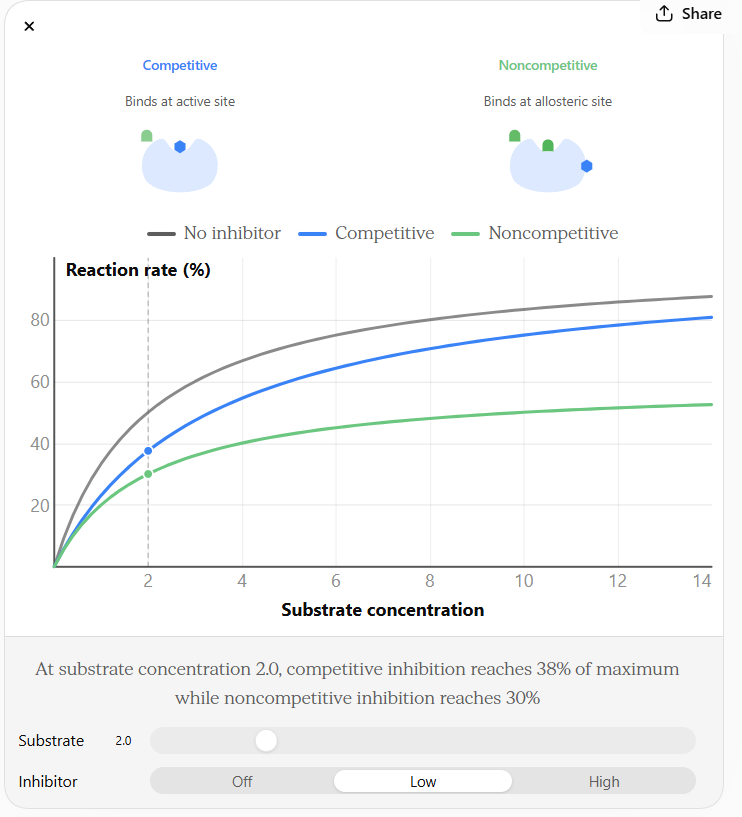

What is non-competitive Inhibition and how does it affect the enzyme kinetics graph?
enzyme regulation where inhibitor binds allosterically to enzyme
not affected by substrate concentration
lowers Vmax
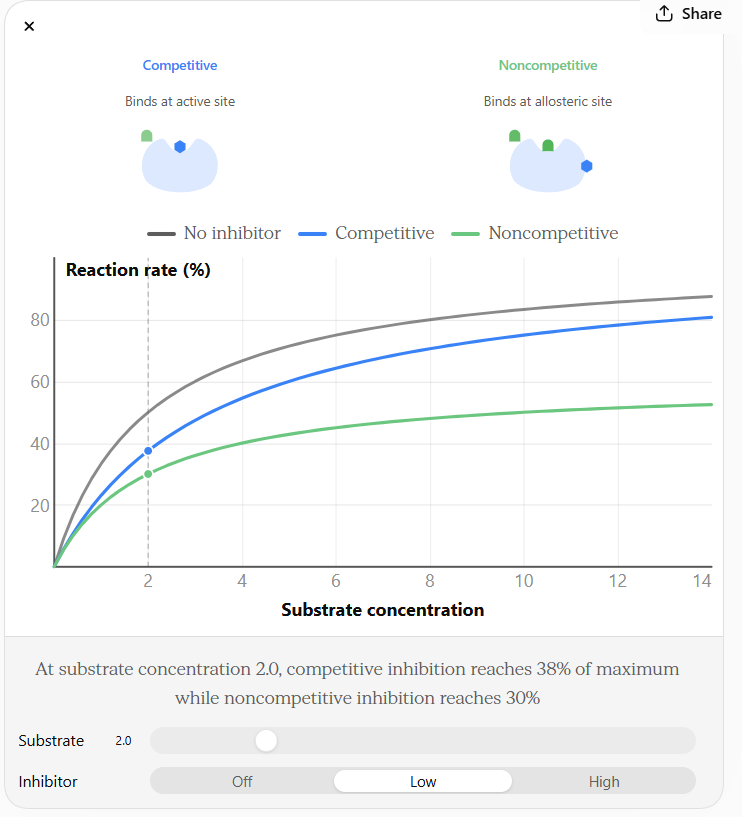

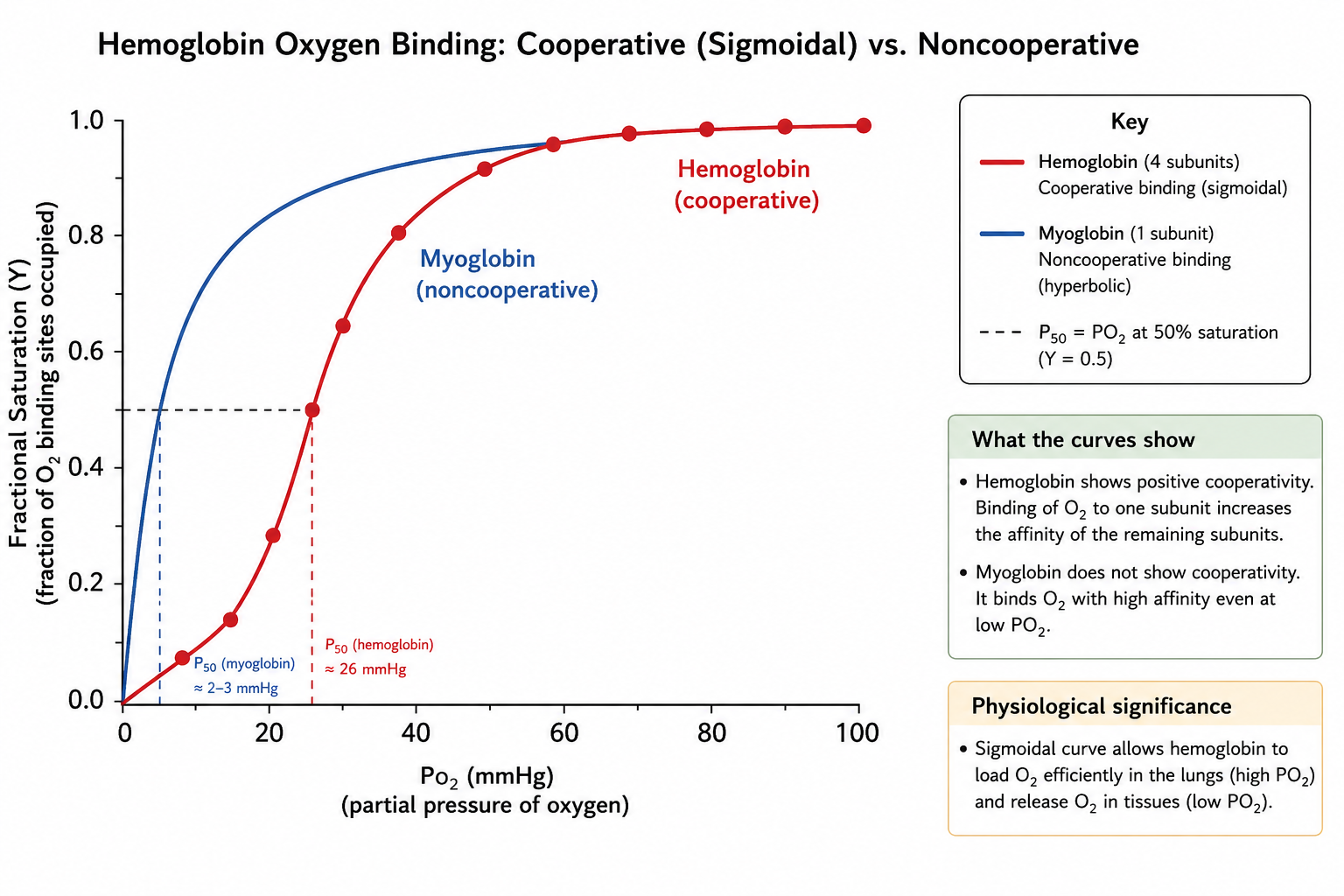
What is cooperativity and how does it affect the enzyme kinetics graph?
form of allosteric regulation where binding of a substrate/regulator at one site changes how easily the substrate binds at other sites
has a sigmoidal curve
often causes conformational change to neighboring subunits
ex. hemoglobin
What is passive transport?
transport across plasma membrane that does not use energy
relies on gradients
What is facilitated diffusion?
type of passive transport
moves small, hydrophobic molecules across membranes
relies on help of pores, channels, or carriers
ex. ions, glucose, H2O
What do pores move across plasma membranes?
help charged/large substances cross
ex. porins
What do channels move across plasma membranes?
specific for specific molecules or types of molecules
How do carriers move things across plasma membranes?
shape changes, no hole (conformational change)
What is simple diffusion?
movement of small, hydrophobic molecules across plasma membrane down concentration gradient
no energy required
ex. steroids, O2, CO2
What is active transport and its types?
movement of molecules againt gradients, requires Energy
primary and secondary
Describe primary active transport
uses ATP directly to move substances against conc gradient
Ex. Na/K ATPase pump
What is the Na/K ATPase pump and why is it important?
primary active transport that pumps 2 K in and 3 Na out (pumpkin)
helps cell maintain osmotic balance
sets up resting membrane potential
sets up gradient for secondary active transport
What is secondary active transport?
uses energy stored in conc gradient of another susbtances (set up by primary active transport) to move molecules across gradients
requires E
potential energy stored in pump (created by primary active transport using ATP to set up gradient) pushes moleucles out
ex. sodium-glucose co transporter; uses Na+ gradient set up by ATPase
What is phagocytosis?
cellular eating
engulfs large particles
What is pinocytosis?
liquid uptake via vesicle
What is receptor-mediated endocytosis?
uses receptors to bring specific molecules into a cell