2.1 Basics of Linear Mixed Modeling
 Call Kai
 Learn
Learn Practice Test
 Spaced Repetition
 Match
Match Flashcards
 Knowt Play
1/28

Earn XP
Description and Tags
Section 2.1 from Exam MAS-II
Name | Mastery | Learn | Test | Matching | Spaced | Call with Kai | Chat |
|---|
No analytics yet
Send a link to your students to track their progress
29 Terms
Clustered data
The dependent variable is measured once for each subject (or unit of analysis), and subjects are grouped into, or nested within, clusters of subjects that share some commonality.
Repeated measures
The dependent variable is measured more than once on the same subject across levels of one or more categorical explanatory variables called repeated-measures factors.
Longitudinal data
The dependent variable is measured at multiple points in time for each subject.
Clustered longitudinal data
The dependent variable is measured at multiple points in time for each subject, and subjects are grouped within clusters.
Hierarchical Data - Level 1
Observations at the most detailed level of data. For clustered data, this is the subject; for repeated measures/longitudinal data, this is the repeated measures made on a subject.
Hierarchical Data - Level 2
The next most detailed level of data. For clustered data, this is a cluster of subjects; for repeated measures, it is the subject.
Hierarchical Data - Level 3
The next level of data after Level 2, consisting of clusters of Level 2 units (clusters of clusters).
Covariate
A predictor variable
Fixed factor
A categorical variable that includes all possible levels.
Random factor
A categorical variable whose levels are randomly sampled from a larger population of levels.
Fixed effect
Describes the relationship between the dependent variable and a fixed factor or continuous covariate.
Random effect
Random values associated with specific levels of a random factor.
Nested factors
Factors where each level of one factor can only be measured within a single level of another factor.
Crossed factor
A factor that can be measured across multiple levels of another factor.
Model Specification for a Single Observation Equation
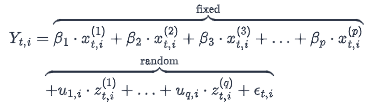
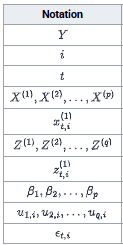
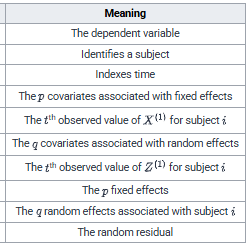
Matrix Specification Equation
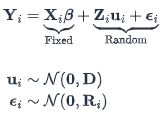
Matrix for Y_i
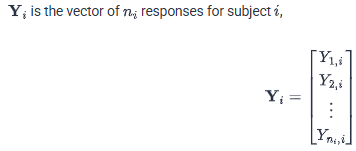
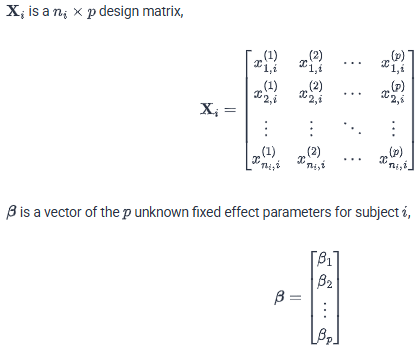
Matrices for Fixed Effects
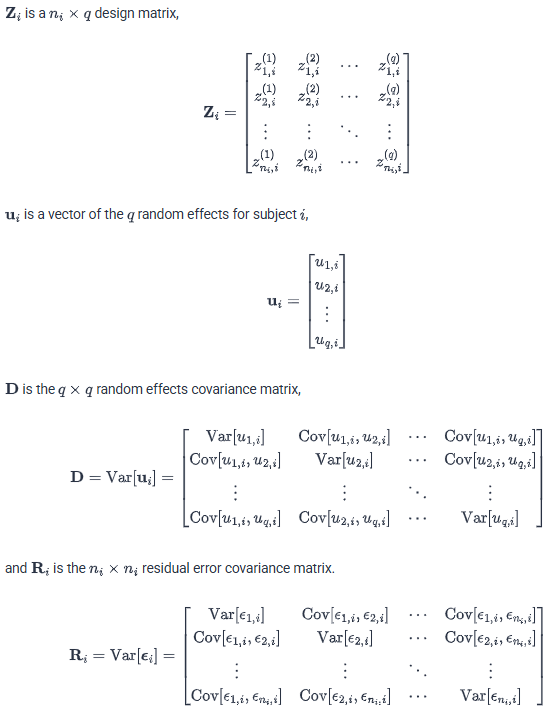
Matrices for Random Effects (including covariance matrices)
Covariance Structures: Unstructured - Define matrix and parameters

Covariance Structures: Diagonal/Variance components - Define matrix and parameters

Covariance Structures: Compound Symmetric - Define matrix and parameters

Covariance Structures: First-Order Auto-Regressive - Define matrix and parameters

Both D and R_i must be ____
Heterogenous variances are…
Positive Definite
Possible. Same structure but different parameters in theta_D and theta_R
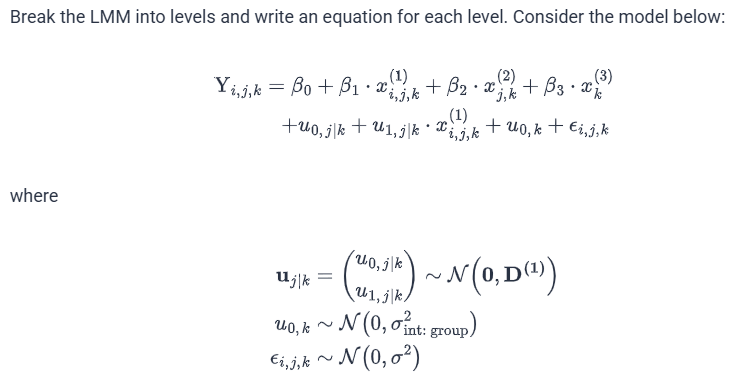
Hierarchical Model Example

Marginal Linear Model: Equation, other name, result, covariance matrix

Implied Marginal Model: Equation and Covariance Matrix
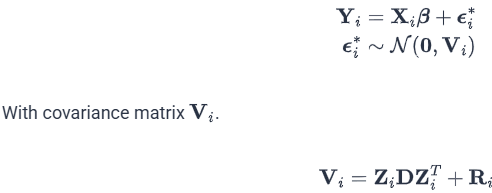
Implied Marginal Model Characteristics:
Perk compared to LMM?
V_i must be ___
E[Y_i] =
Var{Y_i] =
Y_i ~ ____
