2.2 Intermolecular Forces
 Note
Note Call Kai
 Learn
Learn Practice Test
 Spaced Repetition
 Match
Match Flashcards
 Knowt Play
1/6

Earn XP
Description and Tags
Name | Mastery | Learn | Test | Matching | Spaced | Call with Kai | Chat |
|---|
No analytics yet
Send a link to your students to track their progress
7 Terms
What is the difference between Intramolecular Bonds and Intermolecular Bonds? Simply define Intermolecular Bonds.
Intramolecular bonds- hold atoms in a molecule together
Intermolecular Bonds - hold two or more molecules together
much weaker and determine physical state of substance
What are the types of Intermolecular Bonds? What are they collectively known as?
London forces
Dipole-dipole forces
Hydrogen bonds
Collectively known as Van der Waals forces
Tell me about London Forces*
bonds that are formed due to a temporary unequal distribution of electrons in an atom
Very weak, occur between small nonpolar molecules (ex: methane)
Each molecule is weakly attracted to its neighbour
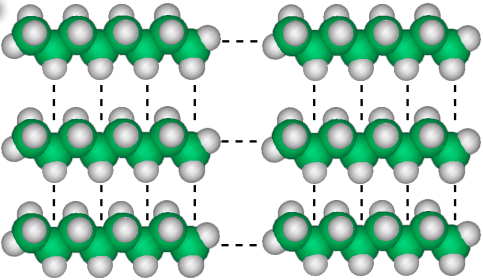
Cumulative effect of London forces become more significant in large nonpolar molecules (ex: octane)
In larger molecules, many weak attractive forces result in a closer association
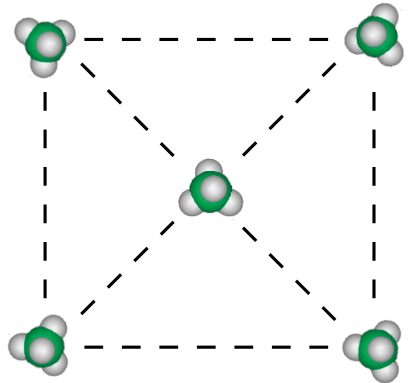
Connect what you know about London Forces to Methane and Octane
Since methane’s molecules are small, it is a gas at room temperature. Whereas octane’s molecules are large meaning the forces accumulate rendering octane a liquid.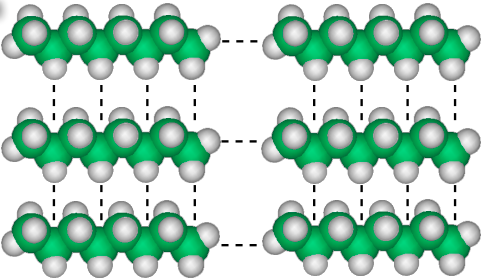
Tell me about Dipole-Dipole Forces*
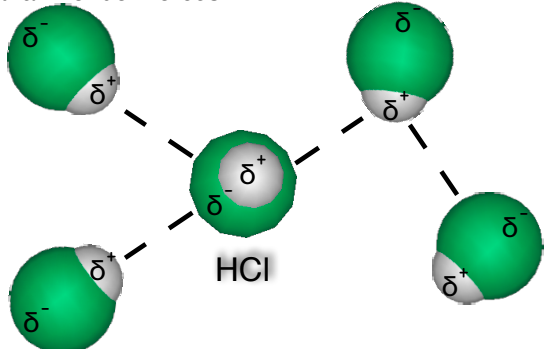
occur between polar molecules, like HCl
Slightly positive end of one polar molecule is attracted to slightly negative end of another polar molecule
Stronger than London forces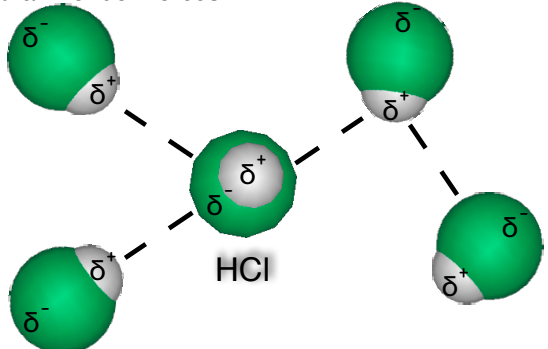
Tell me about Hydrogen Bonds*
dipole-dipole forces that form between electropositive H of one polar molecule and an electronegative N, O, or F of another
Strongest intermolecular force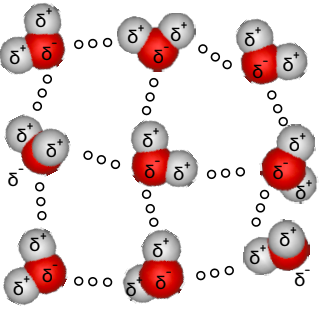
Compare and Contrast
Intramolecular Bonds | Intermolecular Forces |
|---|---|
Holds one molecule together | Holds many molecules together |
Strong attraction between atoms | Weak attraction between molecules |
Commonly called “bonds” | Known as van der waals forces |
Determines if electrons are transferred or shared | Determines state of substance |
Ex: Ionic, covalent, polar covalent | Ex: London forces, dipole-dipole, hydrogen bonds |