LSB142 Week 12 Muscular systems Neuromuscular junction and excitation-contraction coupling
 Call Kai
 Learn
Learn Practice Test
 Spaced Repetition
 Match
Match Flashcards
 Knowt Play
1/23

Earn XP
Description and Tags
Describe the neuromuscular junction and how the action potential leads to excitation in the muscle
Name | Mastery | Learn | Test | Matching | Spaced | Call with Kai | Chat |
|---|
No analytics yet
Send a link to your students to track their progress
24 Terms
Where does communication begin with the nervous system and the skeletal muscles?
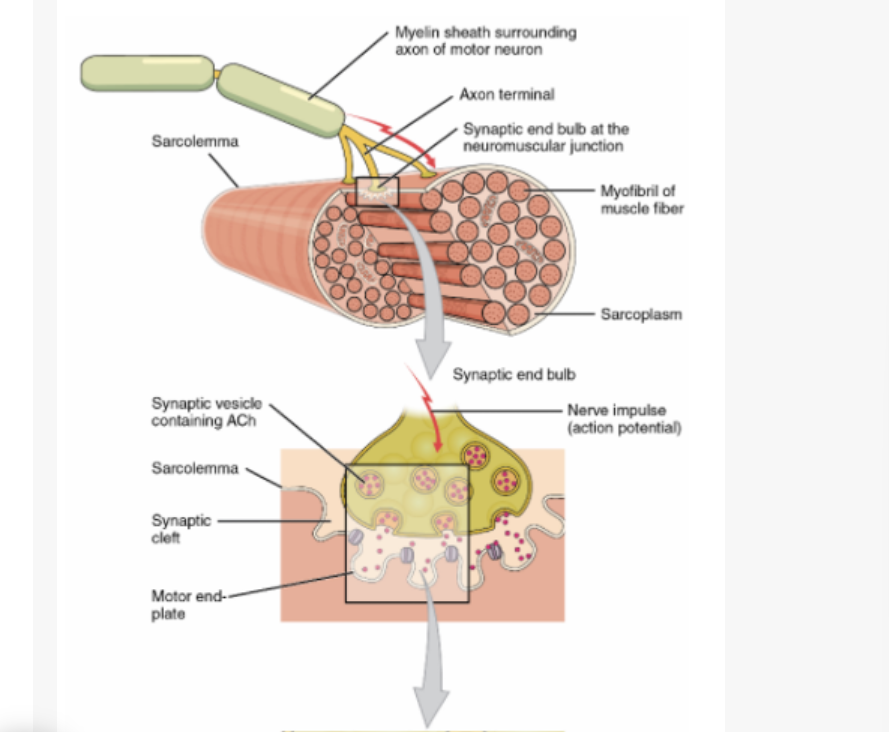
neuromuscular junction (NMJ)
What is the NMJ (Neuromuscular joint)
A specialised synapse where motor neuron transmit signal to myocytes (muscle fibres) to initiate contraction.
What does the signal transmitted from motor neurons to myocytes trigger? What is it?
excitation-contraction coupling, beginning at the NMJ which links the nerve impulse arrival to release of calcium ions in muscle fibre resulting in contraction. The stimulation continues through the spread of the action potential along the sarcolemma and T-tubules.
How is nerve singal transmitted from neuron to muscle fibre with the existence of the synaptic cleft (gap between muscle cells and neuron)?
Though chemical messengers
What are the components of the NMJ
1.. presynaptic terminal of motor neuron
Synaptic cleft
Postsynaptic membrane of myocyte, the motor end plate
what neurotransmitter is released into the synaptic cleft when action potential reaches the presynaptic terminal?
Acetylcholine (ACh)
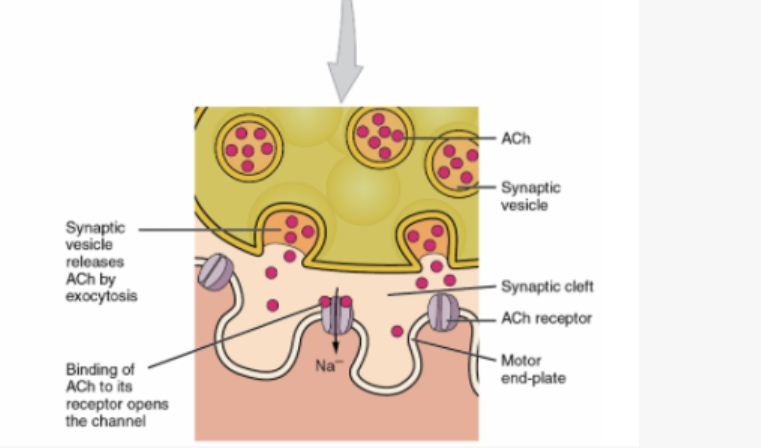
what happens after ACh is released?
It diffuses across the synaptic cleft and binds to receptors on the motor end plate of the muscle fibre. The binding opens ion channels which lets sodium ions enter the muscle cell, which generates action potential along the sarcolemma.
Myofibrils responsible for contraction are located where? which means?
Deep within the myocytes (muscle fibres), meaning the electrical signal generated at the sarcolemma must be transmitted into the interior of the cell.
How do signals transmit into the interior of muscle fibres?
Through invaginations of the sarcolemma called transverse tubules (t-tubules) that allow action potential to travel from the surface to the inner regions of the myocytes (muscle cells).
What is the triad
a structure consisting of a single t-tubules flanked on either side by enlarged regions of sarcoplasmic reticulum called terminal cisternae.
What surrounds the myofibrils?
The triad
What happens when an action potential travels across the T-tubules?
Calcium channels are opened in sarcoplasmic reticulum, Ca2+ is released into myocytes.
What does released calcium by the triad bind to?
troponin complex, which initiates cross-bridge cycling between actin and myosin and muscle contracts.
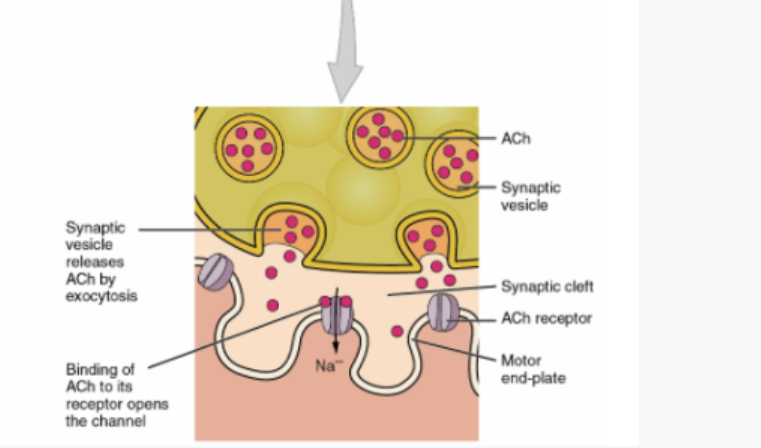
how do skeletal muscles relax?
Motor neurons stop release of ACh into synaptic cleft at the neuromuscular junction (NMJ), without ACh the sarcolemma repolarises and the calcium channels in sarcoplasmic reticulum close.
how do skeletal muscles relax, after closing of calcium channels?
ATP dependent calcium pumps transport calcium ions back into the sarcoplasmic reticulum, lowering calcium levels. AS calcium conc falls, tropomyosin shifts to cober myosin binding sites to stop cross-bridge formation.
What happens when no interaction between myosin and actin occurs?
muscle fibre is inable to create tension and returns to resting state.