Economy Unit 2
 Call Kai
 Learn
Learn Practice Test
 Spaced Repetition
 Match
Match Flashcards
 Knowt Play
1/35

There's no tags or description
Looks like no tags are added yet.
Name | Mastery | Learn | Test | Matching | Spaced | Call with Kai | Chat |
|---|
No analytics yet
Send a link to your students to track their progress
36 Terms
a. economic growth
If a production possibilities curve shifts outward, that is a sign of _____
a. economic growth
b. inflation
c. efficiency
d. development
False- Economic growth cannot be achieved without investing in new resources
Economic growth usually can be achieved without investing in new resources.
Select one:
True
False
d. all of the above
Which of the following would result in a change in the production possibilities frontier in the mythical country Alpha?
a. new technology
b. many workers from other countries move in
c. the discovery of a new natural resource
d. all of the above
a. is efficient
An economy operating on its production possibilities curve has which of the following?
a. is efficient
b. is under utilizing its resources
c. has slow economic growth
d. has to make economic gains to reach its full potential
d. It must bottle less cranberry juice.
A factory bottles apple juice and cranberry juice. If it wants to bottle more apple juice, what is the trade-off?
a. It must build a bigger factory.
b. It must bottle more cranberry juice.
c. It must bottle the same amount of cranberry juice.
d. It must bottle less cranberry juice.
True
Scarcity is an economic problem with which all societies are faced.
Select one:
True
False
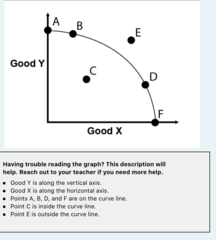
1. C represents Inefficiency
2. E represents Impossible
3. D represents Efficiency
1. What does Point C represent
Impossible
Inefficiency
Efficiency
Perfect
2. What does Point E represent?
Impossible
Inefficiency
Efficiency
Perfect
What does Point D represent?
.Impossible
Inefficiency
Efficiency
Perfect
c. efficient
How would you describe an economy that is using its resources in a way that will maximize production?
a. specialized
b. under utilized
c. efficient
d. scarce
True
Marginal analysis can help a company determine pricing strategies.
Select one:
True
False
d. Goods and services
With marginal benefit, a consumer can get satisfaction from which of the following?
a. Consumers aren't satisfied with marginal benefit.
b. Services only
c. Goods only
d. Goods and services
c. The opportunity cost of purchasing the high speed rail cannot be determined.
Canada decides to spend oil and gas revenue on high speed rail instead of a new university. What does this decision indicate?
a. The marginal benefit of the high speed rail is equal to the marginal benefit of the new university.
b. The marginal benefit of the high speed rail is less than the marginal benefit of the new university.
c. The opportunity cost of purchasing the high speed rail cannot be determined.
d. The decision was a mistake because the cost of the high speed rail is too high.
e. The marginal benefit of the new university is less than the marginal benefit of the high speed rail.
a. Marginal benefit
Which of the following is the maximum amount a consumer is willing to pay for an additional good or service?
a. Marginal benefit
b. Consumption costs
c. Marginal revenue
d. Marginal consumption
c. Marginal costs
_____ are opportunity costs of a decision (foregone benefits) that is not defined in money.
a. Actual costs
b. Implicit costs
c. Marginal costs
d. Explicit costs
a. Marginal benefit
The satisfaction received from using one more unit of a good or service is called which of the following?
a. Marginal benefit
b. Marginal cost
c. Opportunity cost
d. Opportunity benefit
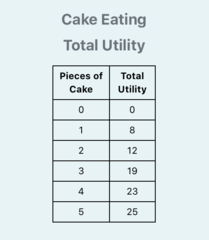
d. The marginal utility of the 5th slice is 5
The chart shows the total utility a typical consumer receives for eating pieces of cake.
Which of the following is correct for this individual?
a. The marginal utility of the 4th slice is 4.
b. This person would eat 5 pieces of cake.
c. This person does not experience diminishing marginal utility.
d. The marginal utility of the 5th slice is 5.
e. The total utility decreases at a constant rate.
a. Explicit costs
_____ can be figured easily in terms of money, or out of pocket costs.
a. Explicit costs
b. Actual costs
c. Implicit costs
d. Marginal costs
a. Trade-offs
When deciding how to use resources, you need to evaluate the costs and benefits of each choice to decide which meets your criteria. What are these called?
a. Trade-offs
b. Shifters
c. Priorities
d. Resource frontiers
True
Marginal analysis can help a company determine the "sweet spot" (or ideal amount) of HOW MUCH to produce.
Select one:
True
False
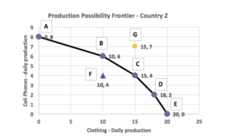
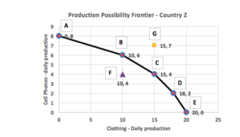
4 cell phones
Use the graph above. Consider the Production Possibility Frontier for the country Z producing 2 groups of goods, cell phones and clothing. The opportunity cost of moving from the combination of cell phones and clothing B to D is _____ .
2 cell phones
8 units of clothing
4 cell phones
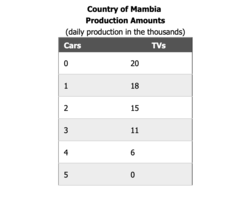
5 TV's
Use the table above. The country of Mambia produces cars and TVs as laid out in the Production Possibility schedule below. What would be the opportunity cost of producing a fourth car (increasing production from 3 to 4 cars)?
6 TVs
1 car
5 TVs
greater at B than at C
Use the graph above. Consider the Production Possibility Frontier for the country Z that produces 2 groups of goods, cell phones and clothing. The opportunity cost of one additional cell phone is _____ .
equal to B and C
greater at C than at B
greater at B than at C
True
The PPC illustrates how countries, businesses, or individuals make the WHAT to produce decision. True False
True
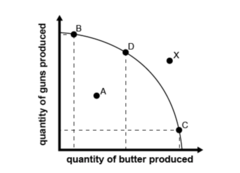
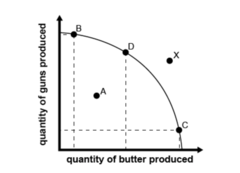
Every point on the PPC (the curve itself) is efficient, meaning that all resources are being used.
False
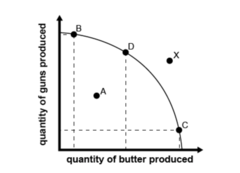
It is possible for production to be completed at a point outside of the PPC curve.
False
Points inside the curve mean that the decision has been made to produce less.
True
Points B, C, and D show efficiency.
True
Point A shows inefficiency. True False
True
Point X on the curve could be possible if there is enough economic growth.
True
False
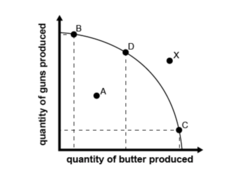
False
Point X on the curve is possible if companies work harder. True False
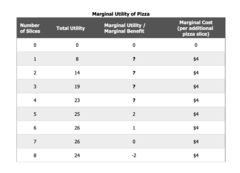
8
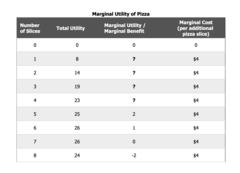
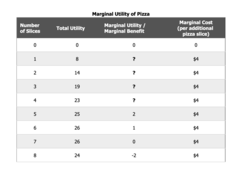
What is the Marginal Benefit of the 1st slice of pizza?
8
6
5
4
5
At what quantity is there no Marginal Benefit to eating another slice of pizza?
5
At what quantity does Marginal Benefit begin to decline?
5
6
7
8
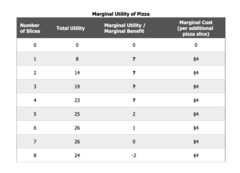
4
At what quantity does Marginal Benefit = Marginal Cost?
1
2
3
4
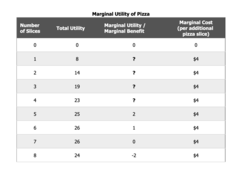
4
What is the Marginal Benefit of the 4th slice of pizza?
8
6
5
4
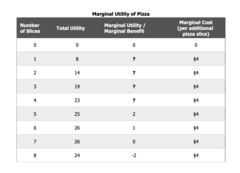
5
What is the Marginal Benefit of the 3rd slice of pizza?
8
6
5
4
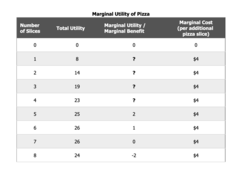
6
What is the Marginal Benefit of the 2nd slice of pizza?
8
6
5
4