DBMB 712: Immunology Week 3
 Call Kai
 Learn
Learn Practice Test
 Spaced Repetition
 Match
Match Flashcards
 Knowt Play
1/63

There's no tags or description
Looks like no tags are added yet.
Name | Mastery | Learn | Test | Matching | Spaced | Call with Kai | Chat |
|---|
No analytics yet
Send a link to your students to track their progress
64 Terms
What is the other name for antibodies?
Immunoglobulins (Igs)
What are the immunoglobulin functions?
- neutralization (prevent binding),
- agglutination (clump pathogens),
- opsonization (increase phagocytosis),
- killing by complement or by NK cells, monocytes/macrophages, or granulocytes
What activates antibodies?
they are secreted by activated B cells (plasma cells) and the B cell is activated by the binding of antigens to their B-cell receptors (BCRs)
How many antigen-binding sites do antibodies have?
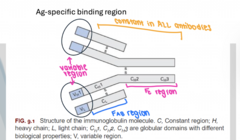
2 identical (varibale region)
What is the variable region of the antibody?
antigen specific binding region
What is the Fc region of the antibody?
- The part that does not change and helps determine the biological activity of the molecule
- Different cells have receptors that can bind to Fc regions, such as mast cells. Once the antigen binds, it causes the mast cells to release histamines
Picture of an Antibody structure.
What is the main immunoglobulin in circulation?
IgG
What is the immunoglobulin that can cross the placenta?
IgG
What are the IgG characteristics?
- memory,
- activate complement,
- cross placenta,
- opsonization
What is the main antibody in secretions?
IgA
What is the structure of sIgA (secretory IgA)?
2 IgA bound together by a J chain
What are the characteristics of IgA?
- protection of mucosal surfaces,
- secretory component protects against proteolysis
- found in secretions
What are the characterisitics of IgM?
- first antibody made when you have an immune reaction,
- agglutination,
- activate complement
What is the structure of IgM?
10 binding sites, 5 subgroups formed into a circle hrough a J chain
What is the first Ig produced in an immune reaction?
IgM
What does high IgM mean?
first exposure to pathogen
What is class switching?
Igs can switch to a different class based on environmental signals
What are the characteristics of IgE?
- in allergic reactions, stimulate basophils and mast cells by having receptors for the Fc region
- immunity to helminths
What is cross-linking?
When IgEs that are bound to the outside of mast cells, bind the antigen which causes mast cell to degranulate
How does an allergy shot work?
It causes IgEs to class switch to IgGs so they do not cause an allergic response
How does it work 1st and 2nd exposure to an allergen?
1st time you encounter an allergen, you dont have a reaction but you are sensitized by the crosslinking so the 2nd exposure you have a response
What are the characteristics of IgD?
- on B cells that are making IgM,
- don't know function,
- never in the circulation,
- never class switch into IgDs
T/F things can class switch to IgD
F
What is a cytokine? What secretes cytokines?
- chemical messengers (involved in communication between cells)
- secreted by leukocytes and other cells
- required for initiation and regulation of all stages of the immune response (differentiation to activation)
What mediates the action of cytokines?
- binding to specific receptors on target cells (if you don't have the receptor for the cytokine, you don't have a response)
- response of a cell depends on the state of differentiation and activation, and presence of other cytokines in the microenvironment
What is pleiotrophy for cytokines?
The ability of a single cytokine to have multiple effects.
What does it mean that cytokines have redundancy?
they overlap in function
- many different cytokine cells perform same function
t/f cytokines do not have pleiotrophy and redundancy
F (have both)
What is a chemokine and their function?
- Related to cytokines
- Function: promote adhesion of cells to endothelium, chemotaxis, and activation of leukocytes
- They are involved in leukocyte trafficking for entry into lymphoid and other tissue
What is the importance of IL8?
chemotactic for neutrophils
How does cytokines help with transfer of endothelium?
help promote adhesion of cells
What is the importance of IL-1?
pro inflammatory cytokine, produce macrophages
What is the importance of Il-6?
pro inflammatory cytokine, b cell differentiation, produce macrophages and T cells
What is the importance of IL-10?
anti-inflammatory cytokine (helps inhibit chronic inflammation)
What is the importance of IL-17?
mucosal inflammatory cytokine (periodontal disease)
What is the importance of IFN-alpha (interferon)?
activation of macrophages, NK cells, upregulation of MHC expression and protection
What is the importance of IFN-gamma?
Activation of macrophages and NK cells, produce antiviral state in neighboring cells, increases expression on HCR I and II, inhibit helper T cells
What is the importance of TGF-beta?
wound healing, IGA production, suppression of cytokine production (anti-inflammatory)
What is the importance of TNF-alpha?
mediator of inflammation, killing of tumor cells (pro-inflammatory)
What are B cells?
highly efficient APC, activate T cells, Ig production
What are the signals B cells need to be activated?
Signal 1: binding antigen to the BCR (B cell receptor), then they internalize the antigen and process peptides onto MHC II molecules for presentation to T helper cells
Signal 2: activated T-helper cells are induced to express CD40L for binding to B cell CD40
*Effect: Induces B cell activation, Ig production, and isotype switching
What is antigen processing?
The intracellular degradation of proteins into peptides that bind to MHC molecules for presentation to T cells.
What cells have MHC I molecules?
virtually any cell type (that have a nucleus)
What cells can have a MHC II peptide?
"professional" antigen presenting cell
T/F the immune process of antigen processing for MHC 1 and MHC 2 are the same
F
What is important for the strength of the signal to activate the T cell?
co adhesion molecules
What are Th0 cells?
undifferentiated T cells
How does a T helper cell differentiate?
the APC and the environment helps it become a type 1 or a type 2
What is the type II THC function?
stimualte B cell activation and antibody production
What is the type I THC function?
macrophage and dendritic cell activation
When are marcrophages activated?
When they process exogenous antigen onto MHC II and present peptides to T-helper cells
What are THC 17 cells?
- produce IL-17 (also produced by neutrophils and macrophages)
What are non-hematopoietic cells that are targets of IL-17?
epithelial cells, fibrolasts, endothelial cells, osteoblasts
What does IL 17 do?
1. immunosurveillance,
2. regulation of tight epithelial junctions,
3. induction of antimicrobial peptide function (keeps bacteria numbers down)
4. release of neutrophil chemoattractants
What does too much IL 17 leads to?
to much neutrophils (damage)
wiping out too much bacteria (could lead to dysbiosis)
What is associated with a lot of chronic inflammatory diseases? What are some of those diseases?
- IL 17
- IBS, Arthritis, Uveitis (eye inflammation), Psoriasis, Periodontitis, MS
What is the function of CD8 T cells?
Recognize and kill target cells, such as virus-infected cells, expressing MHC I and a foreign peptide
What granules are released when CD8 binds to Tc?
perforin (makes hole) and granzymes (proteases that activate apoptosis)
Besides the use of granzymes, how can apoptosis be induced in the target cell?
- binding of Fas ligand (FasL) with the death receptor Fas (CD95) on target cells
What is the difference between the primary and secondary response?
primary is slow and not very strong, the second response is fast and strong due to memory cells
What occurs during the primary response?
- B cell response leads to production of mainly low-affinity IgMs
- Some responding B cells undergo heavy-chain class switching and V region somatic mutation to produce higher affinity IgG, IgA or IgE antibodies which are the memory B cells
T/F. Both T and B cells can become memory cells.
True
Antibody response: primary vs secondary diagram
