bell pepper
 Call Kai
 Learn
Learn Practice Test
 Spaced Repetition
 Match
Match Flashcards
 Knowt Play
1/147

Earn XP
Description and Tags
this glorified potato can barely run knowt so some things might be weird slkadfsalsd;jk
Name | Mastery | Learn | Test | Matching | Spaced | Call with Kai | Chat |
|---|
No analytics yet
Send a link to your students to track their progress
148 Terms
Chattel Slavery
System where enslaved people were legally identified as property for life, used as a source of labor, property that could be wielded, traded, or sold/bought.
Abolition
The act of ending something.
Antebellum America
1820-1861, Pre-Civil War era, propagated by the increase of agriculture + plantation (cotton gin, IR) economy in South + industrialized North, ALL regions played a role.
Complication in 1800's America
Became WHO was to decide on slavery.
Westward Expansion
The movement of settlers into the American West.
Manifest Destiny
God made the US destined to expand its dominion, democracy, and capitalism across entire North American continent, Atlantic→Pacific.
Justification of Westward Expansion
Justified westward expansion, the displacement of Native Americans, and territorial acquisitions such as Texas and California, often through war.
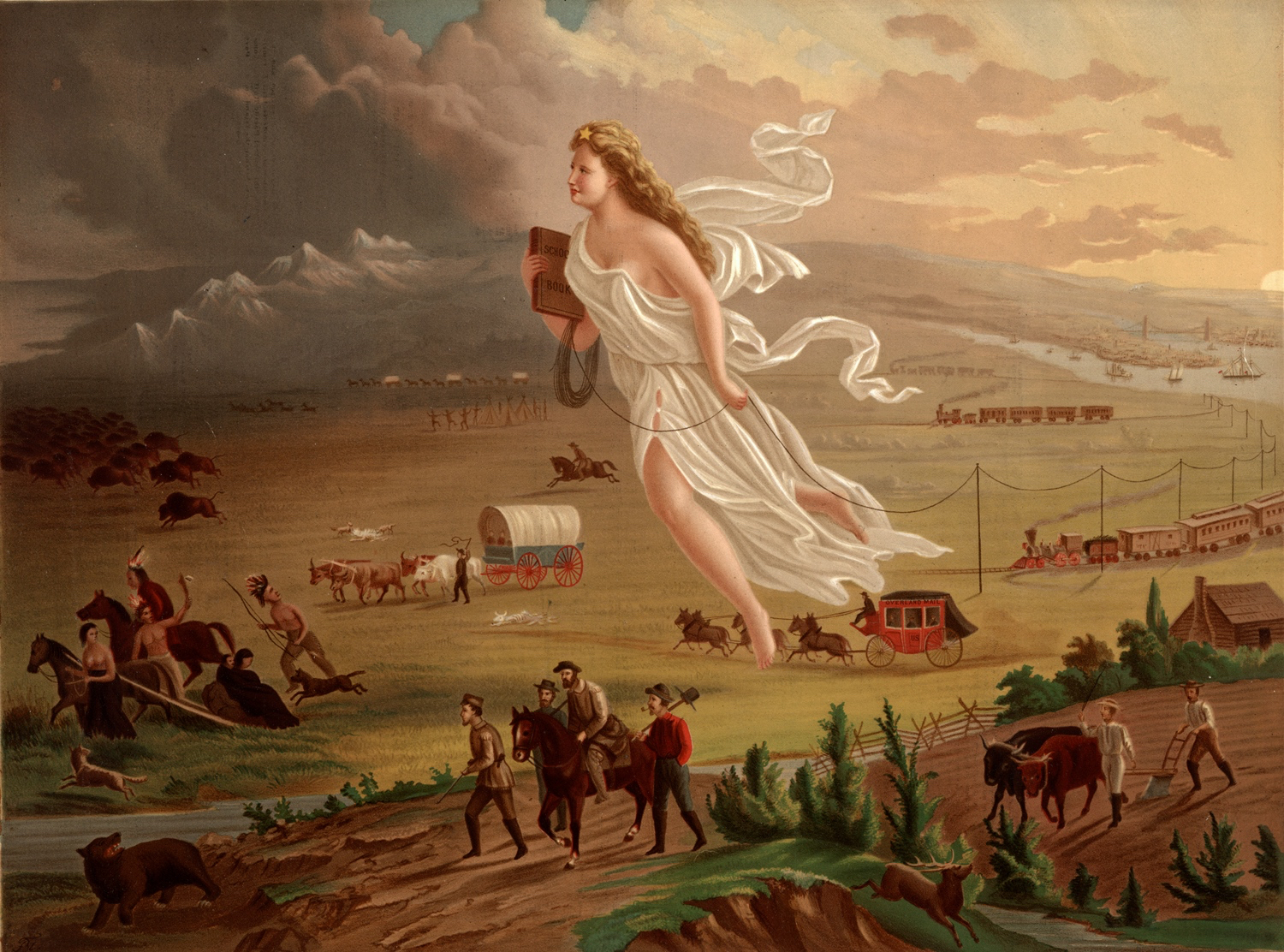
Angelical Floating Woman (lmao)
Symbolizes manifest destiny, progress, light, and education (holding a school book)
ALL of the following land acquisitions (LAP, TA, OT, MC) generally
Fueled westward expansion + manifest destiny, displaced Native Americans, and increased international trade
Louisiana Purchase
1803 deal between US and France where Thomas Jefferson bought LAP for 15 million.
Impact of Louisiana Purchase
Doubled US size, secured New Orleans port, sparked Westward expansion.
Texas Annexation
1845 Texas independence from Mexico, joint resolution + Texas/PR approved annexation proposal → Texas is a state.
Impact of Texas Annexation
Directly led to Mexican-American War (1846-1848), Texas → slave state, further intensifying issue of slavery.
Oregon Territory
1846 joint occupation with Britain + US, Oregon Trail allowed massive influx of US settlers.
Oregon Treaty
Established the 49th parallel as border between Britain + US to prevent war.
Impact of Oregon Territory
US control over present day Oregon, Washington, Idaho.
Mexican Cession
1848 US victory in Mexican-American War (1846-1848), US seized key areas, ex. Mexico City.
Treaty of Guadalupe Hidalgo
Mexico ceded 525000 sq. miles to the US and the US paid Mexico $15 million.
Impact of Mexican Cession
California Gold Rush + economy boom, access to the Pacific, Mexican resident displacement/land loss.
North
Industrial/Commercial, manufacturing, smaller farms, industry
North's view on slavery
Slavery is morally wrong and isn't allowed here
South
Slave economy/agriculture, heavily dependent on enslaved labor
South's view on slavery
Slavery is necessary for economy and societal order, slavery is allowed
West
Expanding frontier, mix of North/South ideals
West's issue on slavery
Debate over whether new territories would allow slavery
Free soil ideology
Western lands = free labor
Disadvantage of North
Unfair that North needs to pay for labor but South doesn't
Slavery
Known cause of the Civil War
Nationalism
Unity, pride, federal power to strengthen the nation as a whole
Sectionalism
Regional interests (North, South, West) over national ones
Concurrent Powers
Powers that belong to BOTH federal and state governments
Concurrent powers examples
Set up courts, impose taxes, spend + borrow money
Federal government rights
~17 enumerated powers given by the USC
3 of the enumerated powers of the federal government
Establish a uniform law of naturalization, maintain a military, declare war
States' Rights
Powers held by each state
State powers examples
Education, policing, health/hospitals
Prohibited state powers
Powers that states cannot exercise
Prohibited state powers examples
Entering into treaties, coin money, keep troops or ships of war in times of peace
State powers exist because…
Fear of fed gov that is too strong/powerful + 10th amendment gives states their rights
Tenth Amendment
Gives states rights by reserving powers not delegated to the US by the Constitution
Supporters of states' rights
Southern slave owners and Anti-federalists
Choices about slavery
Federal government, State government, or popular sovereignty
Popular sovereignty
The people that live in a specific area decide on issues like slavery
Decision makers about slavery, ultimately were…
Rich white land-owning men would likely take the decision
May 22, 1856 (2 years after K+N Act)
Preston Brooks beats up Charles Sumner
Charles Sumner
Antislavery senator from Massachusetts who spoke critically of the Kansas-Nebraska Act and Andrew Butler.
Preston Brooks
Proslavery House of Representatives South Carolina member from South Carolina who beat Charles Sumner with a cane.
Dred Scott v. Sanford was a…
Fed gov, judicial branch, and Supreme Court decision on slavery, first time SP make big decision on slavery
Dred Scott
Enslaved person who sued for his freedom after moving to free states.
Dred Scott’s reasoning for suing Sanford
Sued for his freedom based on his time in free lands (IL + Wisconsin territory/modern day MN) and the Missouri Compromise line
Dred Scott vs. Sanford
Supreme Court case that ruled enslaved people were not citizens and could not sue
Dred Scott decision
Enslaved ppl were personal property, could not be lost upon entering new states/territories + protected by 4th amendment, Missouri Compromise and prohibiting slavery is unconstitutional
Chief Justice Taney
Reported the 7-2 decision in Dred Scott vs. Sanford, stating enslaved people were personal property.
According to the DSD…
Blacks were not citizens/were property, Dred had no right to sue nor did the SP have jurisdiction to make a decision, enslaved ppl could not be lost/was protected by the 4th amendment, + unconstitutional Missouri Compromise and to prohibit slavery anywhere
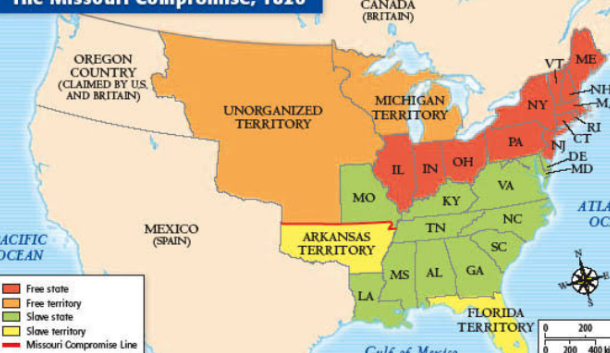
What land does the Missouri Compromise affect?
Louisiana Purchase
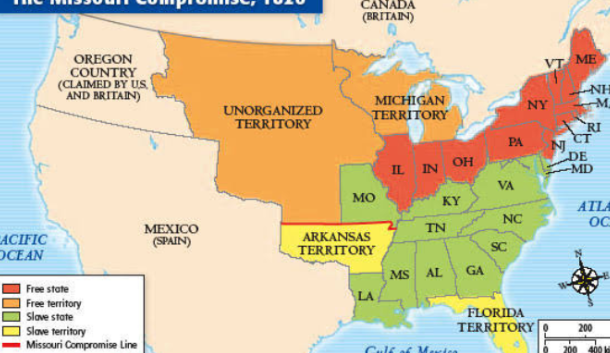
Missouri Compromise
Passed in 1820, allowed Missouri as a slave state and Maine as a free state, creating a line (36 30’N) for slavery.
How the Missouri Compromise deals w/ slavery
Both slows down and spreads slavery + allows state gov to decide on slavery (Missouri, Maine)
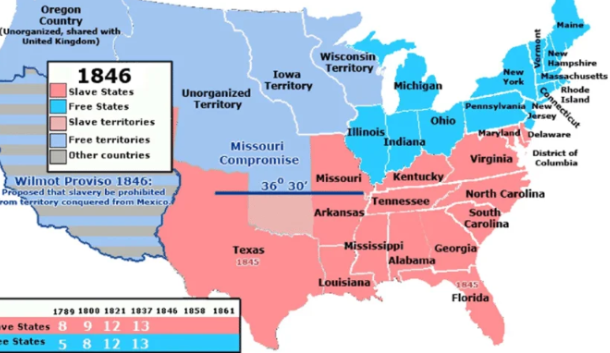
What land would have the Wilmot Proviso affected?
Mexican Cession
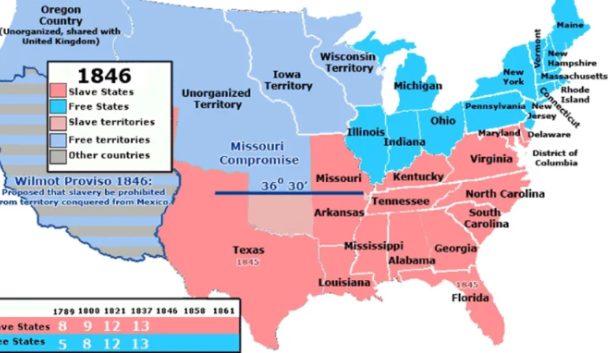
Wilmot Proviso
Proposed in 1846 to ban slavery in new territories from the Mexican Cession; not passed.
How the Wilmot Proviso deals with slavery
(Tried) to stop the spread of slavery all together (in MC)
What lands did the Compromise of 1850 affect?
Mexican Cession
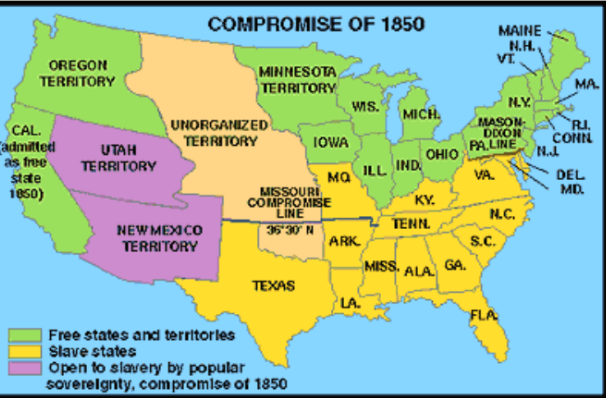
Compromise of 1850
Passed in 1850, allowed CA as a free state, Texas cedes lands (NM territory), NW + Utah pop sov, outlaw slavery in DC, strengthened the Fugitive Slave Act.
How the Compromise of 1850 dealt w/ slavery
Slowed down the spread of slavery (CA + pop sov), allow slavery to spread (pop sov), allowed state gov and the ppl (pop sov) to decide on slavery
Fugitive Slave Act
Initially made it illegal for slaves to run away; strengthened to require all Americans to assist in capturing runaway slaves.
What land did the Kansas-Nebraska Act affect?
Louisiana Purchase
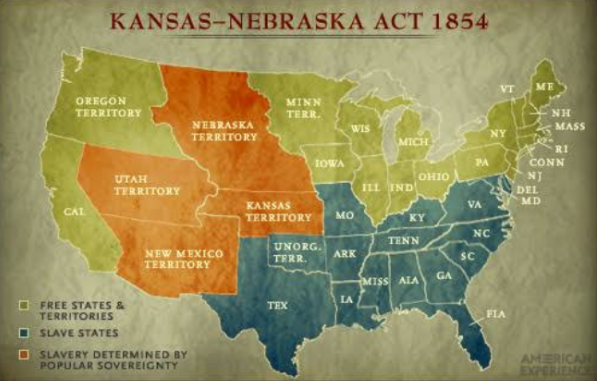
Kansas-Nebraska Act
Passed in 1854, allowed people in Nebraska and Kansas territories to decide on slavery through popular sovereignty (repealed Missouri Compromise line)
How did the Kansas-Nebraska Act deal with slavery?
Allow slavery to spread to new lands and allow the people to decide
Bleeding Kansas
Violence that erupted in Kansas as a result of the Kansas-Nebraska Act and the fight over slavery, ~200 died
Missouri Compromise line
Line established by the Missouri Compromise that determined where slavery was allowed (30°60’N)
Pop. sov (popular sovereignty)
The principle that the people living in a defined territory should decide on the issue of slavery.
Texas cede lands
Texas ceded lands that later became the New Mexico territory as part of the Compromise of 1850.
California joins as free state
Part of the Compromise of 1850, which allowed California to enter the Union without slavery.
Impact of Mexican Cession
The territories acquired from Mexico raised the question of whether they would allow slavery.
Unconstitutionality of prohibiting slavery
The Dred Scott decision declared it unconstitutional for any government to prohibit slavery.
Scott's owner
Dred Scott's owner eventually freed him, and he lived out his life in St. Louis.
Senate and House dynamics w/ the Wilmot Proviso
The Wilmot Proviso passed in the House but failed in the Senate due to the balance of slave and free states.
Strengthening of the Fugitive Slave Act
The Compromise of 1850 made the Fugitive Slave Act stricter, requiring all Americans to assist in capturing runaway slaves.
What is popular sovereignty?
The political power belongs to the people, who decide by voting.
Which territories used the idea of popular sovereignty in the 1840s?
NM, UT, KN, NEB territories
Slavery remained legal until 1862, when…
The fed gov outlaws slavery in all fed lands (everything but states) however continued since little/no enforcement
How does the Compromise of 1850 affect the NM, UT,and KN territory?
NM territory becomes slave territory
What was the outcome of the Kansas territory's voting on slavery?
It became a slave territory, leading to conflict and the formation of two governments + factored into Bleeding Kansas
What was 'Bleeding Kansas'?
A series of violent events involving pro and anti-slavery factions in Kansas from 1850 to 1856.
In 1860, Kansas…
Enters the Union as a FREE state (previously slave)
Who wrote 'Uncle Tom's Cabin'?
Harriet Beecher Stowe.
What was the purpose of 'Uncle Tom's Cabin'?
To expose the evils of slavery and raise awareness.
Uncle Tom’s Cabin (1852) was based on…
Real events from other abolitionists and run away slaves Stowe had heard from
How many copies of 'Uncle Tom's Cabin' were sold in three months?
300,000 copies.
What was John Brown's role in the abolitionist movement?
He was an abolitionist who led violent actions against pro-slavery settlers.
What happened at Pottawatomie Creek?
John Brown and his followers killed five pro-slavery settlers on May 24, 1856.
What was the outcome of John Brown's raid on Harpers Ferry?
He was captured by Robert E. Lee and convicted for treason.
What was the reaction of Southerners to 'Uncle Tom's Cabin'?
They were outraged and bought and burned the book.
What was the significance of the term 'Border Ruffians'?
Pro and anti-slavery supporters who crossed borders to influence votes.
Who was Aaron D. Stevens?
An abolitionist and border ruffian who believed slavery would only end with war + worked with John Brown on his Harpers Ferry raid
What did John Brown hope to achieve at Harpers Ferry?
He planned to arm enslaved people for a revolt.
What was the public reaction to John Brown's execution?
There were very different reactions between the North and South.
What profession did Abraham Lincoln have before entering politics?
Lawyer
How many years did Lincoln serve as an Illinois State Representative?
10 years, 5 terms
How long did Lincoln serve as a U.S. Representative for Illinois?
2 years at the federal level
In which year did Lincoln run for the U.S. Senate?
1858