Micro 150 Ch.9 HW WIP
 Call Kai
 Learn
Learn Practice Test
 Spaced Repetition
 Match
Match Flashcards
 Knowt Play
1/65

There's no tags or description
Looks like no tags are added yet.
Name | Mastery | Learn | Test | Matching | Spaced | Call with Kai |
|---|
No analytics yet
Send a link to your students to track their progress
66 Terms
Photoautotroph
Uses sunlight as an energy source and carbon dioxide as a carbon source (example: cyanobacteria)
Chemoautotroph
Uses simple inorganic compounds for energy and carbon dioxide for a carbon source (example: methanogens)
Photoheterotroph
Uses sunlight as an energy source and an organic carbon source (example: purple photosynthetic bacteria)
Chemoheterotroph
Converts nutrients from other organisms into energy and uses an organic carbon source (example: protozoa)
Saprobe
Metabolizes organic matter of dead organisms for energy and uses an organic carbon source (example: fungi)
Parasite
Utilizes the tissues of a live host and an organic carbon source (example: pathogens)
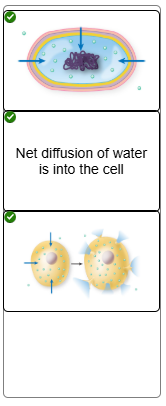
What matches for Hypotonic condition
Netdiffusion of water into cell - solute water concentration is greater so water will move into the cell
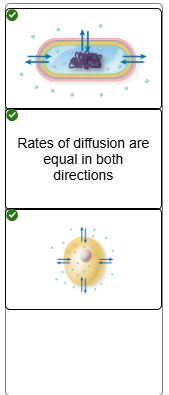
What matches for Isotonic Condition
Rates of diffusion are equal in both direction - Water will move both direction for same solute concentration
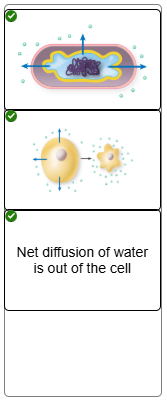
What matches for Hypertonic condition
Net diffusion of water is out of the cell - More solutes outside of cell making water move outside of cell causing shrinkage.
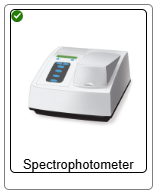
Which method tests for Turbidometry
Spectrophotometer
Which method tests Direct Cell Count
Microscopic Count
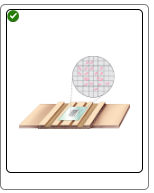
Method that tests for Viable Plate Count
Viable plate count method
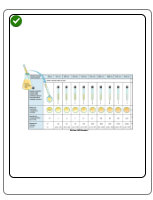
What tests Coulter Counter
Electronic cell counting
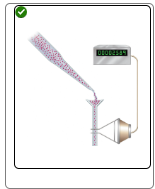
What test Flow cytometry
Method requiring labeling of cells with fluorescent in order to detect bacteria in natural sample
Real-time PCR is
Method that allows for the quantification of microorganisms in environmental or tissue samples without isolating them or culturing them.
Photoheterotroph
An organism which requires light as its energy source and organic compounds as its carbon source
Chemoautotroph
An organism which requires simple inorganic chemicals as its energy source and carbon dioxide as its carbon source
Photoautotroph
An organism which requires light as its energy source and carbon dioxide as its carbon source
Chemoheterotroph
An organism which requires organic compounds as both its energy and carbon source
Hypertonic environment
A cell in this environment will lose water and shrink as water moves out of the cell by osmosis.
Hypotonic Environment
A cell in this environment will swell as water moves in by osmosis and may lyse if it does not have a cell wall.
Isotonic Environment
A cell in this environment will neither shrink nor swell as there is no net movement of water into or out of the cell by osmosis.
Psychrophile
Describes an organism that grows optimally at temperatures ranging from 0°C to 15°C
Psychrotolerant
Describes an organism that has an optimum growth temperature between 15°C and 30°C, but is able to grow slowly at colder temperatures
Mesophile
Describes an organism that grows optimally at temperatures ranging from 20°C to 40°C
Thermophile
Describes an organism that grows optimally at temperatures ranging from 45°C to 80°C
Extreme Thermophile
Describes an organism that grows optimally at temperatures ranging from 80°C to 120°C
Obligate Aerobe
Describes an organism which requires oxygen for growth and has the enzymes to remove toxic by-products of oxygen metabolism
Facultative Anaerobe
Describes an organism that can grow in the presence of oxygen and can detoxify it, but can also grow in the absence of oxygen
Microaerophile
Describes an organism that can’t grow at normal atmospheric oxygen concentrations, but does require a small amount of oxygen for growth
Obligate Anaerobe
Describes an organism that is unable to use oxygen and lacks the enzymes to detoxify oxygen, thus requiring the absence of oxygen for growth
Aerotolerant Anaerobe
Describes an organism that does not use oxygen, but can grow to a limited extent in the presence of oxygen
Mutualism
Two organisms living together in which both partners benefit from the relationship
Commensalism
Two organisms living together in which one organism is benefited and the other is neither benefited nor harmed
Parasitism
Two organisms living together in which one organism is benefited and the other (the host) is harmed
Synergism
A relationship in which free-living organisms cooperate and share nutrients
Antagonism
A competitive relationship between free-living organisms in which one organism secretes substances that are toxic to the other in order to acquire more space or nutrients for itself
Stationary growth Phase
Phase during which nutrient depletion and accumulation of wastes begin to slow cell growth such that the rate of cell increase equals the rate of cell death
Exponential growth Phase
Phase during which cells are growing very quickly, at their maximum rate of cell division
Lag Phase
Adjustment period during which cells are dividing slowly while they adjust to growth conditions
Death Phase
Nutrient depletion and waste accumulation prevent cell growth and cells die exponentially
Turbidometry
A spectrophotometer is used to measure the light scattering properties of a bacterial culture. As the number of bacteria increase, more light is scattered and less is transmitted to the detector
Direct Cell Count
Method uses a special (cytometer) and cells are counted by observing through a microscope
Coulter Counter
This is an automated cell counting device that scans a culture as it passes through a tiny pipette
Flow Cytometry
This is an automated cell counting device that requires fluorescent labeling of cells that will be scanned and counted
Like budding, binary fission produces two differently sized cells that contain an equal amount of genetic information. T/F
False
Selenium is a major essential nutrient required by all bacterial cells for survival. T/F
False
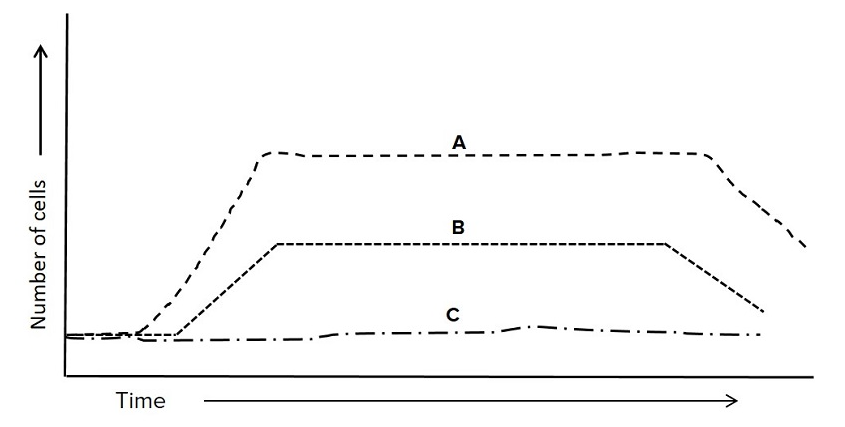
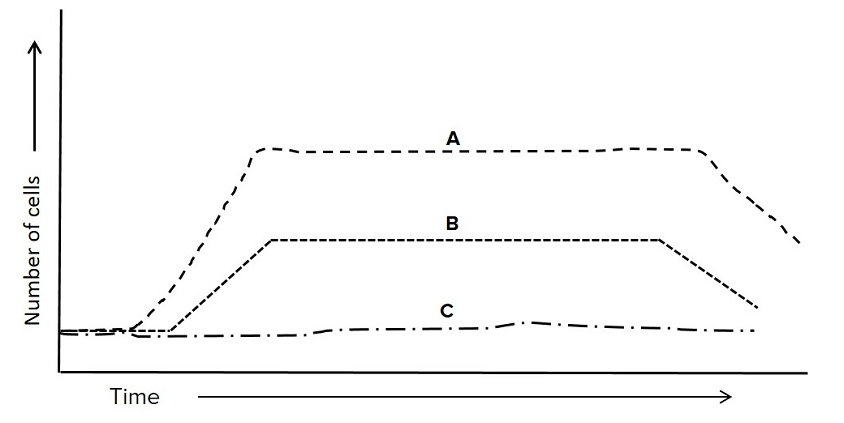
Which of the growth curves represents an obligate aerobe grown in the presence of oxygen?
A
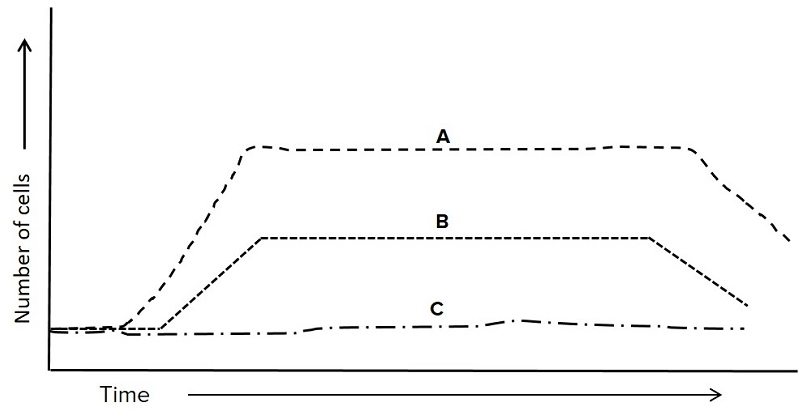
Which of the growth curves represents an obligate anaerobe grown in the presence of oxygen?
C
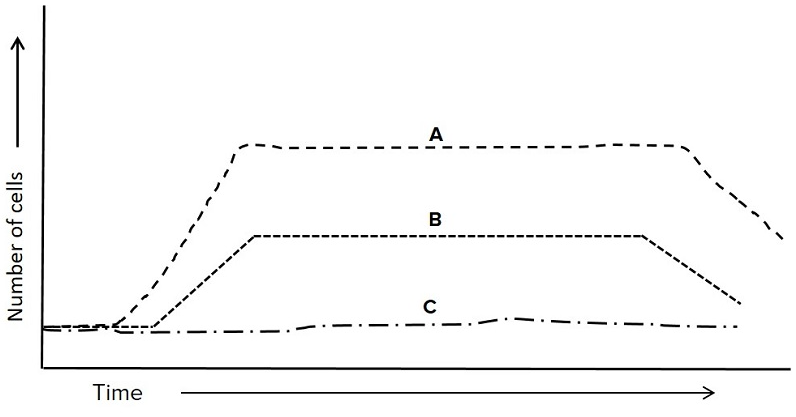
Which of the growth curves represents an aerotolerant anaerobe grown in the presence of oxygen?
B
Which of the growth curves represents a facultative anaerobe grown in the presence of oxygen?
A
Using the equation Nf = Ni (2^n), determine how many Staphylococcus aureus cells are present in a custard tart under these circumstances. During preparation, 15 cells were deposited in the custard, and the tart has sat at room temperature for 5 hours. S. aureus has a generation time of 20 minutes.
4.9 × 10^5
In the United States, the CDC estimates that _________blank people suffer each year from some form of food-borne infection.
Several million
The presence of microbes in food can be
harmful.
beneficial.
neutral.
Individual bacteria (such as Salmonella)
grow best at an optimum temperature and a range above and below it.
The type of food-borne infection known as an intoxication is caused by
toxins produced by microbes as they grow in the food
Most bacteria reproduce by
Fission
After six generations, how many bacteria would have formed from the reproduction of one bacterium?
64
Bacteria that grow in oxygenated environments are referred to as
Aerobes
Bacteria that thrive in environments with a pH of greater than 7 are classified as
alkalinophiles
What is the effect of heat on a population of bacteria?
Cells begin to die at a temperature slightly above the maximum.
What is the effect of cold on a population of bacteria?
Cells survive but do not divide at temperatures below the minimum
What food product is least likely to contain viable vegetative pathogens?
Chicken cooked to 170 degrees F
If conditions are favorable, the generation time of bacteria
can be as short as 30 minutes
The environmental factor that influences bacterial growth the most is
temperature.
The safe temperature ranges for the storage of foods are determined by
the low temperature where microbes stop multiplying and the high temperature where they physically die.