Photosynthesis
 Call Kai
 Learn
Learn Practice Test
 Spaced Repetition
 Match
Match Flashcards
 Knowt Play
1/33

Earn XP
Description and Tags
Name | Mastery | Learn | Test | Matching | Spaced | Call with Kai |
|---|
No analytics yet
Send a link to your students to track their progress
34 Terms
Where does photosynthesis take place inside a cell?
In the chloroplasts.
What are the two reactions that make up photosynthesis?
The light-dependent reaction (LDR) and the light-independent reaction (LIR).
Where does the LDR take place?
In the thylakoid membranes of the chloroplasts.
Where does the LIR take place?
In the stroma of the chloroplasts.
Describe the structure of a chloroplast.
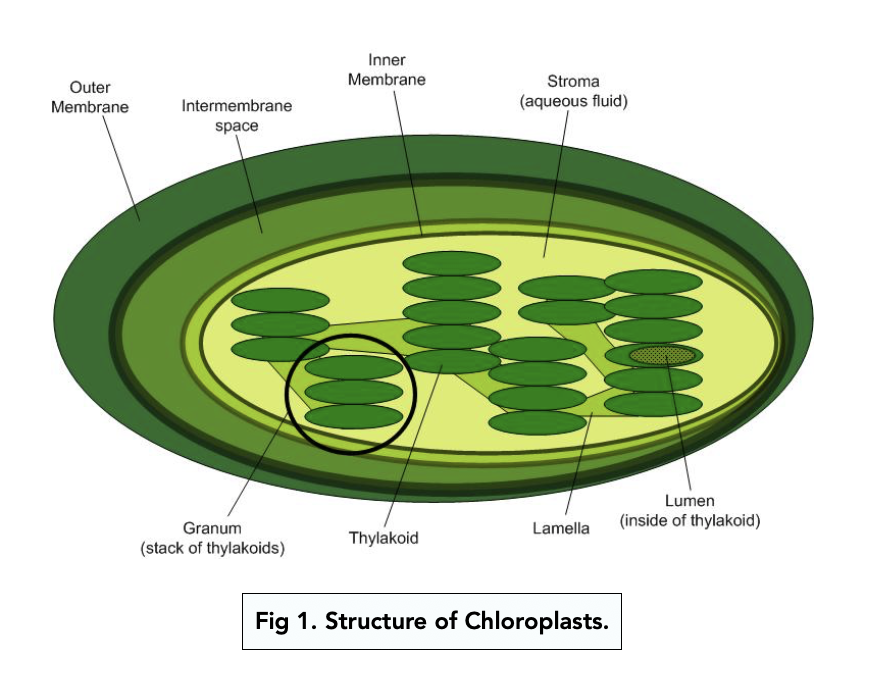
What are the thylakoid membranes in a chloroplast?
Folded membranes that contain photosynthetic proteins (such as chlorophyll) and electron carrier proteins.
What is the stroma in a chloroplast?
Fluid filled centre that contains enzymes.
What is a photosystem?
A mix of photosynthetic pigments (coloured proteins that can absorb light).
What is the advantage of a chloroplast containing multiple different photosynthetic pigments?
Each photosynthetic pigment absorbs light of different wavelengths meaning the spectrum of visible light absorbed is maximised.
What is the first stage in photosynthesis?
The light-dependent reaction (LDR).
Where does the LDR take place?
On the thylakoid membranes.
Give the overall balanced symbol equation for photosynthesis.
6CO2 + 6H2O → C6H12O6 + 6O2
Which reactant from the overall photosynthesis reaction is needed in the LDR?
Water.
What are the overall products of the LDR?
ATP, reduced NADP.
What are the three steps in the LDR?
1) Photolysis (of water)
2) Photoionisation (of chlorophyll)
3) Chemiosmosis
What does photolysis mean?
Photo- = light, -lysis = splitting.
Splitting with light.
Why is photosynthesis important in plants?
It produces glucose and oxygen that the plant has no other way of obtaining but needs for respiration, it allows the plant to make biological molecules.
What product of the overall photosynthesis reaction is produced in the LDR?
Oxygen.
What happens during photolysis?
Light energy is absorbed by chlorophyll and splits water into oxygen, protons, and electrons.
Give a balanced symbol equation to show what happens during photolysis.
H2O → 2H+ + 2e- + ½ O2
What happens to the protons produced from photolysis?
They are used to maintain a proton concentration gradient, they reduce NADP.
What happens to the electrons produced from photolysis?
They replace the electrons lost by chlorophyll when chlorophyll absorbed the light energy.
What happens to the oxygen produced in photolysis?
It is released as a by-product.
Talk me through what happens in photoionisation.
1) Light energy is absorbed by chlorophyll.
2) This excites electrons in chlorophyll, causing them to raise up an energy level and leave chlorophyll, leaving chlorophyll ionised.
Talk me through what happens in chemiosmosis.
1) The electrons from photoionisation move down a carrier protein transport chain in the thylakoid membrane, releasing energy as they do so.
2) This energy is used to actively transport protons from the stroma into the thylakoid lumen, creating an electrochemical gradient.
3) Actively transported protons and protons produced in photolysis move down their electrochemical gradient through ATP synthase, which synthesises ATP.
4) Electrons from from photoionisation and protons are picked up by NADP at the end of the electron carrier protein transport chain forming reduced NADP (NADPH).
Where does this LIR take place?
In the stroma of the chloroplast.
Why is the LIR temperature sensitive?
It uses the enzyme Rubisco.
Give three substances used in the LIR.
Carbon dioxide.
Reduced NADP.
ATP.
Talk me through the LIR.
1) Carbon dioxide combines with RuBP (a five carbon molecule) to form two molecules of GP (three carbon molecule), this reaction is catalysed by Rubisco.
2) By accepting the H from reduced NADP and energy from ATP, GP is reduced into triose phosphate.
3) Each cycle, one carbon is removed to form useful organic substances.
4) RuBP is regenerated from the remaining molecule (five carbons now) using energy from ATP.
How many LIRs must take place to form one glucose molecule?
Six.
Give three limiting factors of photosynthesis.
Light intensity.
Temperature.
Carbon dioxide concentration.
Which reaction in photosynthesis does:
a) light intensity
b) temperature
c) carbon dioxide concentration
concern?
a) LDR
b) LIR
c) LIR
How can you increase light intensity in farming?
Artificial lighting.
How can you simultaneously increase temperature and carbon dioxide concentration in farming?
Burn fuel, this increases temperature and releases carbon dioxide.