Bones of the Skull and Cranial Anatomy
 Call Kai
 Learn
Learn Practice Test
 Spaced Repetition
 Match
Match Flashcards
 Knowt Play
1/34

Earn XP
Description and Tags
Vocabulary flashcards generated from lecture notes covering embryologic divisions, cranial sutures, fontanels, craniosynostosis, sinus anatomy, and landmark structures of the head and neck.
Name | Mastery | Learn | Test | Matching | Spaced | Call with Kai | Chat |
|---|
No analytics yet
Send a link to your students to track their progress
35 Terms
Sutures
Immovable fibrous joints unique to the skull between skull bones that allow for brain growth during childhood and adolescence and fuse completely by around age 20.
Neural crest
Embryologic tissue that forms the anterior part of the skull.
Paraxial mesoderm
forms the posterior part of the skull.

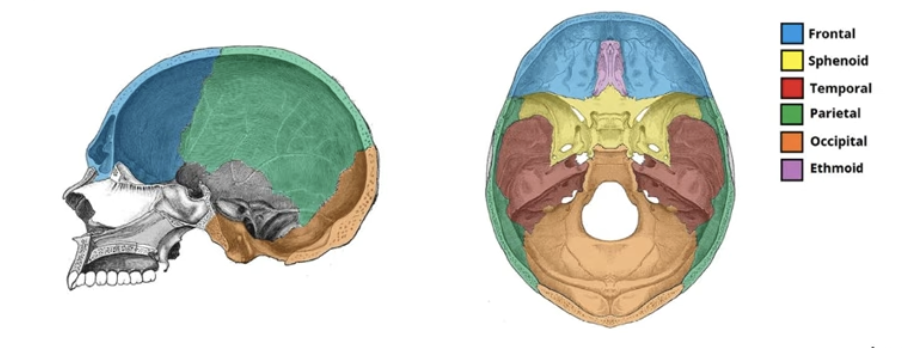
Neurocranium
The cranium; the functional division of the skull that protects the brain, subdivided into a roof (calvarium) and a base.
Calvarium
The roof of the neurocranium that protects the brain from above
frontal
parietal
occipital bones.
Viscerocranium
The skeletal face comprised of 14 individual bones that support soft tissues of the face and house the
orbits
nasal cavity
oral cavity
and sinuses.

Fontanels
Incompletely fused joints manifesting as wide membranous gaps between skull bones in an infant that fuse within 18 months of birth.
Frontal fontanel
located at the junction of coronal and Sagittal suture

Occipital fontanelle
located at the junction of lamboid and sagittal (posterior)
Frontal suture
closes within 3-9 months.
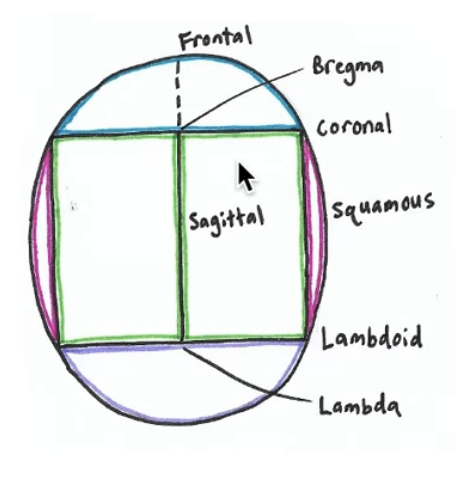
Coronal suture
fuses the frontal bone with the two parietal bones.
Sagittal suture
fuses both parietal bones together.
Squamous suture
Fuses the parietal bone with the temporal bone.
Lambdoid suture
Fuses the occipital bone with the two parietal bones.
Bregma
Where coronal and sagittal sutures intersect
Lambda
Where sagittal and lambdoid sutures intersect
Craniosynostosis
premature closure of fontanels and/or sutures where cranial skeletal growth lags behind brain growth.
Scaphocephaly
early closure of the sagittal suture
resulting in a skull that becomes elongated in an anteroposterior (AP) direction.
Brachycephaly
early closure of the coronal and lambdoid sutures
causing the skull to grow vertically tall and elongate superior-inferiorly.
Plagiocephaly
early closure of the coronal and lambdoid sutures on just one side of the skull
resulting in asymmetrical distortion.
Sinuses
pouches originating from the lateral nasal wall that extend into the frontal, ethmoid, sphenoid, and maxilla bones to reduce
skull weight
assist in voice resonance
thermal insulation
pressure regulation
defense.
Alveolar process
The portion of the mandible that supports the teeth, whose development, full presence, or age-related resorption dictates the angle of the mandible throughout life.
Lafort fracture lines
weak horizontal lines of fracture in the skull that act as common sites of fracture and serve as surgical guides during orthognathic surgery.
Pterion
The weakest region of the lateral calvaria where the frontal, parietal, sphenoid, and temporal bones articulate.

What bones make up the orbit
FM, plesz
frontal, maxillary, palatine, lacrimal, ethmoid, sphenoid, and zygomatic
Ethnoid bones
Crita gallia
uncinate process
cibriform plate
superior and middle nasal conchae
Crista galli
Crest of the ethmoid bone (meaning 'crest of the rooster') that projects upward to attach to the falx cerebri of the dura mater.
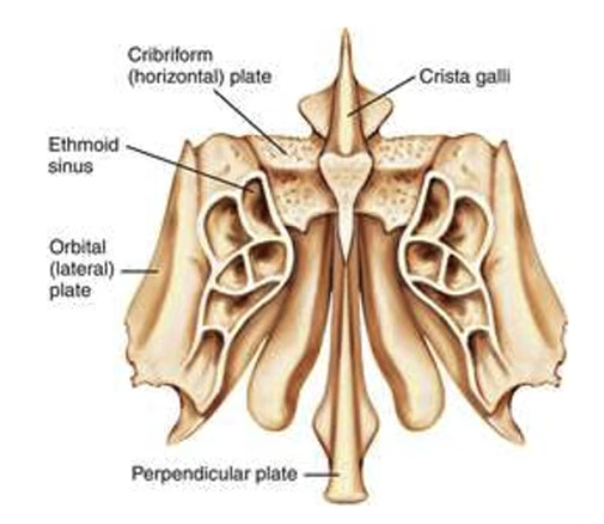
Uncinate process
A sickle-shaped extension of the ethmoid bone that directs sinus drainage to the middle meatus.
Cribriform plate
where cranial nerve I (olfactory nerve) passes.
Superior and middle nasal conchae
curled bone that directs airflow through the nose
Sphenoid bone
Sella turcicia
Clinoid process
lesser wing
greater wing
Sella turcica
A saddle-shaped depression in the sphenoid bone that houses the pituitary gland.

Clinoid processes
Four central extensions of the sphenoid bone surrounding the sella turcica that attach to the dura mater.

Nasal septum
Vertical wall separating right and left of nasal airway,
composed of
septal cartilage
the perpendicular plate
the vomer bone.

Semilunar hiatus
Opening located within the middle nasal meatus through which the middle ethmoid air cells, maxillary sinus, and frontal sinus drain.