lec 21- atomic and mass spect
 Call Kai
 Learn
Learn Practice Test
 Spaced Repetition
 Match
Match Flashcards
 Knowt Play
1/96

There's no tags or description
Looks like no tags are added yet.
Name | Mastery | Learn | Test | Matching | Spaced | Call with Kai | Chat |
|---|
No analytics yet
Send a link to your students to track their progress
97 Terms
What are the main components of an IR interferometer?
Light source, stationary mirror, moveable mirror, beam splitter, and detector. [Slide 2]
What does the IR interferometer produce?
An interferogram, which is a sinusoidal intensity profile. [Slide 2]
What is δ in interferometry?
The optical path difference. [Slide 4]
When does constructive interference occur?
When δ = nλ. [Slide 4]
What determines the spacing of oscillations in an interferogram?
The wavelength. [Slide 4]
How is detected intensity related to optical path difference and wavenumber?
I(δ) ∝ cos(2πν̃δ), where I = detected intensity, δ = optical path difference, and ν̃ = wavenumber. [Slide 5]
How are wavelength and wavenumber related?
ν̃ = 1/λ. [Slide 6]
What mathematical operation converts an interferogram into an IR spectrum?
A Fourier transform: I(δ) → S(ν̃). [Slide 7]
What are the three types of atomic spectroscopy discussed in this lecture?
Emission, absorption, and fluorescence. [Slide 9]
Approximately how wide are atomic spectral lines?
About 0.001 nm. [Slide 11]
What is a resonance transition?
An electronic transition between the ground state and an excited state, or vice versa. [Slide 12]
What is atomization?
The process in which a sample is converted to produce gas-phase atoms or elemental ions. [Slide 13]
Do all types of atomic spectroscopy require atomization?
Yes. [Slide 13]
What does it mean to aspirate a liquid sample?
To draw the liquid sample into the instrument. [Slide 13]
What is nebulization?
The conversion of a liquid into a fine spray or mist called an aerosol. [Slide 14]
What is a nebulizer?
The device that introduces the aerosol into the atomizer. [Slide 14]
How can a solid sample be introduced for atomic spectral analysis?
By laser ablation, where a high-powered beam is directed at the solid and vaporizes it. [Slide 14]
What happens during desolvation?
The solvent evaporates, leaving dry aerosol particles. [Slide 16]
What happens during vaporization?
Further heating produces gaseous molecules, which are then further decomposed into gaseous atoms. [Slide 17]
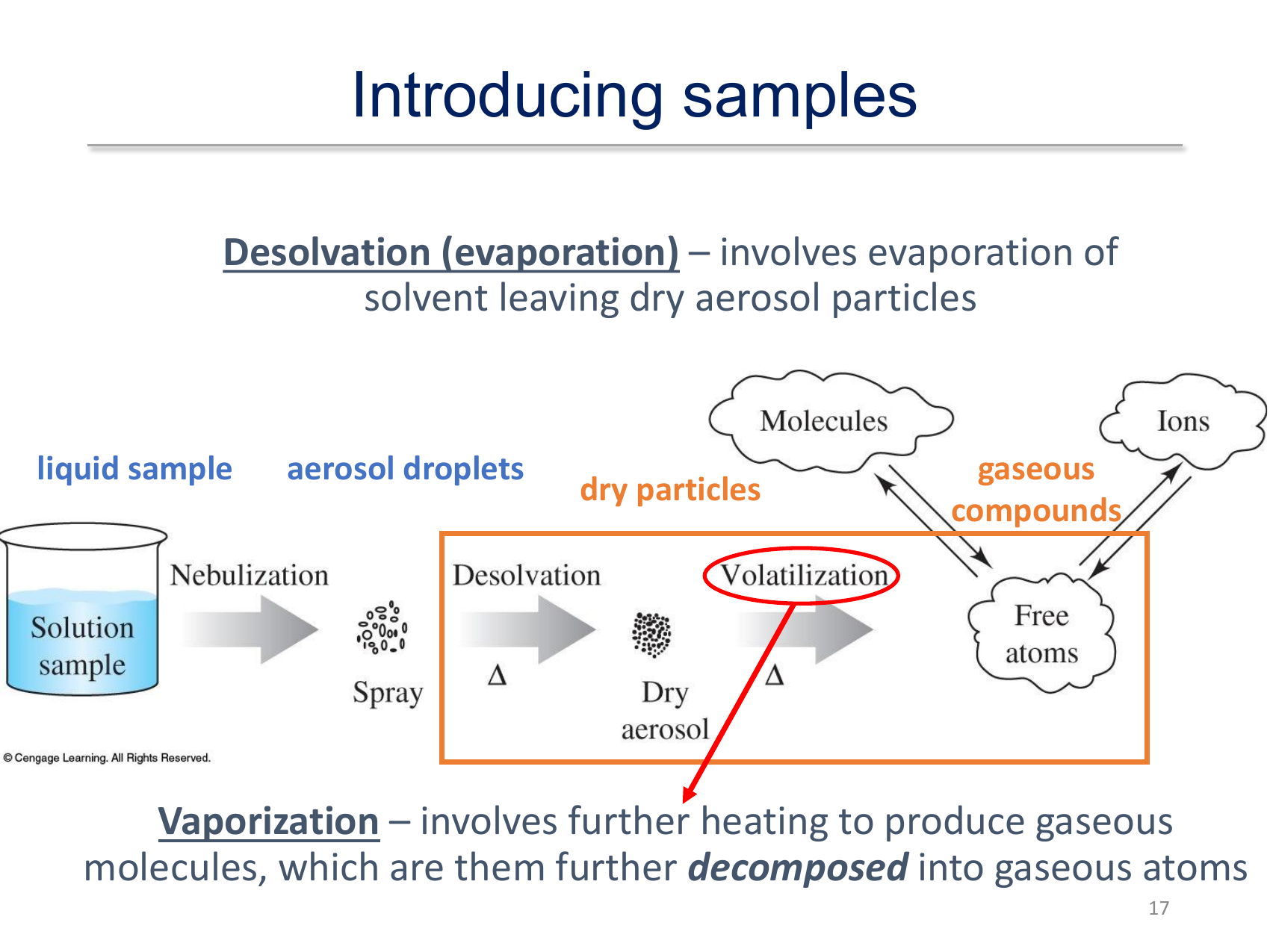
What is the general sample-conversion sequence for a liquid sample?
Liquid sample → aerosol droplets → dry particles → gaseous compounds/atoms through nebulization → desolvation → vaporization. [Slides 16–17]
What are the two major types of atomizers?
Continuous atomizers and discrete atomizers. [Slide 18]
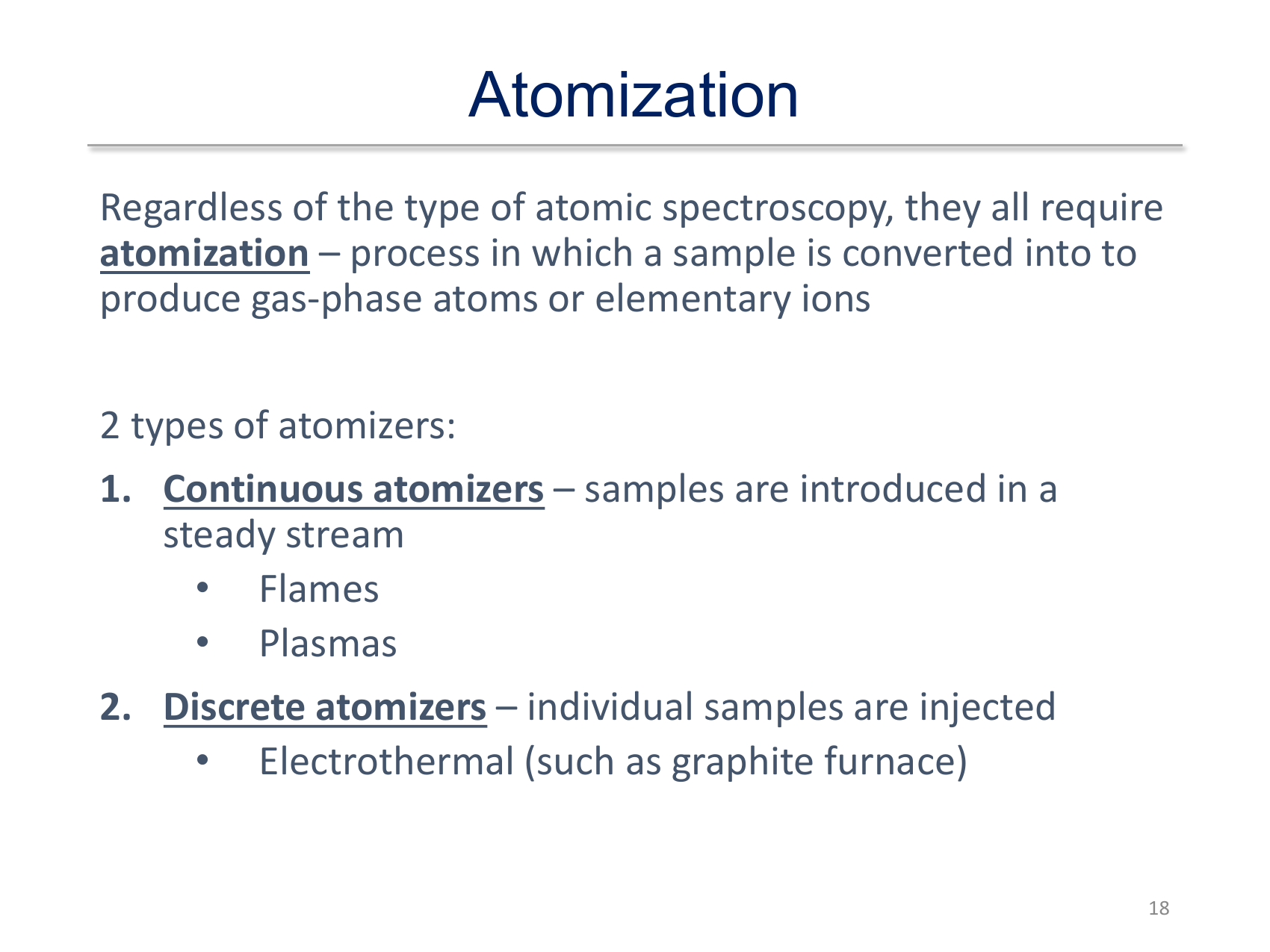
What characterizes a continuous atomizer?
Samples are introduced in a steady stream. [Slide 18]
What are two examples of continuous atomizers?
Flames and plasmas. [Slide 18]
What characterizes a discrete atomizer?
Individual samples are injected. [Slide 18]
What is an example of a discrete atomizer?
An electrothermal atomizer, such as a graphite furnace. [Slide 18]
What happens to aerosol after it enters the spray chamber?
Only the finest droplets remain. [Slide 20]
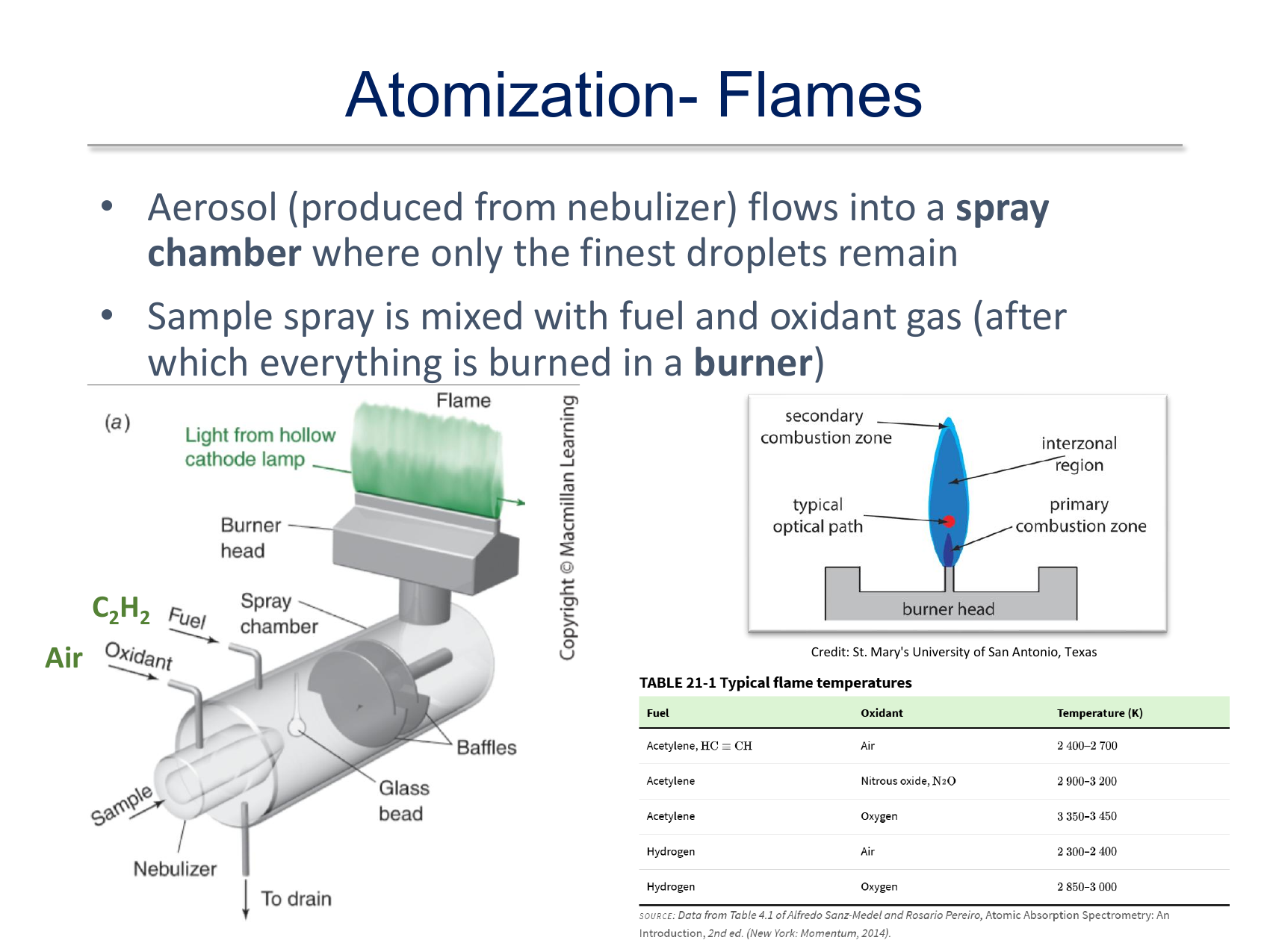
What is the sample spray mixed with before entering the burner?
Fuel and oxidant gas. [Slide 20]
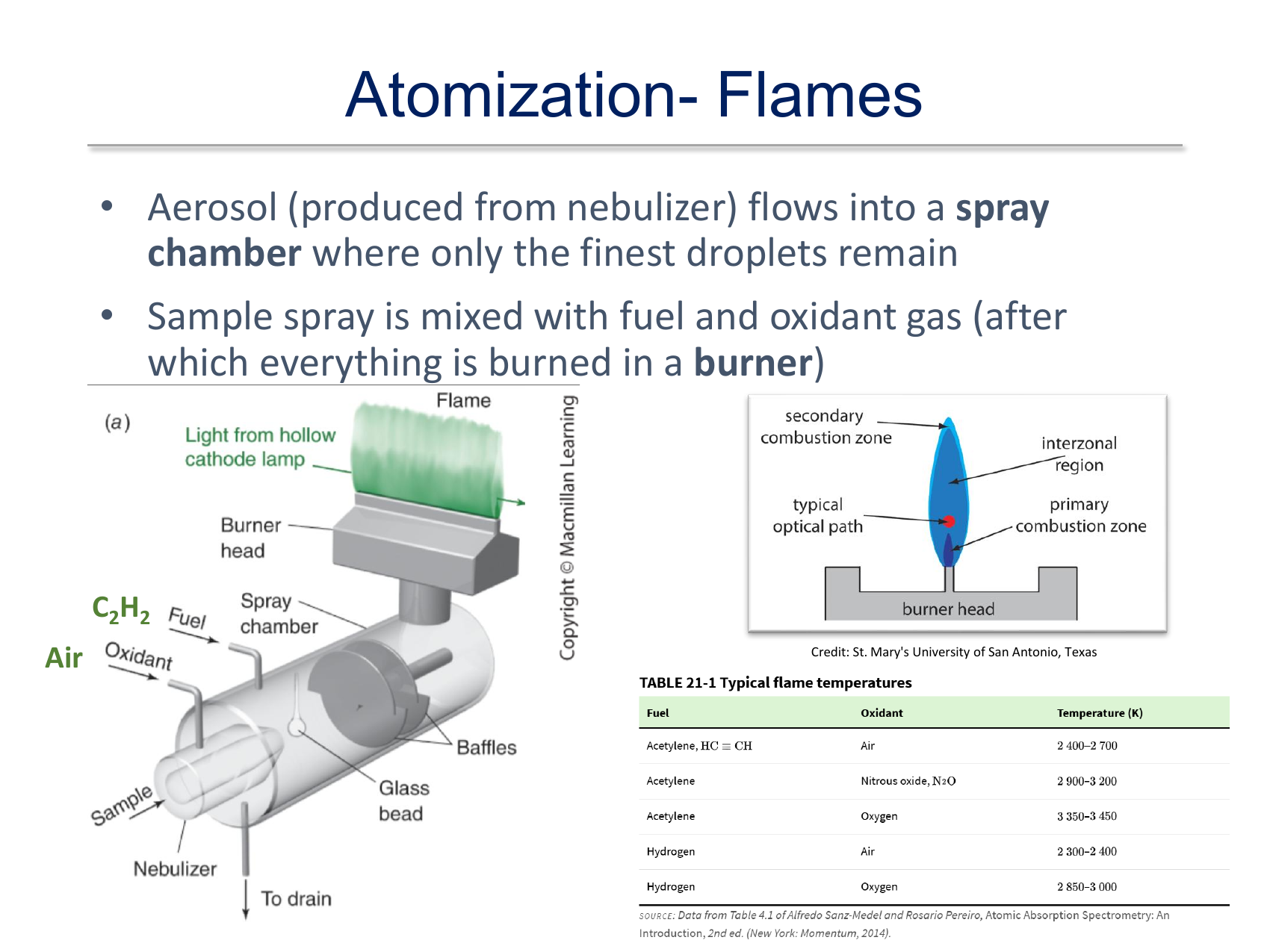
What occurs in the primary combustion zone of a flame?
The nebulized sample is desolvated. [Slide 21
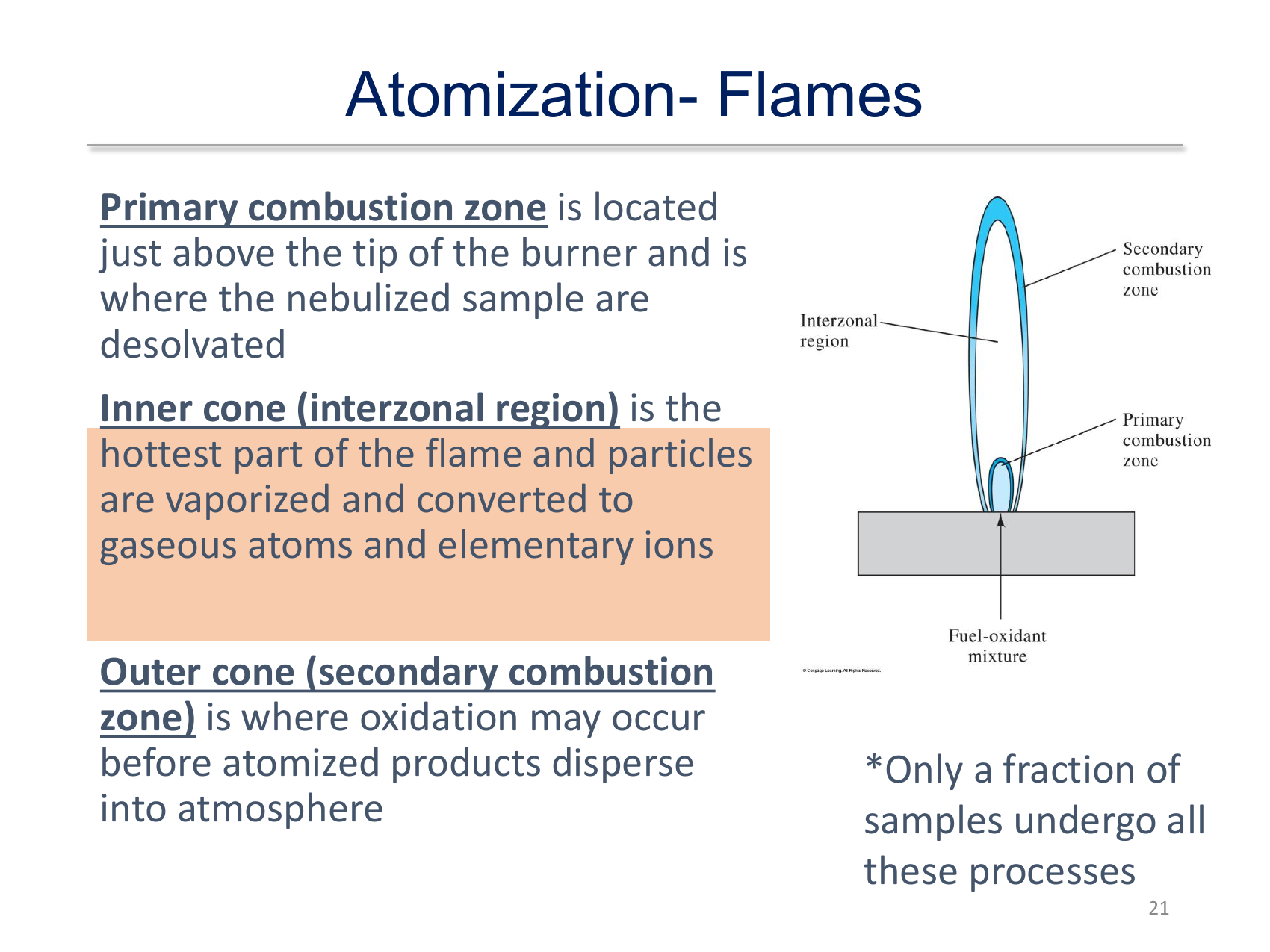
Where is the primary combustion zone located?
Just above the tip of the burner. [Slide 21]
What is the hottest part of the flame?
The inner cone/interzonal region. [Slide 21]
What happens in the inner cone/interzonal region?
Particles are vaporized and converted to gaseous atoms and elemental ions. [Slide 21]
What occurs in the outer cone/secondary combustion zone?
Oxidation may occur before atomized products disperse into the atmosphere. [Slide 21]
Do all sample particles undergo every possible process shown during flame atomization?
No. Only a fraction of the sample undergoes all of the processes. [Slide 21]
Approximately what fraction of the initial sample is shown entering the aerosol pathway in flame atomization?
About 5% of the initial sample. [Slide 22]
What are atomic emission and absorption spectra sensitive to?
The temperature of the flame. Higher temperatures will increase the total atom population, thus sensitivity. [Slide 23]
How can flame temperature affect ionization?
It can influence the position of the ionization equilibrium, such as Ba ⇌ Ba⁺ + e⁻. [Slide 23]
Why can ionization affect atomic spectra?
Neutral atoms and ions can give different spectral lines. [Slide 23]
What two major things can temperature affect during atomization?
The degree to which the sample breaks down into atoms and the extent to which atoms are in ground, excited, or ionized states. [Slide 24]
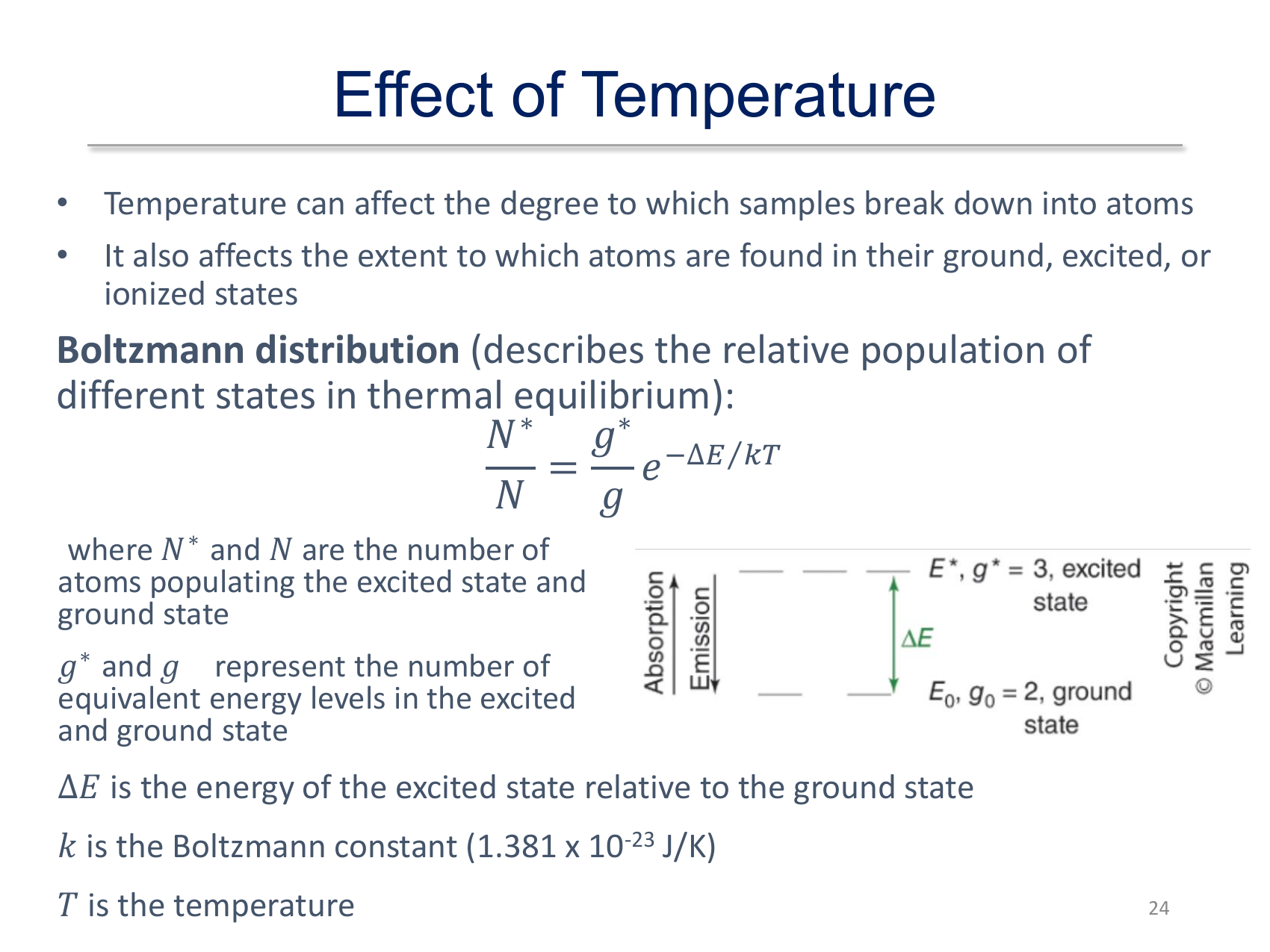
What does the Boltzmann distribution describe?
The relative population of different states at thermal equilibrium. [Slide 24]
What is the Boltzmann distribution equation used in this lecture?
N/N = (g/g)e^(−ΔE/kT). [Slide 24]
What do N* and N represent in the Boltzmann equation?
N* = number of atoms in the excited state; N = number of atoms in the ground state. [Slide 24]
What do g* and g represent in the Boltzmann equation?
The number of equivalent energy levels in the excited and ground states, respectively. [Slide 24]
What does ΔE represent in the Boltzmann equation?
The energy of the excited state relative to the ground state. [Slide 24]
What is the value of the Boltzmann constant k given in the lecture?
1.381 × 10⁻²³ J/K. [Slide 24]
For sodium at 2600 K, what is N*/N?
1.67 × 10⁻⁴. [Slide 25]
Approximately what percentage of sodium atoms are in the ground state at 2600 K?
99.98%. [Slide 25]
What happens to the excited-state population of sodium when temperature rises from 2600 K to 3200 K?
It increases from approximately 0.0167% to 0.097%. [Slides 25–27]
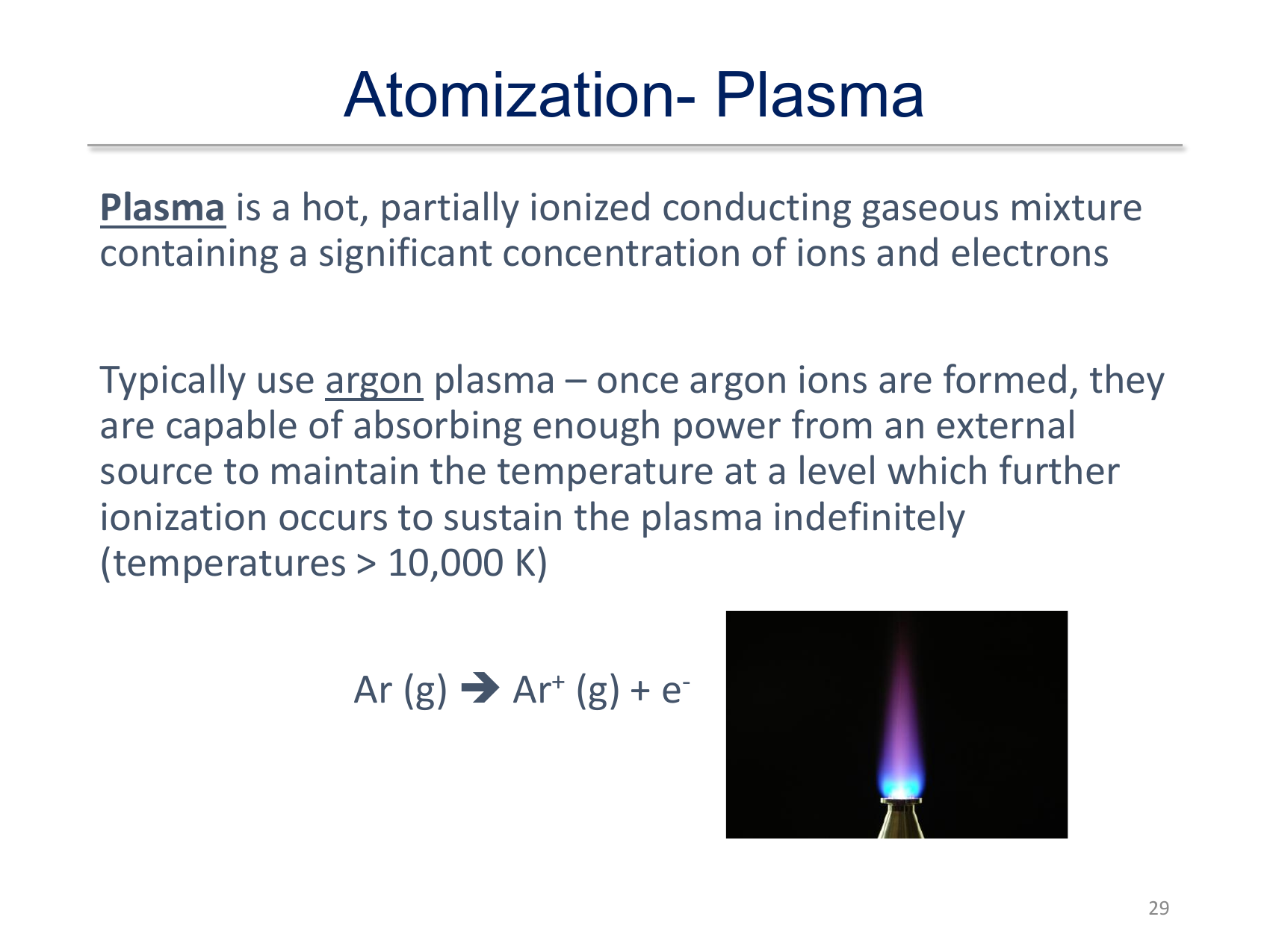
What is a plasma?
A hot, partially ionized, conducting gaseous mixture containing a significant concentration of ions and electrons. [Slide 29]
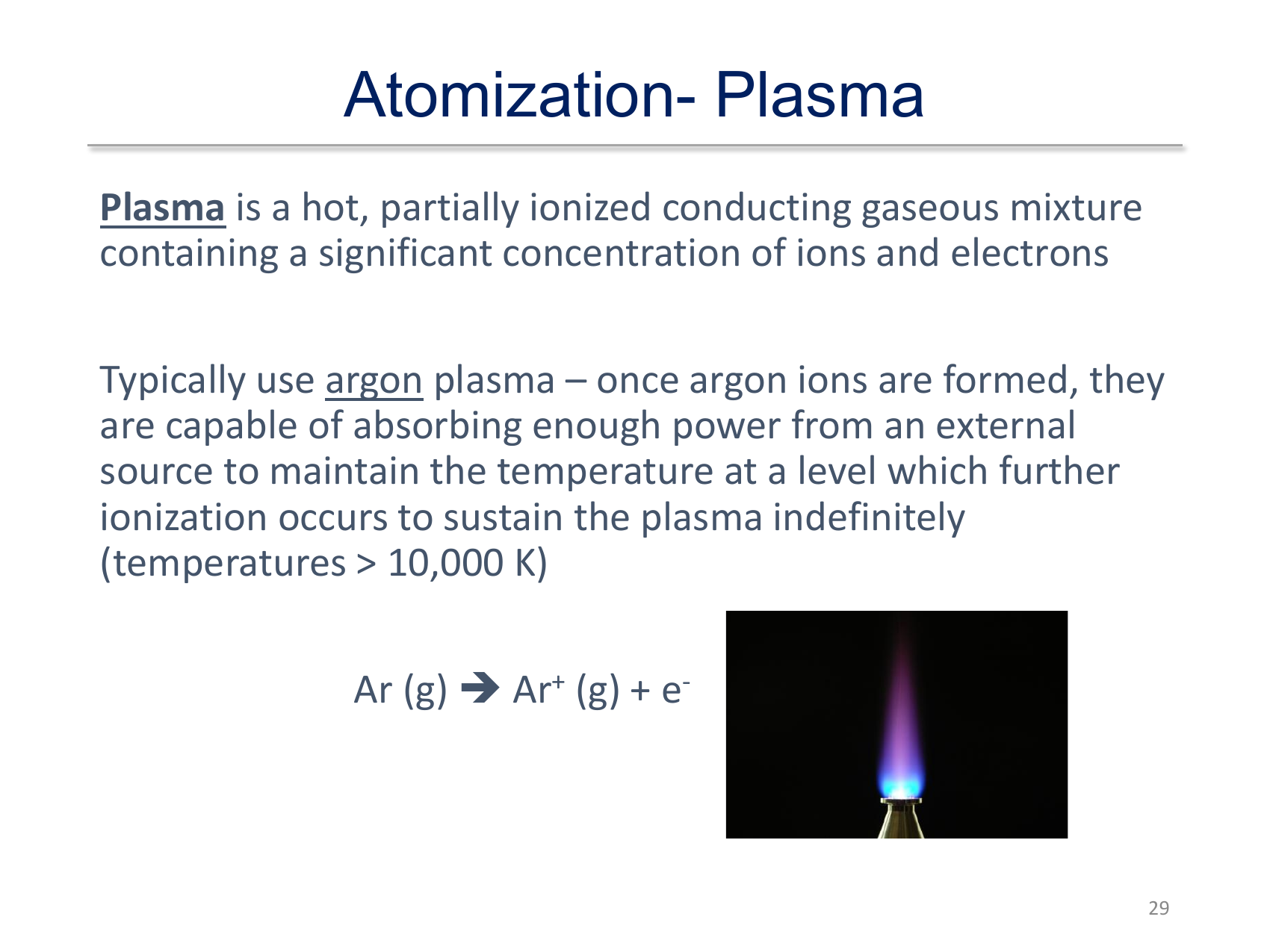
What gas is typically used to form the plasma discussed in this lecture?
Argon. [Slide 29]
How does argon plasma sustain itself?
Once argon ions form, they absorb enough power from an external source to maintain a temperature where further ioniz
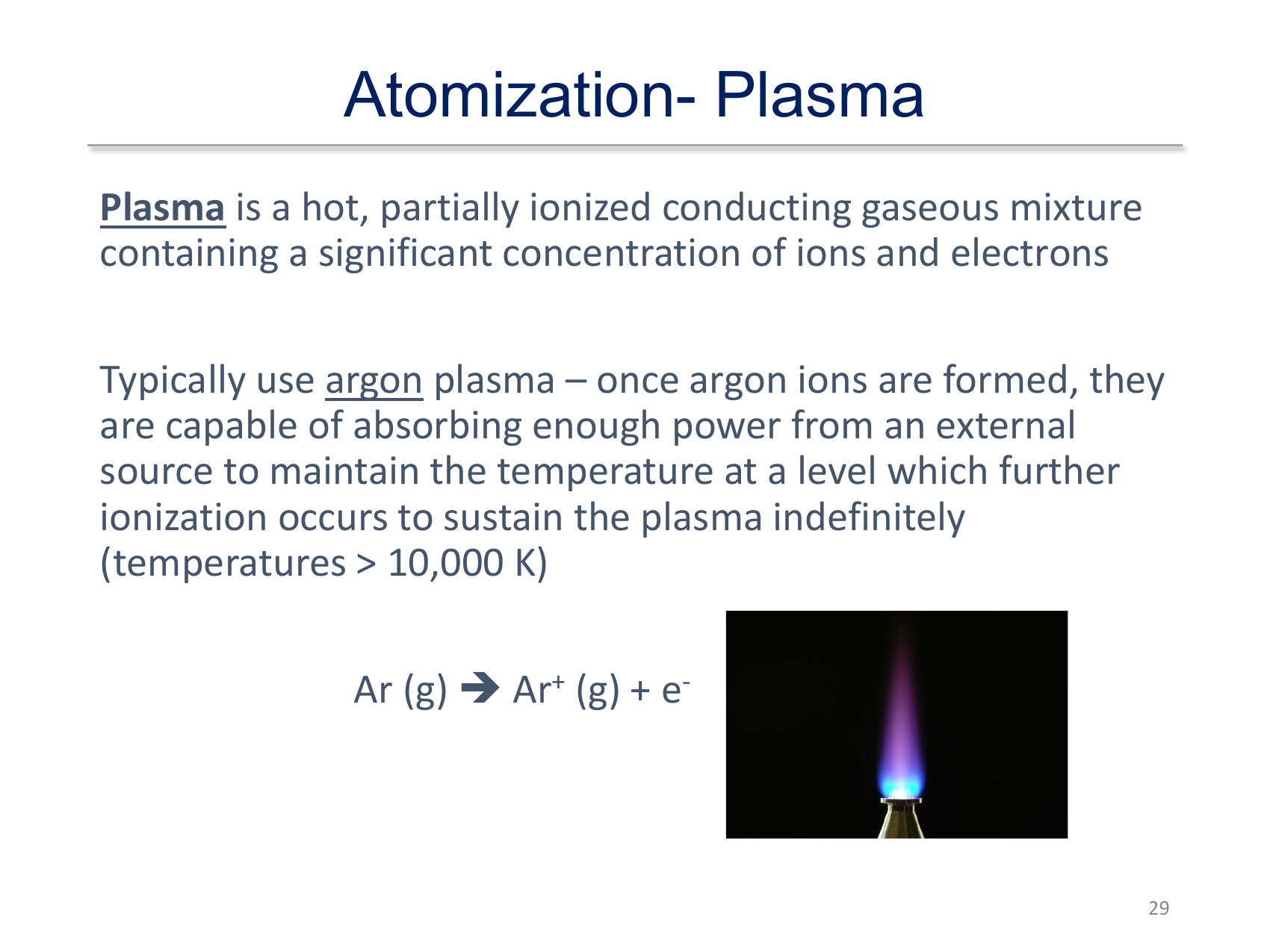
ation occurs. [Slide 29]
What temperature can the argon plasma described in the lecture exceed?
10,000 K. [Slide 29]
What is ICP?
Inductively Coupled Plasma, a power source often used to produce argon plasma. [Slide
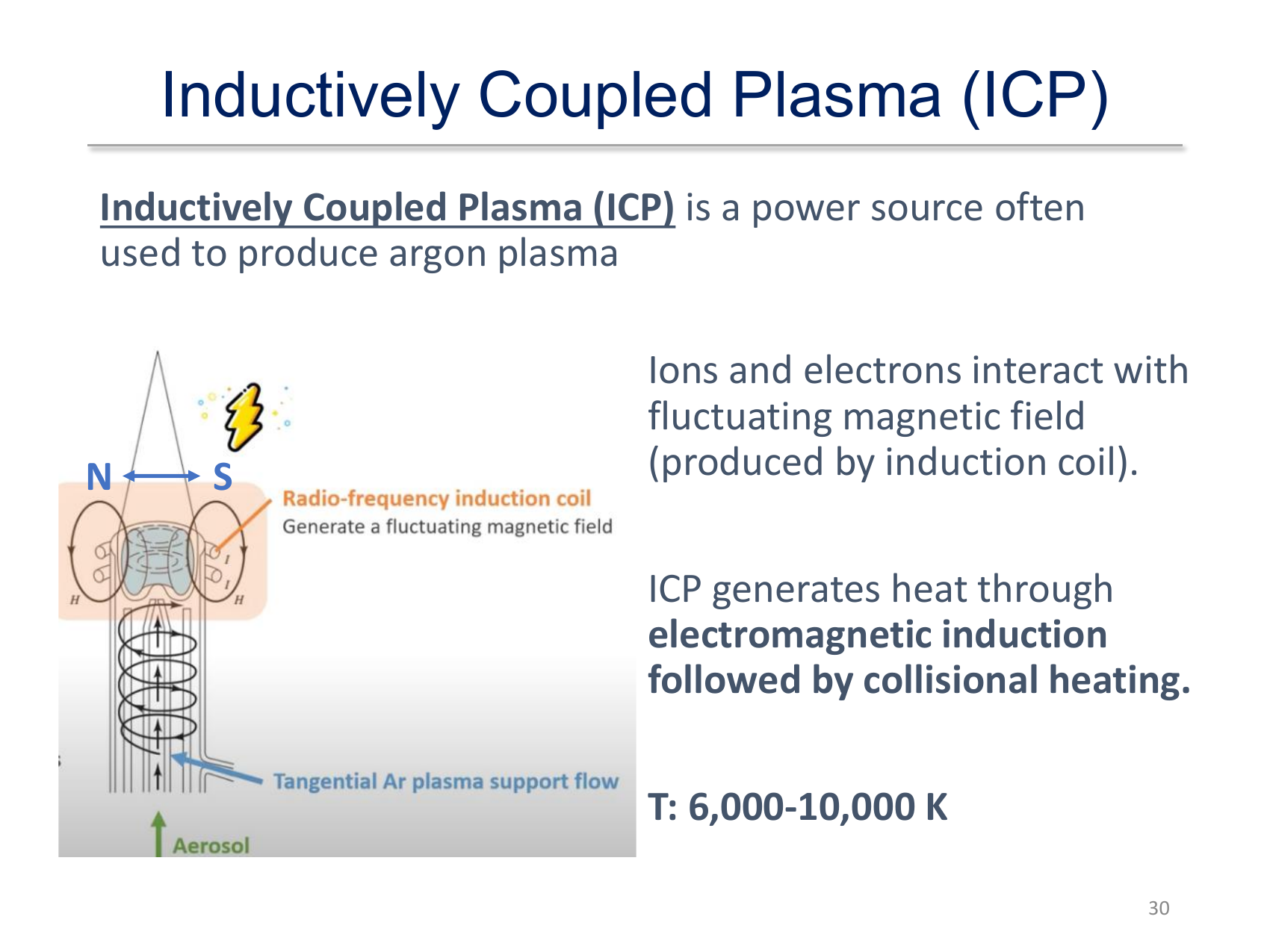
30]
How does ICP generate heat?
Through electromagnetic induction followed by collisional heating. [Slide 30]
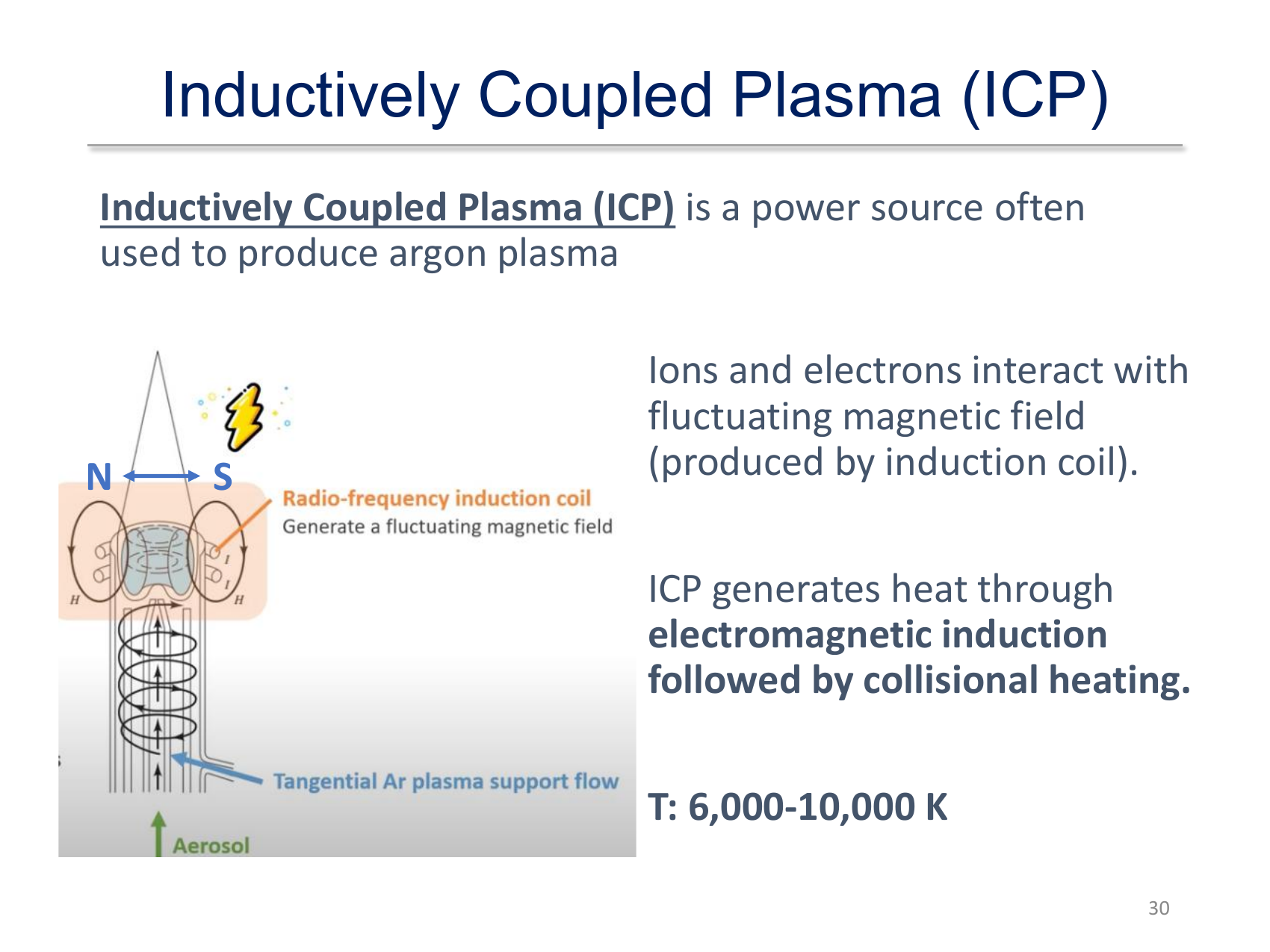
What interacts with the fluctuating magnetic field in ICP?
Ions and electrons. [Slide 30]
What produces the fluctuating magnetic field in ICP?
The induction coil. [Slide 30]
What temperature range is given for ICP?
Approximately 6000–10,000 K. [Slide 30]
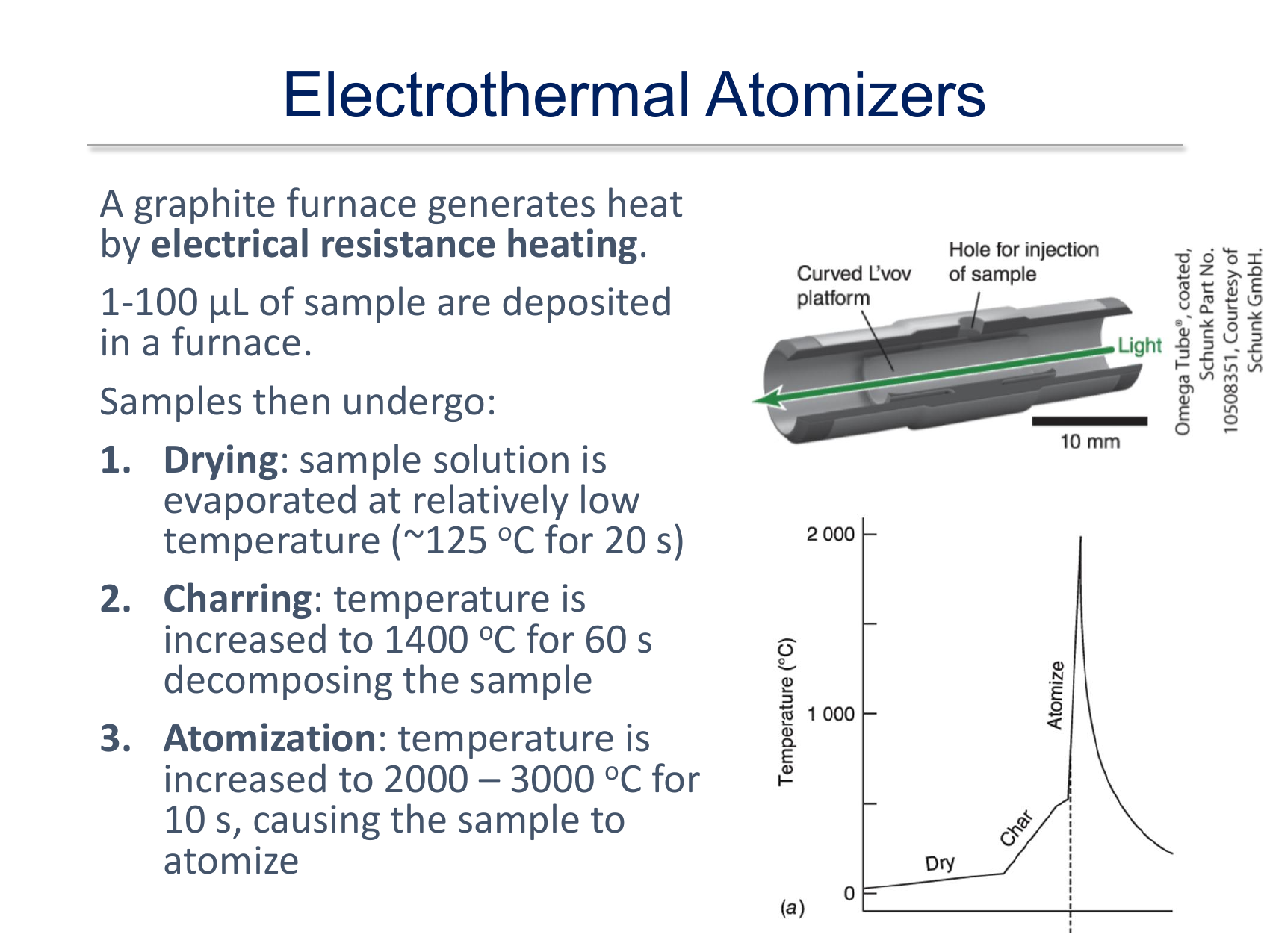
How does a graphite furnace generate heat?
By electrical resistance heating. [Slide 32
]
How much sample is deposited into a graphite furnace?
Approximately 1–100 µL. [Slide 32]
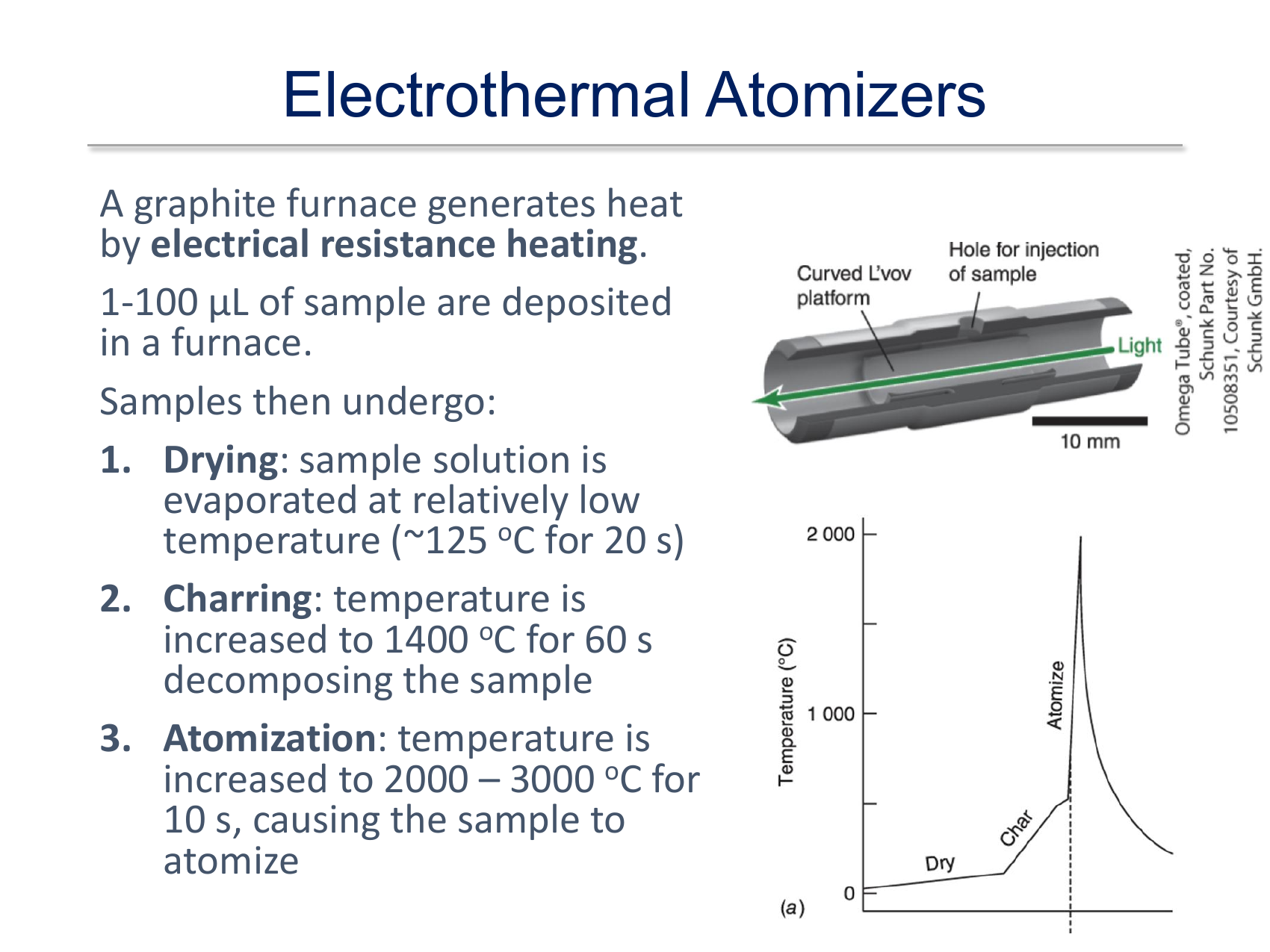
What are the three stages of graphite-furnace atomization?
Drying, charring, and atomization. [Slide 32
]
What happens during the drying stage of graphite-furnace atomization?
The sample solution is evaporated at approximately 125°C for 20 s. [Slide 32]
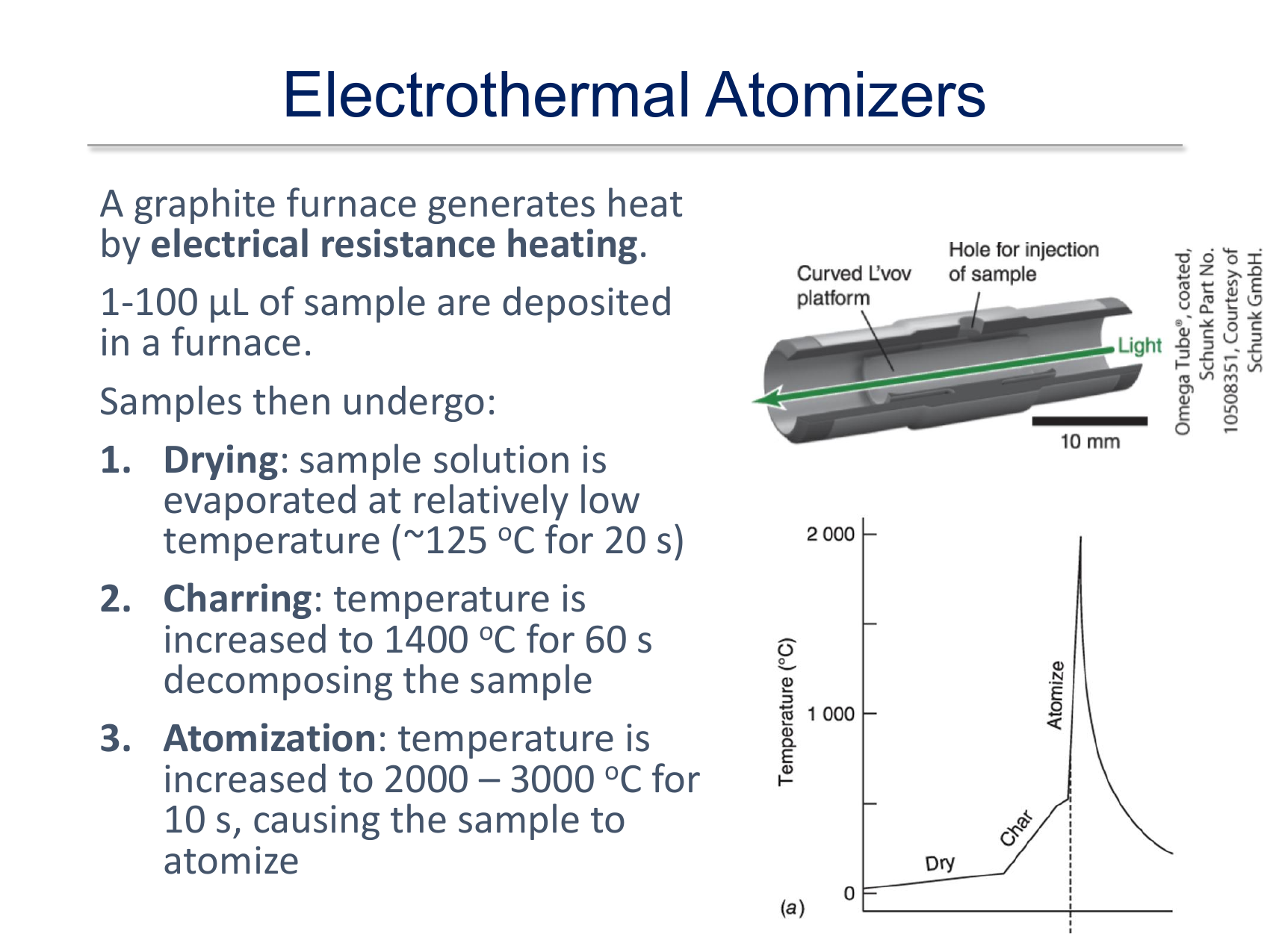
What happens during the charring stage?
The temperature is raised to approximately 1400°C for 60 s, decomposin
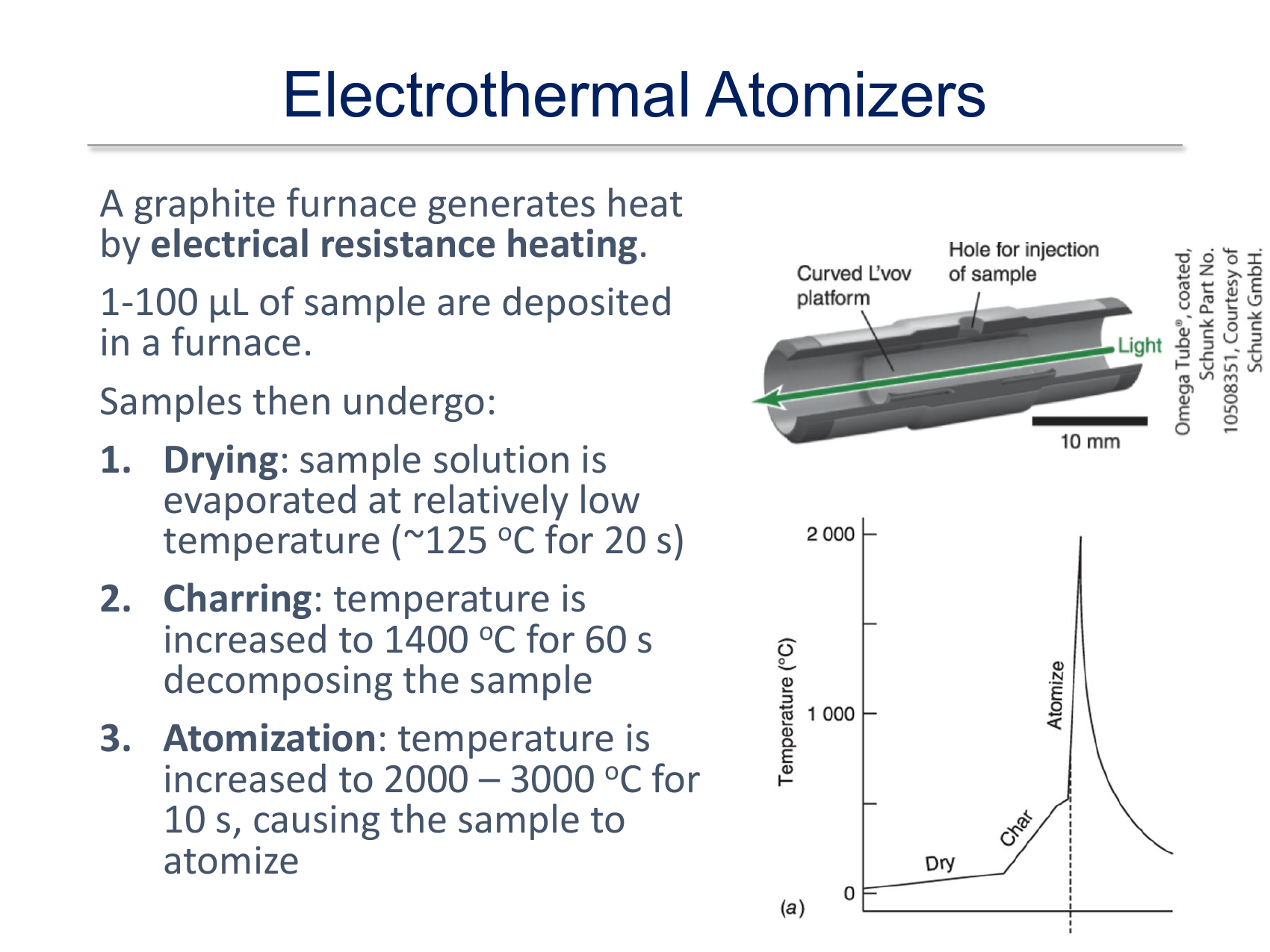
g the sample. [Slide 32]
What happens during the atomization stage of a graphite furnace?
The temperature is raised to approximately 2000–3000°C for 10 s, causing the sample to atomize. [Slide 32]
What is matrix smoke interference?
During the charring step, smoke from the matrix can partially block light and produce unwanted background absorbance. [Slide 33]
What example of matrix smoke interference is given in the lecture?
When Mn is analyzed in seawater, a blank containing no Mn can still show apparent absorbance because of optical scattering from smoke produced by heating NaCl. [Slide 33]
What is the matrix of a sample?
Everything in the sample other than the analyte. [Slide 34]
What is a matrix modifier?
A substance added to a matrix to increase matrix volatility or decrease analyte volatility, suppressing unwanted background signals. [Slide 34]
What matrix modifier example is given for NaCl?
NH₄NO₃. [Slide 34]
How does NH₄NO₃ help reduce smoke from NaCl?
It converts NaCl into NH₄Cl and NaNO₃, which evaporate more efficiently instead of producing smoke. [Slide 34]
What are two factors discussed that broaden atomic spectral lines?
Collisional/pressure broadening and Doppler broadening. [Slides 36–37]
What causes collisional or pressure broadening?
Collisions between gas-phase atoms that lead to deactivation of the excited state. [Slide 36]
How does concentration or partial pressure affect collisional broadening?
Broadening increases as concentration or partial pressure increases. [Slide 36]
Is collisional broadening sensitive to temperature?
Yes. [Slide 36]
What causes Doppler broadening?
The rapid motion of atoms as they emit or absorb radiation. [Slide 37]
What frequency does a detector observe when an atom moves toward it?
A higher frequency. [Slide 37]
What frequency does a detector observe when an atom moves away from it?
A lower frequency. [Slide 37]
Is Doppler broadening sensitive to temperature?
Yes. [Slide 37]
What equation is given for Doppler linewidth?
δλ ≈ λ(7 × 10⁻⁷)√(T/M), where T is temperature in K and M is atomic mass in Da. [Slide 38]
What units are used for atomic mass M in the Doppler linewidth equation?
Daltons (Da), with 1 g/mol = 1 Da. [Slide 38]
What Doppler linewidth is calculated for Fe at 300 nm, M = 56 Da, and 2500 K?
0.0014 nm. [Slides 39–40]
What is the general instrument sequence shown for AAS?
Line source → atomizer → monochromator → PMT → signal processor → computer system. [Slide 41]
What type of source is used in the AAS setup shown in this lecture?
A line source, such as a hollow-cathode lamp. [Slides 41–42]
What are the main components of a hollow-cathode lamp?
A tungsten anode, a cathode made of the element being analyzed, and a chamber filled with an inert gas such as argon or neon. [Slide 42]
Approximately what potential difference is applied across a hollow-cathode lamp?
Approximately 500 V. [Slide 42]
What happens when the potential difference is applied across a hollow-cathode lamp?
The inert gas is ionized, producing cations and electrons that travel to their respective electrodes and generate current. [Slide 42]
What is sputtering in a hollow-cathode lamp?
Inert-gas cations strike the cathode with enough energy to eject metal atoms into the gas phase. [Slide 42]
Why is the cathode made from the element being analyzed?
The cathode is made of the element being analyzed so atoms of that element can be sputtered into the gas phase. [Slide 42]
Approximately how many elements have commercially available hollow-cathode lamps?
About 70 elements. [Slide 42]
Why is source modulation used in AAS?
To discriminate between radiation from the line source and radiation from the atomizer. [Slide 43]
What is modulation?
Changing a property of a waveform, called the carrier, by the desired signal so that the carrier conveys information about the desired signal. [Slide 44]
How is the line source modulated in AAS?
Its intensity is made to fluctuate at a constant frequency. [Slide 44]
What type of signal does the transducer receive from the line source after modulation?
An alternating signal. [Slide 44]
What type of signal does the transducer receive from the flame?
A continuous signal. [Slide 44]
Approximately how many elements can flame AA be used to determine?
About 60–70 elements. [Slide 45]
What are two advantages/applications of flame AA?
It is useful for routine measurements and can be used by relatively inexperienced operators. [Slide 45]
What is one major limitation of flame AA regarding elemental analysis?
Only one element can be determined at a time. [Slide 45]
Why is only one element determined at a time in flame AA?
This limitation is related to how the element-specific line sources operate. [Slide 45]
What instrumental adjustment may need to be made for each sample in flame AA?
The flame position needs to be adjusted. [Slide 45]