IPE exam 2
 Call Kai
 Learn
Learn Practice Test
 Spaced Repetition
 Match
Match Flashcards
 Knowt Play
1/65

There's no tags or description
Looks like no tags are added yet.
Name | Mastery | Learn | Test | Matching | Spaced | Call with Kai | Chat |
|---|
No analytics yet
Send a link to your students to track their progress
66 Terms
Health Belief Model
Known as a value expectancy theory.
People will engage in healthy behavior if-
They value the outcome of that behavior.
They think the behavior is likely to result in that outcome.
But things can get in the way...
the health belief model
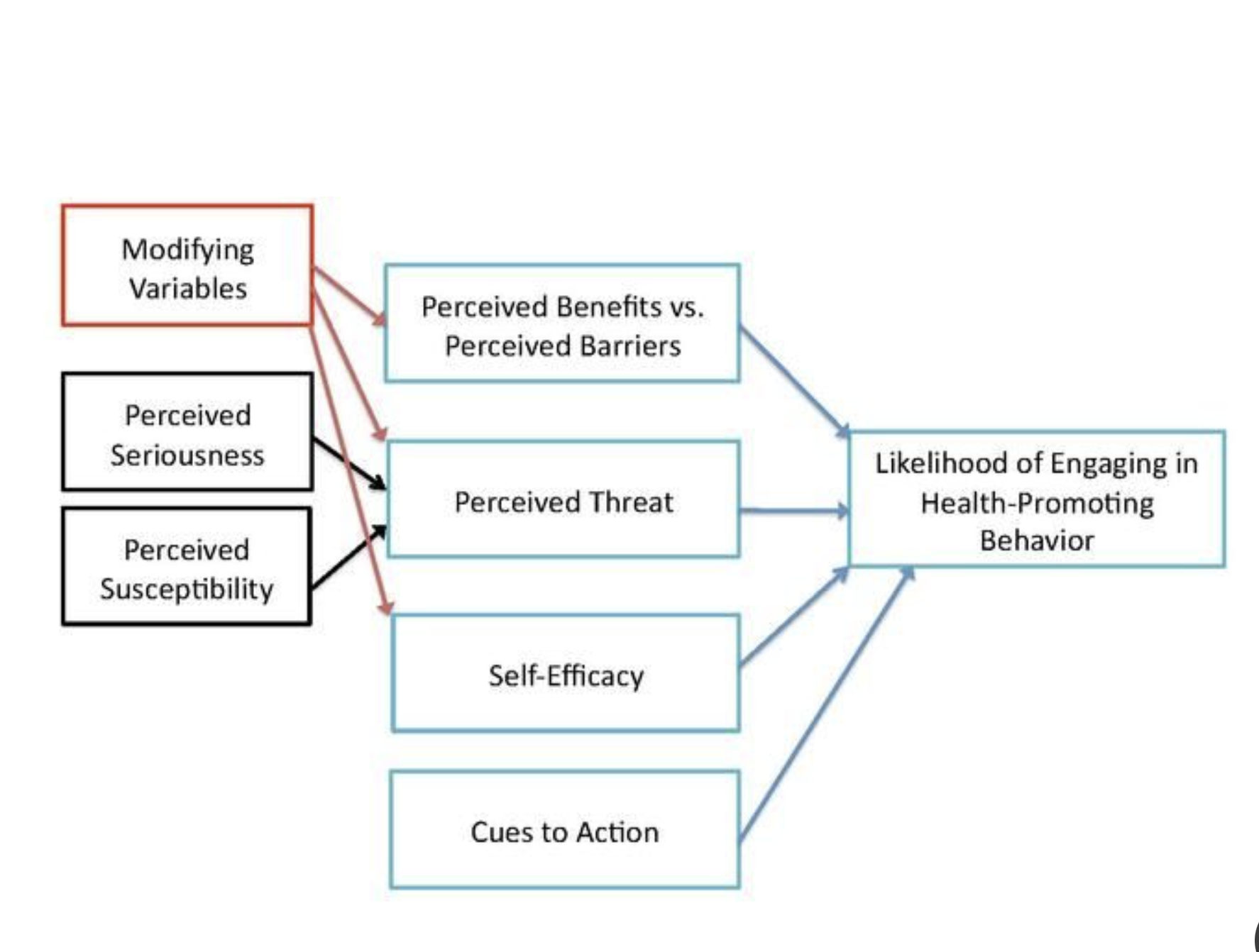
Health Behavior is Motivated by
perceived susceptibility
perceived severity
perceived benfits
perceived barriers
self efficacy
cues to action
Benefits Must outweigh Barriers
Difficulty of behavior
Work schedule
Laziness
No time- family, etc.
Unaware of health behavior
Motivation and support
Lack of knowledge
Weather
Etc......
Critiques of HBM
focuses on individual decisions
lack of clarity in how all components affect the changing of behavior.
Theory of Planned Behavior
Theory of Reasoned Action (foundations of TPB)
Explores the relationship between people’s attitudes and their behaviors.
Focuses on rational, cognitive decision-making processes similar to HBM.
Key Components
Of TRA/TPB
Intention to do a behavior based on the following:
Person’s attitude toward a specific behavior.
Person’s perception of the subjective norms associated with said behavior.
What do we mean by subjective norms?
Subjective norms - This refers to the belief about whether most people approve or disapprove of the behavior.
It relates to a person's beliefs about whether peers and people of importance to the person think he or she should engage in the behavior.
Tra reformulated to TPB
Behavior intention alone not predictor of behavior.
Perceived behavioral control composed of:
Control beliefs - beliefs about factors that will make it easy or difficult to do the behavior.
Perceived power - to facilitate or inhibit the behavior.
TPB as a Whole
Attitude: a person’s beliefs, judgement on behavior.
Subjective norms: beliefs on what others will think and motitivation to conform.
Behavioral intention: intent to do behavior, influenced by all other factors. Most Predictive of All!
Perceived behavioral control: beliefs on what will make it easy/hard to do behavior.
Perceived power: power a person believe they have on behavior.
Critiques of TPB
Assumes behavior is the output of rational, linear decision-making processes.
clarity of constructs
time between intent and action is not considered
Transtheoretical Model
Prochaska and DiClemente developed ‘stages of change’.
Useful in determining where a person is in relation to making a behavior change.
Self-efficacy is the key component of the model.
Focus on cooperation not compliance.
TTM /
Stages of Change
stage 1 precomtemplaton
stage 2 contemplation
stage 3 preparation
stage 4 action
stage 5 maintenance
Precaution Adoption Process Model
Main difference from TTM is ‘taking a precaution’ against something.
Developed in response to explain how people react to hazards.
stages of Precaution Adoption Process Model
unawear of the issue
unengaed in the issue
deciding about action
decideing not to act
decideing to act
acting
maintance
Critiques of TTM and PAPM
These 2 models say that a person will go from Stage 1 to Stage 2 in sequential order.
how do we mesausre what stage a person is in?
Information-Motivation-Behavioral Skills Model (IMB)
Prevention information is important but not enough.
Self-Esteem Enhancement Theory
Building self-esteem enhances resilience and promotes healthy behavior.
Self-Determination Theory
Humans are innately oriented to growth and health
social groups
Family and family-related groups
Peer groups
Occupational groups
Clubs, civic associations
Social class - related groups, racial/ethnic groups
Faith-related groups
Risk behavior - related social networks
Assumptions about Groups and Behavior
Group dynamics often over-ride individual motives.
People do things in groups they might not do on their own.
Individual emotions can be shaped by a group.
Cost/benefit: People may view loss of group membership to be a risk, more than specific health consequences.
Individual address internal factors
Health Belief Model
Transtheoretical Model
Theory of Planned Behavior
Social/Env address external factors.
Social Cognitive Theory
Social Network Theory
Diffusion of Innovations
Social Marketing
Social Cognitive Theory
Most well-known and productive theory in PH.
Began as a branch of behaviorism
1960s - Bandura and others proposed principle of operant conditioning - Social Learning Theory.
person learns behavior through -/+ reinforcement
Social Learning Theory
key principle was learning by observation (vicarious learning). -
Introduction of self-efficacy came shortly afterwards
Renamed Social Cognitive Theory (SCT) in 1986
Relates to how people change behavior.
Concept of reciprocal determinism added.
Behavior is part of a continuous interactive cycle that includes individuals and their social & physical environments. .
Factors Involved in Changing Behavior
1. Individual (internal) characteristics
2. Environmental (external) factors
3. Interactive process of reciprocal determinism
Social Cognitive Theory- individual factors
Self-efficacy
Behavioral capability
Outcome expectations
Outcome expectancies
Self-Control
Emotional coping
social cognitive theory- environmental factors
Vicarious learning (modeling)
Situation it takes place
Reinforcements (+/-)
Reciprocal determinism
social cognitive theory- reciprocal determinism
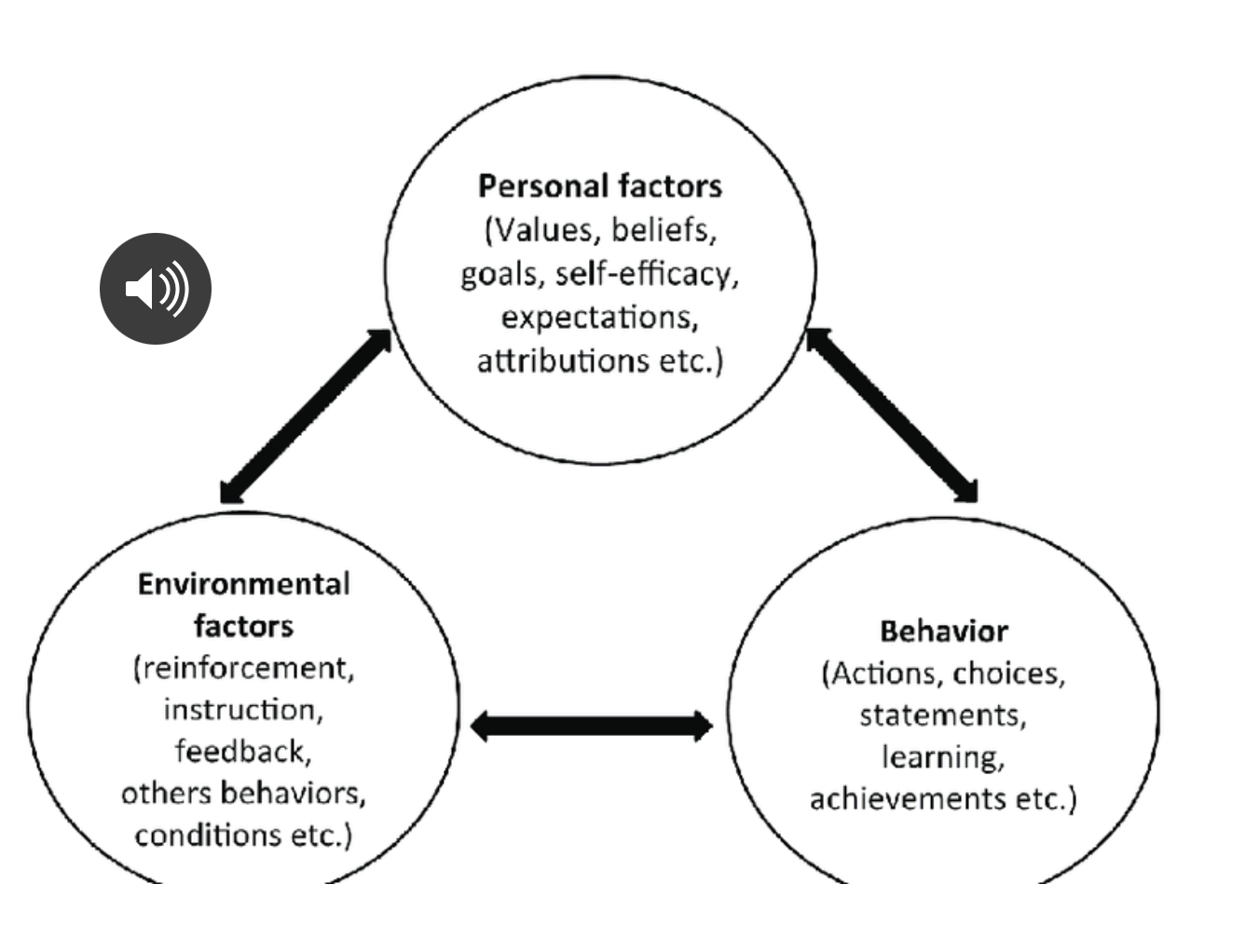
Using SCT in Health Promotion
to boost self-efficancy
social skill training
education on risks and outcomes of behavior
through vicarious learning
Critiques of SCT
It is very complex.
Viewed as less of a theory.
Components from earlier versions are still around, which makes for a sticky situation.
Social Network Theory
Key Factor:
Focus on relationships between and among individuals, and how the nature of those relationships influence beliefs and behaviors. Explanation for how random people are connected.
Set of relationships that an individual participates in:
Family networks, work networks, social groups.
Useful in the study of large groups and understanding how their members relate to others in the group. It provides insight into viral phenomena, such as viral content, the spread of diseases, etc.
SNT requires research
People in network = Actors
Frequency of interactions
Types of interactions
Work, social
Social Network qualities to assess role of a network on health behavior
Centrality vs. marginality of individuals in the network
Reciprocity of relationships
Complexity or intensity of relationships in the network
Homogeneity or diversity of people in the network
Subgroups, cliques, and linkages
Communication patters in the network
Critiques of SNT
Limited theory and approach.- Best used with small or defined group interventions.
Labor intensive and can be difficult.- i.e., Identifying networks and conducting interviews
Diffusion of Innovations
Process by which a behavior/technology makes its way into a population and is (or is not) adopted.
Diffusion is the process by which innovation is communicated.
Innovation is seen as the behavior or technology that is seen by the population as new.
DOI and Key Processes
innovation develpoment
dissemination
adoption
implementation
maintenance
Innovation Development - doi
Development of innovation itself.
planning, formative research and testing
Dissemination- doi
‘Active knowledge of transfer’
Also, identification of communication channels and dissemination channels.
Adoption- doi
Referred to as ‘uptake’ of behavior or technology.
Must go through the following stages:
Knowledge of the innovation
Persuasion or attitude development (about adopting)
Decision (to adopt)
Implementation
Confirmation
To Adopt or Not- doi
The following types of knowledge weigh-in the decision to adopt or not:
Awareness knowledge (innovation exists)
Procedural knowledge (how to use)
Principle knowledge (understanding how the innovation works)
Implementation- doi
Initial use of the practice.
Focus is on improving self-efficacy and skills of attended user
Maintenance- doi
Focus on sustainability.
This could also be referred to institutionalization of a behavior or technology.
Product Attributes
Related to speed and extent of diffusion -
Relative advantage
Compatibility
Complexibility
Trialability
Observability
Attributes that Might Need Consideration
effect on social relations
reversibility
communicability
time
risk and uncertainty
commitment
modifiability
Critiques of DOI
describes multiple constructs and processes embedded within processes as a whole not all constructs are incorporated
as a theory, hard to test or pro
Social Marketing
Incorporates principles of marketing to help the consumer ‘buy’ a behavior change or product
Principles of Social Marketing
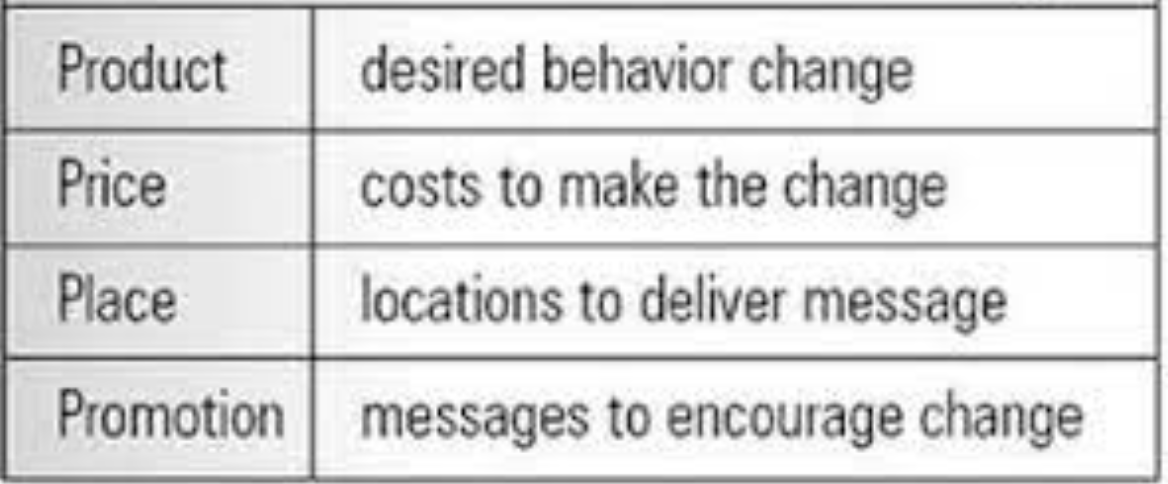
Social Marketing Constructs
Market segmentation- Purpose behind dividing groups for message to be delivered.
Targeting- Needs, attitudes, beliefs, and behaviors all taken into consideration when delivering message.
Critiques of Social Marketing
Assessing the impact might be difficult.
i.e. Behavior change is the goal
.If product introduced is the behavior change, easier to track.
i.e. Use of birth control pills.
Communication OVERALL
Spoken and written word
Nonverbal communication including gestures & touch, facial & eye expressions, movement & distance, body signals and artistic symbols, appearance
Telehealth
Brief encounters can be effective.
All behavior is communication.
You cannot not communicate!
Therapeutic Communication
Health promotion requires sensitivity to each person’s goals and values.
Must get to “know” the individual/audience.
Health promotion requires effective communication.
Successful health promotion involves interpersonal skills, personal insight, accountability, mutual respect, and supportive working environment.
Mutual learning experience = mutual respect.
Is a dialogue- two way street!
Respects ethical and cultural differences of participants.
Simple Behaviors to Enhance Therapeutic Communication
Being present and attending to patient
Person-centered focus, respect culture
Friendliness, smiling, use of humor
Providing comfort, attend to needs
Allow to “tell their story”
Conversational interviewing style
Mutual respect, empathy, confidentiality
Giving information about health for decisions
Communication Theory
communication is an essential function of any organism, communication is symbolic
Communication channels
Family, friends, health care practitioners, co-workers, teachers, counselors, faith leaders, coaches, etc.
Radio.
Television.
Newspaper.
Flyers.
Brochures.
Internet.
Social media tools (i.e., Twitter, Facebook, and YouTube)
Shannon-Weaver Model
sender encodes the message
sender transmits the message through a channel
message might encounter interference
receiver gets the message who interprets and decodes
receiver can either provide feedback or a reaction
Other Factors to Consider about shannon weaver model
context or setting
relationship between sender and reciver
meaning attached to channel
process of encodeing and decoding
social context (group or individuals)
Communication as a Code
how do you speak to certain people or groups
understanding the receiver’s ability to decode
Critiques of
Communication Theory
Complicated and difficult to assess effect.
i.e. Levels of impact
Technology
Community and Organizational Change
A change in health behavior is dictated first by change in community, system, or organization.
ex- cant give people all diabetes education on screening if no facilities to get it done.
This can also support or inhibit these health behavior changes.
Community Mobilization
community change often affected by political and social movements.
Concept of empowerment.
MADD, Women’s rights, HIV/AIDS activism
Key Issues in
Mobilizing Community
Defining community.
Assessing, and working with, the community’s capacity for mobilizing.
Understanding the community agenda and selecting the right issue.
Identifying the best strategies for specific communities.
Organizational and Systems Change
Health promotion, disease prevention, and health care accomplished through organizations and systems.
Flip side, as much as can be a facilitator, can also be a barrier.
ex: collaboration between fields.
Focus of Organizational Change
assessing and improving group dynamics within organization/ system
encouraging shared goals and missions
identifying impediments to change and unfreezing to move forward
identify and implementing new polices and practices
Critiques of organizational change
Mobilizing a community, or changing an organization, is a complex process.
some factors can not be controlled
Culture overall
A phenomenon that exists as a kind of whole that integrates patterns that links groups or ways of life.
A relationship between what people know and believe and what they do.
It is acquired, born with it and learn during your life.
Shared between members of a group or society.
Underlies our ability to interpret the world around us into meaningful actions.
Anthropology and Cultural Theory
Understand the role culture plays in what people, groups, and societies do.
Anthropologists involved in issues of health created new subdiscipline- medical anthropology.
Culture: customs, social institutions, morals, beliefs, laws of a particular nation, people, or social group.