Chp. 34 - The Biosphere: An Introduction to Earth’s Diverse Environments
 View linked note
 Call Kai
 Learn
Learn Practice Test
 Spaced Repetition
 Match
Match Flashcards
 Knowt Play
1/38

Earn XP
Description and Tags
Flashcards covering the vocabulary of ecology, environmental factors, climate patterns, and the characteristics of various aquatic and terrestrial biomes from Chapter 34.
Name | Mastery | Learn | Test | Matching | Spaced | Call with Kai | Chat |
|---|
No analytics yet
Send a link to your students to track their progress
39 Terms
Ecology
The scientific study of the interactions of organisms with their environments.
Biotic factors
The living component of the environment, including all of the organisms in an area.
Abiotic factors
The environment’s nonliving component, consisting of physical and chemical factors.
Habitat
The surroundings of an organism, including both the biotic and abiotic factors present.
Population
A group of individuals of the same species living in a particular geographic area.
Community
An assemblage of all the populations of organisms living close enough together for potential interaction.
Ecosystem
An ecological level of study that includes both the abiotic and biotic components of the environment.
Landscapes
Arrays of ecosystems that are usually visible from the air as distinctive patches.
Biosphere
All of the Earth that is inhabited by life, extending from the atmosphere several kilometers above Earth to the depths of the oceans.
Silent Spring
A 1962 book by Rachel Carson that played a key role in awakening environmental awareness regarding pesticide use.
Pronghorn
A herbivorous running mammal of North American open country whose blazing speed likely evolved due to selection pressure from the now extinct American cheetah.
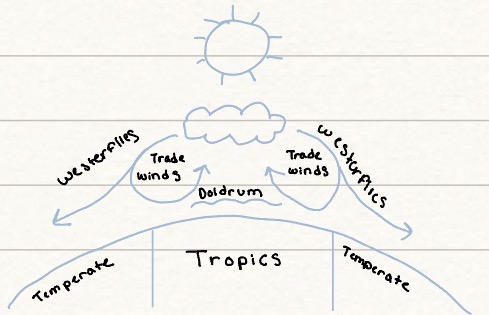
Tropics
The region surrounding the equator between latitudes 23.5∘ north and 23.5∘ south.
Doldrums
An area of calm or very light winds near the equator created by rising moist air.
Trade winds
Cooling winds that dominate the tropics, blowing from east to west as air moves back toward the equator.
Temperate zones
Latitudes between the tropics and the Arctic Circle in the north or the Antarctic Circle in the south, characterized by seasonal variations.
Westerlies
Prevailing winds in temperate zones that blow from west to east.
Ocean currents
River-like flow patterns in the oceans resulting from prevailing winds, Earth's rotation, unequal heating, and the shapes of continents.
Biomes
Major types of ecological associations that occupy broad geographic regions of land or water.
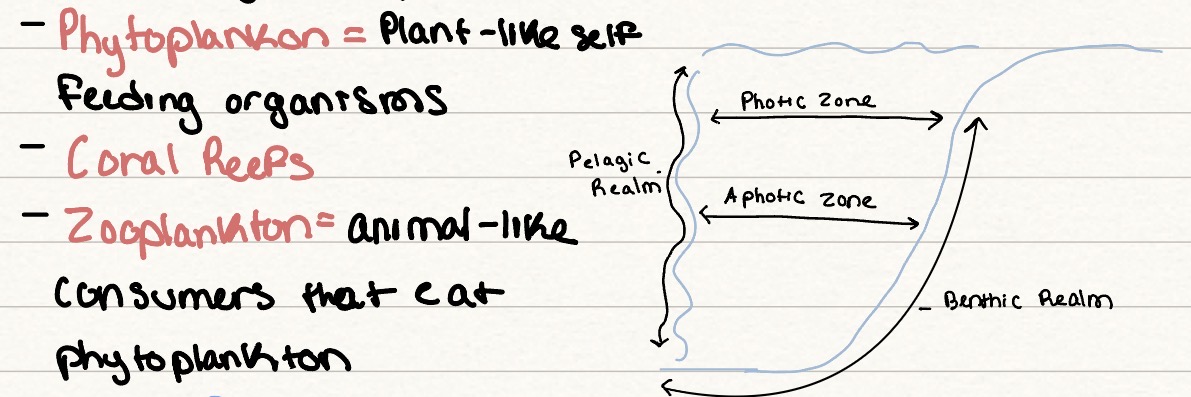
Pelagic realm
The region of the ocean that includes all open water.
Benthic realm
The seafloor of the ocean, extending from the continental shelf to the deep-sea bottom.
Photic zone
The ocean depth where light penetration is sufficient for photosynthesis to occur.
Aphotic zone
The ocean depth where there is insufficient light for photosynthesis.
Intertidal zones
Marine biomes where the ocean meets the land, characterized by being pounded by waves at high tide and exposed to air at low tide.
Estuaries
Productive marine biomes located where rivers meet the ocean.
Wetlands
Ecosystems that are transitional between aquatic and terrestrial environments.
Tropical forests
Equatorial biomes with warm temperatures and 11−12 hour days year-round.
Savannas
Grasslands with scattered trees that are warm year-round and receive 30−50cm of annual rainfall.
Deserts
The driest of all terrestrial biomes, characterized by low and unpredictable rainfall.
Desertification
A significant environmental problem involving the conversion of semiarid regions to desert.
Chaparral
A shrubland biome characterized by cool, rainy winters and hot, dry summers, with vegetation adapted to periodic fires.
Temperate grasslands
Mostly treeless biomes (except near water) with 25−75cm of annual precipitation and cold winters.
Taiga
The northern coniferous forest; it is the largest terrestrial biome on Earth.
Permafrost
Continuously frozen subsoil characteristic of the arctic tundra.
Polar ice
Terrestrial biome at high latitudes covering land north of the tundra, much of the Arctic Ocean, and Antarctica.
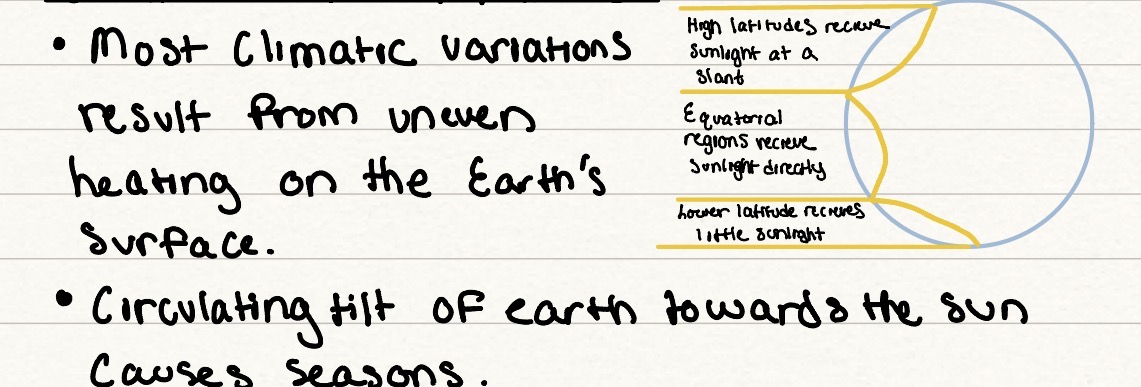
Two Primary Determinants of Earth’s global climate
Input of solar energy
Planet’s movement in space
Relation of latitude and solar energy on Earth
The winds & earth working together
Two types of freshwater biomes
Standing Water: lakes & ponds
Flowing water: Rivers & Streams
All ocean zones + what the photic zone contains