MLS 407 | Pipetting Concepts
 Call Kai
 Learn
Learn Practice Test
 Spaced Repetition
 Match
Match Flashcards
 Knowt Play
1/54

There's no tags or description
Looks like no tags are added yet.
Name | Mastery | Learn | Test | Matching | Spaced | Call with Kai | Chat |
|---|
No analytics yet
Send a link to your students to track their progress
55 Terms
Accurate test results are dependent upon ___ and ____ measurement of specific volumes of patient specimens and reagents
accurate; precise
T/F: All measuring devices used in the testing process have a potential of error (inaccuracy)
True; error potential is additive
What are considerations when selecting laboratory supplies?
Formulation
Heat tolerance
Chemical tolerance
Inert-ness
Proper Use
Maintenance and Care
Cost
Tolerance of Accuracy
Class A
preferred in clinical labs
guaranteed by manufacturer to deliver stated volume within error tolerance of ASTM standards when used properly
accurate and precise
Example: Error ~0.1% of stated capacity = 0.1 mL error for 100 mL
Class B
Twice the tolerance limits
Used when durability is needed
Example: Error ~0.5-1% of stated capacity = 0.5-1.0 mL for 100 mL
What class would these belong to?
Glass graduated cylinder
Polypropylene (PP) graduated cylinder
Polymethylpentene (PMP) graduated cylinder
Glass volumetric flask with stopper
A
B
A
A
T/F: Erlenmeyer flasks can be used for volumteric measurements
False; they can only be used for mixing and transferring
T/F: Beakers can only be used for mixing and transporting, not volumetric measurements
True
What do TC and TD mean? and where would you find these labeled?
TD = to deliver
TC = to contain
On volumetric pipettes
What does TC 20C mean?
To contain at 20C; at 20C, the pipette will have the specified volume contained in it
If you allowed liquid in a TC pipette to drain out of it and into a receiving vessel, you would need to what?
get every last drop of liquid out of the pipette to have that volume transferred to the receiving vessel. the original vessel contains the specified volume, but may not deliver that exact volume accurately
What does TC 20D mean?
To deliver at 20C
At 20oC, the specified volume listed on the pipette will be transferred to the receiving vessel when the liquid is allowed to drain freely from the pipette
After allowing the liquid to freely drain out of a TD pipette into a receiving vesse, is it necessary to get every last drop out of the pipette?
No, there will be residual liquid left, but that is expected
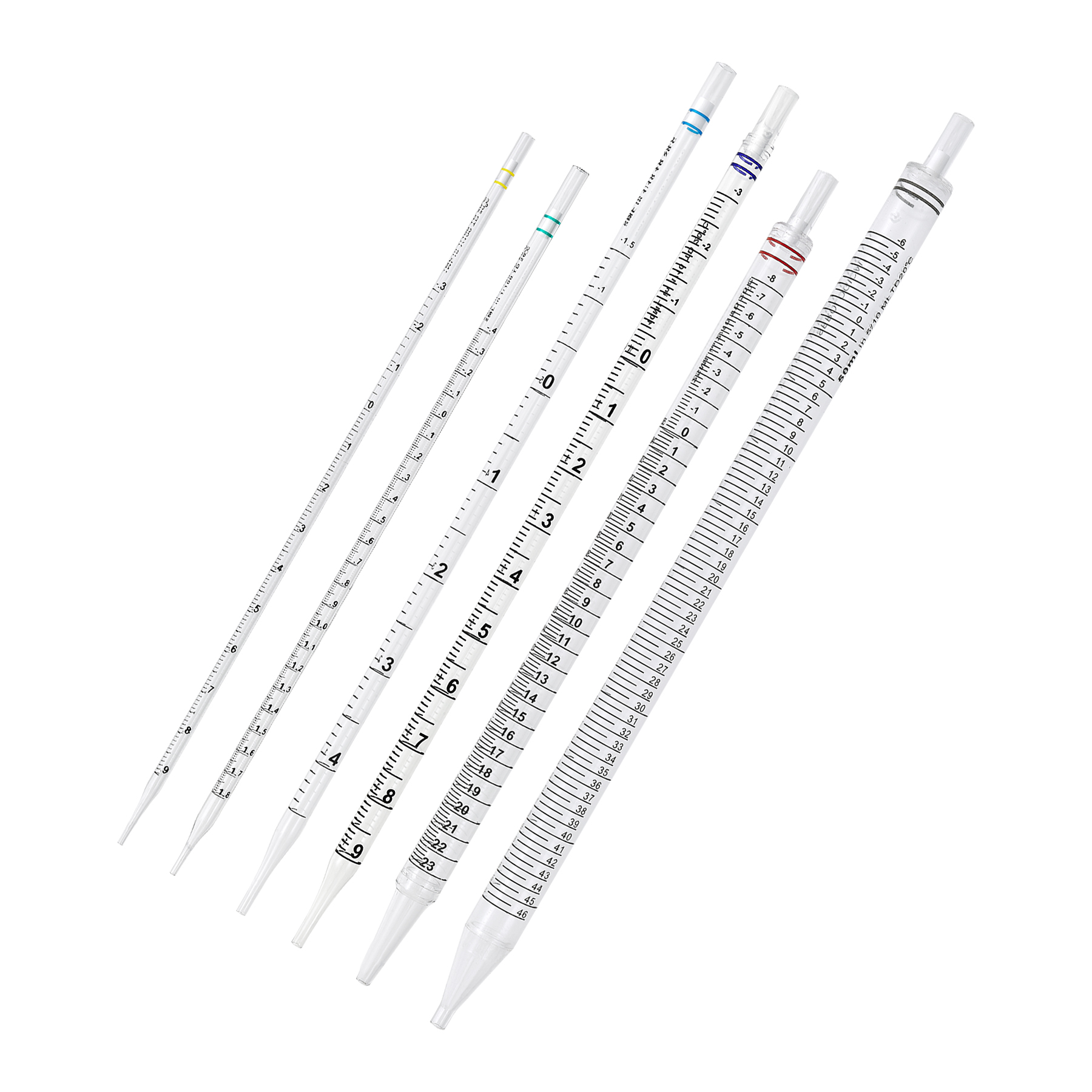
What is a serological pipette?
Used for measuring and delivering volumes (1-25mL) of liquid
These are TD pipettes
Have size color codes on top
What should you use for volumes:
Smaller than 1 mL
Larger than 25 mL
micropipette
serological/volumetric pipette
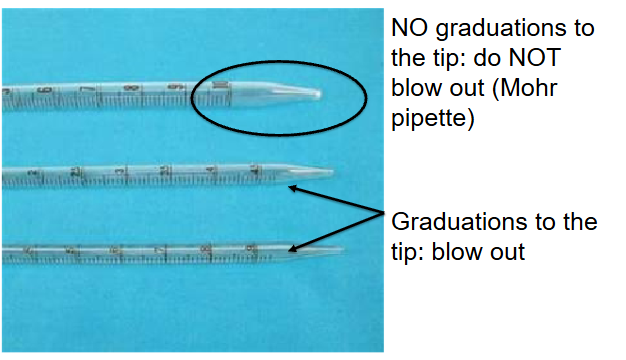
What do frosted rings or double stripes indicate on a serological pipette?
Indicates the pipette requires a “blow out” step to deliver the entire contents of the pipette (including the residual volume)
How are increments labeled on a serological pipette?
1/10 = 0.1 mL increments
1/100 = 0.01 mL increments
What is a safety bulb?
Device used to fill a serological pipette with liquid and deliver the residual volume of liquid left in the tip after the liquid is allowed to drain freely out of the pipette into the receiving vessel
Use a safety bulb to force the residual liquid out of the pipette tip into the receiving vessel with ___ puff(s) of air
One
How do you choose which serological pipette to use?
Choose the pipette size that best approximates the intended delivery volume
How do you use a serological pipette?
With a safety bulb, fill to 0 mark with proper meniscus alignment. Then, allow contents to freely drain. Then, stop the flow and bring meniscus to the targeted volume mark. Blow out
How to use a safety bulb?
Expel air out of bulb
Place bulb on top of pipette, keeping the bulb expelled of air
Slowly release to aspirate liquid into pipette, NOT into bulb; ~1-2 inches above calibration mark
Remove safety bulb from top of pipette and place index finger on top of pipette to stop flow
Wipe outside of pipette
Gently release finger pressure, controlling liquid flow out of pipette
STOP liquid flow when meniscus is properly aligned to calibration mark
After meniscus is in proper alignment, release finger pressure from top of pipette, allowing liquid to freely drain into receiving vessel
When liquid stops draining, place bulb on top of pipette and introduce one puff of air, then remove bulb
Touch pipette tip to inside of receiving vessel to capture residual fluid by capillary action. Any liquid remaining will stay in pipette
Removing pipette without touching or dragging tip along inside wall of vessel
If your eye is positioned above the meniscus, the amount of liquid measured will be falsely ___
LOW
If your eye is positioned below the meniscus, the amount of liquid measured will be falsely ___
HIGH
If a pipette tip has graduations what do you do?
Blow out
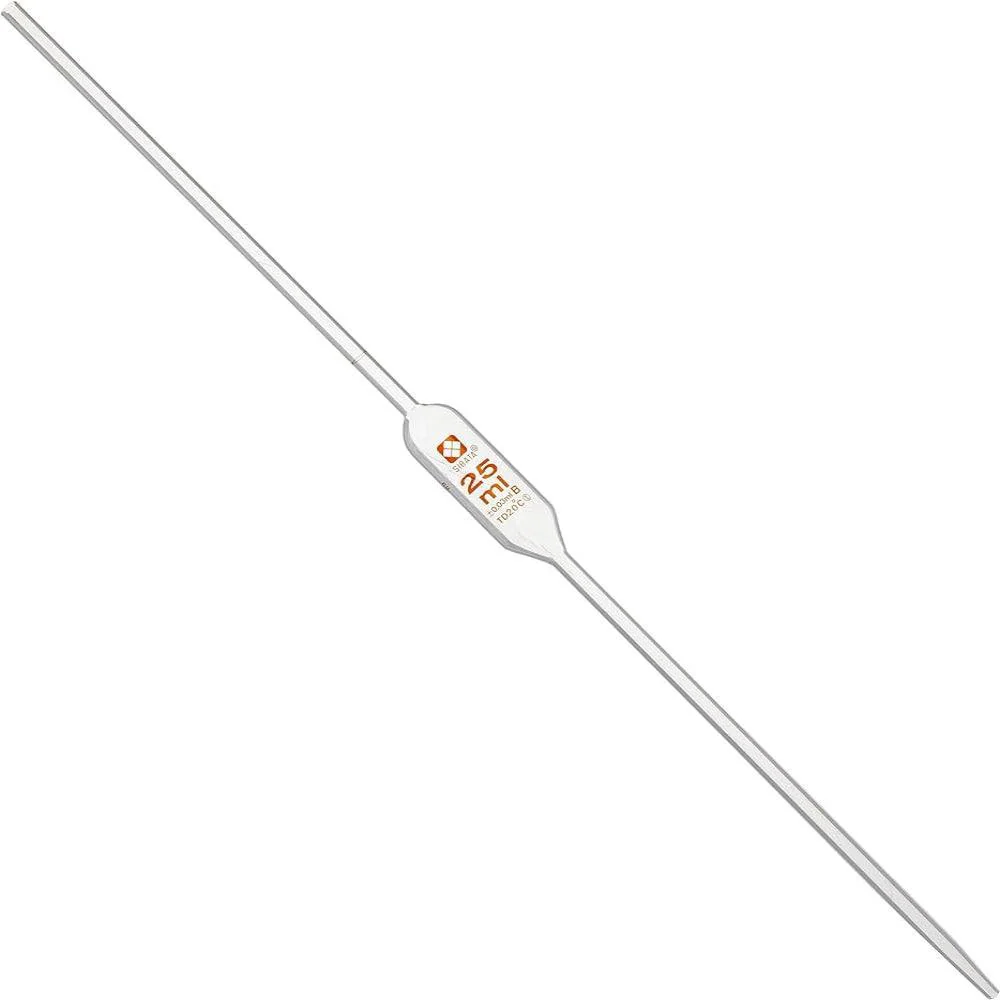
What are volumetric pipettes?
Pipettes designed with an open-ended bulb in the center of a glass/plastic tube, which holds the bulk of the fluid.
There are no volume graduation markings to the tip.
Delivers single, specified volume of liquid
Are serological or volumetric pipettes more accurate?
Volumetric. These are used when greatest accuracy is required (ex: preparation of calibrators, standards)
What are the most common sizes for volumetric pipettes?
5 mL, 10 mL
T/F: The color codes are the same for both volumetric and serological pipettes
False
Do volumetric pipette tips have frosted rings on top?
No, which means no blow out step required
How can you eliminate sources of error when pipetting?
Choose correct pipette size
Use correct technique
Wipe excess fluid off outside pipette properly
Meniscus properly aligned
All samples/equipment at room temperature
Hold pipette vertical
No bubbles
What is the range for micropipettes?
1 uL to 5000 uL (most often up to 1000 uL)
What does “automatic” mean for micropipettes?
Implies the parts of the pipette used to aspirate and dispense volumes is an integral part of the pipette
What happens if you use a 1.0 mL micropipette 5 times to deliver 5.0 mL of liquid?
Each time you pipette, there is a potential of delivering an inherent amount of error. By doing it 5 times, you introduce 5X the amount of error. Use a different pipette.
Single Stop Micropipette
there is only ONE plunger stop to fill pipette tip and dispense liquid into receiving vessel
Double Stop Micropipette
there are TWO plunger stops to fill pipette tip and dispense liquid into receiving vessel
Fixed Volume Micropipette
This pipette delivers one specific volume
Used in laboratories with limited variety of testing procedures
Limitation: fixed volume
Variable Volume Micropipette
This pipette is able to deliver various volumes by changing the indicator dial to the desired volume setting
Used in larger laboratories having a larger testing menu
Limitation: cost; must check calibration at each volume used for testing
Forward Pipetting Technique
Routinely used when pipetting aqueous solutions
Clinical Laboratory: serum, plasma, urine, body fluids
Reverse Pipetting Technique
Not routinely used when pipetting aqueous solutions.
Error: Increases delivery volume
Clinical Laboratory: used when pipetting viscous, dense, volatile solutions such as whole blood, solvents, alcohols
How deep should the micropipette dip be in a liquid?
2-3 mm (small)
4-6 mm (large)
T/F: When delivering the same sample and same sample volume in multiple tubes, use the same tip for improved precision
True
How long should you wait for the sample to fill a micropipette tip?
1 second
What are barrier pipettes and tips?
These types of pipettes and micropipette tips contain a filter acting as a liquid barrier
Prevents contamination between samples
Prevents contamination of equipment
Used when protection from aerosol and liquid contamination is required
Clinical Laboratory: Polymerase Chain Reaction (PCR) techniques
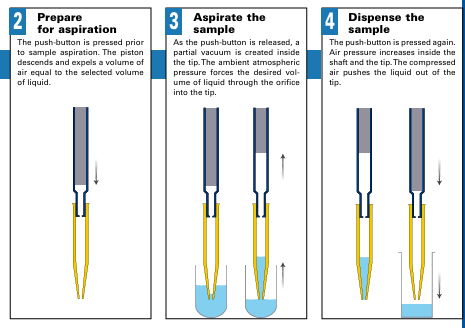
What are air-displacement pipettes?
recommended for aqueous samples and general lab work
always have a cushion of air (dead volume) between pipette piston and liquid sample
piston is permanent part of pipette
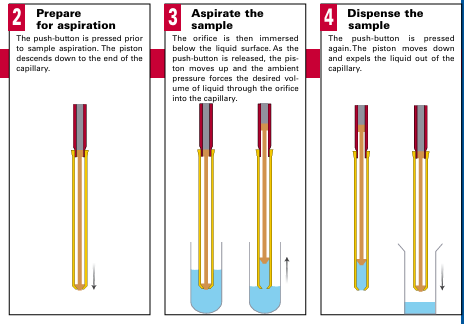
when the push-button is pressed, the piston inside moves down to let air out (displaced)
the volume of air displaced = volume liquid aspirated
What are positive-displacement pipettes?
recommended for problem samples (viscous, dense, volatile, radioactive, corrosive)
direct contact of piston with sample (no air cushion)
disposable piston
works like syringes
with no elastic air cushion, aspiration force is constant, unaffected by physical properties of sample
What would be the appropriate immersion depth for these volumes?
0.1-1 uL
1 - 100 uL
101 - 1000 uL
1001 uL - 10 mL
1 mm
2-3 mm
2-4 mm
3-6 mm
What is the difference in technique between forward and reverse mode on air-displacement micropipettes?
Forward: go to first top before aspiration
Reverse: go to second stop before aspiration
What are the most used laboratory instruments?
variable volume air displacement single channel pipettes because of its versatility and wide volume range
What are multichannel pipettes commonly usd for?
microplate applications like ELISA, PCR, or cell culture
What is the most commonly used function of electronic pipettes?
aliquoting a reagent into multiple doses (stepper mode)
What are serological pipettes used for in a lab?
cell and tissue culture applications; general laboratory liquid dosage
What is a bulk reagent dispenser useful for?
it is reliable and easy for dispensing reagents directly from reagent bottle
What causes a micropipette to become contaminated in its interior? And what should you when this happens?
Causes
laying a filled micropipette on its side
holding a filled micropipette upside down
snap back plunger
Action
take it out of service and notify instructor
What causes this error: Distorts flow of liquid, resulting in an inaccurate volume of liquid delivered to RV (receiving vessel)
Allowing pipette tip to come in contact with the liquid already present in the RV