BIO201 Exam 1
 Call Kai
 Learn
Learn Practice Test
 Spaced Repetition
 Match
Match Flashcards
 Knowt Play
1/167

There's no tags or description
Looks like no tags are added yet.
Name | Mastery | Learn | Test | Matching | Spaced | Call with Kai | Chat |
|---|
No analytics yet
Send a link to your students to track their progress
168 Terms
in general, a negative result needs to be supported by what kind of control?
positive control
which type of graph is a better choice for categorical rather than continuous data, line or bar graph?
bar graph
True or false: circular DNA molecules are only found in prokaryotic cells.
false: circular DNA can also be found in the mitochondria and chloroplasts
2 structural differences and 2 similarities between plant and animal cells
plant cells have a cell wall and chloroplasts, animal cells do not, many small Golgi units for plants, usually one prominent Golgi complex for animals, plant cells are often larger than animal cells
both cells have a plasma membrane, membrane-bound organelles, linear chromosomes that are packages with histones, DNA inside membrane-bound nucleus, cytoplasm, ribosomes, rough and smooth ER, Golgi apparatus, lysosomes, same genetic code, cytoskeleton (nucleus and cell membrane main)
Is it possible to predict whether a large plant, such as an oak tree, will have a bigger genome than a small plant, such as a daffodil? (can we predict genome size?)
no — very broad generalizations can be made (eukaryotes generally have bigger genomes that prokaryotes, vertebrates generally have bigger genomes than fungi) but cannot be more specific
5 themes of life
structure and function
transformation of matter and energy
information storage, transmission, and flow
interactions between and within systems
evolution
The six most commonly used model organisms in biology are Arabidopsis (a plant), fruit flies, mice, C. elegans (a nematode), yeast, and E. coli. E. coli is a prokaryote. What processes would you be unable to study using E. coli?
transport of necessary proteins into and out of the nucleus
mechanisms by which cells differentiate (specialize into different tissue types)
eubacteria are single-celled organisms and do not differentiate into multiple types of tissue, also do not have a nucleus
what are some processes we can use to study E. coli?
transport of necessary ions into and out of the cell
transcription of DNA into RNA
metabolism of food sources into chemical energy
what is the experimental group, positive control, and negative control?
finding out whether the protein YFP1 is found in the cell membrane — experiment where you fluorescently tag the protein, induce its production, and monitor fluorescent over time in different parts of the cell, also similarly tag and monitor the CFTR protein (found in the cell membrane) and TUBA1C protein (found throughout the cytoplasm)
experimental group: YFP1
positive control: CFTR
negative control: TUBA1C
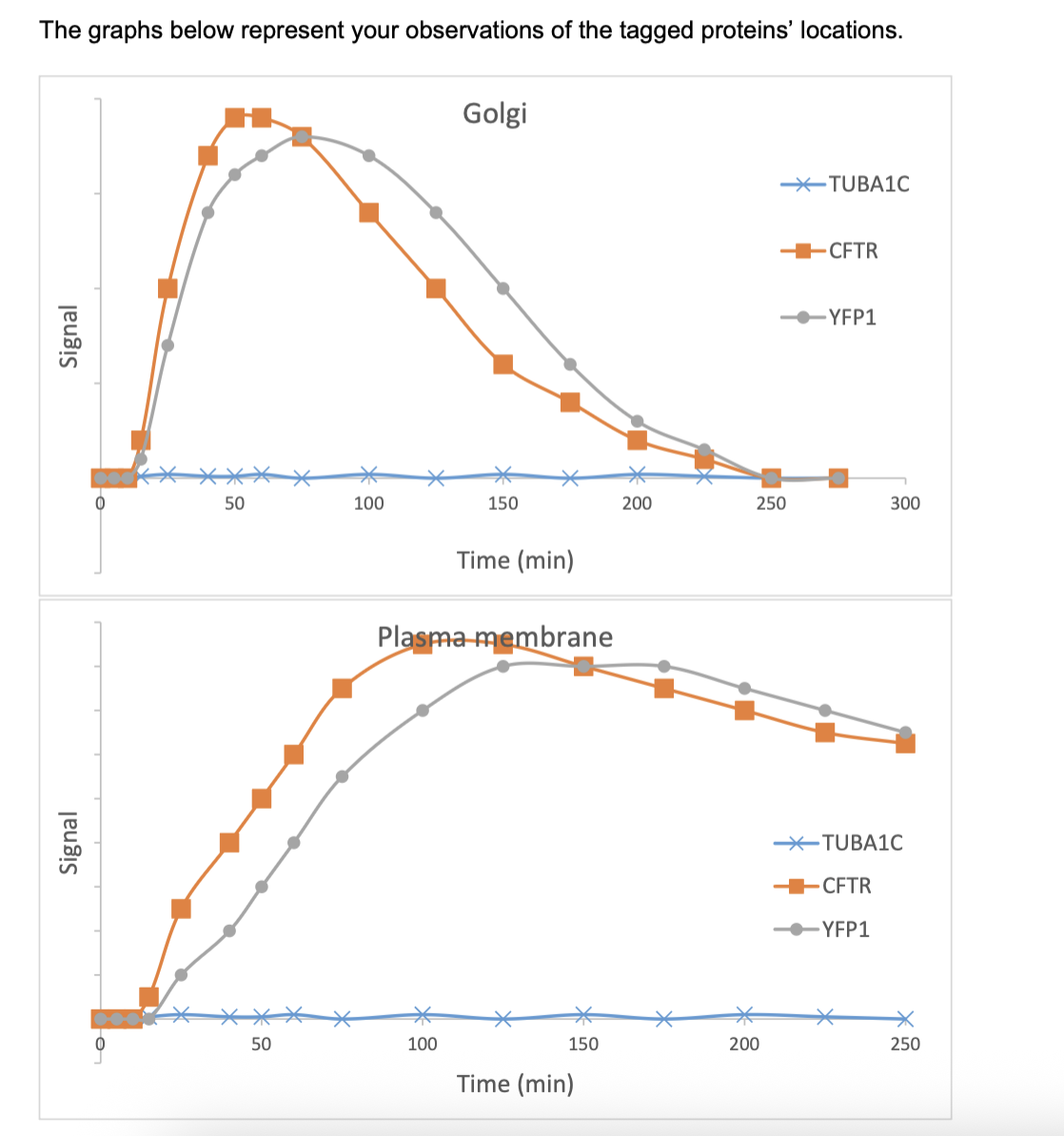
Independent and dependent variable in the graph
did the controls work as expected?
what can we conclude about YFP1 localization in the cell?
independent: which protein was tagged and observed
dependent: signal strength/amount of fluorescence observed
controls did work as expected because CFTR was found in the Golgi and then in the plasma membrane, and TUBA1C was not
YFP1 is in the cell membrane

which graph would have been different if YFP1 were a secreted protein and why?
secreted = protein reaches cell membrane, crosses it, and diffuses away in extracellular fluid
if secreted, would not accumulate in the plasma membrane and the curve on the plasma membrane graph would look more similar to the one for the Golgi but just shifted to the right on the X axis

observations of RER and cytoplasm — would would the graphs look like?
CFTR & YFP1: RER graph would show signal present at the start and then none; TUBA1C would not be seen
CFTR & YFP1: cytoplasm graph would show signal very close to zero at all the points observed; TUBA1C should show a rapid increase to some max level followed by slow decrease as the proteins produced naturally degrade over time

arrange the following in order from the one that makes the fewest bonds to most: carbon, hydrogen, nitrogen, oxygen
hydrogen < oxygen < nitrogen < carbon
difference between a non polar covalent bond and a polar covalent bond
non polar covalent bond is between atoms that have the same/similar electronegativity (difference ≤ 0.4)
polar covalent bond is between atoms with greater difference in electronegativity (difference 0.4-1.8)
most polar covalent bonds that will be seen in this course is going to involve either oxygen or nitrogen
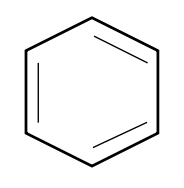
how many carbons and hydrogens does benzene have?
6 carbons, 6 hydrogens

water-soluble or not?
yes
has hydrocarbons but also nitrogens and oxygens around its perimeter which makes it fairly water-soluble

water soluble or not?
no
almost entirely hydrocarbons, with only one H-bond donor and one acceptor → insoluble in water, but soluble in lipids

water soluble or not?
yes
has hydrocarbons but also nitrogens and oxygens around the perimeter
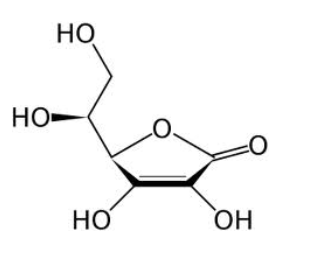
water soluble or not?
yes
has carbonyls and hydroxyls (more than enough) to compensate for a few carbon atoms

water soluble or not?
no
the benzene ring, three more hydrocarbons, single amino group - non polar

possible interactions between molecule and water
OH2 — O bonds with the H from NH2 group, H2O — H bonds to N

features of prokaryotes (bacteria, e.g., E. coli)
no nucleus, DNA located in a nucleotide region, usually one main circular chromosome, may contain plasmids, no membrane-bound organelle, ribosomes are present, transcription and translation can occur in the same general cellular region, usually smaller and structurally simpler
eukaryotes (yeast, plants, animals, and fungi)
nucleus surrounded by a nuclear envelope, multiple linear chromosomes, membrane-bound organelles, ribosomes, more extensive internal compartmentalization, transcription occurs in the nucleus, translation occurs in the cytoplasm or on the RERg
what is a genome?
complete genetic material of an organism
what does a bacterial genome commonly include
a main circular chromosome, genes arranged in a compact region (nucleoid), optional plasmids, relatively little noncoding DNA compared compared with many eukaryotes, genes sometimes arranged in operons
what does a eukaryotic genome generally include
multiple linear chromosomes, DNA associated with histone proteins, nucleus, noncoding regions, regulatory DNA, introns and exons in many genes, mitochondrial DNA
intron
non-coding DNA sequences, any nucleotide sequence within a gene that is not expressive/operative in the final RNA product, removed by RNA splicing, found only in eukaryotes
exons
protein-coding DNA sequences that require the necessary codons/information necessary for protein synthesis, found in eukaryotes and prokaryotes
yeast as a eukaryotic model organism
good because it has nucleus and can be used to study eukaryotic processes while remaining relatively easy to grow and genetically manipulate, able to perform many eukaryotic cellular processes, and normal and mutant forms
genotype
the genetic information an organism possesses
change genotype can cause a change in phenotype
phenotype
observable characteristics: colony color, growth rate, shape, metabolism
phenotype can also change without a change in genotype
cytoplasmic proteins
protein synthesized on free ribosomes generally remains in the cytoplasm unless it contains a targeting signal
secreted proteins
ribosome on the RER → RER lumen → transport vesicle → Golgi apparatus → secretory vesicle → plasma membrane → extracellular space
what type of proteins are antibodies?
antibodies are secreted proteins and so they are synthesized on ribosomes associated with the RER and then pass through the Golgi apparatus
membrane proteins
synthesized on ribosomes associated with the RER — inserted into the ER membrane, transported through the Golgi, and delivered to the plasma membrane
what groups can water form hydrogen bonds with
hydroxyl groups, amino groups, carbonyl groups, charged groups
phospholipid bilayer
hydrophobic, so molecules that are small and nonpolar/hydrophobic will cross relatively easily
examples of molecules that can cross across a phospholipid bilayer easily
O2, CO2, steroid hormones, some weak acids in their uncharged form
molecules that cross poorly across a phospholipid bilayer
ions, large polar molecules, strongly charged molecules, large proteins, nucleic acidswh
what do molecules that cross the phospholipid bilayer usually require
channels, transporters, pumps, endocytosis/exocytosis
what does every amino acid have?
an amino group, carboxyl group, central alpha carbon, hydrogen, R groupw
what determines the amino acid’s chemical properties?
R group — polar, nonpolar, acidic, basic
nonpolar amino acids
R groups are mostly hydrocarbon and tend to be buried inside water-soluble proteins
polar uncharged amino acids
R groups can form hydrogen bonds but do not usually carry a full charge at physiological pH
acidic amino acids
R groups are usually negatively charged in cellsb
basic amino acids
R groups are usually positively charged in cells
primary structure of a protein
amino acid sequence that is held together by peptide bonds, which is a covalent bond between the carboxyl group of one amino acid and the amino group of another
secondary structure of a protein
alpha helices, beta sheets
stabilized mainly by hydrogen bonds between backbone groups: carbonyl oxygen, N-H hydrogen
tertiary structure of a protein
the overall 3-D shape of one polypeptide chain
involves hydrophobic interactions, hydrogen bonds between R groups, ionic interactions, disulfide bonds, van der Waals interactions
quaternary structure of proteins
how multiple polypeptide chains interact
stabilized by hydrophobic interactions, ionic interactions, hydrogen bonds, disulfide bonds
quaternary vs tertiary protein structure
a protein does not need multiple chains to have tertiary structure, but it must have multiple chains to have quaternary structure
protein variation
if a protein has n amino acids and each position can contain any of the 20 amino acids, possible sequences = 20^n
structure of an antibody
typically contains
2 identical heavy chains
2 identical light chains
disulfide bonds connecting chains
constant regions
variable antigen-binding regions
variable regions of antibodies and antibody-antigen binding
variable regions recognize antigens, and antibody-antigen binding can involve hydrogen bonds, ionic interactions, hydrophobic interactions, van der Waals interactions
exposed binding surfaces of antibodies
because they function in blood (aqueous environment), the exposed binding surfaces of antibodies often contain polar or charged groupsb
4 major classes of biomolecules
proteins, lipids, polysaccharides, nucleic acidspr
proteins — examples and common cellular locations
enzymes, antibodies, channels
found everywhere in the cell
lipids
phospholipids, steroids
found in membranes, droplets, signaling
polysaccharides
cell walls, glycogen
found in cell walls, storage
nucleic acids
DNA, RNA
found in nucleus, cytoplasm, ribosomes
how does yeast DNA extraction separates biomolecules
separation is based on properties such as solubility:
lyticase breaks down the yeast cells wall → SDS disrupts membranes and denatures proteins → potassium acetate helps precipitate denatured proteins and debris → centrifugation separates debris from nucleic acid containing supernatant → isopropanol precipitates nucleic acids → ethanol washes away excess salt → TE buffer redissolves the nucleic acids
solubility
substance is soluble when it interacts favorable with the solvent
hydrophilic molecules have
charged groups, many exposed polar groups, hydrogen-bond donors, hydrogen-bond acceptors
hydrophobic molecules generally have
large hydrocarbon regions, few polar groups, few charged groups
best test of prediction of solubility
place the substance in water and observe whether it dissolves
positive control is known soluble substance, known insoluble substance is negative control
yeast RNA types
mRNA, rRNA, tRNA, other noncoding RNAs
mRNA
carries coding information from DNA, used to make proteins
rRNA
forms part of ribosomes, helps catalyze peptide-bond formation
tRNA
carries amino acids to the ribosome, matches anticodons with mRNA codons
other noncoding RNAs
helps with RNA processing, gene regulation, ribosome production, splicing
RNase
enzyme that degrade RNA — if a sample has both DNA and RNA, RNase treatment reduces/removes DNA, and DNA should remain mostly intact
RNA signal may disappear/become much less visible after RNase treatment on agarose gel
EcoRI
restriction enzyme that cuts DNA at a specific recognition sequence
if DNA contains several EcoRI sites, it is cut into multiple fragments (# of fragments depends on the number and arrangement of cutting sites), smaller fragments travel farther through an agarose gel, larger fragments remain closer to the wells
restriction-enzyme cutting frequency
expected frequency = 1/4^n
ELISA
used to detect or quantify a specific protein, antibody, or antigen
antisense oligonucleotide technology
uses short nucleic-acid sequence that binds a target mRNA and interferes with translation/promotes mRNA degradation; used to reduce expression of a specific gene
SDS-PAGE
separates proteins mainly by size after sis gives them similar charge-to-mass ratios
smaller proteins migrate farther through the gelW
Western blot
uses antibodies to detect a specific protein after gel electrophoresis
is the protein present? is the size correct? is its abundance changed?
immunohistochemistry
uses antibodies to determine where a protein is located in cells or tissues
useful for testing localization (e.g., is a receptor in the nucleus?)
x-ray crystallography
determines the 3-D structure of crystallized molecules
useful for high-resolution structural information
cryogenic electron microscopy
determines structures of large molecules or complexes frozen in near-relative conditions
useful for when crystallization is difficult
mutational analysis
changes a gene/protein sequence and observes the effect
useful for identifying functional regions, binding sites, structural residues, localization signals, catalytic residues
what DNA change causes a missense mutation
usually caused by a base substitution that changes a codon into a different codon specifying a different amino acid
resulting protein then has a changed primary structure
silent mutation
base substitution, but same amino acid
nonsense mutation
base substitution has led to a new amino acid that is a stop codon
single-base insertion
frameshift mutation
codons are read in groups of 3, so inserting one base shifts the reading frame for every codon after the insertion
possible effects of frameshift mutation
many amino acids change, premature stop codon appears, protein becomes shortened, protein folds incorrectly, protein loses its function
three-base insertion
does not shift the reading frame, but adds one amino acid
how can a missense mutation affect tertiary structure?
missense mutation changes one amino acid in the primary sequence — effect depends on location and chemical difference
conservative change from missense mutation
one amino acid is replaced by another with similar properties → little or no effect on folding
nonconservative change
nonpolar amino acid is replaced by a charged/polar amino acid or vice versa
change in hydrophobic interactions and bonding, ionic interactions change, buried hydrophobic region becomes unstable, new charge appears, protein folds differently, active site changes, protein is degraded
key chain of reasoning for mutation
DNA mutation → altered codon → altered amino acid sequence → altered chemical interactions → altered tertiary structure → altered function
predicting interactions of molecules — nonpolar molecules
hydrophobic and van der Waals interactions
predicting interactions - charged molecule
ionic interactions with oppositely charged groups
predicting interactions - polar molecule
hydrogen bonds
enzymes in metabolic pathways
enzymatic pathway is a sequence of reactions where each enzyme usually catalyzes one particular step
interpreting pathway mutations: A → B → C → D
mutation disables enzyme that converts B into C
less C and D, more B, possibly normal amounts of A
feedback inhibition
in many pathways, final product inhibits an early enzyme where A → B → C → final product
if there is already plenty of final product, the pathway is slowed or stopped, which conserves energy and raw materials
what does SDS do?
2 major effects: unfolds proteins, making them more linear; coats proteins with negative charge
proteins have similar charge-to-mass ratios after SDS treatment, main factor affecting their movement through the gel is size
separates proteins primarily by size
what can SDS-PAGE tell you
how many major protein bands are present, approximate protein sizes, whether a protein sample is relatively pure, whether total protein patterns differ between samples
limitation of SDS-PAGE
SDS-PAGE alone usually cannot identify a specific protein because many different proteins can have similar molecular masses