K211: Augmented Feedback + Observational Learning + Motor Imagery
 Studied by 0 people
 Call Kai
 Learn
Learn Practice Test
 Spaced Repetition
 Match
Match Flashcards
 Knowt Play
1/80

There's no tags or description
Looks like no tags are added yet.
Name | Mastery | Learn | Test | Matching | Spaced |
|---|
No study sessions yet.
81 Terms
Four reasons were presented as to why people may
choose to use physical guidance techniques. Which
of the following is NOT a reason?
a) To reduce risk of injury
b) To develop in the learner a 'sensory reference'
c) To increase variability
d) To encourage engagement/motivate
e) To allow attention to other task components
r
c) to increase variabilty
types of feedback
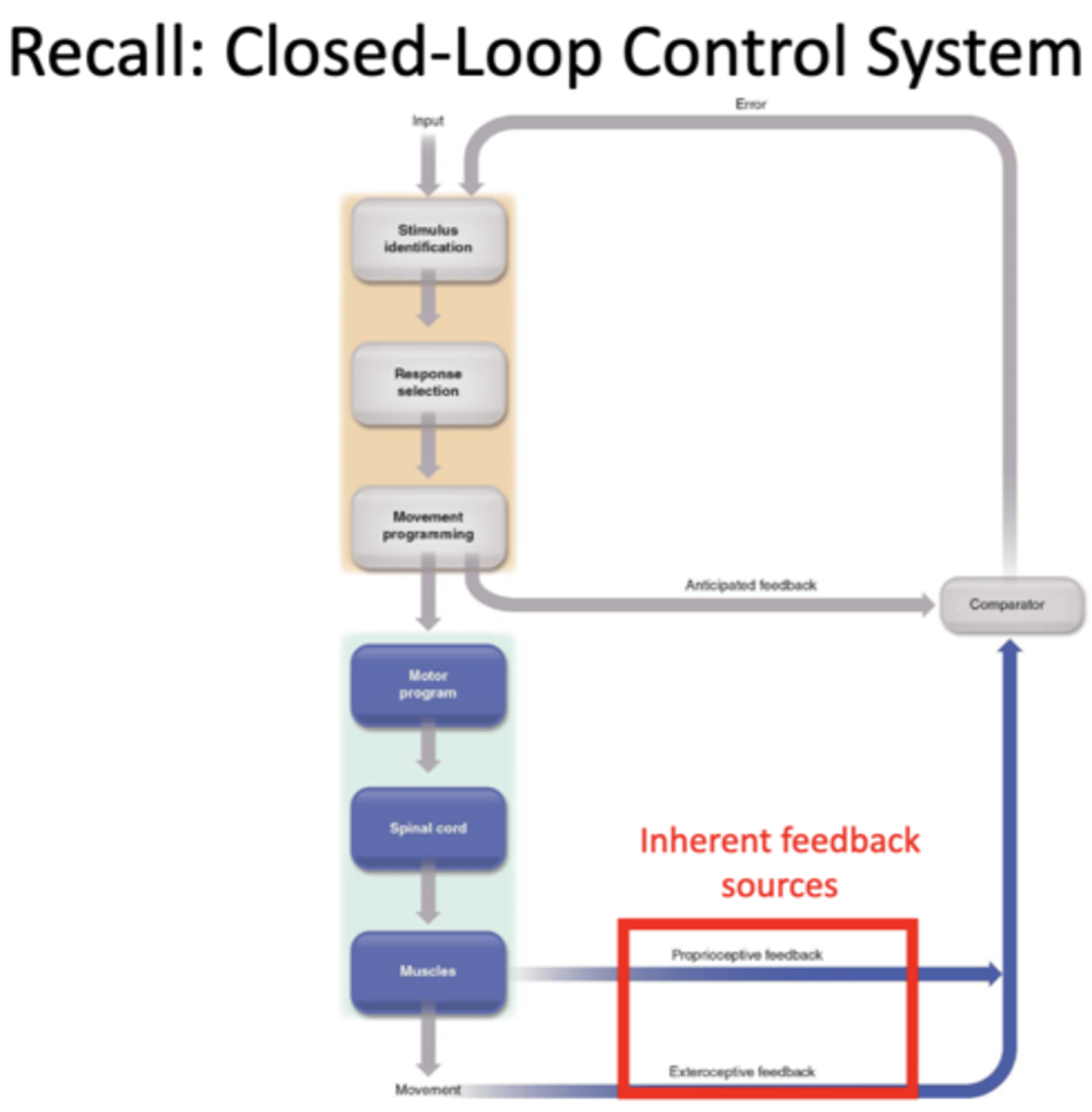
Inherent FB (intrinsic /response-produced sensory)
Augmented FB (extrinsic/ not naturally occurring)
Inherent FB (intrinsic / response-produced sensory)
sensory feedback internal to us
recall. closed loop control system. where would inherent feedback sources be
proprioceptive and exteroceptive feedback
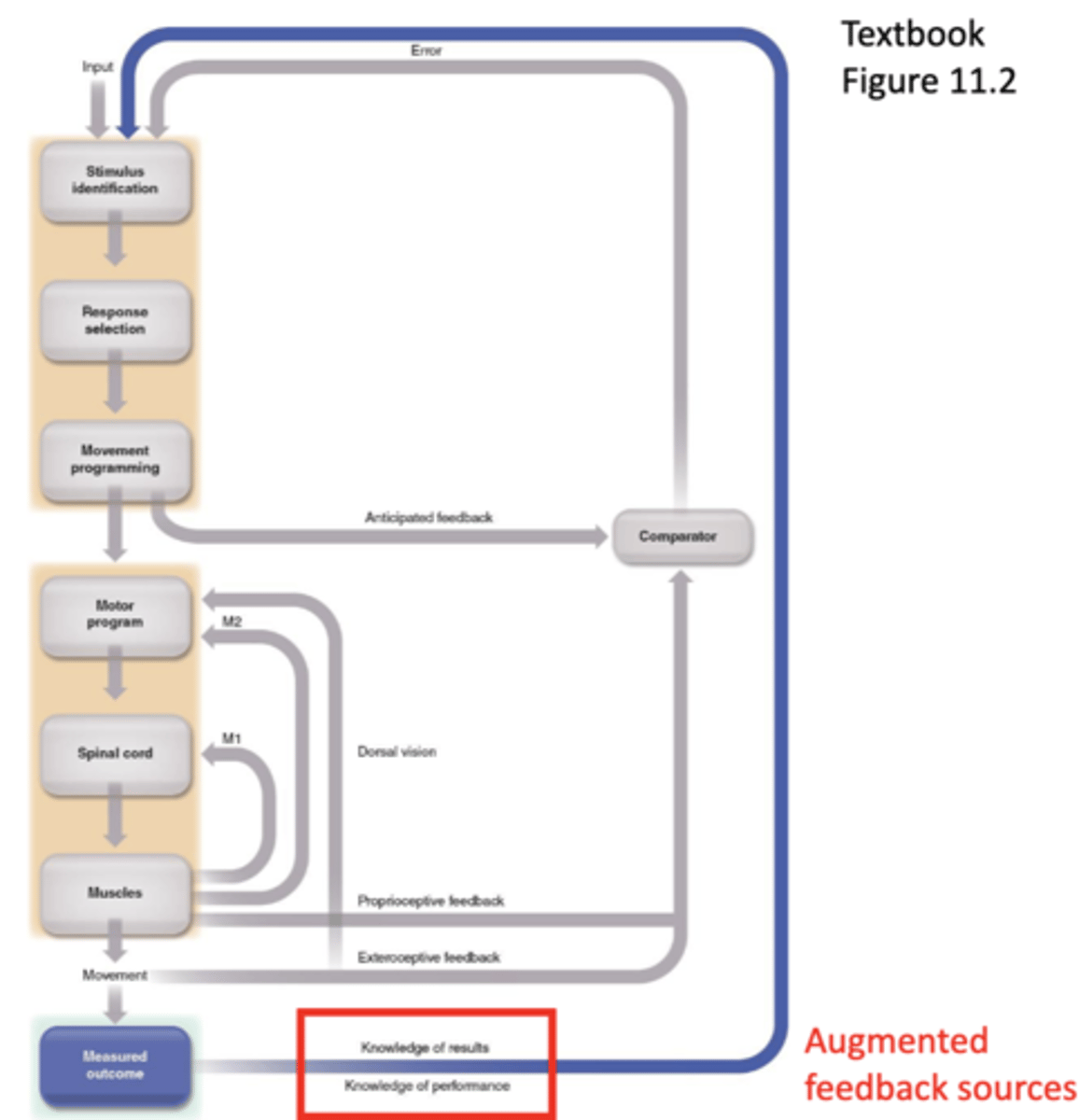
Augmented FB (extrinsic/ not naturally occurring) is two types
Knowledge of results (KR)
knowledge of performance (KP)
where would augmented feedback be in closed loop system
measured outcome.
Augmented feedback definition:
movement-related information provided by extrinsic source
What is augmented FB?
adds to a performer’s intrinsic FB
provides info about the movement or movement outcome
Given by instructor, video or device
Four ways that Augmented Feedback functions
1. MOTIVATIONAL ROLE
provides reward fx “good job”
2. ATTENTION-DIRECTING ROLE
you can direct attention with FB
3. INFORMATIONAL ROLE
provides error/accuracy info
4. DEPENDENCY ROLE
guidance hypo: fb is used as a crutch
Knowledge of Results (KR) is? When is it important?
information on outcome (in relation to a goal)
It’s important when:
Learner cannot assess their own success
Helps improve next attempt by detecting error
Knowledge of Performance (KP) is
information about movement quality/form (kinematics).
Concerned with quality of the mvmt pattern
It doesn’t say anything about goal success
You can find out WHY the success worked
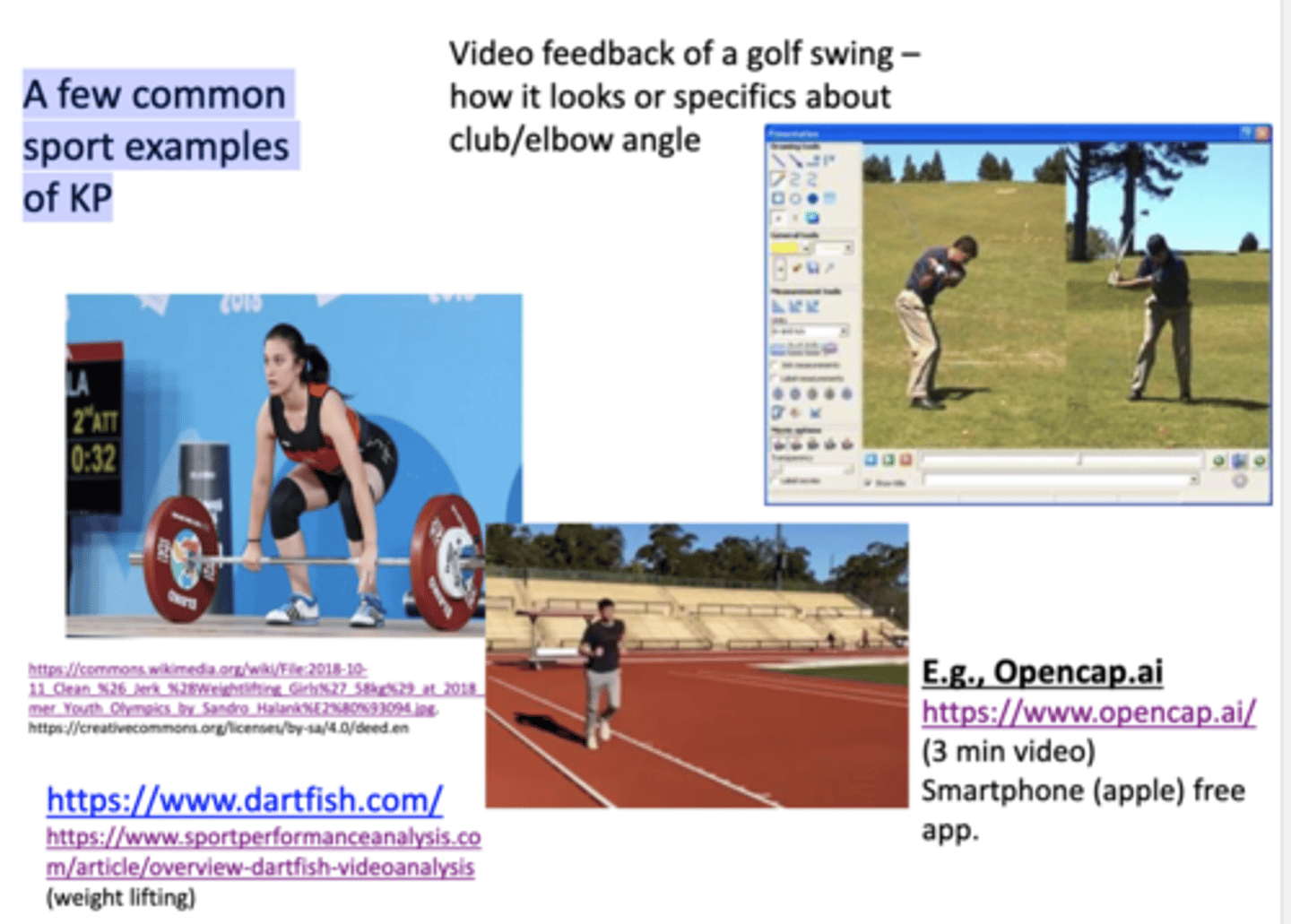
Common examples of KP
dartfish, ironpath
Video/motion feedback. What kind of FB is it and is it enough?
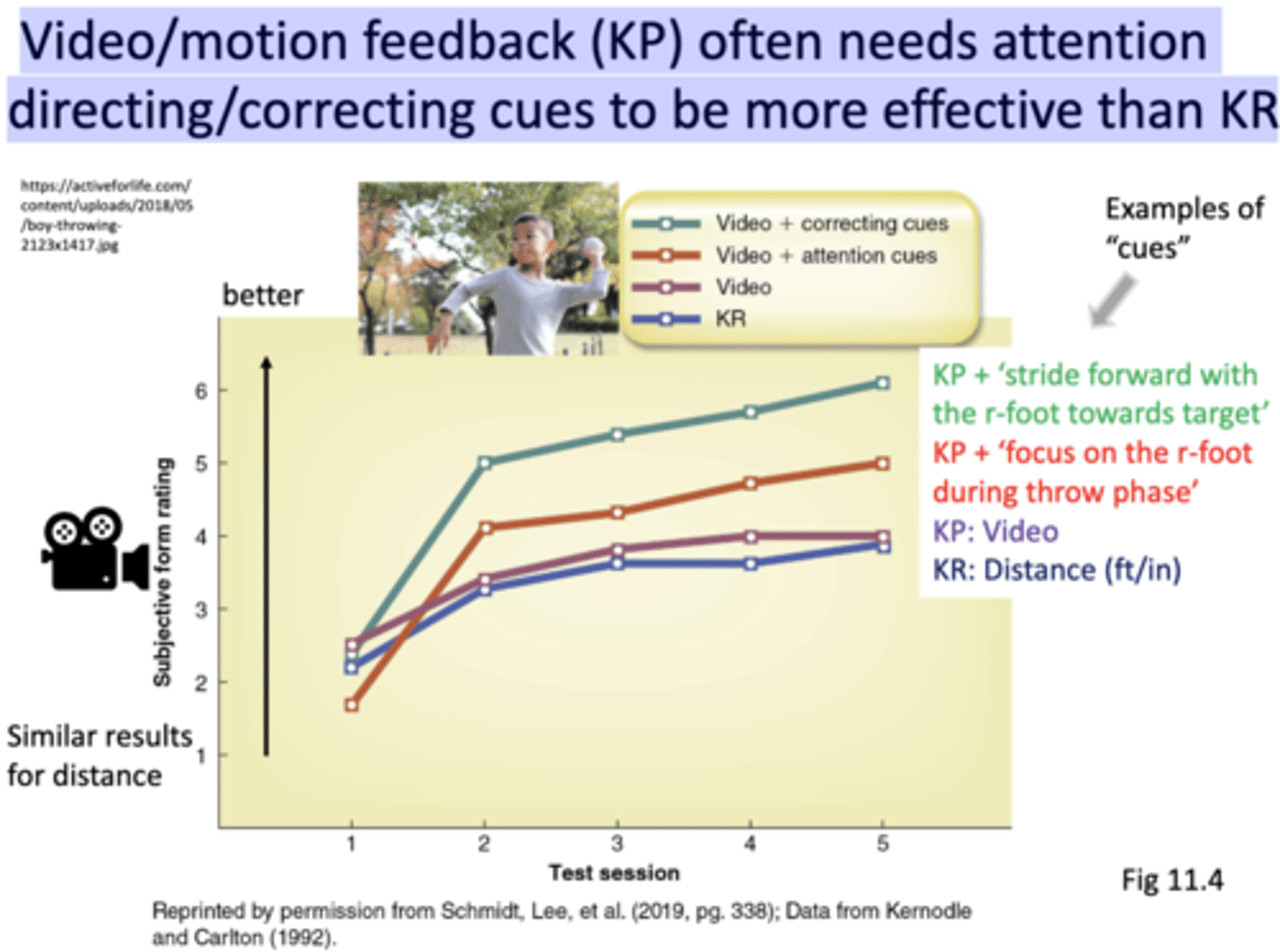
Video/motion FB is KP
Video FB is NOT enough, we want to supplement with additional info.
We want to direct people’s attention on where to look on the video
Bio or neuro-feedback
Electronic feedback of internal biological processes
e.g. EMG, HR, blood pressure
can KR and KP overlap?
Yes, they overlap when:
situations where the goal is the movement e.g. diving
score that person is given is both KR and KP
if goal is target HR, HR is both KR and KP
Problems with too much KP
Too much information (overload)
Directs attention internally
discourage ‘active learning’ via dependency
Direction of attention
Matters for performance. Can be internal or external. External (KR) is better than KP (internal)
• Two main types of augmented feedback
KR: related to an env goal
KP: how the mvmt itself was produced
• Often it's not enough to just show people what they did when
giving KP through video feedback for example, we often have
to
direct them to key information sources (error detection).
• Both KR and KP serve 4 functions:
Motivate, give info about error, direct attention, give guidance
• KP can inadvertently
direct focus of attention internally
Be overwhelming with info overload
cause reliance due to guidance
Feedback is similar to what, causing dependency..
physical guidance. Used as a crutch, stops active problem solving which causes issues in transfer when it’s not there
General term for how often/how much FB? What are the methods for reducing that?
Feedback frequency (every trial or some trials?)
-Methods for reducing frequency:
Bandwidth FB
Fading FB
Summary FB
Average FB
When to give FB?
During = concurrent
After = terminal
Immediately or after a delay
2 ways to measure feedback frequency
1. Absolute Frequency:
Total number of feedback presentations
2. Relative Frequency
% of trials in which FB given
relative frequency formula
total number of feedback presentations / total number of movement attempts x 100
Is more frequent feedback better than less frequent feedback for learning?
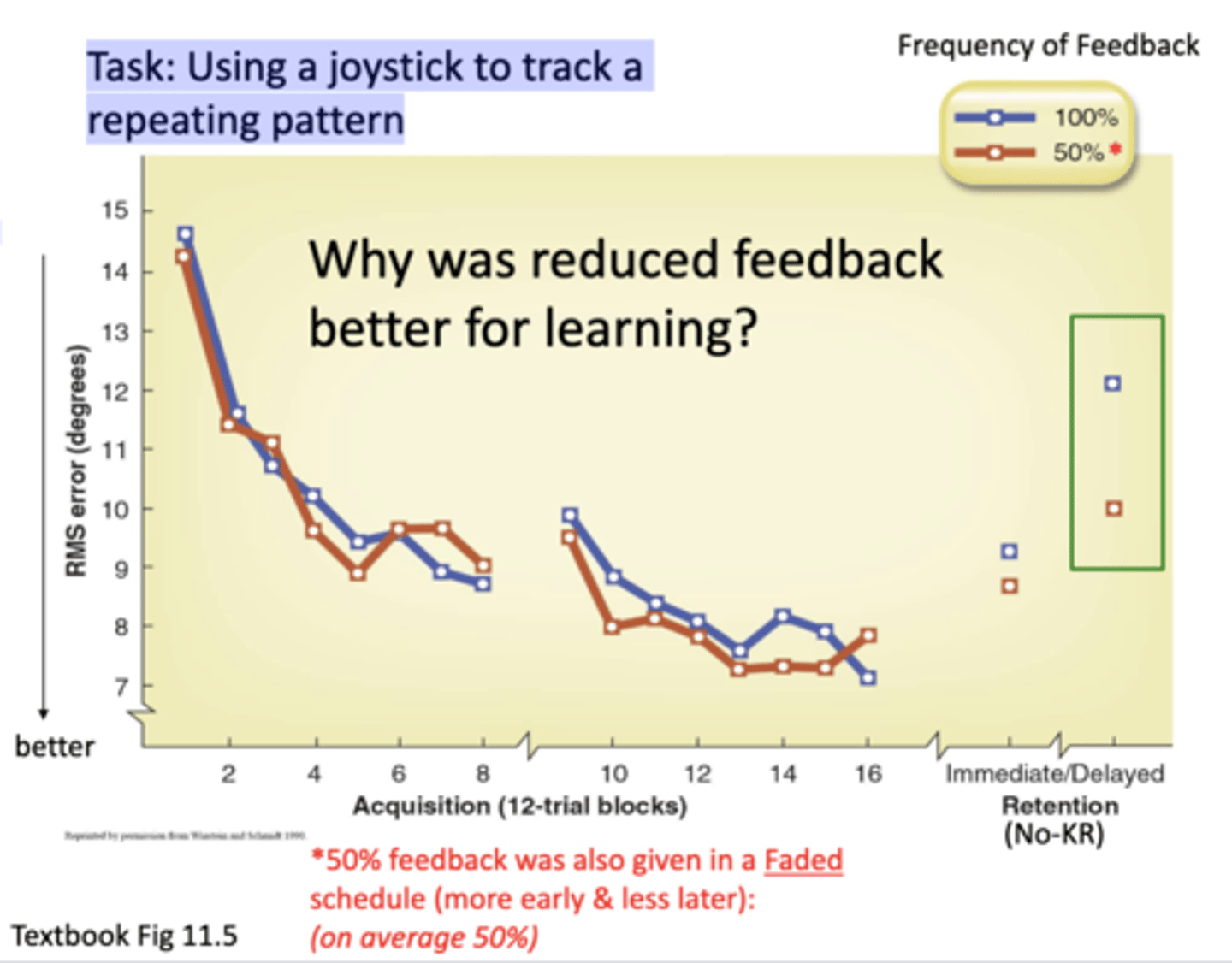
Task: Using a joystick to track a repeating pattern
Study: Gun shooting with 100% vs 50% feedback with faded feedback (where you start with almost 100% FB but gradually drop to 50%)
Result: In retention without any FB, 50% group did better than 100% group
Guidance hypothesis
a failure to properly process intrinsic feedback
Coach giving info → don’t have to pay attn to internal FB → fail in transfer because coach not present there
The __________________ is critical for testing for
dependency
No-KR retention test
Guidance hypothesis can occur if FB is
provided too frequently
concurrent with performance
provided too quickly after practice attempt
What is one way to reduce amount of feedback?
Bandwidth FB
Bandwidth feedback (FB) is a
is a useful method to reduce feedback. Only give FB when errors fall outside ‘bandwidth of acceptability'
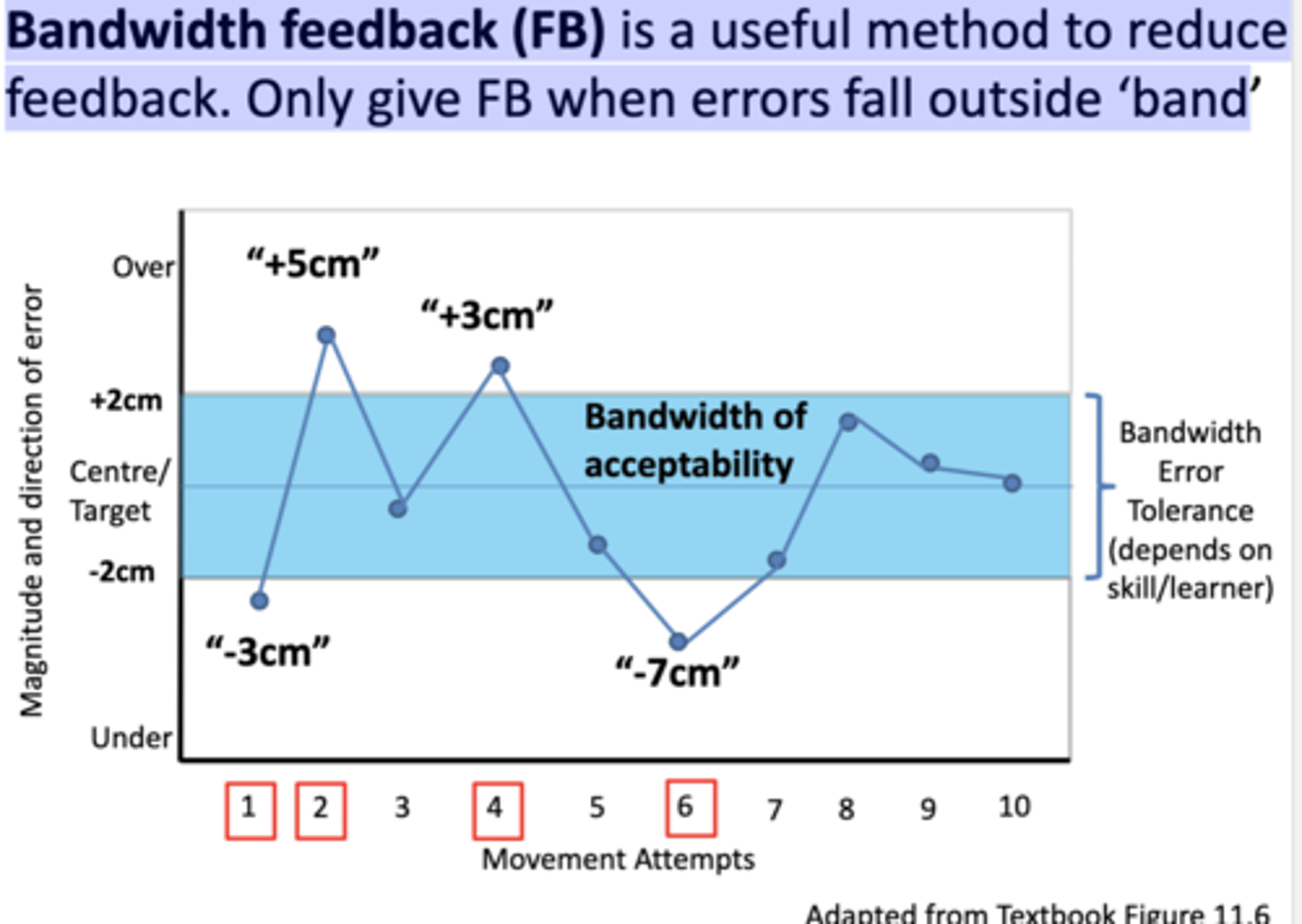
3 reasons why bandwidth feedback is more effective than feedback every trial
1. Motivation as less FB means they’re correct
2. Good for stability. Not trying to correct/adjust on every trial.
*Correcting small errors from trial to trial can be harmful, especially as a novice. you don't have the motor proficiency to yet control those errors
3. Prevents dependency. Frequency of feedback decreased (faded schedule).
WHEN: FB given “during” trial is called? It’s similar to what?
Concurrent FB
Similar to physical guidance
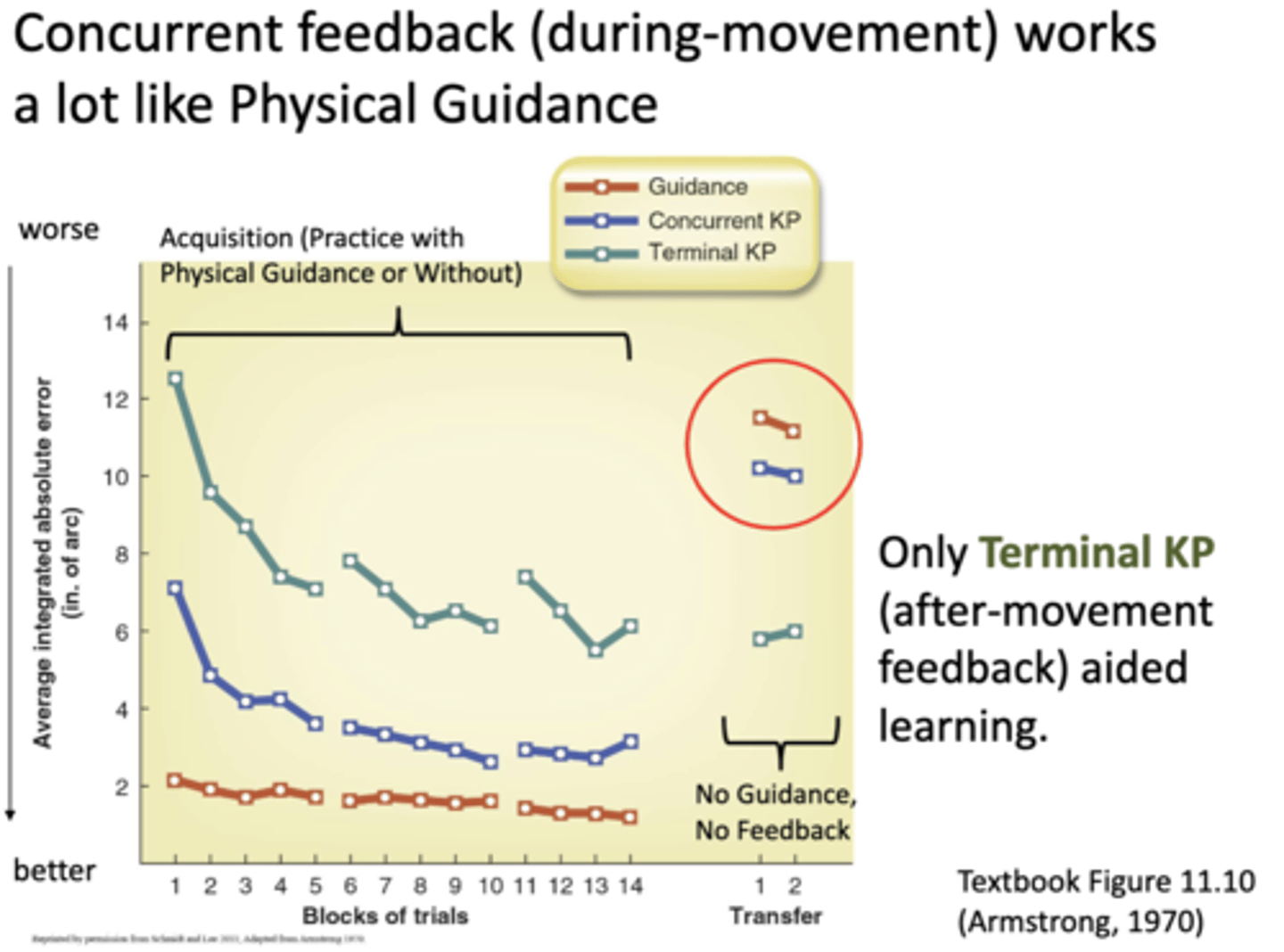
Study that talks about WHEN of FB
Armstrong study
Task:
3 levels of feedback: Guidance, Concurrent and Terminal
Outcome
Only terminal FB (after-movement) aided learning
Concurrent and guidance fb were good at practice but horrible at transfer because crutch not there
When to give feedback post trial? why?
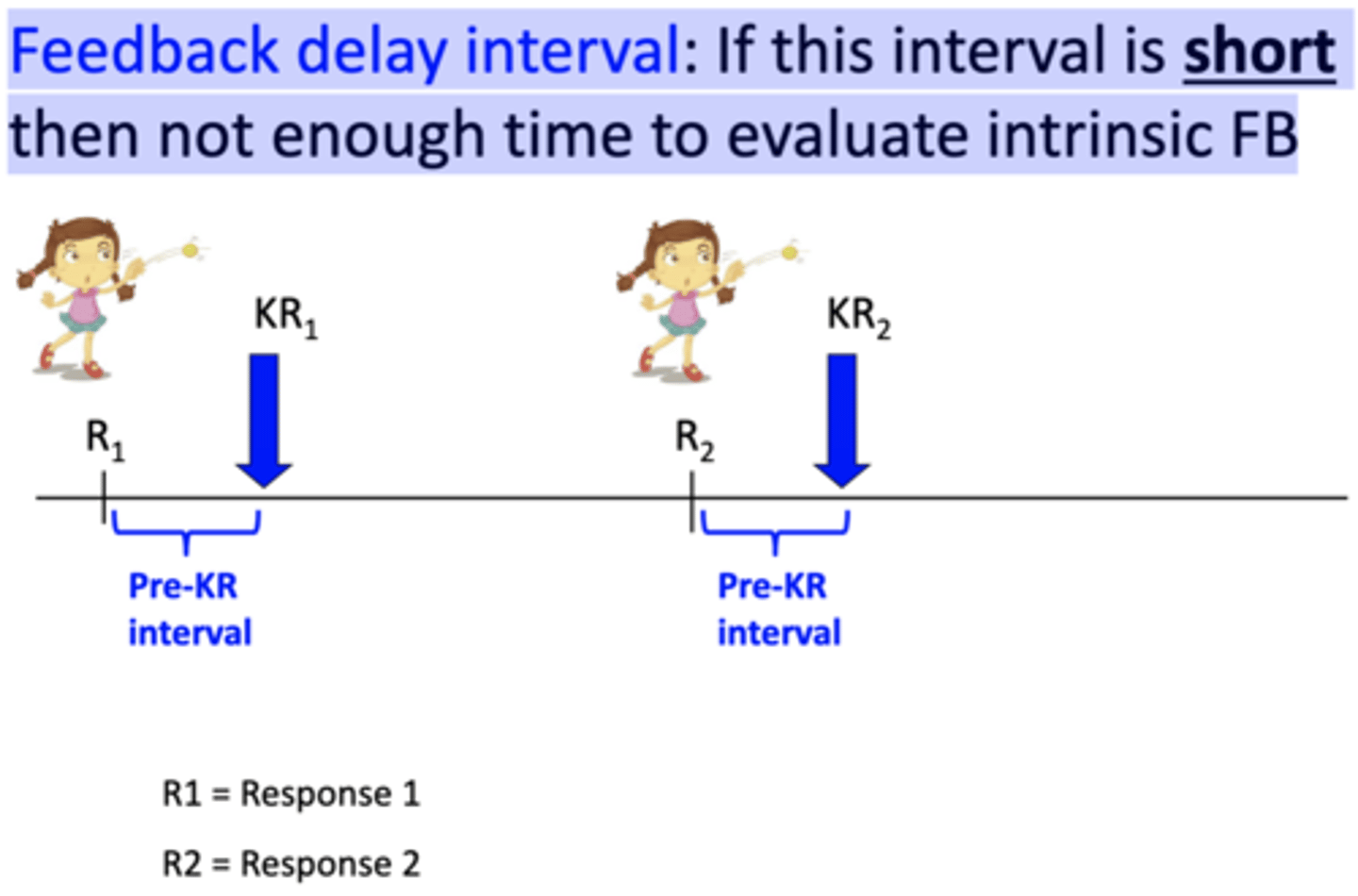
Feedback delay interval: If this interval is long then
After a feedback delay interval, NOT immediately
When feedback delay interval is longer, learning is enhanced
This is because it teaches listening to intrinsic feedback which develops error detection capability
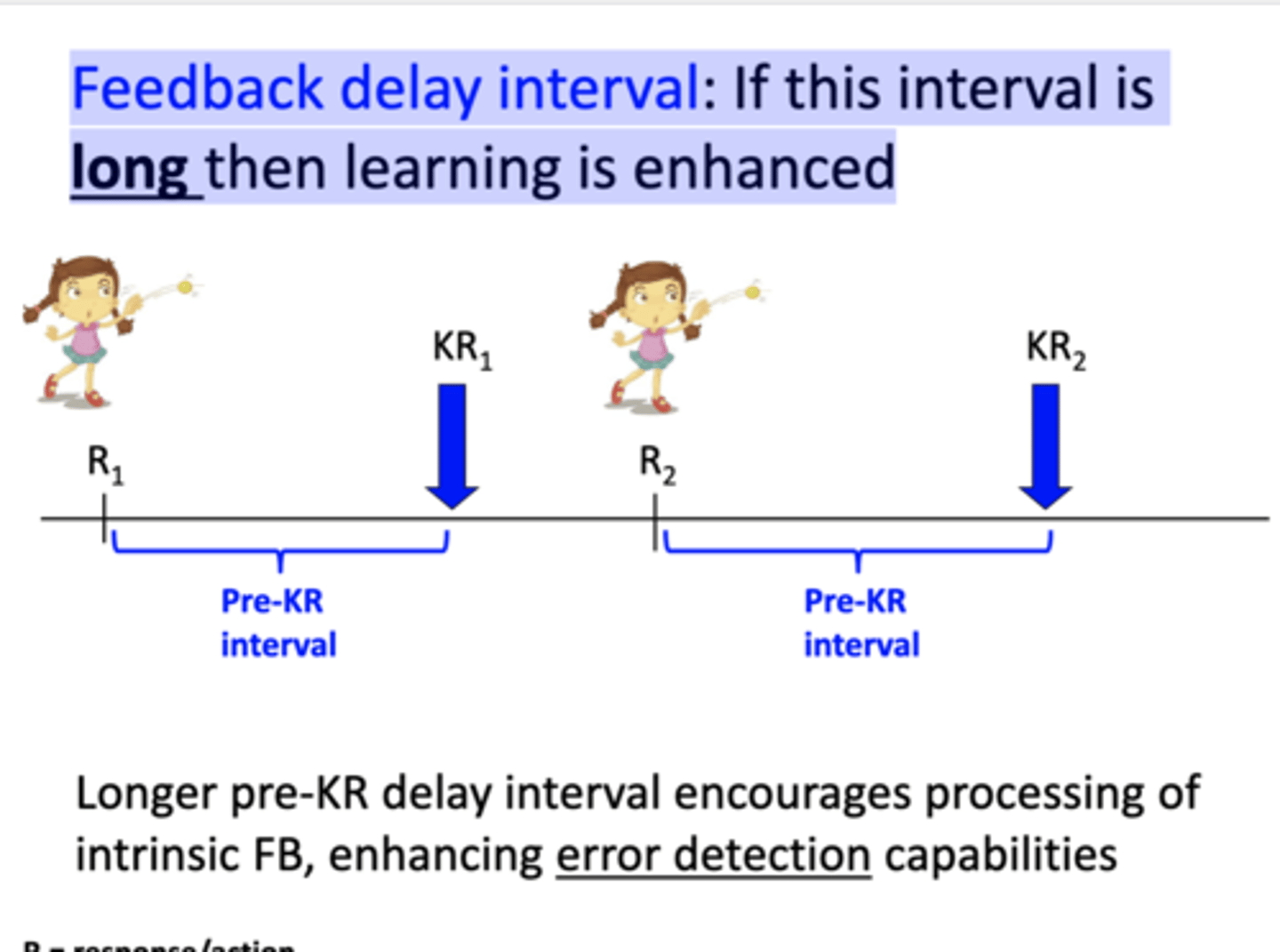
Longer pre-KR delay interval
encourages processing of intrinsic FB, enhancing error detection capabilities
If this is delay is long then learning is enhanced
Feedback delay interval such as PRE-KR delay interval
Feedback delay interval: If this interval is short then
not enough time to evaluate intrinsic FB
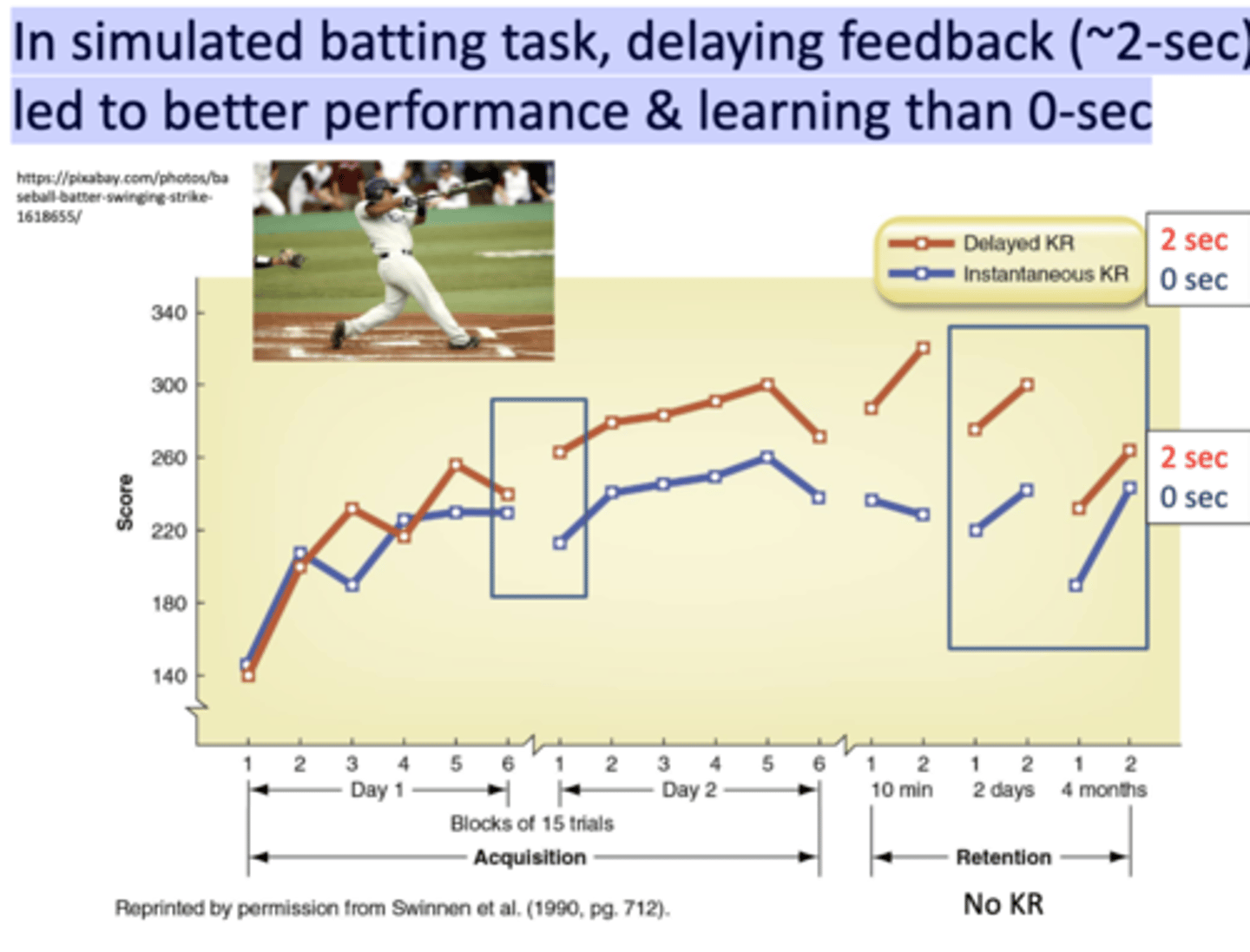
Evidence for delaying feedback interval.
Why was the outcome so?
Simulated batting task delaying feedback by ONLY 2 seconds lead to better performance!
Allows more time to process intrinsic fb and enhance error detection
Various techniques for alleviating effects of feedback and "Guidance"
Reduced Frequency of feedback
Fading feedback - FB is gradually reduced
Bandwidth feedback
Summary feedback
Reduce when give feedback
• Terminal feedback vs. concurrent
• Increased KR delay
• Self-control of FB: Choose when to get FB
Not only is the content of feedback important, but so is the
timing.
Decreased frequency benefits are discussed in terms of the what hypo?
guidance hypothesis
...we fail to process our own intrinsic feedback of what we're doing (or what should be doing), when someone or something is doing this for us.
twos way to reduce guidance are
decreasing feedback over trials (i.e., reducing absolute and/or relative frequency)
OR
use a method to do that (e.g. bandwidth feedback - only giving feedback when outside of a predetermined band).
3 reasons were discussed for the potential benefits of bandwidth feedback
(motivation, stability, and prevention of guidance).
• In terms of when to give feedback it can be
during (concurrent)
or
after (terminal) a movement,
AND/OR
instantaneous or delayed (i.e., increased pre-KR interval).
Providing information at the end of a trial/after some delay
increases attention to other sources of naturally available, intrinsic sensory feedback - aids learning.
• There are many techniques for reducing guidance effects:
reducing, delaying, summarizing, fading & making decisions about when to receive feedback
refection 17A and B
What might be 2 inherent (intrinsic) feedback sources and 2 augmented (extrinsic) feedback sources in throwing a javelin, discus or shot-put?
From your answer to the question above about various types of feedback; how would you classify the sources of augmented/extrinsic feedback you listed with respect to KR and KP?
What is the main reason that would explain why not giving feedback on every trial is good for learning? What hypothesis has been proposed to explain this effect (and others) and what is thought to happen when feedback is given on every trial?
From the readings, what does it mean to say that feedback can have a DIRECT (vs indirect) motivational effect on learning? To answer this question, consider the study discussed in the book and how giving feedback for “successful” trials impacts learning (p255)
There are many possible answers. As to intrinsic, this could be how it felt/proprioceptive feel about the shoulder or elbow, maybe what it looked like (the ball or javelin in the air), what it sounded like as it hit the floor or how long it took to hear the sound of it hitting the ground etc.
Extrinsic feedback could be the actual outcome in cm as to where the object landed (you may see where it landed but wouldn't know the exact distance). Video feedback about technique or coach feedback would be other examples of extrinsic feedback.
KR = outcome feedback; so things such as where did it land (distance in cm)
KP = performance feedback, information about the quality/form of the movement, so things like video feedback or coach feedback about movement technique (e.g., elbow angle on release, flight path of the javelin).
Guidance hypothesis.
If feedback is given too much or too frequently, then the individual learner is not paying attention to their own intrinsic feedback sources and become dependent on the augmented feedback; such that when it's removed, performance suffers.
"Guidance hypothesis relates to a failure to properly process intrinsic feedback"
reflection 17B continued
From the readings, what does it mean to say that feedback can have a DIRECT (vs indirect) motivational effect on learning? To answer this question, consider the study discussed in the book and how giving feedback for "successful" trials impacts learning (p255)
Feedback can have a indirect motivational effect on learning, whereby the feedback may make you feel more motivated and this makes you practice for longer. If you practice for longer/more, then you're likely to show improved learning and as such, there was an indirect effect of feedback on learning (the direct effect was of practice amount). but, feedback has also been shown to directly impact learning (probably through reward/consolidation pathways in the brain). This direct impact of increased motivation on learning was shown in the research example where individuals only given feedback after successful trials, vs. less successful trials, showed improved retention
Observational learning:
Observer watches a demonstration and adapts their perfomance afterwards. Changes their behavior
e.g.
watch videos or coach demos
if injured, can watch model
coach showing a serve
Motor imagery
Imagining ourselves doing an action, without actually moving
Official lol:
Cognitive simulation process that allows us to represent perceptual info in our minds in the absence of sensory input
What information could have been conveyed with a demonstration?
Cognitive-Spatial elements of the task
Perceptual-Motor elements of the task
Cognitive-Spatial elements of the task
• Goal / reference-of-correctness: knowledge of how the task should look, sound, and/or feel like
• Explicit strategies - observers will copy the strategy used by the model
Perceptual-Motor elements of the task
• Implicit (non-verbalizable) motor plans, potentially via
action simulation
Observation: explicit
more conscious of it, instructed to do it
Observation: implicit
non-conscious, non verbalized, process going on while we’re observing it
What is implicit mapping?
Implicit mapping through action simulation: Mapping observed actions onto our own motor plan
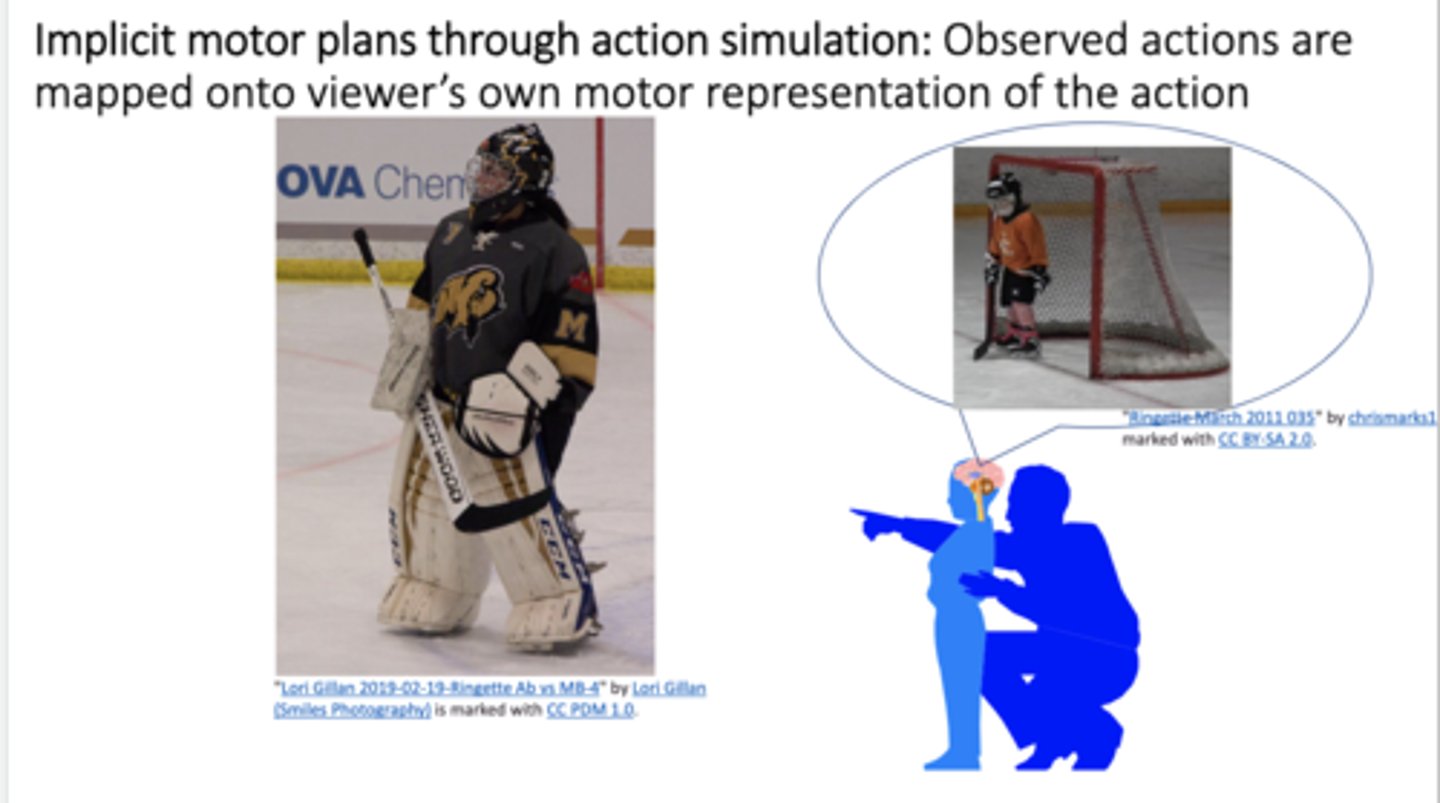
Evidence that we engage in 'simulation' when watching others
"Mirror Neuron System" or "Action observation network"
You as the observer are not doing the action, but the neurons are still firing as if you are. So we engage in sim when watching others
______ and _______ movements share a _____ neural code
Watching, executing, common
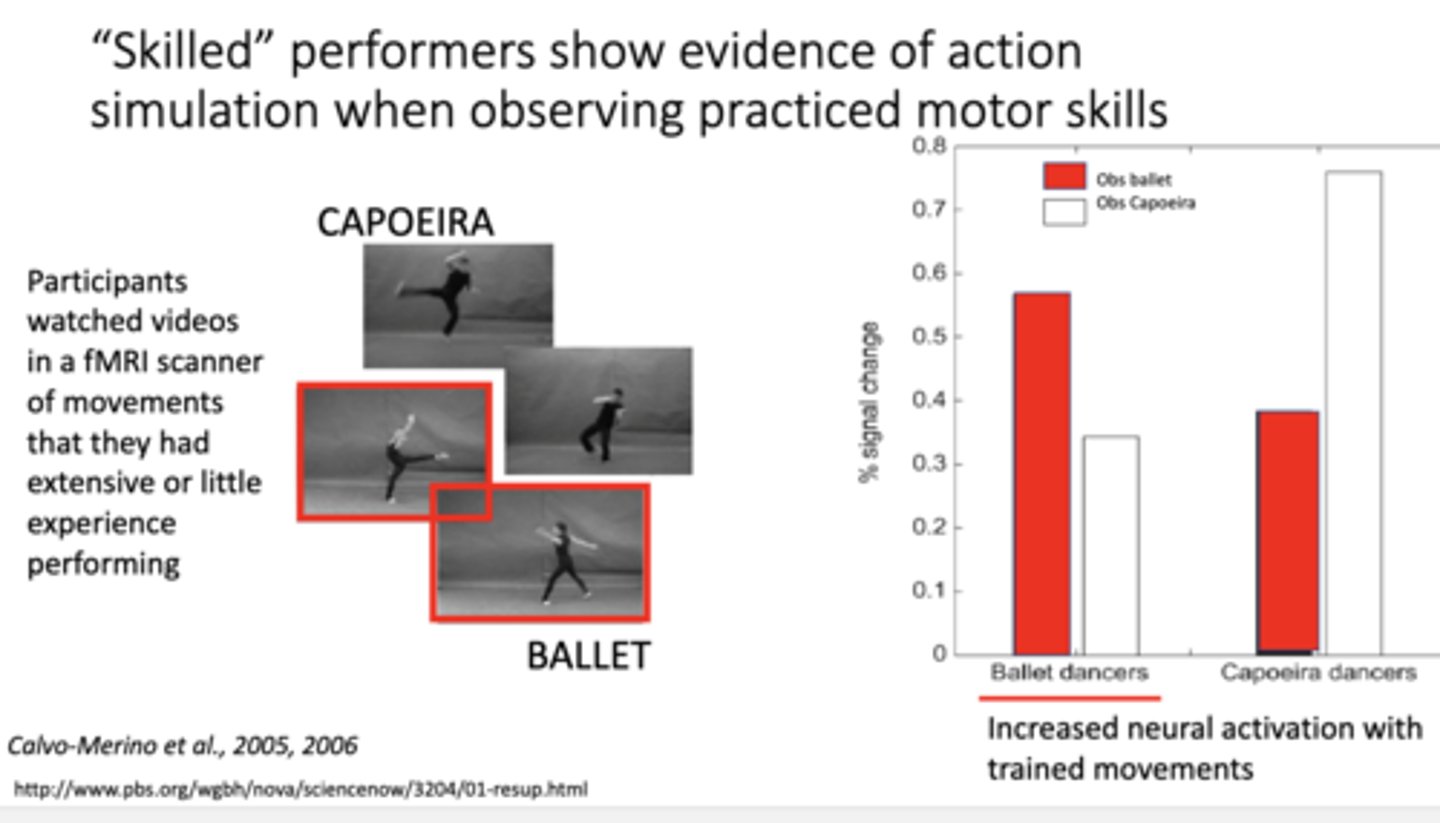
Study showing evidence of action sim in skilled performers
Task:
recruit expert dancers and martial artists to watch dance and martial arts
Outcome:
Skilled performers show evidence of action sim when observing motor skills they have a background in ie. neurons more active for familiar movements
The mirror neuron system is also involved during
observational practice of new skills
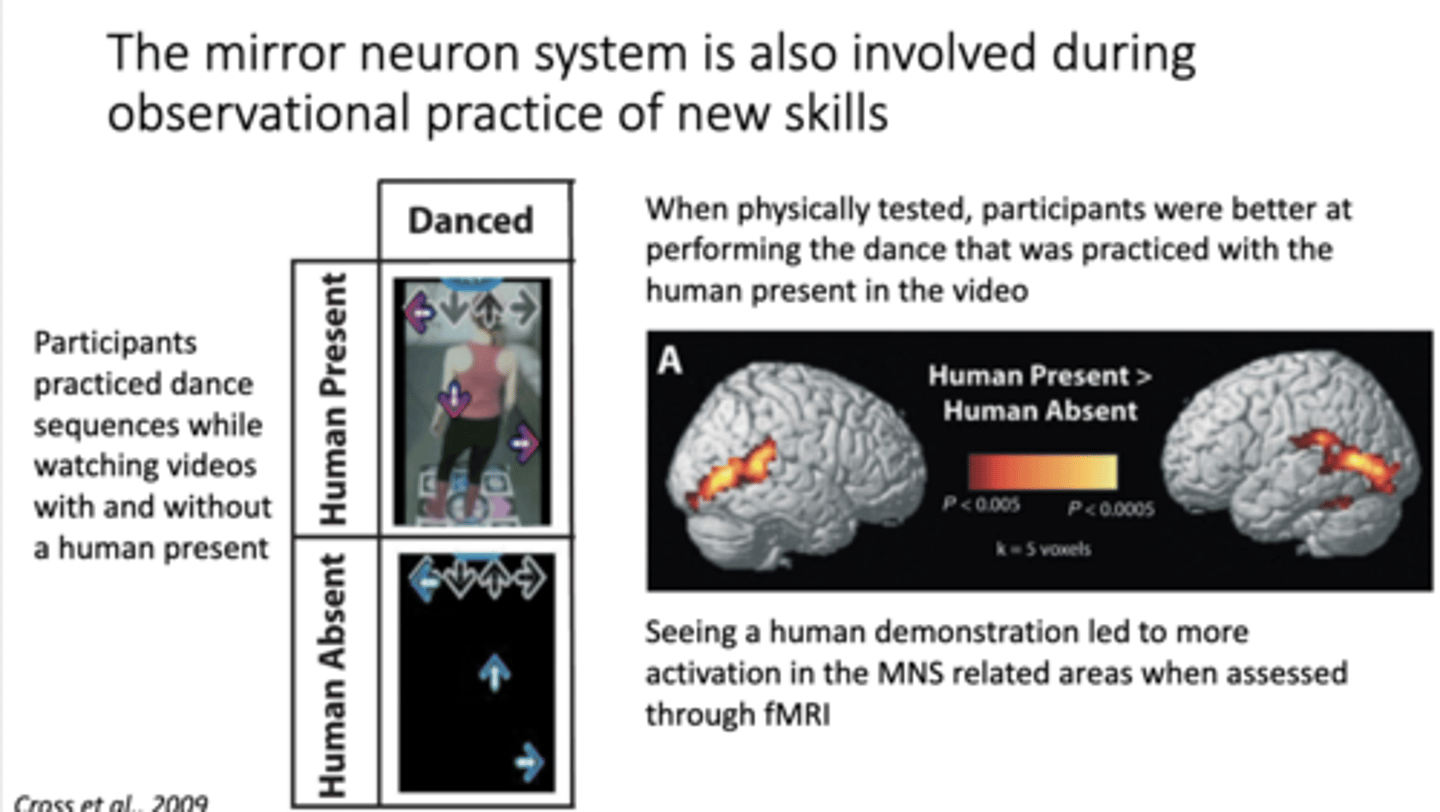
Evidence that mirror neuron system is involved during observational practice of NEW skills
Task:
Watch DDR demo with a human doing it or just with arrows
Outcome:
People learned best when they had someone to observe
Model skill level: Who should we watch?
Both
What do you learn from observing an expert?
Reference of correctness
More attention given to expert
Could be demotivating
What do you learn from observing a novice?
More problem-solving
Alerts to errors novices can make, helping avoid them
More at par with stage of learner
More variability in demo
Summary of features that can be picked up from watching others
Watching an expert and novice both good for learning, but thru diff mechanisms
Watching an expert:
More accurate template of goal/reference of correctness
Watching a novice:
Better parameterization from observed variability
Improvement in error detection and correction abilities from problem solving
What’s the best model: correct or learning?
Learning model with KR > Correct Model > Learning model
ie watching errors was GOOD as long as some extra info about those errors were given (Learning w/ KR)
Motor imagery
Cognitive process that allow us to represent perception into motor simulation without sensory input
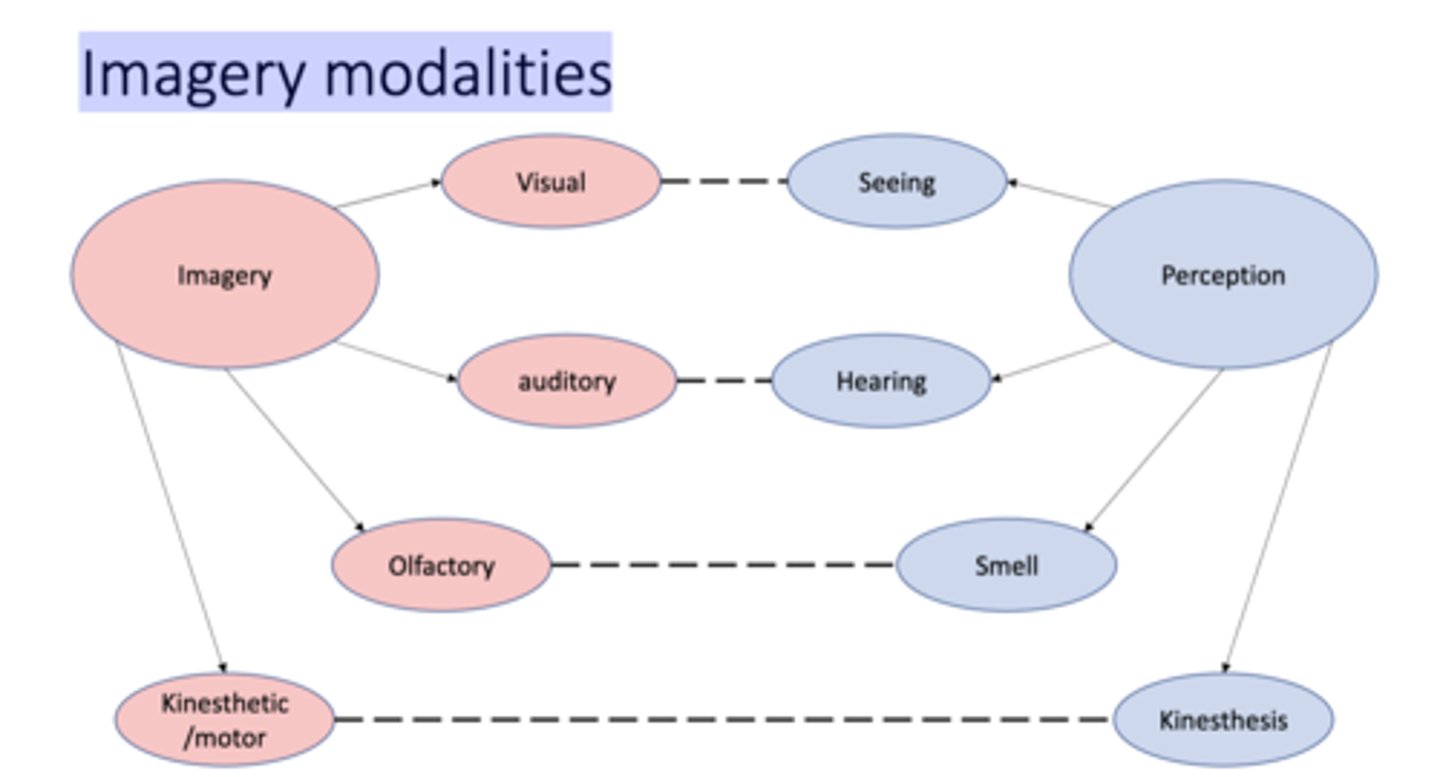
Imagery modalities
Visual content imagery
Auditory
Olfactory
Kinesthetic/motor
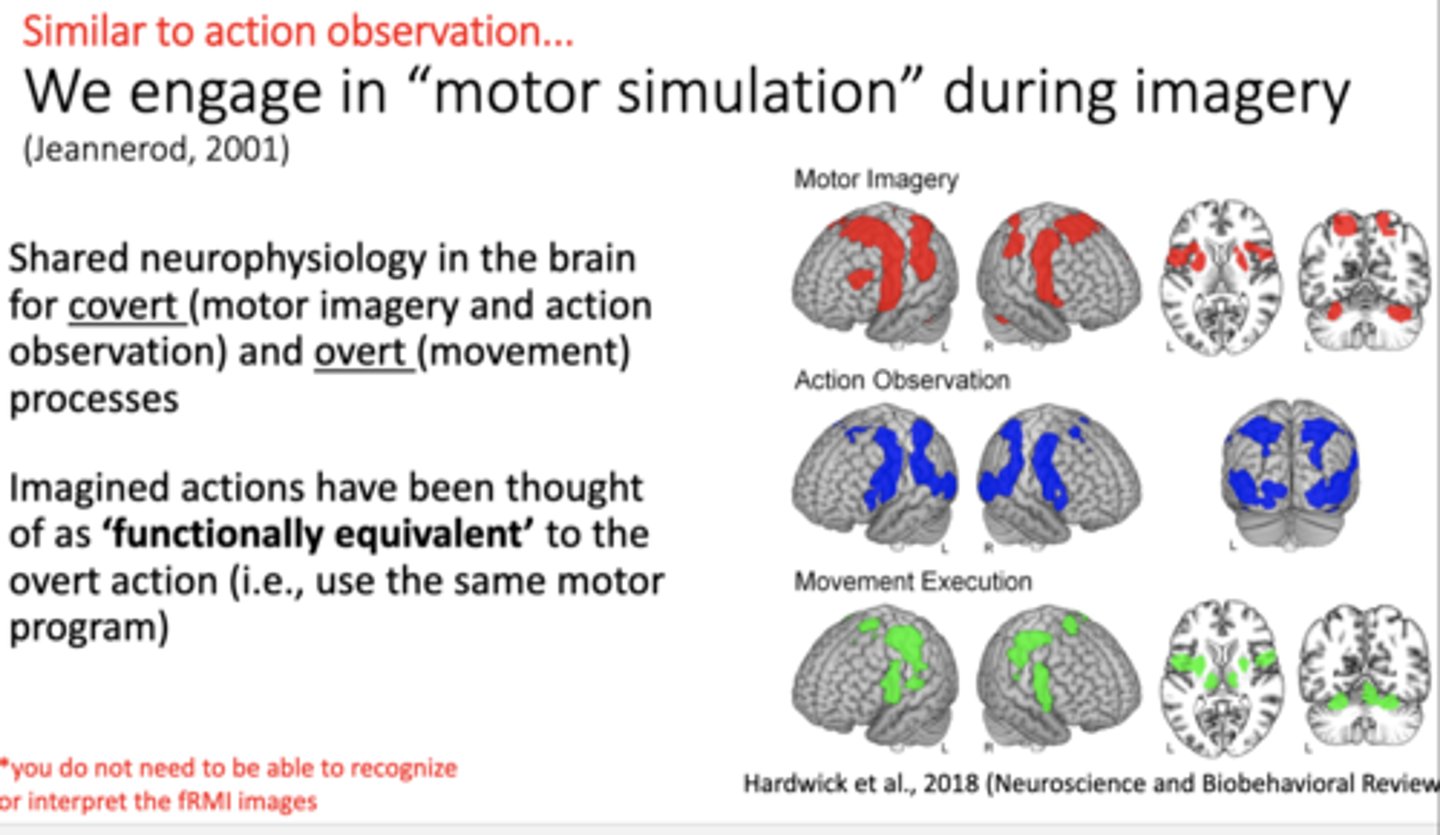
We engage in __________ during imagery. Similar to?
"motor simulation"
Action simulation during observation
What components can you improve in motor imagery?
improvements with imagery practice. Such as:
Generation: bring the imagine to mind
Maintenance: be able to maintain that image
Manipulation: able to manipulate that image
Vividness: how clear/bright is that image
How do we measure motor imagery?
Questionnaire
Mental rotation
FMRI/TMS
Mental chronometry
Mental chronometry method
If action and imagery are “functionally equivalent”, they should have similar timing
ie. similar times between imagined vs physical action bc action and imagery are ‘functionally equivalent’
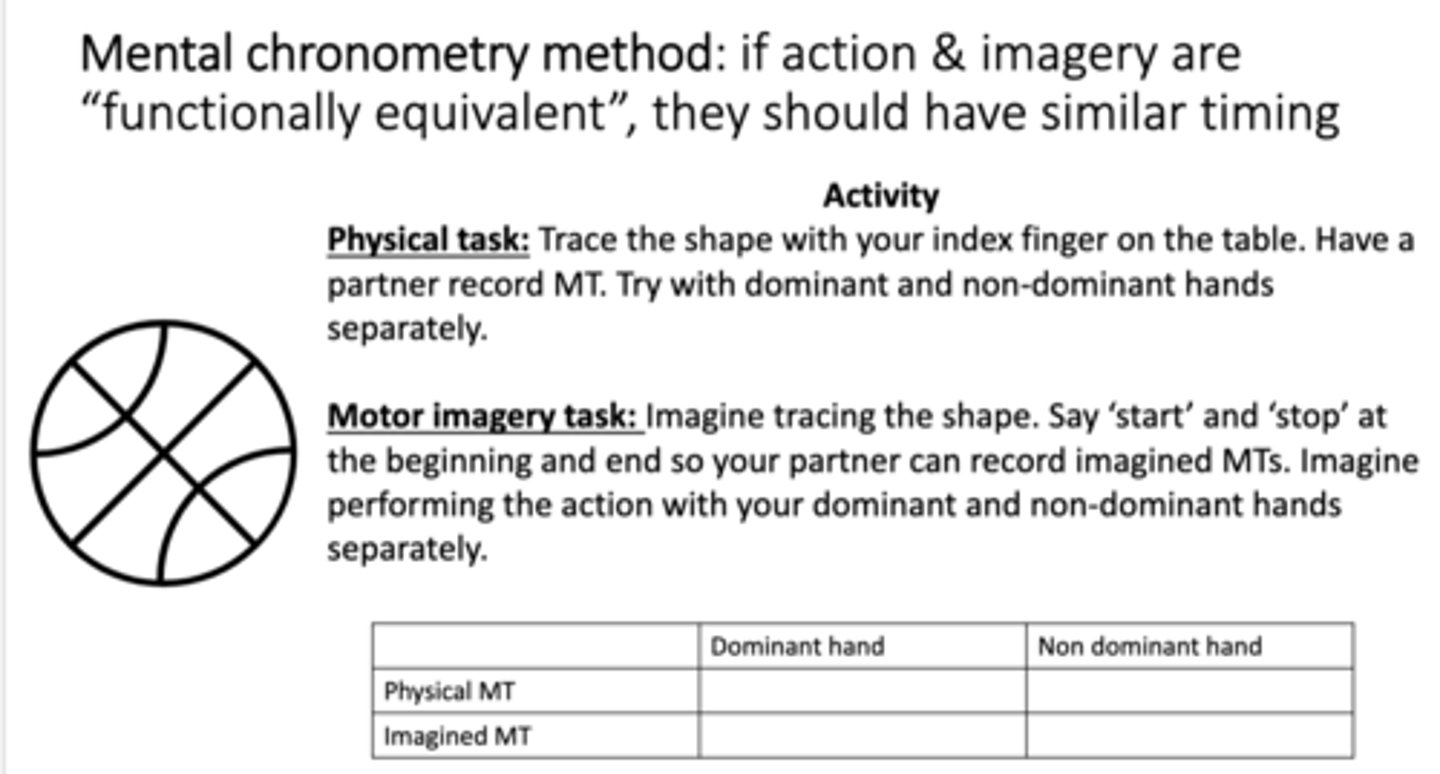
Functional equivalence:
imagined actions have been thought to be functionally equivalent to the overt action
Mental chronometry activity
Switching from the dominant to non-dominant hand should show similar MT increases in both physical task execution and motor imagery.
Because you 'have access' to your motor capabilities through motor simulation!
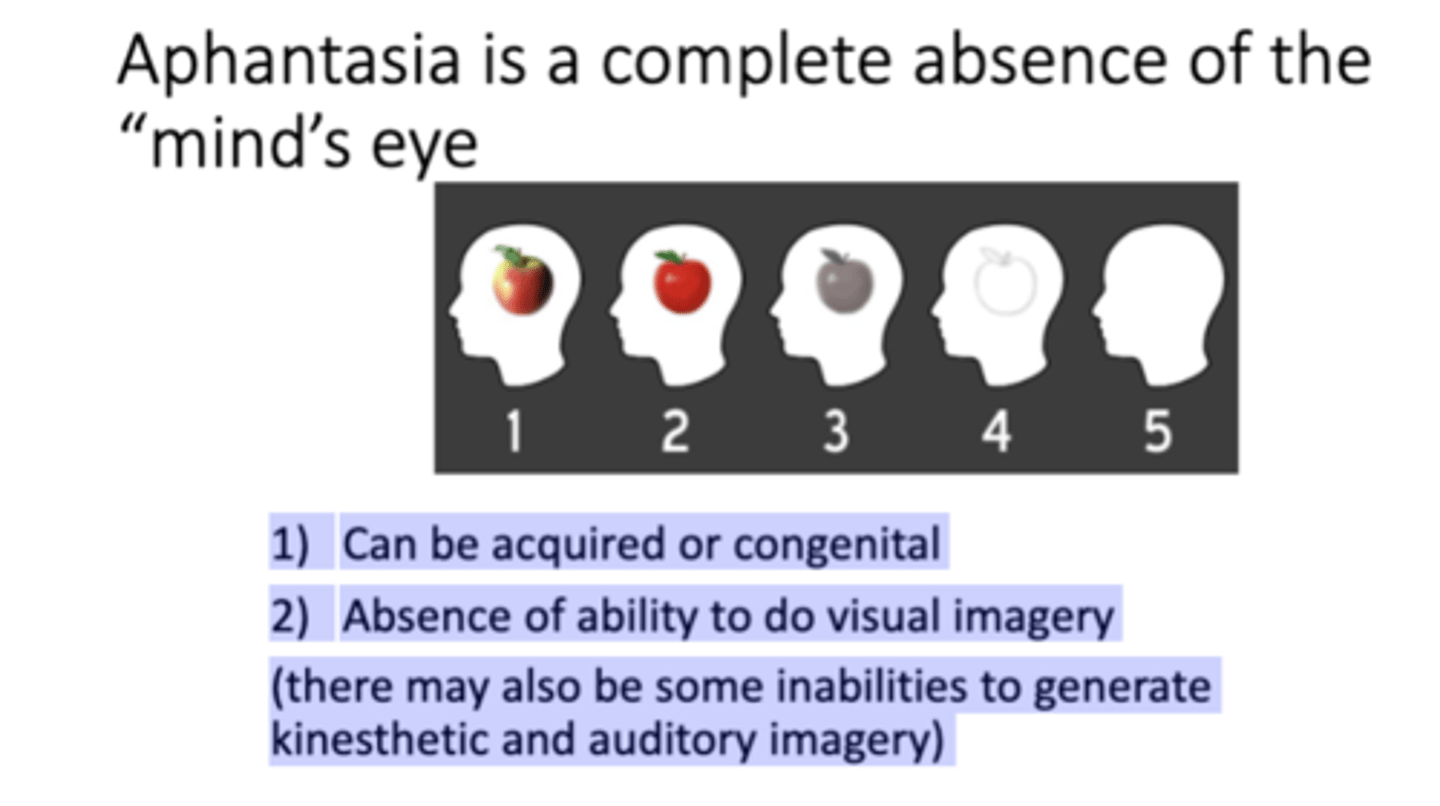
Aphantasia is a
Absence of ability to do visual imagery
Can be acquired (injury) or congenital (from birth)
Motor imagery uses
simulative processes - idea that imagined & physically executed actions are 'functionally equivalent'
Motor imagery consists of
different processes, which can be inferred using a variety of measures such as
Mental chronometry
TMS/fMRI
Questionnaires
Mental rotation/laterality judgements
• For improved outcomes
ensure engagement
Alternate physical and mental practice
supplement imagery with observation
• Some people are unable to do motor imagery, termed
aphantasia, but it doesn't seem to have much impact on their general activities.