2A- The Atom and Redox
 Call Kai
 Learn
Learn Practice Test
 Spaced Repetition
 Match
Match Flashcards
 Knowt Play
1/40

There's no tags or description
Looks like no tags are added yet.
Name | Mastery | Learn | Test | Matching | Spaced | Call with Kai | Chat |
|---|
No analytics yet
Send a link to your students to track their progress
41 Terms
mass number definition
number of protons and neutrons
relative mass of an electron
1/1840
atomic number definition
number of protons in the nucleus of the atom of an element
charge on an ion is
number of protons subtract the number of electrons
isotope definition
atoms with the same number of protons but with different number of neutrons therefore different masses
relative isotopic mass definition
average mass of 1 atom of an isotope
measured relative to 1/12th mass of a carbon-12 atom
why is carbon-12 chosen as international standard
can be obtained in an isotopically pure state and is unreactive
relative atomic mass (Ar) definition
average mass of 1 atom of an element
compared to 1/12th mass of a carbon-12 atom
how can percentage abundance of an isotope be found experimentally
using a mass spectrometer
how does a mass spectrometer work
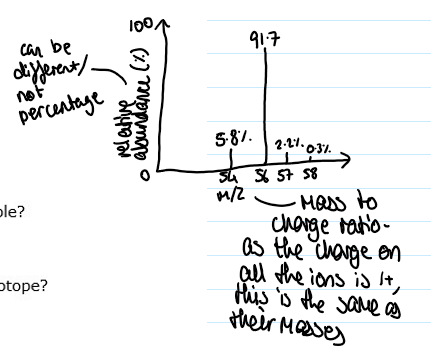
Atoms can be deflected by a magnetic field provided they are first converted into a positive ion. Electrically charged particles are affected by a magnetic field although electrically neutral ones are not. The deflected ions are detected and displayed on a mass spectrum as a mass-to-charge ratio, m/z.
example of mass spectrum labelled
y axis- relative abundance- can be percentage or not, check!
x axis- mass to charge ratio (m/z), as the charge on all the ions is 1+, this is the same as their masses
relative molecular mass (Mr) definition
the weighted mean mass of a molecule compared with 1/12th of the mass of an atom of carbon-12
relative formula mass definition
the weighted mean mass of a formula unit compared with 1/12th of the mass of an atom of carbon-12
1st ionisation energy definition
the amount of energy required to remove 1 mole of electrons from 1 mole of gaseous atoms of an element to make 1 mole of gaseous 1+ ions
chlorine first ionisation energy equation
Cl(g) → Cl+(g) + e-
how to compare first ionisation energies
Nuclear charge (no. of protons)
Atomic radius (size of atoms)
Shielding (no. of inner shells)
Attraction (nuclear attraction)
atomic radius trend for nuclear attraction
as atomic radius increases, nuclear attraction decreases
shielding effect trend for nuclear attraction
as the number of inner shells increase, shielding increases, so nuclear attraction decreases
nuclear charge trend for nuclear attraction
as the nuclear charge increases, nuclear attraction increases
first ionisation energy trends across a period
across a period first ionisation energy is most likely affected by nuclear charge and atomic radius; shielding remain almost the same. FIE increases across a period
first ionisation energy trends down a group
down a group there is an increase in atomic radius and shielding; FIE therefore more affected by atomic radius and shielding, despite the increase in nuclear charge, FIE decreases down a group
order of filling subshells
1s, 2s, 2p, 3s, 3p, 4s, 3d, 4p, 4d, 4f
calcium electron configuration
1s2 2s2 2p6 3s2 3p6 4s2
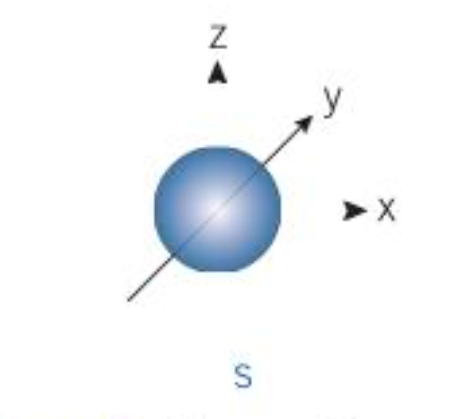
shape of an s-orbital
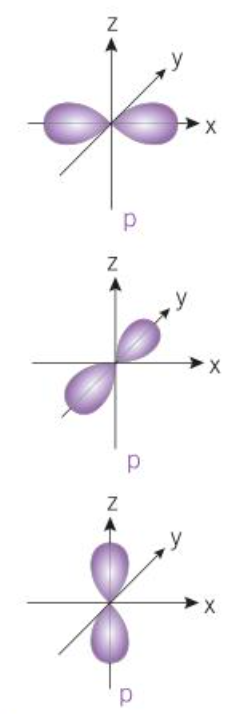
shape of a p-orbital
order which electrons are lost
always from the orbital furthest from the nucleus regardless of energy level (4s before 3d this time)
2 exceptions in filling order for orbitals
chromium and copper
chromium reason for electron configuration (has 5 electrons in 3d subshell but only 1 in 4s subshell)
one electron in each 3d orbital is symmetrical and therefore more stable than expected. This extra stability more than compensates for the energy needed to promote and electron from the 4s subshell
copper reason for electron configuration (has 10 electrons in 3d subshell but only 1 is 4s subshell)
pairs in each 3d orbital makes it symmetrical and so is more stable than expected. This more than compensates for the energy needed to promote an electron from 4s.
oxidation definition (electrons)
the loss of electrons
reduction definition (electrons)
the gain of electrons
oxidation half equation magnesium
Mg → Mg 2+ + 2e-
reduction half equation oxygen
O2 + 4e- → 2O2-
redox reaction definition
both reduction and oxidation occurring in a chemical reaction
oxidation number rules
every atom in a species has its own oxidation no.- written with +/- before the number
uncombined elements have oxidation no. of 0
in neutral compounds sum of oxidation numbers=0
in ions sum of oxidation numbers=charge of ion
oxidation number in fluorine is always -1
oxidation number of a combined group 1 metal is always +1
oxidation number of a combined group 2 metal is always +2
oxidation number of a combined oxygen is +2
oxidation number exceptions
in metal hydrides, H has an oxidation number of -1 (LiH)
in hydrogen peroxide (H2O2) O has an oxidation number of -1
disproportionation definition
same element is oxidised and reduced
oxidising agent definition
a reagent that oxidises (takes electrons from another species)
reducing agent definition
a reagent that reduces (adds electrons to another species)
oxidation definition (oxidation no.)
increase in oxidation no.
reduction definition (oxidation no.)
decrease in oxidation no.