Hole's Essentials of Human Anatomy & Physiology - Chapter 6: Integumentary System
 Call Kai
 Learn
Learn Practice Test
 Spaced Repetition
 Match
Match Flashcards
 Knowt Play
1/45

Earn XP
Description and Tags
A set of vocabulary flashcards covering key terms and structures of the integumentary system from Chapter 6 of Hole's Essentials of Human Anatomy & Physiology.
Name | Mastery | Learn | Test | Matching | Spaced | Call with Kai | Chat |
|---|
No analytics yet
Send a link to your students to track their progress
46 Terms
Organ
A body structure composed of two or more different types of tissues working together to perform specific functions.
Integumentary System
The organ system comprising the skin and its accessory organs, including hair, nails, sweat glands, and sebaceous glands.

Epidermis
The outer layer of the skin, composed of stratified squamous epithelium, that lacks blood vessels.
Dermis
The inner layer of skin composed of connective tissue containing collagen and elastic fibers in a gel-like ground substance, which binds the epidermis to underlying tissues.
Subcutaneous Layer (Hypodermis)
A layer beneath the dermis made of loose connective tissue (areolar and adipose) that binds the skin to underlying organs and houses major blood vessels.
Stratum Basale
The deepest layer of the epidermis consisting of actively dividing cells nourished by blood vessels in the dermis.
Keratinization
The process in which older skin cells age, accumulate the protein keratin, harden, and die as they are pushed toward the surface.
Stratum Lucidum
A clear, distinct layer of the epidermis located between the stratum granulosum and stratum corneum, found only in the thick skin of the palms and soles.

Epidermal Layers
The strata of the epidermis listed from superficial to deep: stratum corneum, stratum lucidum (palms and soles only), stratum granulosum, stratum spinosum, and stratum basale.
Melanocytes
Specialized cells located deep in the epidermis and underlying dermis that produce the skin pigment melanin.
Melanin
A dark pigment produced by melanocytes that absorbs ultraviolet light, protecting deeper cells from solar radiation damage.
Cytocrine Secretion
The process by which melanocytes pass melanin pigment granules through long cellular extensions directly into neighboring epidermal cells.

Eumelanin
A type of melanin pigment that produces dark brown to black hair colors.
Pheomelanin
A type of melanin pigment that produces reddish and blonde hair colors.

Nail Structure
Protective coverings on fingers and toes consisting of a nail plate overlying a nail bed, with the lunula serving as the most actively growing region.
Lunula
The whitish, half-moon-shaped region at the base of the nail plate, which serves as the most actively growing region of the nail root.
Hair Follicle
A tubelike depression in the skin extending from the epidermis into the dermis from which a hair develops.

Arrector Pili Muscle
A bundle of smooth muscle attached to a hair follicle that contracts in response to cold or fright, causing goosebumps.
Sebaceous Glands
Holocrine exocrine glands associated with hair follicles that secrete an oily substance called sebum to waterproof and moisturize hair shafts.
Eccrine Sweat Glands
Merocrine sweat glands that respond throughout life to elevated body temperature by releasing watery secretions through surface pores.
Apocrine Sweat Glands
Sweat glands that activate during puberty and secrete in response to emotional upset, fear, pain, stress, and sexual arousal.
Ceruminous Glands
Modified sweat glands located in the ear canal that produce earwax.
Mammary Glands
Modified sweat glands located in the breasts that secrete milk.
Vasodilation
The enlargement of dermal blood vessels in response to body heat, increasing blood flow to the skin surface to radiate heat outward.
Vasoconstriction
The narrowing of dermal blood vessels in response to cold, restricting skin blood flow to conserve body heat.
Radiation
The primary method by which body heat escapes from the warm skin surface into cooler surrounding air.
Inflammation
A normal body response to injury where blood vessels dilate and become permeable, resulting in localized red and swollen tissues.
Granulations
Small, rounded masses of proliferating fibroblasts and new capillary branches that form during the healing of large deep wounds.

A
Epidermis

B
Dermis

C
Hypodermis

5
Stratum Corneum

4
Stratum Lucidum
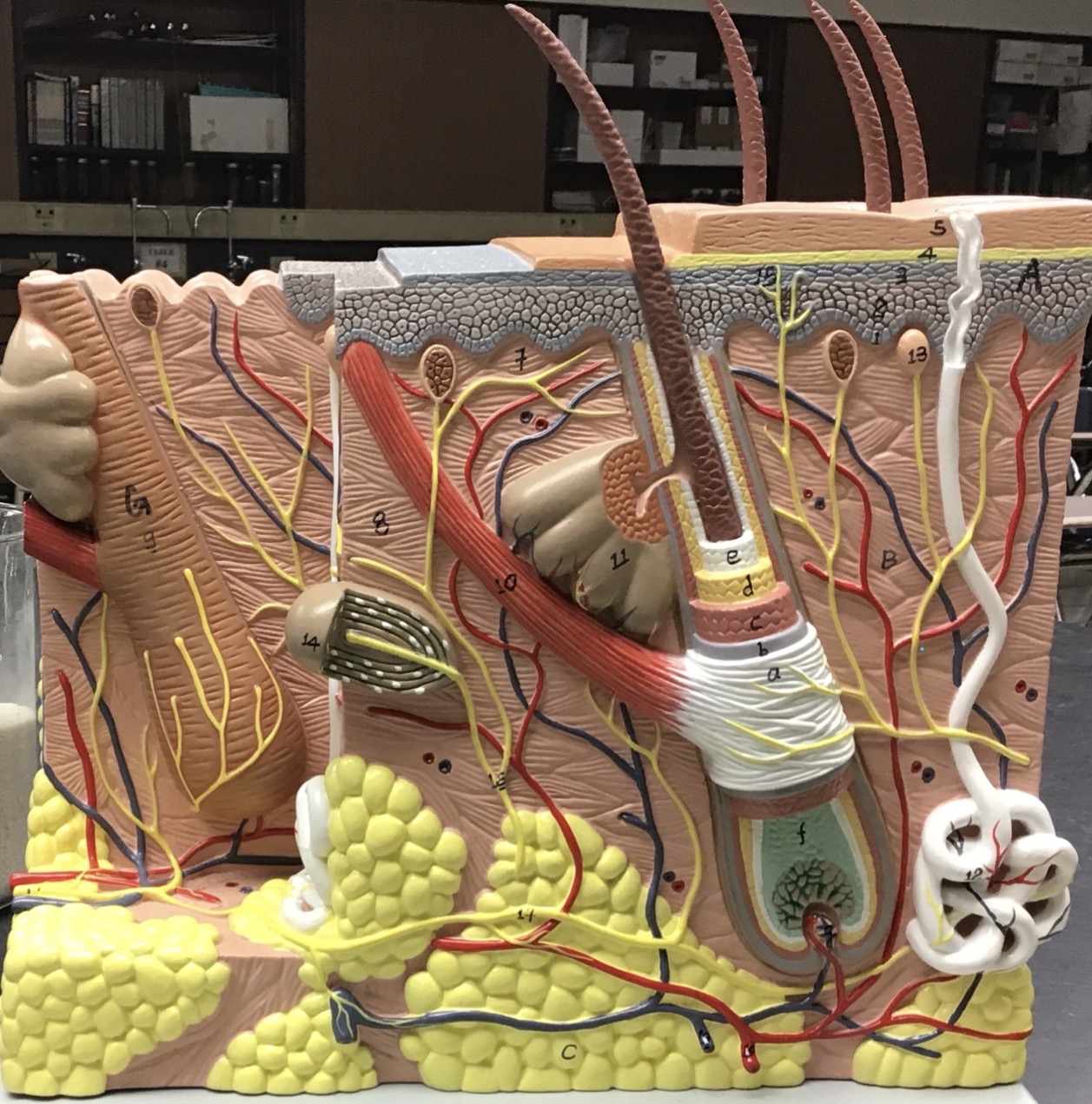
1
Stratum Basale

G
Hair Follicle

f
Hair root

Hair
Hair shaft

12
Sweat Gland
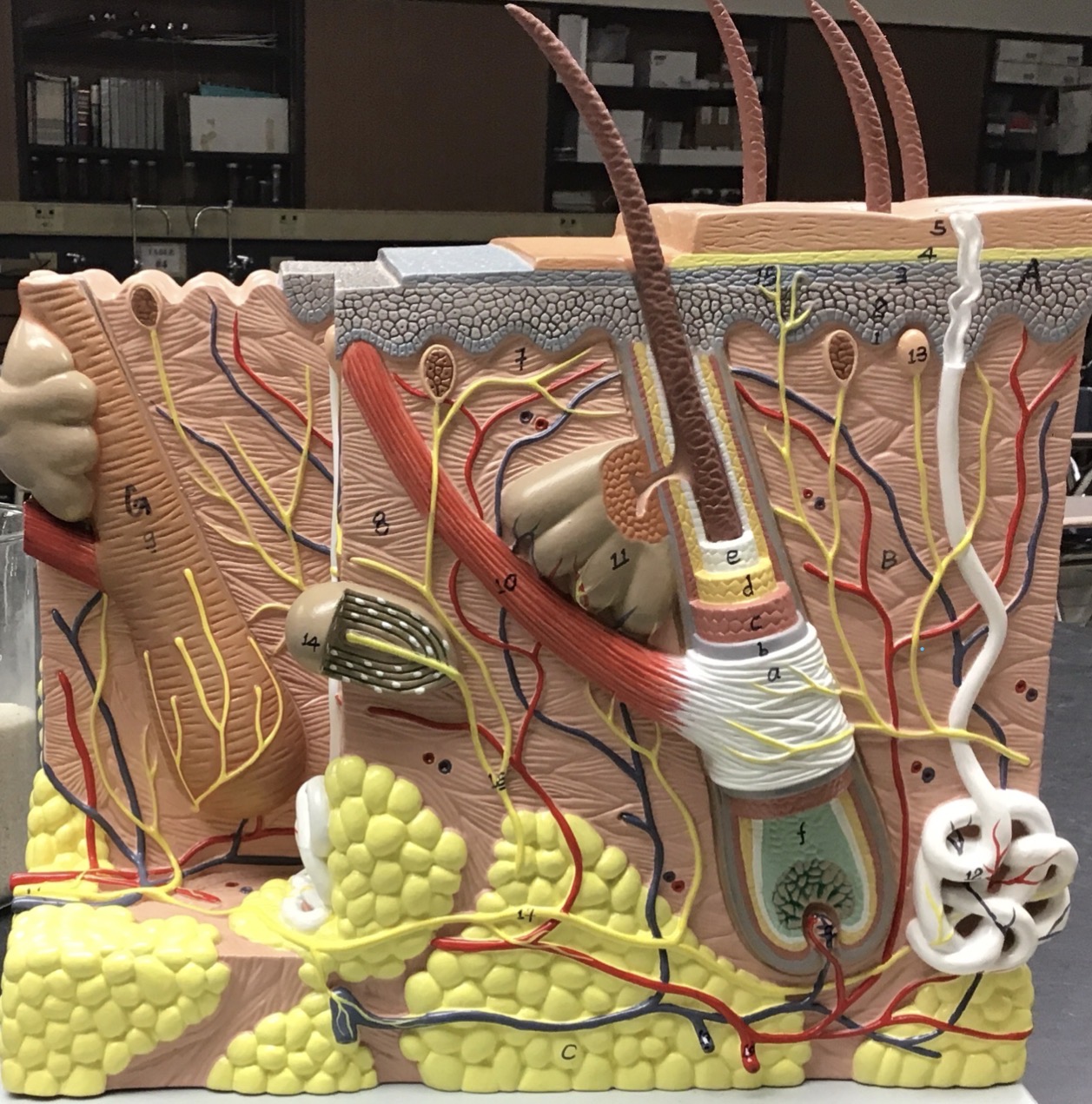
12
Sweat Gland

11
Sebaceous Gland

10
Arrestos Pili Muscle

19-Blue
Vein

18-Red
Artery

17-Yellow, Thick, Horizontal
Motor Nerve

16, Yellow, vertical
Sensory Nerve

14
Lamellar Corpsucle