BIOL 445 Chapter 14 Energy Conservation in Chloroplasts
 Call Kai
 Learn
Learn Practice Test
 Spaced Repetition
 Match
Match Flashcards
 Knowt Play
1/15

There's no tags or description
Looks like no tags are added yet.
Name | Mastery | Learn | Test | Matching | Spaced | Call with Kai | Chat |
|---|
No analytics yet
Send a link to your students to track their progress
16 Terms
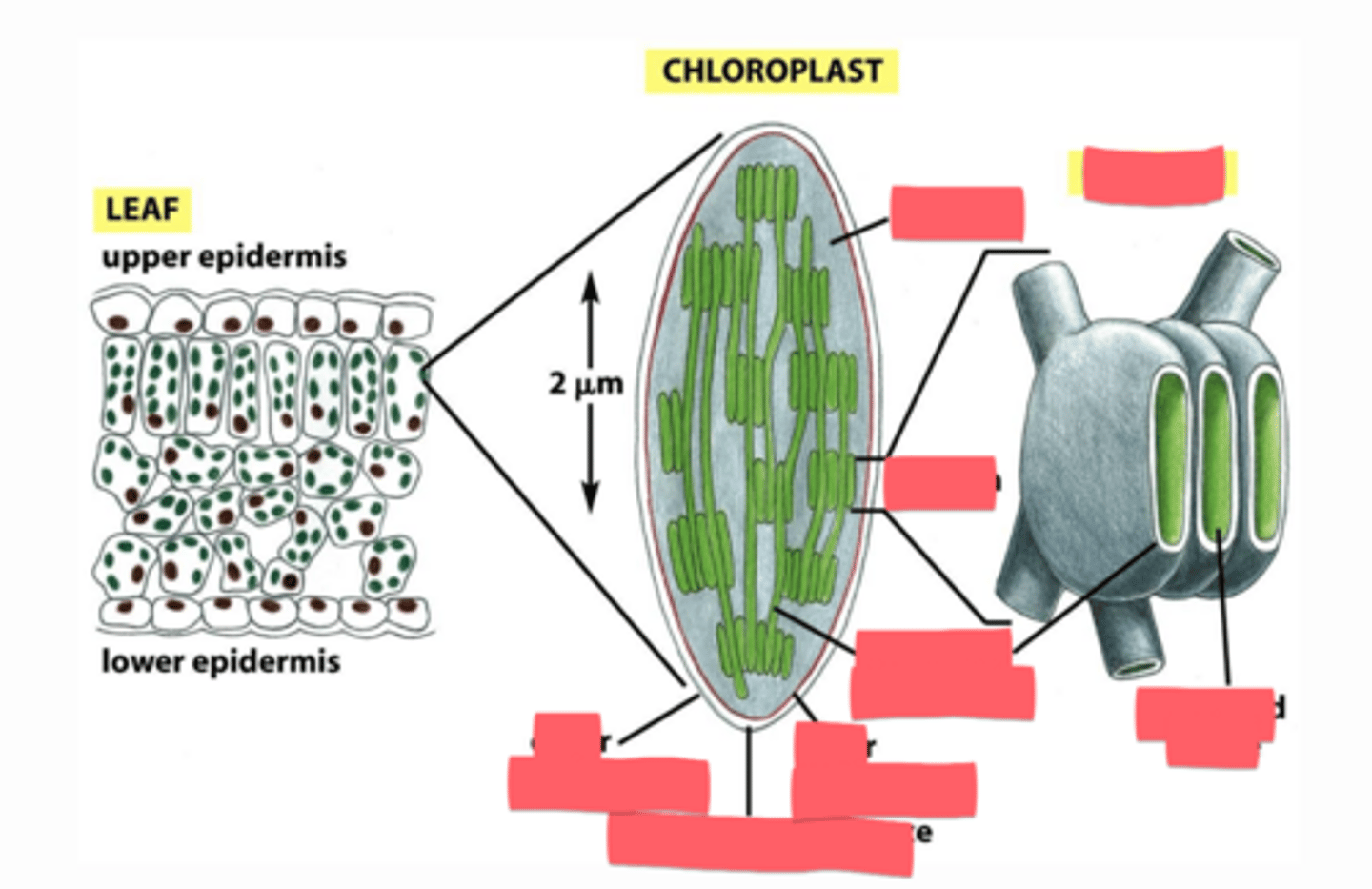
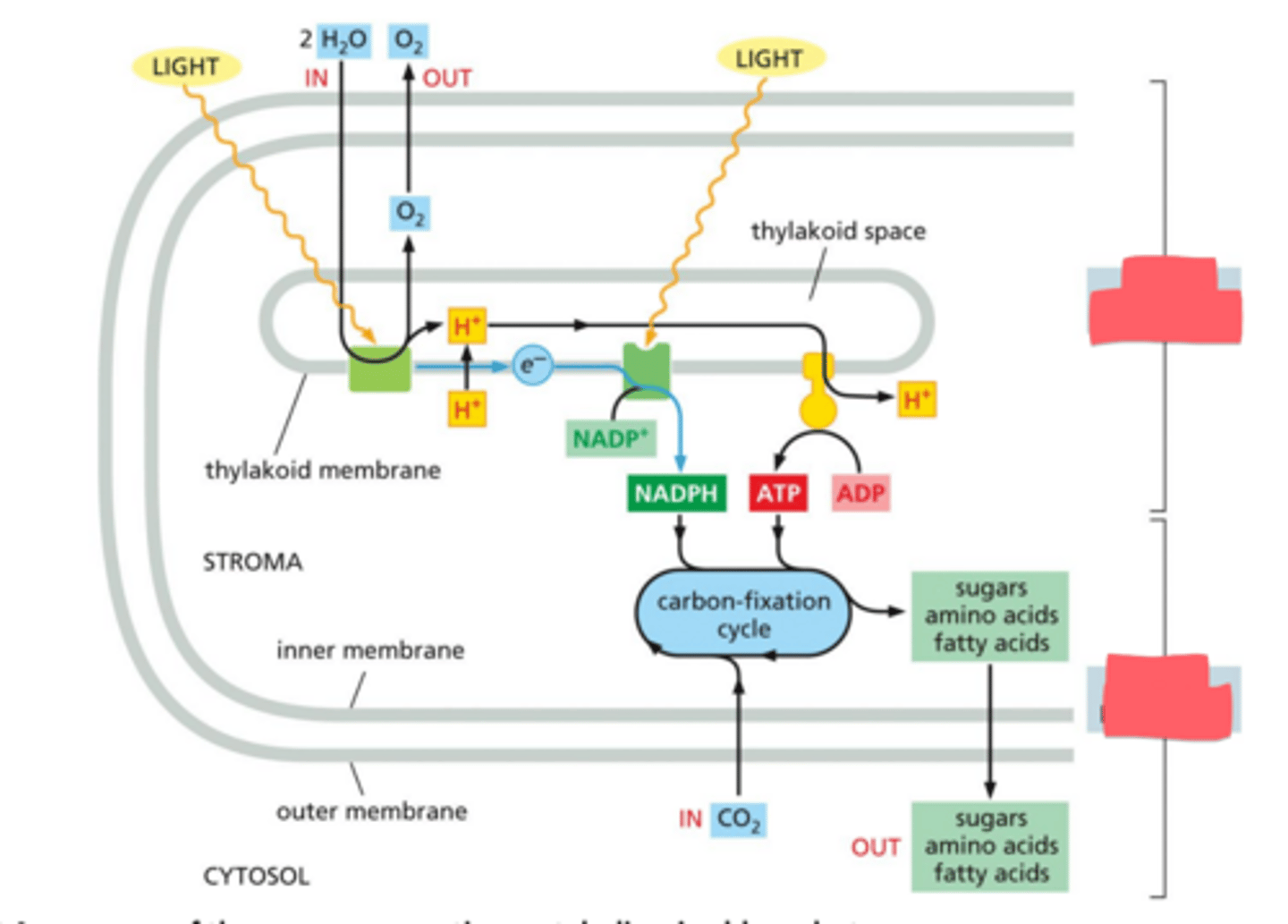
Composed of an Outer Membrane, Intermembrane Space, an Inner Membrane, a Stroma filled with Thylakoid Membranes (Granums), Ribosomes, and Circular DNA.
Describe the structure of a chloroplast.
Light reactions and Dark reactions
Name and describe the 2 major sets of reactions that occur during photosynthesis
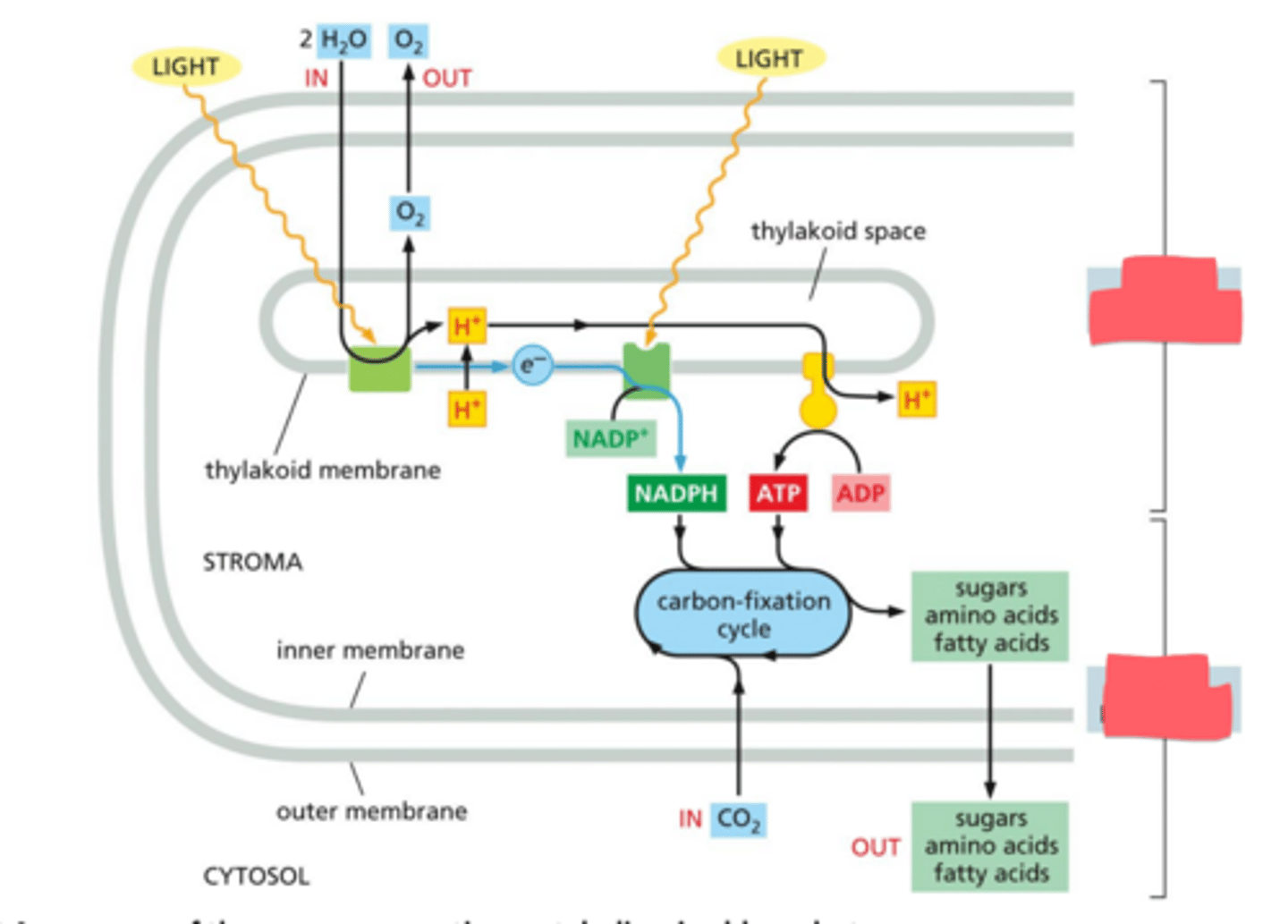
Light Reactions:
Reactants: Light + H2O + NADP+ + ADP
Products: O2, NADPH, ATP
Dark Reactions:
Reactants: CO2 + Ribulose 1,5-bisphosphate + NADPH + ATP
Products: Glyceraldehyde 3-Phosphate
What are the reactants/products for the light reactions? For the dark reactions? (Try to avoid looking at the picture for this)
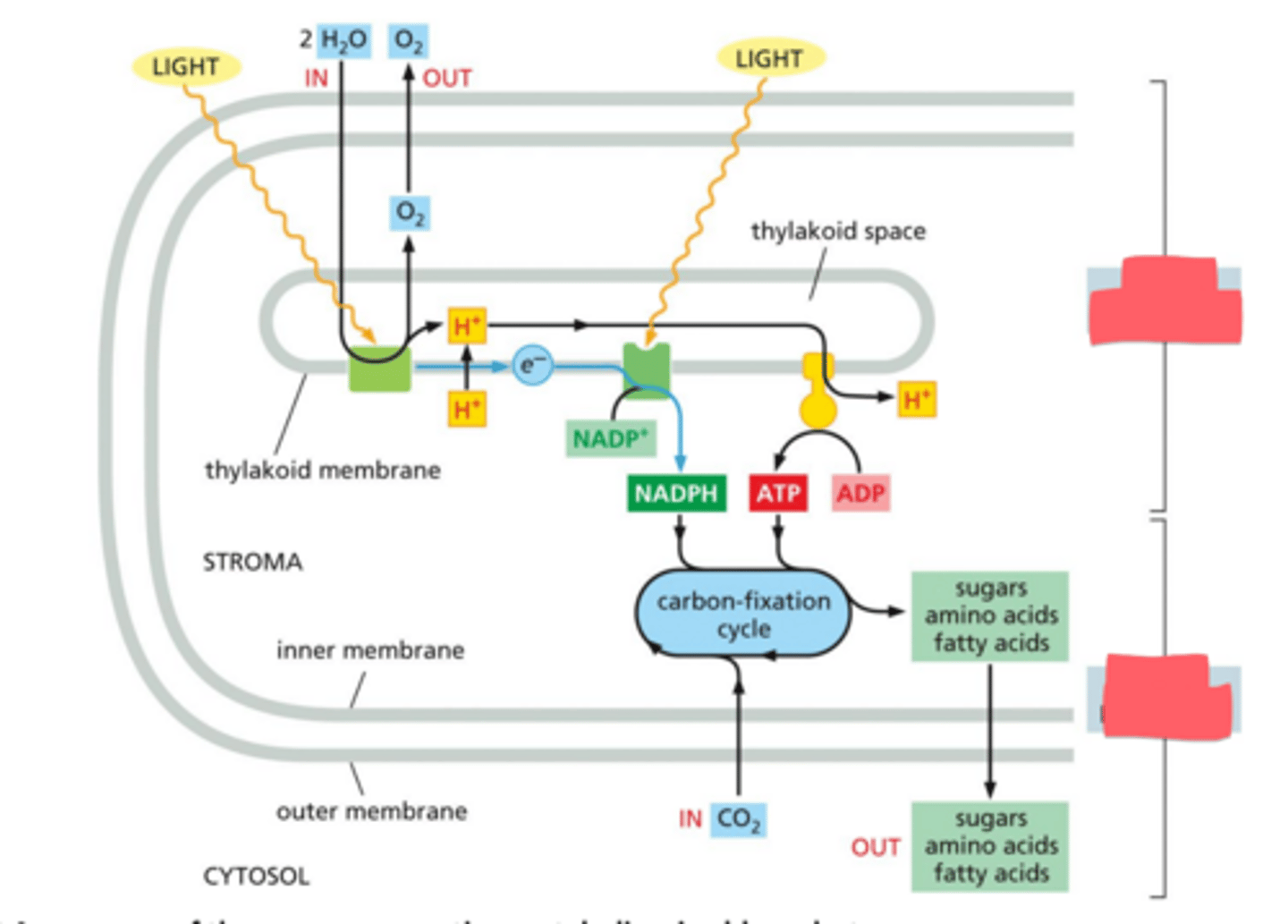
Light reactions occur within Thylakoid Membranes while Dark reactions occur within the Stroma
Where in the chloroplast do these reactions occur? (Try to avoid looking at the picture for this)
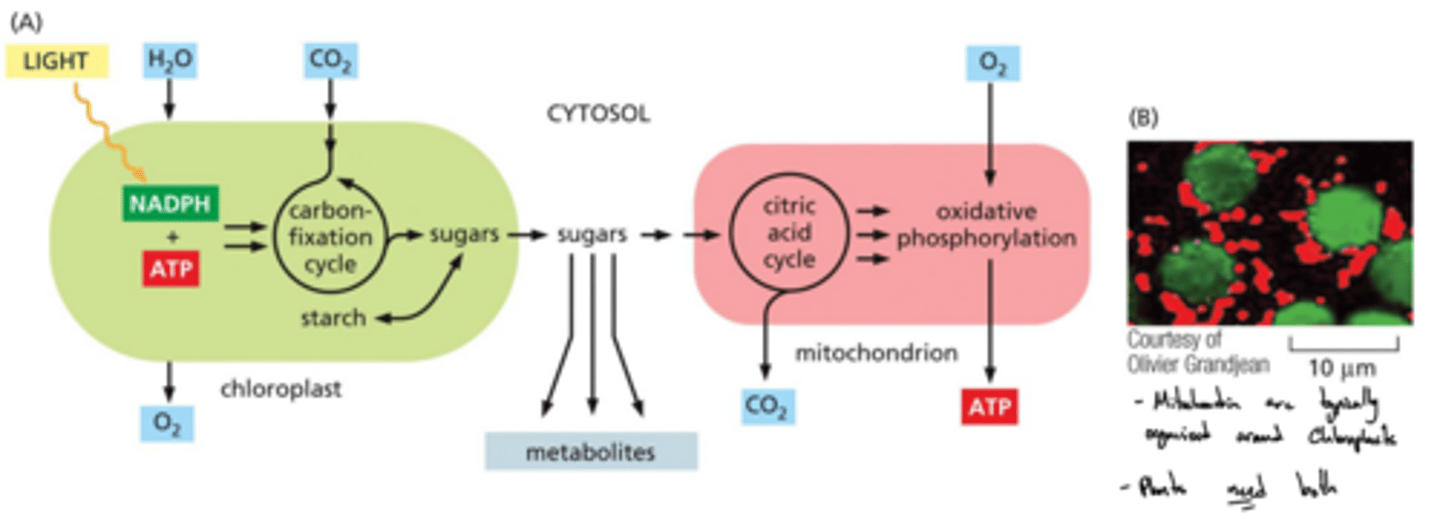
The ATP generated within Chloroplasts is immediately used up in the Calvin Cycle to generate Sugars, Amino Acids, and Fatty Acids (FOOD). They are they processed within the Mitochondrial Krebs Cycle in order to be used within the ETC to generate the Proton Gradient needed to power the ATP Synthase.
How do chloroplasts and mitochondria collaborate within a plant cell?
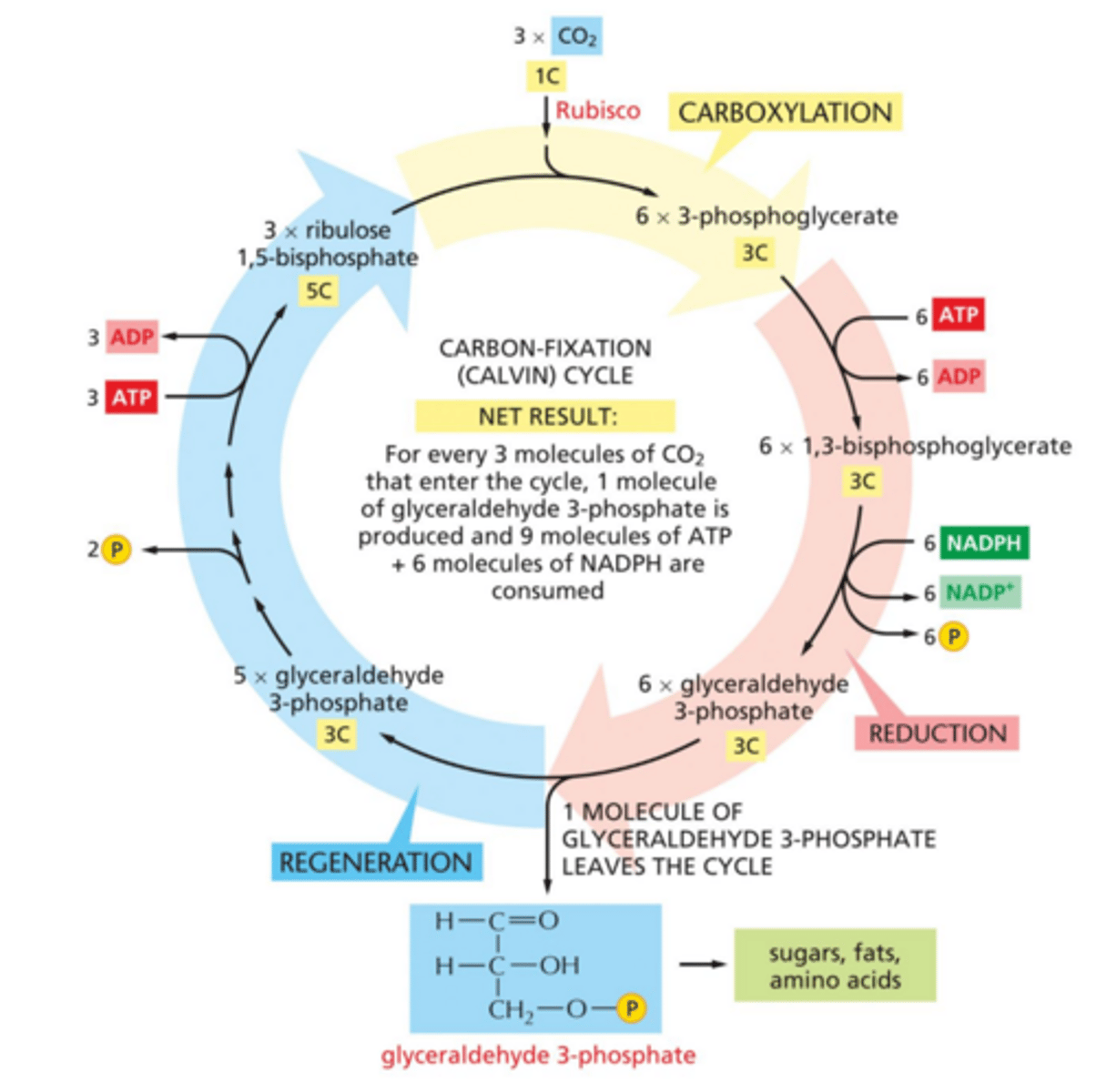
Rubisco catalyzes the fixation of CO2 into Ribulose 1,5-bisphosphate to make 3-phosphoglycerate (Carboxylation Reaction)
What is the initial reaction of carbon fixation in C3 photosynthesis?
Carboxylation:
1) 3 CO2 + 3 Ribulose 1,5-bisphosphate -> 6 3-phosphoglycerate
Reduction:
2). 6 3-phosphoglycerate + 6 ATP -> 6 1,3-bisphosphoglycerate + 6 NADPH -> 6 glyceraldehyde 3-phosphate (One of these leaves the cycle)
Regeneration:
5 glyceraldehyde 3-phosphate + 3 ATP -> 3 Ribulose 1,5-bisphosphate
What happens during the carbon fixation cycle? (Describe the 3 major phases)
Glyceraldehyde 3-phosphate. This molecule will be used to make Sugars, Amino Acids, and/or Fatty Acids
What product is formed by the Calvin cycle? How is this product used within a plant cell?
Dumbahh and Slowahh Rubisco attaches O2 instead of a CO2 on Ribulose 1,5-bisphosphate
What happens during photorespiration?
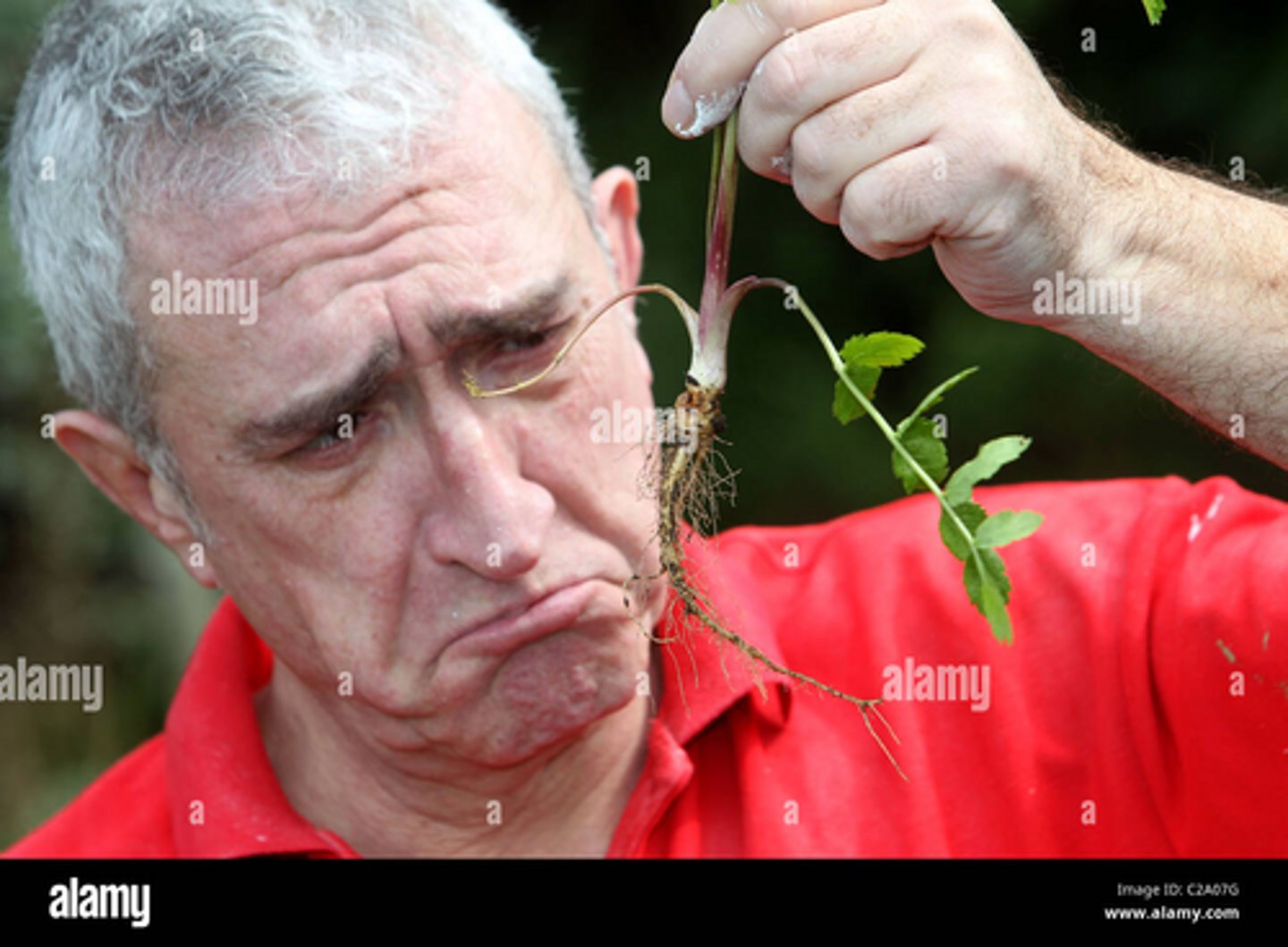
C4 plants prevent photorespiration by having Mesophyll Cells fix CO2 into Phosphoenol-pyruvate to make Oxaloacetate catalyzed by PEP-Carboxylase. This process ensures that only CO2 is entering the Bundle-Sheath Cells which is where the Calvin Cycle occurs.
How does C4 photosynthesis alleviate some of the inefficiencies of photorespiration?
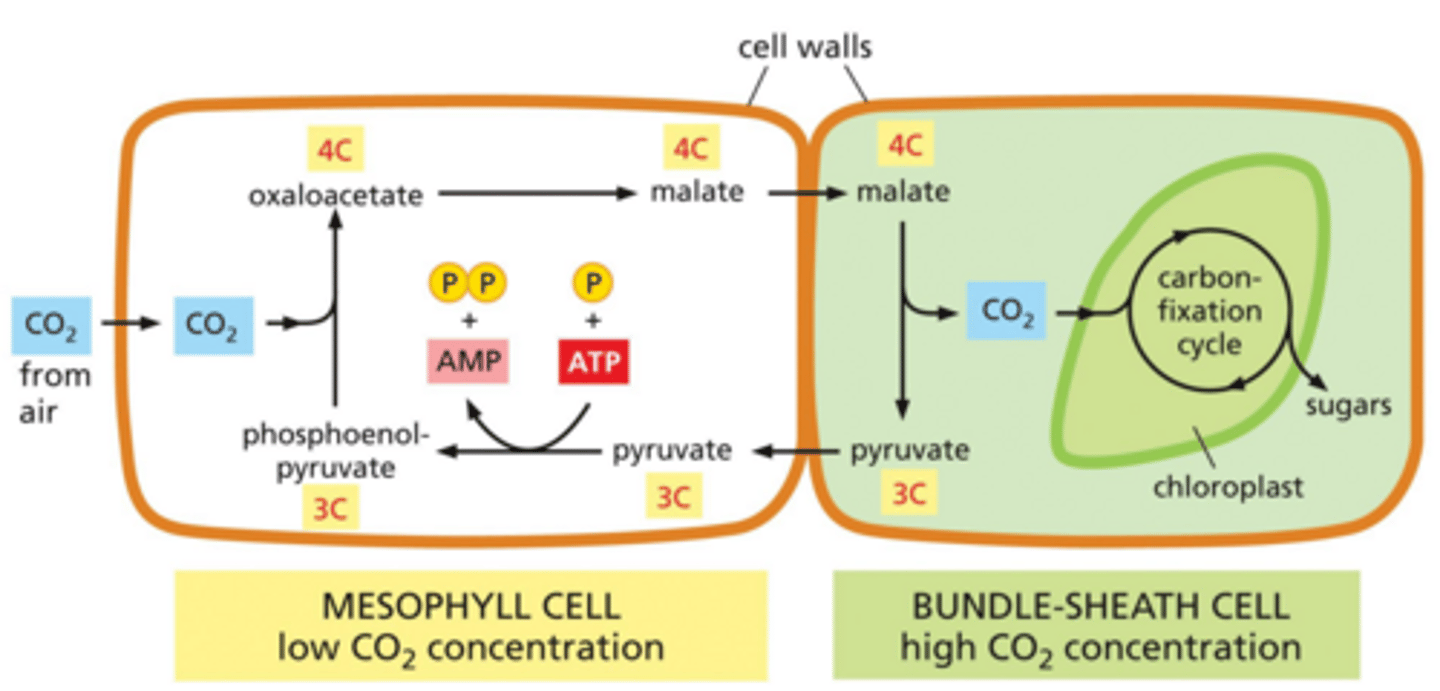
C3 plants use their mesophyll to do standard Calvin Cycle processes while C4 plants use them to shuttle CO2 into Bundle-Sheath Cells.
What is the function of mesophyll cells in C3 plants? in C4 plants?
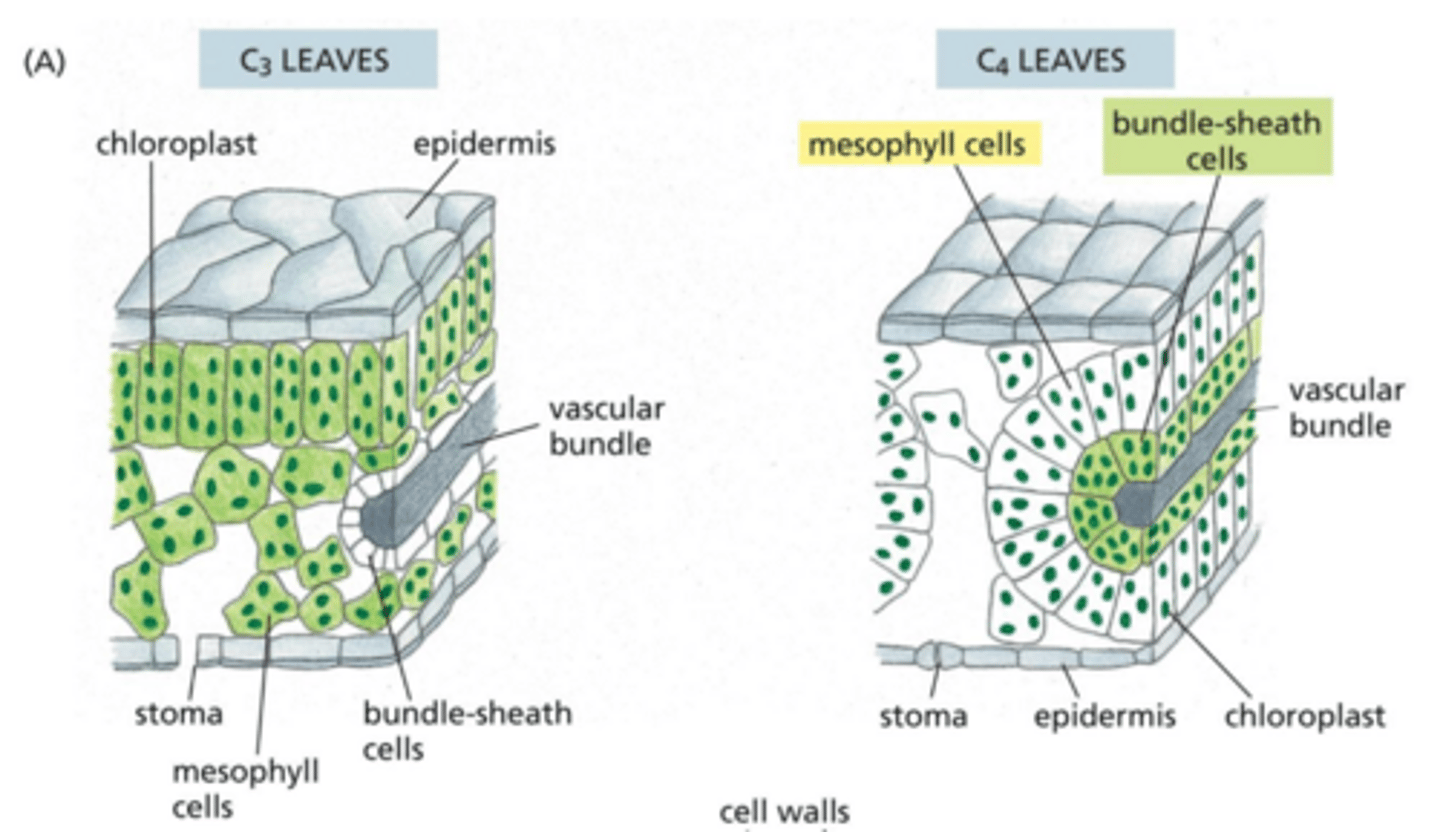
A Porphyrin Ring with a Mg center attached to a hydrophobic tail. The Porphyrin Ring has lots of Delocalized Electrons (Many Pi Bonds) for Resonance
Describe the structure and functions of chlorophyll.
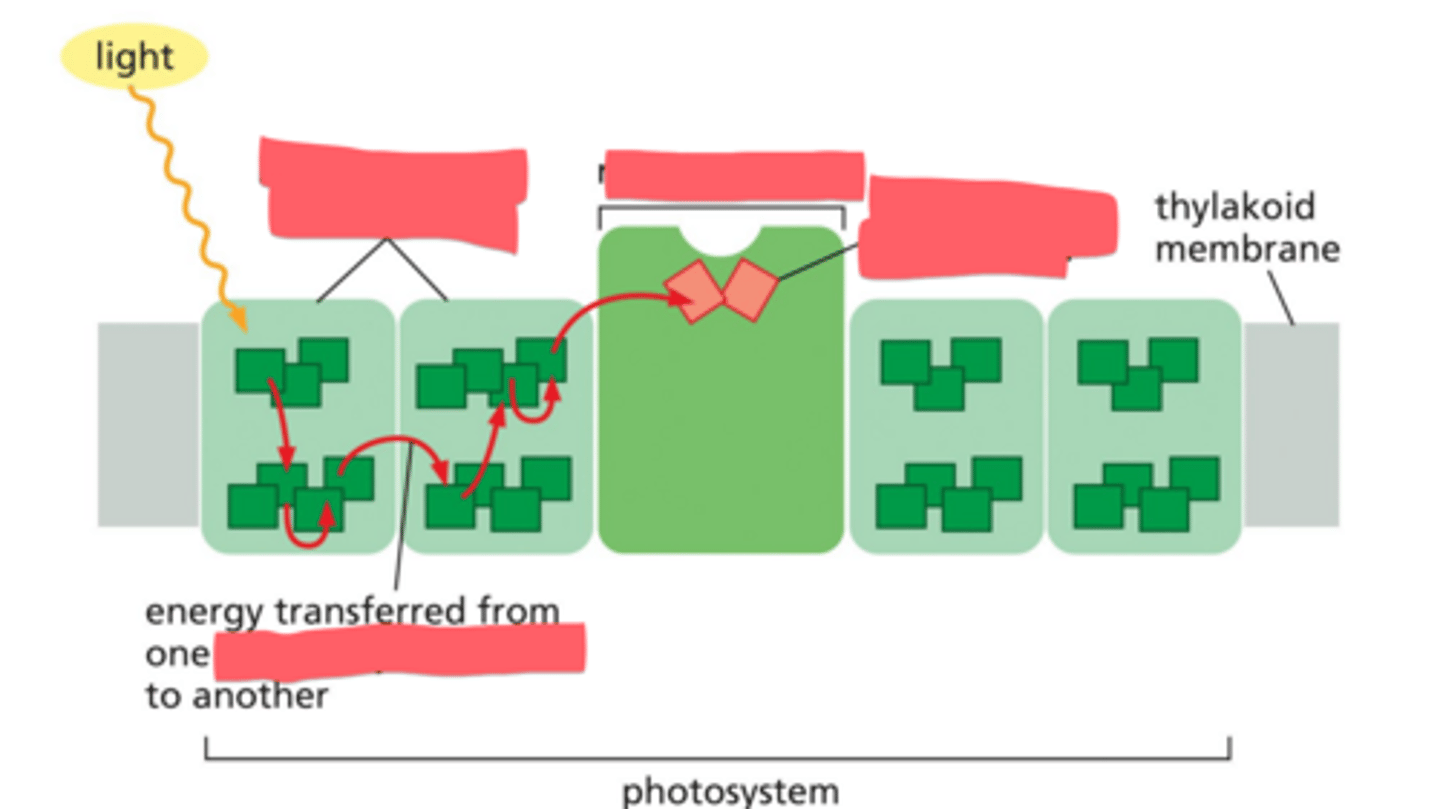
Photosystem II and I have Light-Harvesting Antennae that contain Chlorophyll Molecules as well as a Reaction Center with a special Chlorophyll Pair that is able to participate in Oxidation Reactions.
Describe the structure and functions of photosystems II and I.
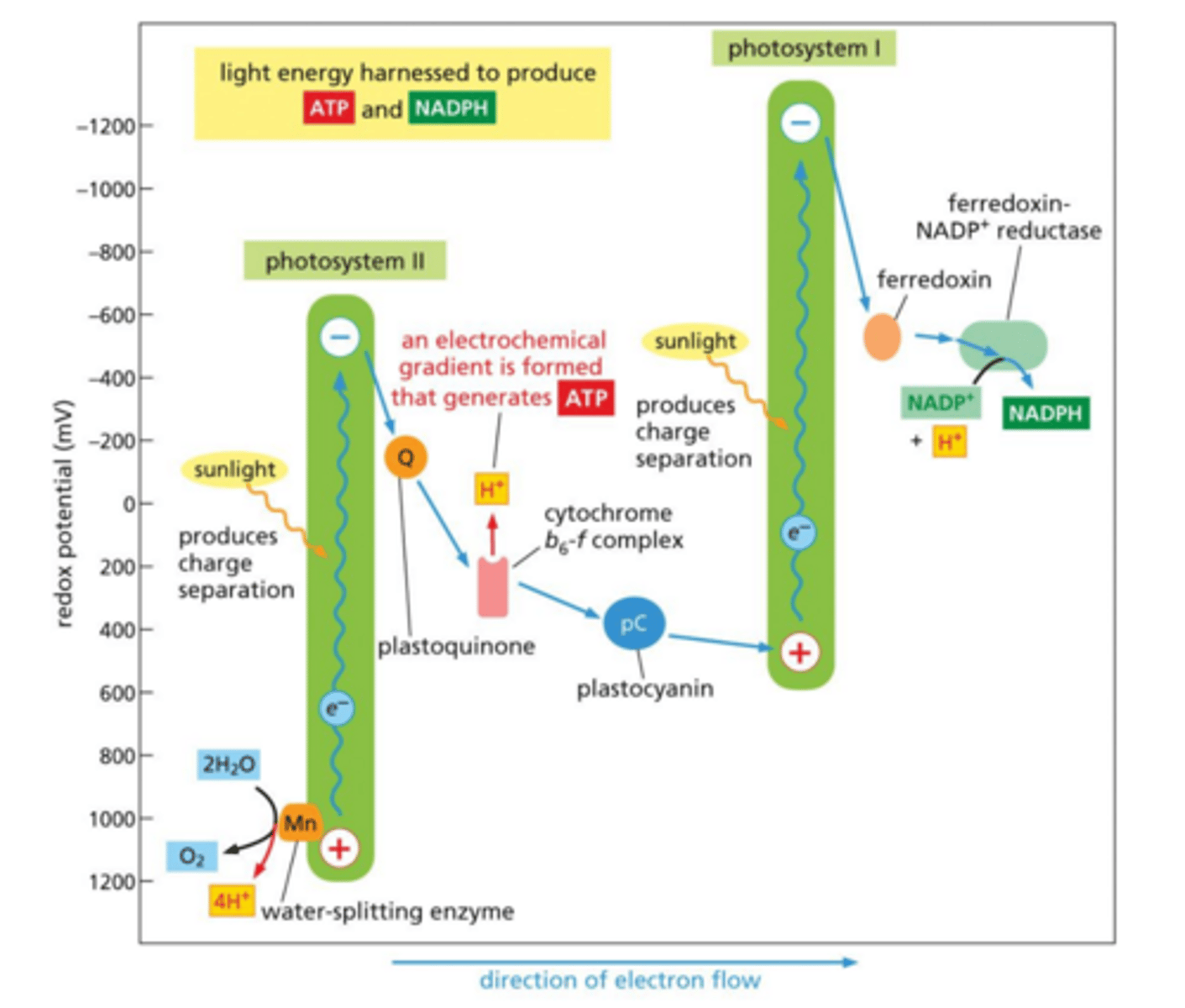
1. (We go up Redox Potential) Sunlight excites Photosystem 2 which results in the Oxidation of water.
2. (We go down in Redox Potential) Electrons from Photosystem 2 are transferred to Plastoquinone and then a Cytochrome Complex where a Proton Motive Force is generated for ATP Synthase and then into Plastocyanin.
3. (We go up in Redox Potential) Electrons are then transferred to Photosystem 1 which was excited by sunlight where the electron will travel into Ferredoxin and then into Ferredoxin-NADP+ reductase where NADP+ becomes NADPH.
Explain the path of electron flow (in detail) for Z-scheme photosynthesis.
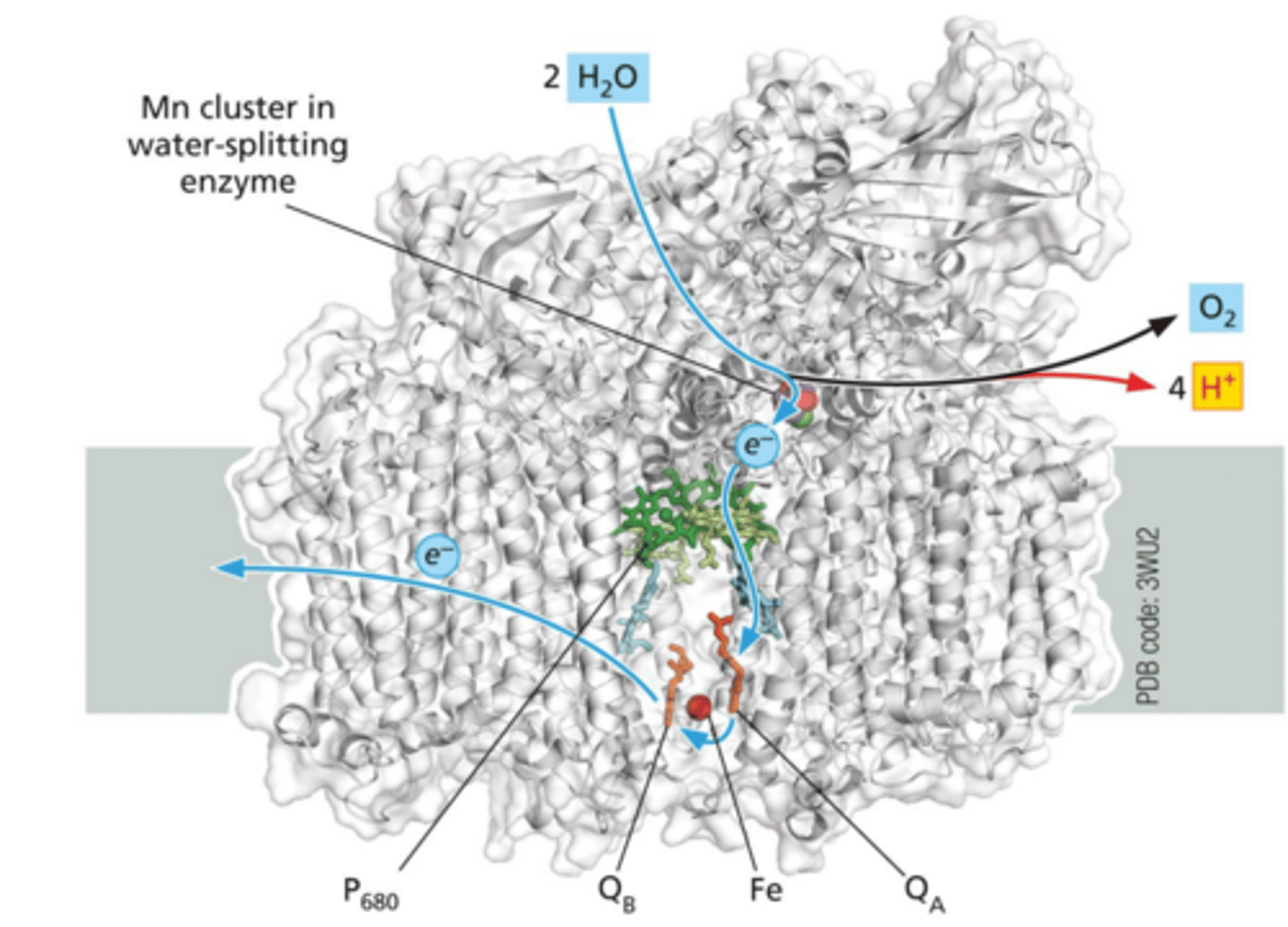
A Manganese Cluster (4 Mn, 1 Ca, and 5 O) is connected to P680 (4 Chlorophylls, 2 Pheophytins, 2 Plastoquinone, and an Iron Atom) via a Tyrosine side chain will split 2 H2O into 2 O2 with the use of 4 Photons of Light. Each photon oxidizes P680 into P680+ where it will pull an electron away from H20 that is bound at the Manganese Cluster.
How does PS II accomplish the water-splitting reaction?
- Both were obtained via Endosymbiosis
- Chloroplasts make food / Mitochondria process food into ATP
- Chloroplasts are large organelles located throughout the cell while Mitochondria tend to be around Chloroplasts
- Initial source of e- in Chloroplasts is H2O with a NADP+ being the Terminal Acceptor , Initial source of e- in Mitochondria is NADPH with O2 being the Terminal Acceptor.
- Initial source of Carbon in Chloroplasts is CO2 while it's Sugars/Amino Acids/Fatty Acids in Mitochondria
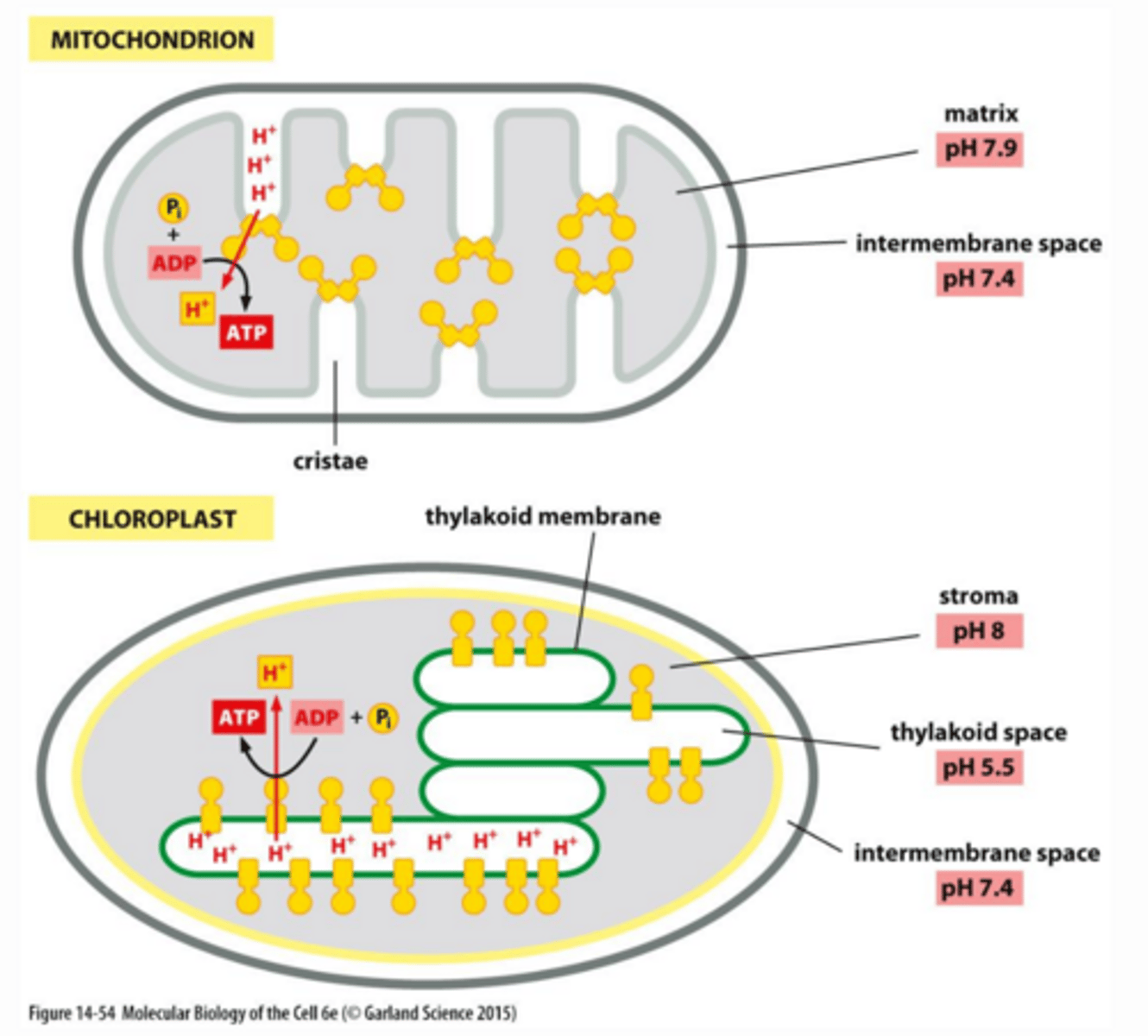
- ATP Synthase releases into the Stroma, Generates a Proton Motive Force in the Thylakoid Space, with concentration gradient being primary driver of Proton Motive Force in Chloroplasts, ATP Synthase releases into Matrix, Generates a Proton Motive Force in the Intermembrane Space, with membrane potential being the primary driver of Proton Motive Force in Mitochondria
Compare a mitochondrion and a chloroplast regarding their
o evolutionary origins
o overall function
o location & structural components
o initial source of electrons & terminal electron acceptor in the ETC
o initial source of carbon and products of carbon redox transformations
o ATP synthase orientation, H+ gradients, and proton motive force