1.1. basic principles of communication
 Call Kai
 Learn
Learn Practice Test
 Spaced Repetition
 Match
Match Flashcards
 Knowt Play
1/25

There's no tags or description
Looks like no tags are added yet.
Name | Mastery | Learn | Test | Matching | Spaced | Call with Kai | Chat |
|---|
No analytics yet
Send a link to your students to track their progress
26 Terms
Communication
active behaviour/process
takes part in speech acts & language games
Speaking involves
doing something with language

Speech acts – J. L. Austin
a framework illustrating how a speech act can be understood by its meaning, by its force (what someone is trying to accomplish) & by its effect (the reaction to what is said)
Speech acts – J. L. Austin → Three different acts
Locutionary acts
Illocutionary acts
Perlocutionary acts
Locutionary acts
the literal meaning.
The sounds, words, phrases & sentences that combined create the actual literal meaning.
llocutionary acts
what the speaker is trying to do (the force of the action).
Types of Illocutionary acts
Directives (orders)
Rogatives (petitions)
Representatives (claims/opinions)
Expressive (reflections of psychological states)
Commisive (with future value – intentions, threats, promises…)
Declarations (change the world – I do)
Perlocutionary acts:
Intended or unintended effects that the illocutionary acts have on the receiver
Language Games - Ludwig Wittgenstein.
the meaning of words & expressions depends on their use in specific forms of life or social contexts
Ludwig Wittgenstein believed that language is
not just about naming objects or describing facts
embedded in various human activities, or "games," where meaning emerges through use
Language has many functions
Meaning is contextual
Language is fluid
No fixed essence

Ludwig Wittgenstein → Language has many functions
It’s used not only to describe things but also to ask, command, joke, promise, etc
Ludwig Wittgenstein → Meaning is contextual
The meaning of words or phrases isdetermined by how they are used within a particular social activity or "game," like giving directions, making a promise, or participating in a debate
Ludwig Wittgenstein → Language is fluid
Different "games" have different rules.
What makes sense in one context might not work in another.
Ludwig Wittgenstein → No fixed essence
No single, universal logic behind all language.
Instead, different forms of life dictate how language functions.
according to Ludwig Wittgenstein & game language to effectively communicate
Discriminate the type of game language
Understanding its meaning is less about abstract definitions and more about observing how language is used in practice within different social interactions
Depends upon certain conditions
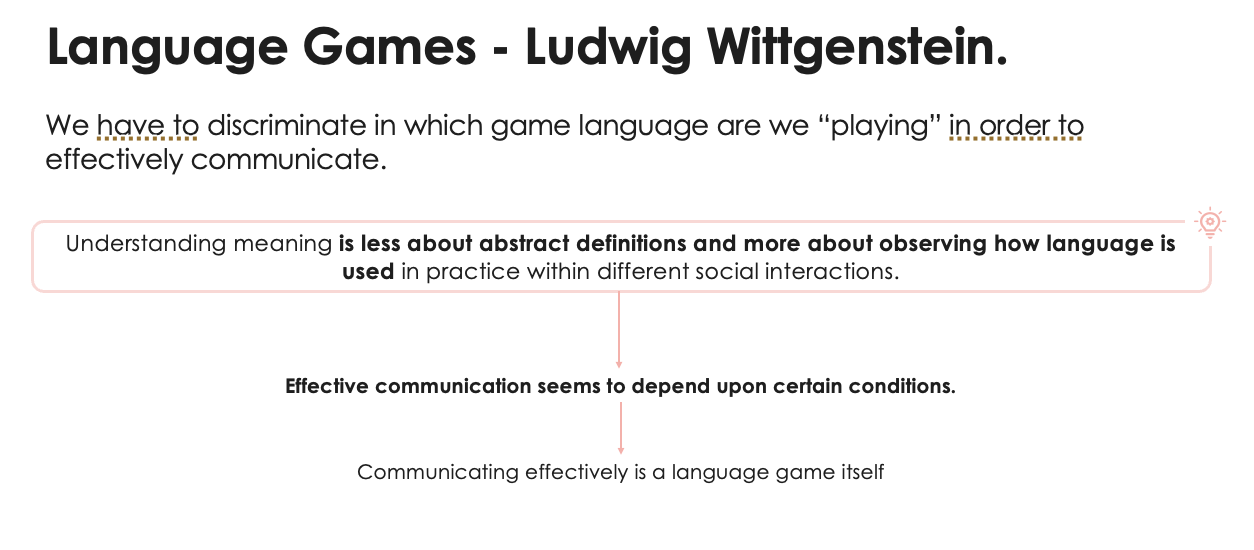
Effective communication
detect the “language game”:
the audience
the context
the goal
Essential communication skills
active listening
clarify
emotional discrimination
nonverbal communication
cultural sensitivity
written communication in professional settings
Active listening
Fully concentrating on the speaker, showing understanding of their message, responding thoughtfully, & remembering key details.
Importance: Helps build trust, allows audience to feel understood.
Clarity
Ensures that the message is understood as intended, reducing the potential for misinterpretation.
How does it work?: Feedback, synthesis, questioning, asking for clarification
Open vs. closed questions: Using probing questions to gather more information while avoiding leading questions
Emotional discrimination
To share other’s emotions, to make them feel understood and act based on these emotions (adapting the communication)
How does it work?
Consider what the situation that triggered the emotion means to the individual, rather than interpreting it through your own perspective
Seek feedback by offering multiple options, allowing the person to choose the word that best captures their emotion (both opened & closed questions, depending on the client).
Nonverbal communication
The use of body language, facial expressions, eye contact, posture, & gestures to communicate.
Understanding body language, facial expressions, & tone of voice.
The role of nonverbal cues & people’s interactions
The importtance of nonverbal communication
Nonverbal cues might transport more than words & can help or hinder communication.
Awareness of these cues is critical in both understanding others & presenting oneself effectively.
Cultural sensitivity
Being open to different perspectives, avoiding premature judgments, & maintaining a neutral stance in communication.
The importance of cultural sensitivity
This helps create a supportive environment for clients, encouraging honest dialogue without fear of criticism (punishment).
Written communication in professional settings
Writing professional reports, case notes, & psychological assessments
Clarity, conciseness, and ethical considerations in documentation
Digital aids
Motivational interview (Miller & Rollnick, 1991)
Engaging → opened questions, empathy, hopes & expectations, values goals
Evoking → without giving the answer, showing discrepancy, we find out why people change in the first place
Planning → give advices towards the change, being specific, measurable achievable, relevant, & time bound