🤕 Pain + Nociceptors
 Call Kai
 Learn
Learn Practice Test
 Spaced Repetition
 Match
Match Flashcards
 Knowt Play
1/25

There's no tags or description
Looks like no tags are added yet.
Name | Mastery | Learn | Test | Matching | Spaced | Call with Kai | Chat |
|---|
No analytics yet
Send a link to your students to track their progress
26 Terms
Learning Objectives
Explain why pain is a critical animal welfare issue
Distinguish between nociception, pain and suffering
Describe the biological mechanisms underlying pain
Recognize and categorize different types of pain
Pain assessment
Routine procedures cause pain
Principles of pain mitigation/analgesia

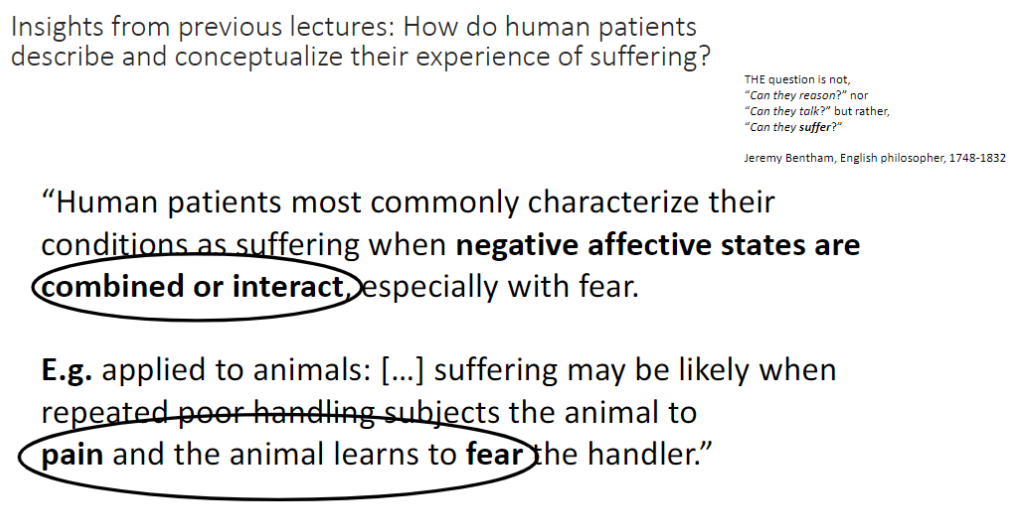
Insights – Human and Animal Suffering
Key Question
Not: Can they reason? or Can they talk?
But: Can they suffer? – Jeremy Bentham, 1748–1832
Human Perspective
Suffering arises when negative affective states combine or interact, often with fear
Application to Animals
Suffering is likely when repeated poor handling causes pain and animals learn to fear the handler
Inflammatory Airway Diseases – Symptoms
Respiratory Symptoms
Coughing
Nasal discharge
Labored breathing
Breathlessness
Difficulty breathing
Fear of oxygen deprivation
Chest Pain
Inflammation can cause chest pain, tightness, and discomfort
Examples
Porcine Reproductive and Respiratory Syndrome – pigs
Infectious bronchitis – chickens
Kennel cough – dogs

History of Analgesia – Key Points
19th Century
~30% of human amputations performed without anesthesia/analgesia (1860s, Pernick, 1985)
Late 20th Century
Laboratory animals often received no analgesics post-surgery (Philips, 1993)
21st Century
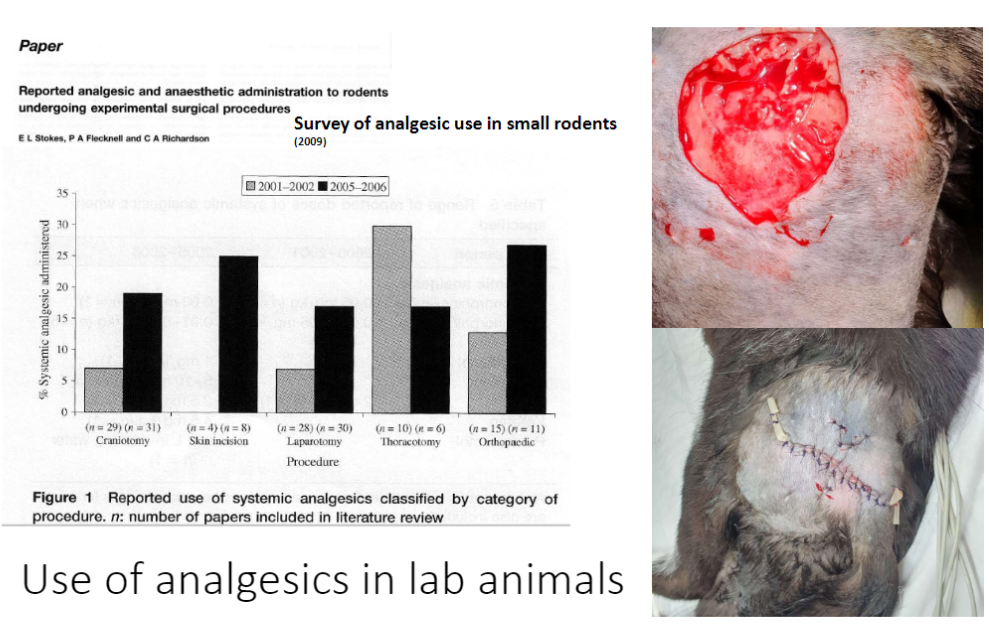
Many laboratory rodents still do not receive sufficient analgesia

Analgesic Use in Laboratory Animals
Purpose
Reduce pain and suffering during and after experimental procedures
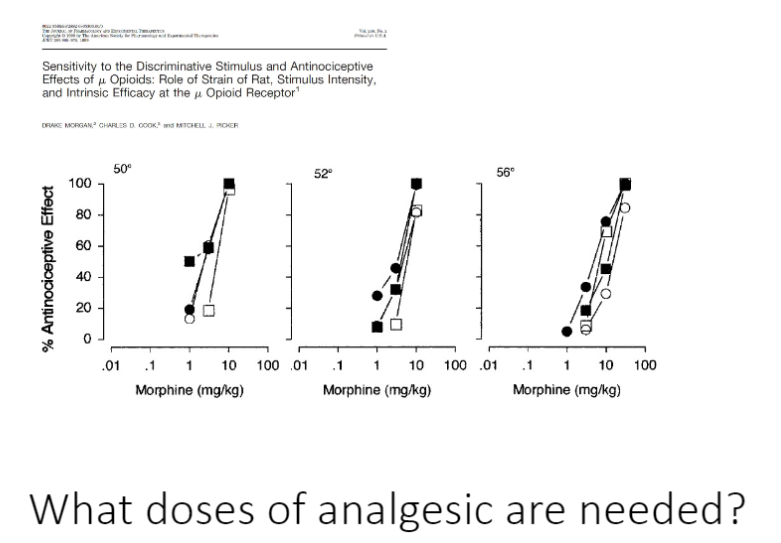
Analgesic Dosing
Goal
Provide effective pain relief without causing adverse effects
Recognizing Pain in Veterinary Practice
Veterinarian Concern
96% of French veterinarians are moderately or extremely concerned about recognizing and alleviating pain
Analgesic Use
Varies by procedure:
Orthopedic surgery – 84% receive analgesics
Castration – only 17% receive analgesics
Barriers to Analgesic Use
1. Difficulty in recognizing pain
2. Lack of knowledge about appropriate therapy

Recognizing Pain on the Farm
Challenges
Farm animals may hide signs of pain due to natural behavior or predator-prey instincts
Subtle changes in posture, gait, or feeding behavior are often the only indicators
Indicators of Pain
Behavioral – reduced activity, reluctance to move, vocalizations, abnormal postures
Physiological – increased heart rate, respiratory rate, or stress hormone levels
Production – decreased feed intake, growth, or milk yield

Definition and Components of Pain
Pain
An unpleasant sensory and emotional experience associated with actual or potential tissue damage, or described in terms of such damage
Components
1. Nociception – neural detection and processing of potentially harmful stimuli
2. Emotional experience – the subjective feeling of discomfort or suffering
Expanded Definition of Pain
Pain
A distressing experience linked to actual or potential tissue damage
Components
Sensory – detection of harmful stimuli
Emotional – unpleasant feelings associated with damage
Cognitive – interpretation and attention to pain
Social – effects on interactions with others

Pain – Revised Definition
Pain
An unpleasant sensory and emotional experience associated with actual or potential tissue damage

Pain – Descriptive Terms and Significance
Terms Used to Describe Pain
Aching, pulling, throbbing, burning, sharp, needle-like, itching, beating
Key Points
Pain perception serves as a warning mechanism for actual or potential tissue damage
Being indifferent to pain can be potentially harmful

Animal Pain – Earlier Definition
Physiological and Behavioural Changes
Pain changes the animal’s physiology and behaviour
Purpose
To reduce or avoid damage, prevent recurrence, and promote recovery

Animal Emotions – Conceptual Basis
Private Experience
Emotional states are private – we can only be certain of our own experience
Comparative Evidence
Shared ancestry, anatomy, and physiology (e.g., nervous system, cortex or equivalent structures)
Similar responses to similar situations suggest animals can experience emotions

Animal Pain – Analogy Approach
Brain Structures
All vertebrates have primitive brain areas to process nociceptive information: medulla, thalamus, limbic system, and cortex (or equivalent system)
Pain Signaling
Structures and pathways for sending and receiving pain signals are well known
Pharmacology
Pharmacological methods for pain mitigation are well studied
Analogy Reasoning
Using reasonable analogy, denying the existence of similar pain states in animals is considered absurd

Limits of Analogy
Key Point
Analogy does not prove that all beings experience identical feelings
Application
Strength of similarities can justify inferences about an individual animal’s subjective state
Reflexes vs. Conscious Pain
Reflexes
Automatic responses to stimuli
Pain
Subjective experience, different from reflexes
Key Point
Assessment of pain is essential because analgesia treats the felt experience, not just reflex responses

Function of Pain & Three Components
Function of Pain
Protects the body from injury
Withdrawal reflex acts as a first protective response
Three Components of Pain
Nociception (sensory detection) – detects harmful stimuli; not the same as feeling pain
Immediate emotional experience – unpleasant feeling when tissue is damaged
Long-term emotional impact – chronic worry, distress, changes in mood or behaviour

Tissue Damage – Examples
Goat – broken horn
Dog – bite wound

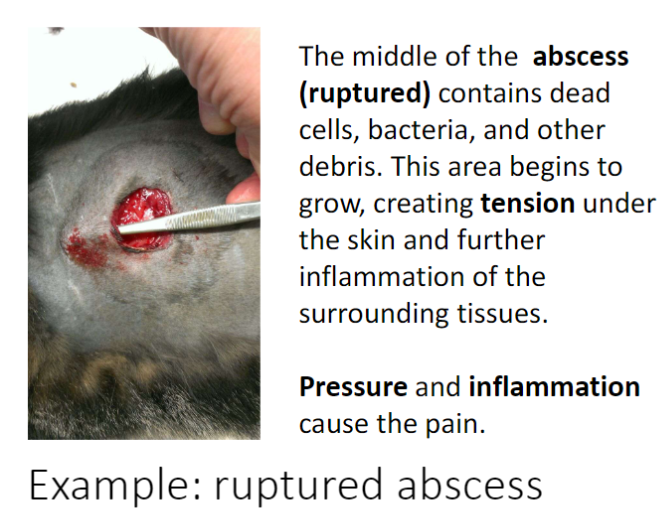
Ruptured Abscess – Pain Mechanism
Contents
Middle contains dead cells, bacteria, and debris
Growth
Area expands, creating tension under the skin
Inflammation
Surrounding tissues become inflamed
Pain
Caused by pressure and inflammation
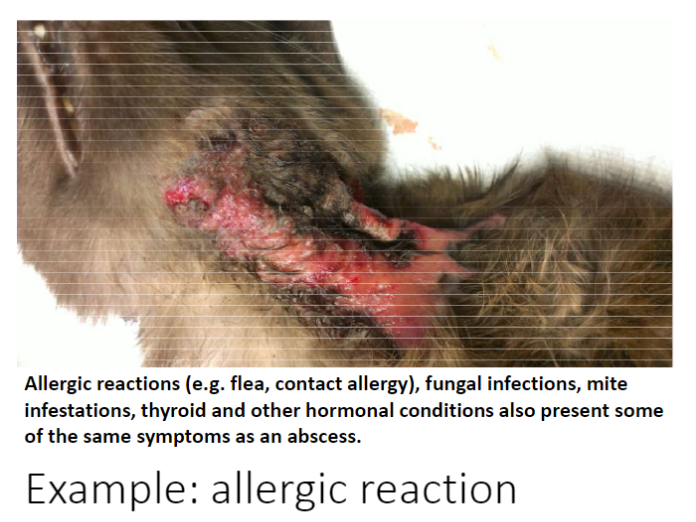
Allergic Reaction – Pain and Discomfort
Causes
Flea bites, contact allergens, fungal infections, mite infestations, thyroid or hormonal conditions
Symptoms
Similar to abscess: inflammation, redness, irritation, discomfort
Pain Mechanism
Inflammation and tissue irritation trigger unpleasant sensations
Tissue Damage – Chemical Mediators of Pain
Mechanism
Tissue damage releases chemicals that stimulate free nerve endings
Signals are sent to the spinal cord via the dorsal root ganglion
Cells Involved
Mast cells, macrophages, neutrophils
Chemical Stimulators
Histamine, prostaglandins, bradykinin, cytokines
Effect
Chemical stimulation triggers nociception and contributes to pain perception

Nociceptors – Specialized Sensory Receptors
Function
Detect extreme pressure, temperature, and noxious chemicals that can damage tissue
Mechanism
Transform harmful stimuli into electrical signals
Pathway
Signals travel to the central nervous system (CNS) for processingNoci
Nociceptors – Classification Based on Stimulus
Mechanical Nociceptors
Respond to intense pressure
Thermal Nociceptors
Respond to extreme hot or cold temperatures
Mechano-Thermal Nociceptors
Respond to both mechanical and thermal stimuli
Fiber Type
Typically myelinated A fibers
Collective Name
These three types are called A(δ-β)-nociceptors
Nociceptors – Polymodal & Silent
Polymodal Nociceptors
Respond to noxious mechanical, thermal, and chemical stimuli
Fiber type: small, unmyelinated C fibers
Impulse velocity: < 3 m/s
Silent Nociceptors
Activated by chemical stimuli (inflammatory mediators)
Respond to mechanical and thermal stimuli only after activation
Fiber type: small, unmyelinated C fibers
Impulse velocity: < 3 m/s

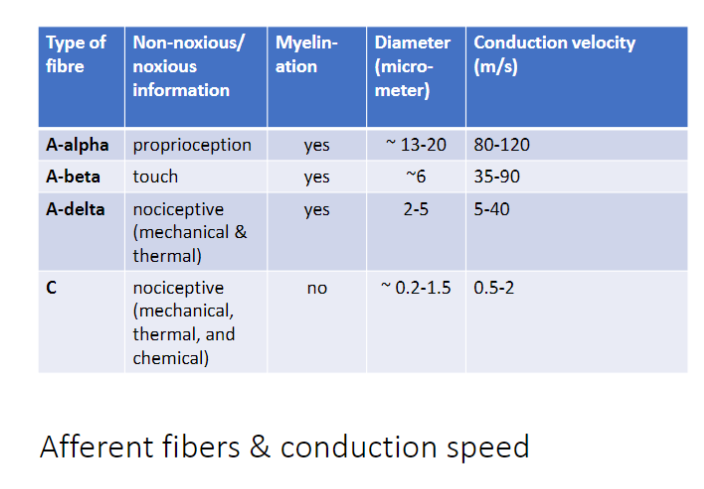
Afferent Fibers & Conduction Speed
A-alpha
Function: proprioception
Myelination: yes
Diameter: ~13–20 µm
Conduction velocity: 80–120 m/s
A-beta
Function: touch
Myelination: yes
Diameter: ~6 µm
Conduction velocity: 35–90 m/s
A-delta
Function: nociceptive (mechanical & thermal)
Myelination: yes
Diameter: 2–5 µm
Conduction velocity: 5–40 m/s
C fibers
Function: nociceptive (mechanical, thermal, chemical)
Myelination: no
Diameter: ~0.2–1.5 µm
Conduction velocity: 0.5–2 m/s