Security Non Negotiable Facts
 Call Kai
 Learn
Learn Practice Test
 Spaced Repetition
 Match
Match Flashcards
 Knowt Play
1/85

There's no tags or description
Looks like no tags are added yet.
Name | Mastery | Learn | Test | Matching | Spaced | Call with Kai | Chat |
|---|
No analytics yet
Send a link to your students to track their progress
86 Terms
What are the Fundamental Security Services?
Authentication
Access Control
Confidentiality
Integrity
Non-Repudiation
Availability
Authentication
Assurance that an entity is really the one who it claims to be
Access Control / Authorization
It offers the assurance that the entity performing a given action has the rights to do so
Confidentiality
Guarantee that data are available only to intended parties
Integrity
Assurance that data have not been modified maliciously
Non-Repudiation
Ensures that an entity cannot deny having done an action (e..g, either the sender or the receiver cannot deny to have sent/received a particular message)
Services Availability
Property of a system to be always available and ready to serve requesting entities
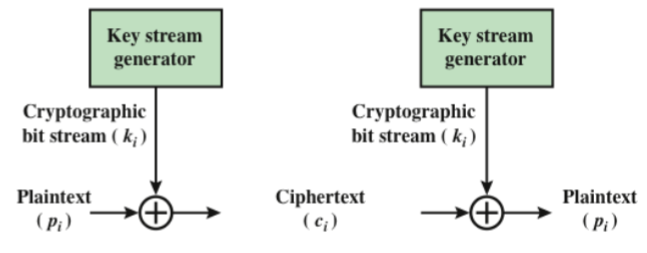
What Cipher is this?
Vernam Cipher
Vernam Cipher
Keystream generator generates a random key for each plaintext. Theoretically unbreakable, but in practice hard to implement due to lack of psuedo randomness
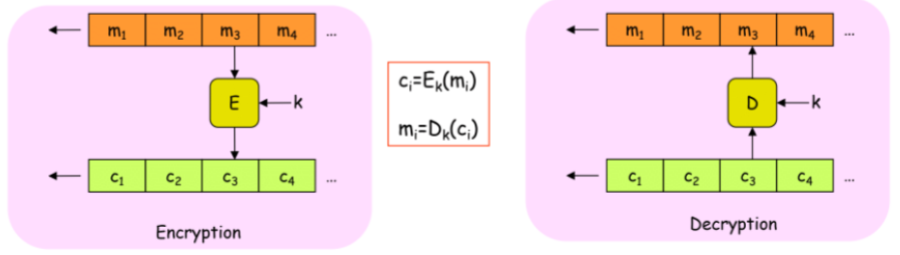
What Cipher is this?
Electronic Code Block
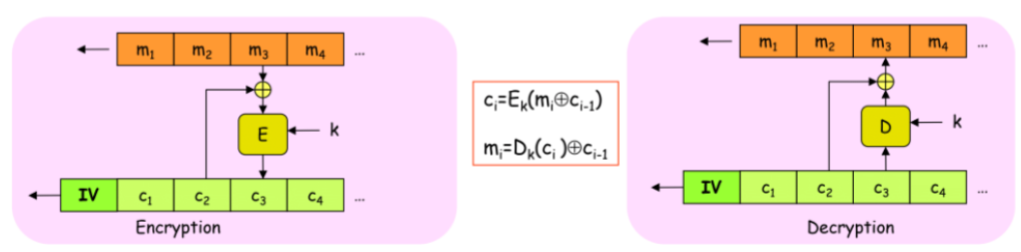
What Cipher is this?
Cipher Block Chaining
Cipher Block Chaining Limitation
If error occurs, it propagates indefinitely
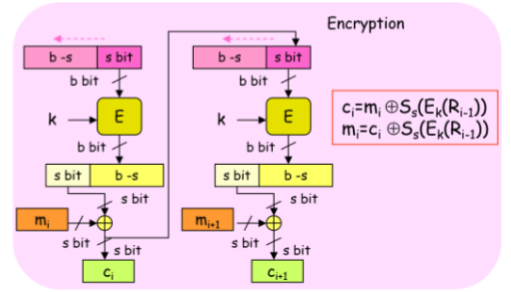
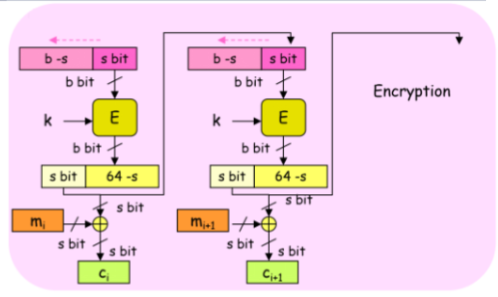
What Cipher is this?
Cipher Feedback
What Cipher is this?
Output Feedback
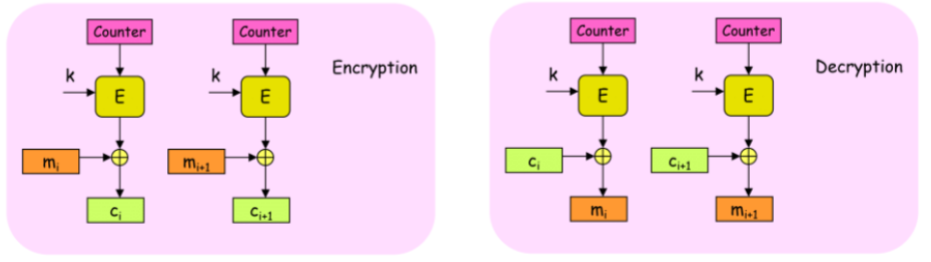
What Cipher is this?
Counter Mode
Counter Mode Advantages
Very fast, can be parallelizable
Errors only propagate to one block
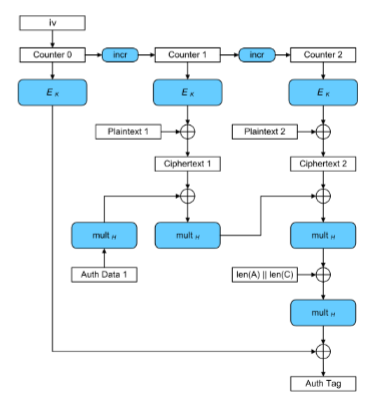
What Cipher is this?
Galois Counter Mode
What is IPSec (Internet Protocol Security)?
Network layer protocol that establishes secure, encrypted tunnels between two peers
IPSec Services
Confidentiality, Integrity and Authentication
IPSec Consists of..
IKE - Internet Key Exchange (handles mutual authentication and key negotiation)
ESP (Encapsulating Security Payload) or AH (Authentication Header) (Protects actual user data traversing the network)
IKE (Internet Key Exchange)
Protocol part of IPSec responsible for authenticating, setting up the security association between peers and distributing the keys for the current session (which are temporary to ensure perfect forward secrecy)
IKE Security Services
Authentication
Integrity
IKE General Flow
IKE_SA_INIT → IKE_AUTH → CHILD_SA
IKE_SA_INIT
Initiator and Responder agree on a cryptographic algorithm. Responder also shares Diffie-Hellman public value and random nonce
Shared Diffie-Hellman is independently computed, which is used to derive the master secret
From master secret, SK_e (encryption), SK_a (integrity), and SK_d (keying material for child SAs) keypairs are derived + establishing the IKE_SA (the secure control channel)
IKE_AUTH
Mutual authentication occurs, peers negotiate and establish the first CHILD_SA (the IPSec data channel), which defines the algorithms and keys used to encrypt the actual user traffic
CHILD_SA
Once the CHILD_SA is established, all user data traffic is encrypted using ESP (Encapsulating Security Payload), and IKE continues to manage the lifecycle of both SAs
ESP (Encapsulating Security Payload)
core IPSec protocol responsible for protecting the actual user data traffic that travels over the VPN
ESP Modes
Tunnel Mode and Transport Mode
Tunnel Mode
ESP takes the entire original IP packet (including the original source/destination IP headers), encrypts it, and wraps it inside a new outer IP header that contains the public IPs of the VPN gateways
Transport Mode
Encrypts only the payload (used for end-to-end host communications)
SPD (Security Policy Database)
Dictates WHAT traffic needs IPsec protection; it contains the policy rules that specify which selectors (e.g., source/destination IPs, ports, protocols) must be secured, bypassed, or discarded
SAD (Security Association Database)
Stores HOW to protect the traffic; it holds the actual cryptographic parameters for each active Security Association (SA). Stores IKE_SA and CHILD_SA IKE_SA
WPA2 / Robust Security Network (RSN)
Second-generation Wi-Fi security protocol, officially mandated for all devices carrying the Wi-Fi trademark since 2006, and it replaced the severely flawed WEP protocol
WPA2 Services
Authentication, Access Control, and Data Confidentiality
WPA2 - Authentication
Defines an exchange between a user and an AS (authentication server) that provides mutual authentication and generates temporary keys to be used between the client and the AP over the wireless link
WPA2 - Access Control
Enforces the use of the authentication function, routes the messages properly, and facilitates key exchange. It can work with a variety of authentication protocols
WPA - Confidentiality with Message Integrity
MAC-level data are encrypted along with a message integrity code that ensures that the data have not been altered.
WPA Protocol for Access Control
IEEE 802.1, Port-based, Access Control
WPA Protocol for Authentication and Key Generation
Extensible Authentication Protocol (EAP)
WPA Protocol for Confidentiality, Data Origin Authentication and Integrity and Replay Protection
CCMP
WPA Algorithms - Confidentiality
AES-CCM (AES-CTR mode to encrypt plaintext), NIST Key Wrap
WPA Algorithms - Integrity and Data Origin Authentication
HMAC-SHA-1
AES-CBC-MAC
WPA Algorithms - Key Generation
HMAC-SHA-1
RFC 1750
Extensible Authentication Protocol (EAP)
Used to carry out mutual authentication in WPA2, exchange credentials and establish the MSK. RADIUS server authenticates client, and distributes MSK to AP
WPA-2 Personal and WPA-2 Enterprise differences
Personal: Pre-shared key is used
Enterprise: Master Session Key is generated between client and AP
4-Way Handshake
Anonce sent to STA to generate PTK
Snonce sent from STA to AP to generate PTK
AP demonstrates to STA it is alive and PTK is fresh via MIC (Message Integrity Code)
STA sends acknowledgement message (no function, finishes the handshake)
Protected Data Transfer - Schemes
WPA → Temporal Key Integrity Protocol (TKIP) (deprecated)
WPA2 → Counter Mode-CBC MAC Protocol (CCMP)
WPA2 vs WPA3
Personal:
More robust authentication process via the Simultaneous Authentication of Equals (SAE) protocol, in place of the 4-ways handshake, forward secrecy + natural password selection
• Use of AES-GCM in place of AES-CCMP
Temporal Key Integrity Protocol (TKIP)
Core data encryption protocol designed to address flaws in WEP (later deprecated in 2008 after serious vulnerabilities were exposed)
TKIP Services
Message integrity and Data Confidentiality
TKIP Main Implementations
Each packet has a unique key, the RC4 key (generated from Temporal Key, MAC Address, Initialization Vectors)
Using MIC Key derived from PTK, integrity of data can be checked, AP computes same hash and compares the hash it received
Counter Mode-CBC MAC Protocol (CCMP)
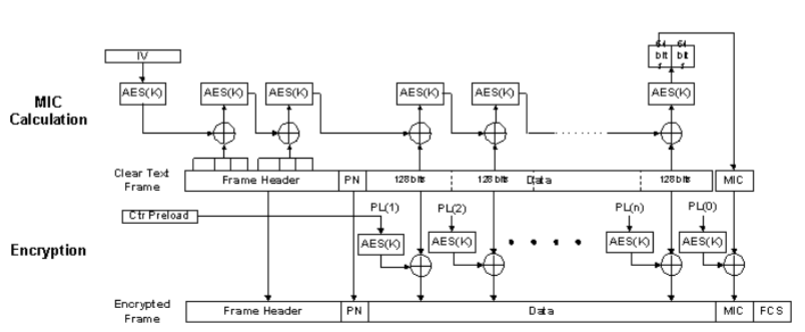
WPA2 algorithm responsible for encrypting the payload and providing integrity via the MIC calculation
How does CCMP work?
CBC-MAC Mode for MIC calculation
CTR Mode for payload encryption
TLS
Transport Layer Security: the foundational protocol that secures communication over the Internet.
It is the successor to SSL (Secure Sockets Layer)
TLS Uses
General purpose protocol: the core technology behind HTTPS, securing web browsing, email, VoIP, and many other applications.
TLS Services
confidentiality, integrity, and authentication
TLS Algorithms
(They are algorithms of the TLS Record Protocol)
Confidentiality: AES CBC mode
Integrity: HMAC in RFC 2104
What data does TLS encrypt?
TCP traffic
TLS Main Protocols
Record Protocol and Handshake Protocol
TLS Record Protocol
Responsible for fragmenting, compressing (optional), encrypting, and transmitting all application data (e.g., HTTP) and handshake messages between the client and server
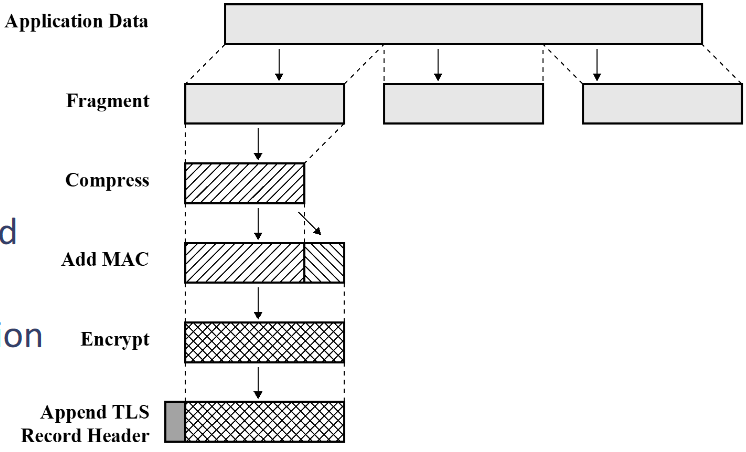
TLS Record Protocol Steps
Application data is fragmented into records, compressed, MAC is appended (message authentication code), encrypted and the TLS record header is appended
TLS Record Header Content
Message Type, Protocol variant, data size
TLS Handshake Protocol Objectives
Ran at the establishment of a TLS session to:
Authenticate the parties (mutual authentication)
Establish the Cipher Specifications (encryption and MAC)
Establish keys
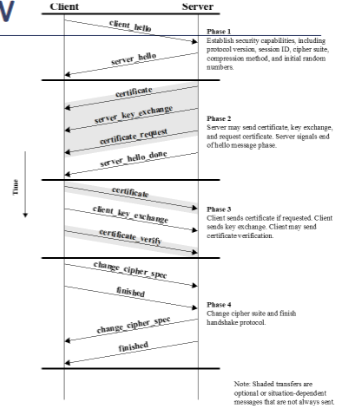
TLS Handshake Steps
Phase 1: Establish Security Capabilities
Phase 2: Server Authentication and Key Exchange
Phase 3: Client Authentication and Key Exchange (DH)
Phase 4: Finish - verification of successful authentication and key exchange
TLS Master Secret
Master Key from which keys for record protocol are derived.
Created using pre master key (from DH), client and server random number
TLSv1.3 vs TLSv1.2 changes
Removed Compression Option
No RSA for Key Exchange (only signature)
Inclusion of 32-bit timestamp in ClientHello
No RC4 for stream cipher, only block ciphers
Use of Hashed Key Derivation Functions (HKDF) in place of PRF
Use of AES-GCM for confidentiality and integrity
1-round trip handshake (re-use of security parameters from previous handshakes)
HTTP Secure (HTTPS)
Secure version of HTTP that runs over TLS/SSL. It secures communication between client and server
HTTPS Services
Authentication
Confidentiality
Integrity
HTTPS port
443
HTTP port
80
HTTPS Connection Initiation
HTTPs client connection triggers TLS Handshake protocol.
After successful completion of TLS Handshake, HTTPS client delivers HTTP data in a TLS Record packet
HTTPS Connection Closure
HTTP(s) client or server can indicate the closing of a connection by including the line Connection: close in an HTTP(s) record
TLS implementations must initiate an exchange of closure alerts before closing a connection (otherwise the closure is incomplete)
Secure Shell (SSH) Protocol
Protocol for secure network communication between two hosts
SSH Port
22
SSH Protocol Stack
SSH Transport-Layer Protocol, SSH User Authentication Protocol, SSH Connection Protocol
SSH Transport-Layer Protocol
Foundational component of SSH, providing a secure, low‑level channel over an insecure network, typically on top of TCP/IP
SSH Transport-Layer Flow
Identification Key Exchange, Algorithm Negotiation, Key Exchange (DH), Service Request (Authentication or Connection Protocol)
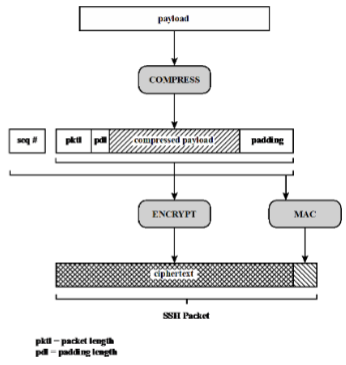
SSH Packet Structure
Payload compressed, MAC computed from sequence number and payload. Plaintext encrypted (without MAC), MAC is attached. Server recomputes MAC on ciphertext. If same, accept
SSH Packets Services
Integrity, Confidentiality, Message Authenticaiton (sender must have used symmetric key for this session to compute
SSH User Authentication Protocol
SSH Protocol used to Authenticate Client to Server
SSH User Authentication Protocol Message Types
SSH_MSG_USERAUTH_REQUEST (50: Username, connection protocol, authentication method)
SSH_MSG_USERAUTH_FAILURE (51: list of methods that are allowed, publickey, pass, hostbased)
SSH_MSG_USERAUTH_SUCCESS (52: single byte)
SSH Connection Protocol
Allows packet (data) exchange over secure connection, new communication opens a channel (max packet size and application specified during opening of channel)
SSH port forwarding/tunneling
Convert any (insecure) TCP session into a secure SSH connection (SSH tunneling). Packets are delivered to correct app via port number
SSH Port Forwarding Types
Local Forwarding and Remote Forwarding
Local Forwarding
Client and Server redirect traffic to/from SSH ports
Remote Forwarding
User SSH Client acts on server’s behalf (packets are directly delivered to SSH port on the server)