Raymond Cattell - A True Empiricist
 Call Kai
 Learn
Learn Practice Test
 Spaced Repetition
 Match
Match Flashcards
 Knowt Play
1/17

Earn XP
Description and Tags
“The statistical technique of factor analysis is a research tool as important to psychology as the microscope was to biology.”
Name | Mastery | Learn | Test | Matching | Spaced | Call with Kai | Chat |
|---|
No analytics yet
Send a link to your students to track their progress
18 Terms
Raymond Cattell: Background
Born in 1905 in England
Graduated college at 19!
Became interested in mental testing
Education
Majored in chemistry at U. of London
Did graduate work in Psychology (respect for Freud)
Interested in heritability of intelligence
Moved to U.S. after failed marriage and floundering career
Worked with Edward Thorndike
Worked at:
Columbia, Clark, Harvard, Duke, U. of Illinois
Retired in 1973
Wrote books while living in Hawaii until 1998, when he passed away
Definition of Personality
Is that which permits a prediction of what a person will do in a given situation
Definition of Traits
The units of personality that have predictive value
Factor Analysis
A procedure for analyzing a set of correlations among various measures into a simpler underlying pattern, termed a “factor structure.”
Gather information via observations
Compute correlations between variables
Identify significant correlations
Name the factors!
Interpretation may be difficult
High correlations may not mean that they are directly related
Price of milk over the years
My age
Average temperature of the globe
Two ideas regarding the research approach - Data Types
Q-data
Questionnaire
L-data
“Life” data
Behavioral observation
T-data
“Test data”
Lab tests, like physiological data
Two ideas regarding the research approach - Data Analysis
R-technique
Usually With Q-data
Hundreds of people take questionnaires and then F. A. the data
dR-technique
Same as R, but people take the test twice to assess change. See how changes relate to one another
P-technique
One person over and over; used to study STATES, not TRAITS
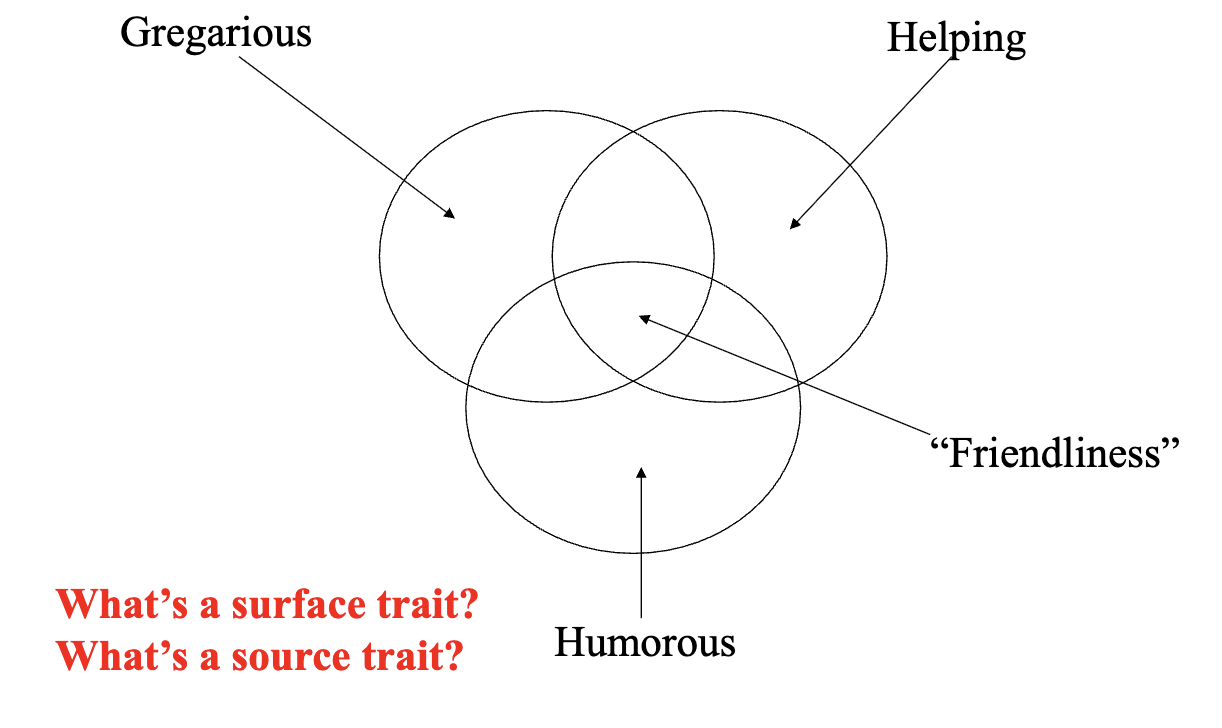
Types of Traits - Surface Trait
Traits that are at the level of observable behavior
Types of Traits - Source Trait
A primary factor derived from factor analysis
Ability Trait – how a person works to a desired goal (e.g., intelligence)
Temperament Trait – General style with which someone carries out tasks (e.g., positive affect)
Dynamic Trait – Provides energy and direction to action; motivations and interests (i.e., Ergs and Metaergs)
Diagram
A Special Ability Trait: Intelligence
Fluid Intelligence (e.g., Raven’s Progressive Matrices)
The innate ability to learn
“Fluid” because it can be expressed in different types of learning, depending on opportunities presented to the individual
Crystallized Intelligence (e.g., SAT)
Includes the effects of opportunity or education
Cattell was particularly interested in trying to learn about Fluid intelligence, outside of the domain of education
Dynamic Traits - Ergs
Constitutional dynamic source traits (like instincts)
Innate motivational traits (include anger, curiosity, fear, greed, hunger, loneliness, pity, pride, sensuousness, and sexual interest)
Expression of “instincts” is learned
Sex —> mating
Food —> eat what?
Dynamic Traits - Metaergs
Environmentally-molded source traits
Learned motivations
Sentiments: Formed early and are enduring
E.g., religion, politics
Attitudes: More specific
E.g., value of Mother’s/Father’s Day
Subsidiation
A type of meta-erg
Basic drives are met by multi-step sequences
E.g., in part because we need to eat, we work!
They are “means-end” activities
Cattell’s 16PF
Measures that Cattell saw as the most important source traits
Each is measured dimensionally (1 to 100 as opposed to yes/no)
List of Cattell’s 16PF
• Cool
• Concrete Thinking
• Affected by feelings
• Submissive
• Sober
• Expedient
• Shy
• Tough-Minded
• Trusting
• Practical
• Forthright
• Conservative
• Group-Oriented
• Undisciplined
• Relaxed
• Self-Assured
• Warm
• Abstract Thinking
• Emotionally Stable
• Dominant
• Enthusiastic
• Conscientious
• Bold
• Tender-Minded
• Suspicious
• Imaginative
• Shrewd
• Experimenting
• Self-sufficient
• Controlled
• Tense
• Apprehensive
The Big Five (Costa & McCrae)
Openness to Experience
Wide interests, original, curious, artistic, imaginative
Conscientiousness
Thorough, reliable, persevering, efficient
Extraversion
Talkative, energetic, enthusiastic, outgoing
Agreeableness
Helpful, trusting, forgiving, considerate, cooperative
Emotional Stability vs. “Neuroticism”
Relaxed, stable, confident, calm
Research
Fiske (1949): Reported 5 factors from 16PF
1960: More replications
1980s: Revived, with many studies showing 5 factors.
Differ on naming
Heritability
The extent to which two people with similar genetic status have similar personality, even when they have developed in different environments
Twins who are raised apart
Each of The Big 5 have been found to be significantly acquired from genetics
The Big-Five Inventory - Scoring
STEP 1: “Reverse score” items
1, 3, 5, 7, 9, 10, 12, 13, 16, 18, 19, 21, 26, 27, & 29
Emotional Stability
Add responses to questions 1-5
M=13.95, SD=4.83
Extraversion
Add responses to questions 6-11
M = 21.99, SD = 5.24
Openness
Add responses to questions 12-17
M=20.87, SD=4.68
Agreeableness
Add responses to questions 18-23
M=22.48, SD=4.34
Conscientiousness
Add responses to questions 24-29
M=21.19, SD=4.03