Lecture 6: Periodontal Disease Management
 Call Kai
 Learn
Learn Practice Test
 Spaced Repetition
 Match
Match Flashcards
 Knowt Play
1/19

There's no tags or description
Looks like no tags are added yet.
Name | Mastery | Learn | Test | Matching | Spaced | Call with Kai | Chat |
|---|
No analytics yet
Send a link to your students to track their progress
20 Terms
What are the symptoms of periodontal disease?
Reluctance to chew
Head shyness
Pawing at the face
Dropping food when eating
Sneezing/nasal discharge
Exaggerated jaw motion when chewing
Aversion to food or water - most patients will still eat with severe periodontal disease
What are the typical intraoral PE findings of periodontal disease?
• Halitosis
• Gingivitis
• Calculus
• Gingival recession/root exposure
• Missing teeth
• Mobile teeth
What are the typical extraoral PE findings of periodontal disease?
submandibular swelling
perioral swelling
draining tracts
How is periodontal disease diagnosed?
minimum database
COHAT - requires anesthesia, requires imaging, requires probe exam
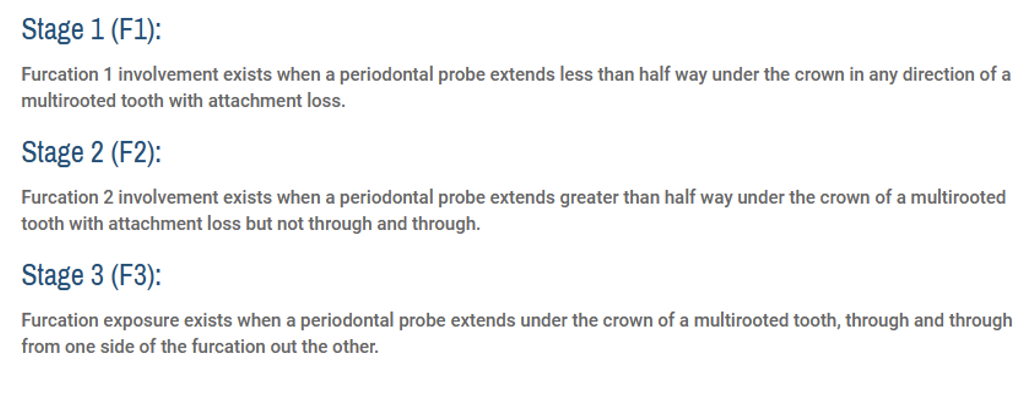
What are the 3 stages of the furcation index?
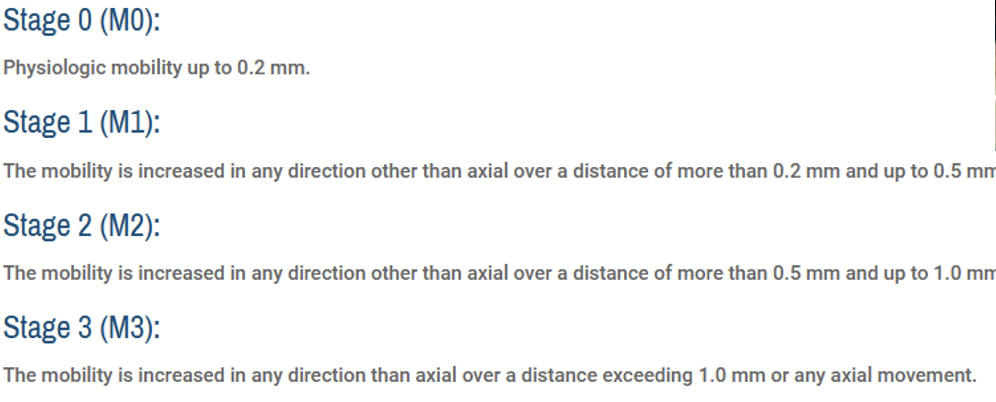
What are the 3 stages of tooth mobility index?
What are the 3 levels of the gingival index?
Gingival index 1 - Inflammation and swelling of the gingiva with no bleeding during periodontal probing.
Gingival index 2 - Inflammation and swelling of the gingiva with bleeding during periodontal probing.
Gingival index 3 – Inflammation and swelling of the gingiva with spontaneous bleeding of the inflamed gingiva prior to periodontal probing.
What are the 4 stages of periodontal disease?
normal/PD0: 0% attachment loss, no gingivitis
stage 1: 0% attachment loss, gingivitis present
stage 2: <25% attachment loss, possible stage 1 furcation
stage 3: 25-50% attachment loss, possible stage 2 furcation
stage 4: > 50% attachment loss, possible stage 3 furcation
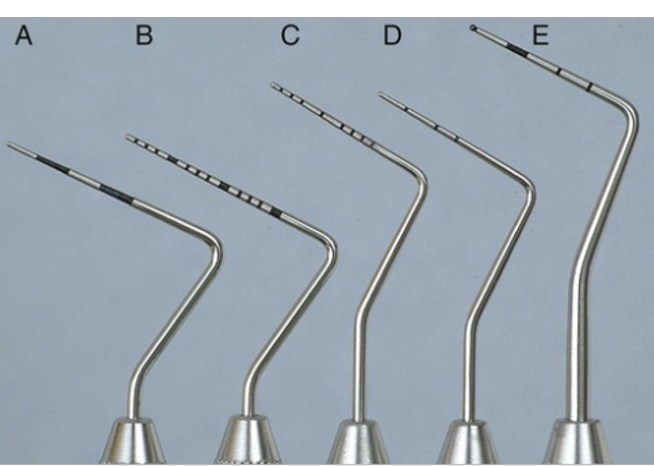
What are the first three instruments>
A. Marquis color-coded periodontal probe - calibrations in 3 mm sections (dog)
B. UNC-15 probe - markings at each mm and color coding at 5, 10, and 15 mm (cat or dog)
C. Uni. of Michigan “O” probe with Williams markings at 1, 2, 3, 5, 7, 8, 9, and 10mm (cat or dog)
How do you measure a periodontal pocket with a probe?
Gently place the probe in between the gingiva and tooth
Stop when you feel resistance at the end of the probe
Record pocket depth
Do NOT use too much force à if you do then you can damage the attached gingiva and cause pocketing!
What are the non-surgical treatment options for periodontal disease?
Ultrasonic scaling and polishing
Closed root planning
With or without perioceutic application
Homecare: Tooth brushing, Water additives, Diets, Chews
Barrier/sealant application
Can be performed in general practice
What are the surgical treatment options for periodontal disease?
Defined as any procedure requiring a mucogingival flap
Examples
Open root planning
Bone grafting
Guided Tissue Regeneration
Regenerative procedures with stem cells and grafts
Advanced mucogingival flap techniques to reduce pocketing
Surgical and non-surgical extractions
Requires referral (except certain extractions)
What are perioceutics?
antimicrobial products available for dental applications - doxycycline or clindamycin gels → acts as physical barrier to pocket contamination, doxycycline in addition has anticollagenase activity
How is treatment planned for early-stage for advanced stage periodontal disease?
Early-stage periodontal disease
PD0, PD1 – managed with annual COHATs and homecare\
PD2/F2 – closed root planning +/- perioceutic application
Advanced stage periodontal disease
PD3 – open root planning +/- perioceutic application, GTR, extraction
PD4 – extraction
Combined periodontal and endodontic lesions – extraction
Periapical pathology - extraction
Why should a tooth not be scaled longer than 10 seconds?
ultrasonic scaler causes thermal damage to pulp when held against tooth for extended time?
What are the two types of ultrasonic scaling tips?
perio tip: thin, curved tip designed to reach deep into periodontal pockets and furcations, appropriate to use for subgingival cleaning
universal tip: thicker, straight tip that is used for moderate to heavy supragingival calculus removal
What is the most effective way to prevent periodontal disease?
daily tooth brushing
What is root planing?
deep dental cleaning: Run the curette along the surface of the tooth into the periodontal pocket, “hook” the granulation tissue and calculus, scrape upward along the tooth to remove debris
What are the steps of guided tissue regeneration?
Ultrasonic scaling and polishing of tooth
Regional nerve block: Bupivacaine
Creation of mucogingval flap (15, 15c surgical blade)
Open root planning for removal of calculus and granulation tissue from periodontal pocket
Bone grafting material filled into boney defect: Synergy, Periomix
Membrane placed, sutured into place 5-0 Monocryl: Doxirobe vs. Ossiflex membrane (Demineralized freeze-dried membrane allograft)
Flap closure with 5-0 Monocryl
dental rad recheck in 6 mo to monitor osseous integration
Why are antibiotics sometimes given prophylactically for dentals?
Goal is to prevent metastatic bacteremia and to reduce infections associated with surgery.
COHATs have been documented to cause transient bacteremia that resolves within 24hrs of the procedure → Immune-competent patients resolve bacteremia on their own
systemically administered antibiotics are needed for animals that are immune compromised, have underlying systemic disease, and/or have severe oral infections