Birds and Small Mammals
 Call Kai
 Learn
Learn Practice Test
 Spaced Repetition
 Match
Match Flashcards
 Knowt Play
1/68

There's no tags or description
Looks like no tags are added yet.
Name | Mastery | Learn | Test | Matching | Spaced | Call with Kai | Chat |
|---|
No analytics yet
Send a link to your students to track their progress
69 Terms
What are the different classes of birds of prey? Give an example for each
Hawks (long-winged)
Harris Hawk
Goshawk
Red-tailed Hawk (buzzard)
Falcons (short-winged)
Peregrine Falcon
Saker
Merlin
Eagles
Golden Eagle
Owls
Barn Owl
Snowy Owl
What is meant by the term ‘falconry‘?
The keeping of falcons (or other birds of prey) and training them to hunt wild animals
What is meant by the term ‘flight weight‘?
Ideal weight for flying (lowest weight that allows optimal performance)
What is meant by the term ‘cast‘?
Cast (1): the method to hold a bird for examination
Cast (2): to regurgitate a pellet
Cast (3): 2 or more birds flown together
What is meant by the term ‘cast off‘?
Released from the fist
What is meant by the term ‘casting‘?
Indigestible part of the diet
What is meant by the term ‘footing‘?
When a bird strikes with its feet
What is meant by the term ‘imping‘?
Replacement of damaged feathers, gluing a new tip onto a broken feather (allows precision in flying)
What is meant by the term ‘mutes‘?
Droppings/faeces
What is meant by the term ‘manned‘?
A bird that has been tamed and is used to humans
What is meant by the term ‘mews‘?
Building that a bird is kept/trained in
What is meant by the term ‘hood‘?
Leather cap that covers a bird's face, used to calm birds
What are the different types of flying ‘furniture’ used for bird of prey?
Aylmeri/Anklet
Jesse
Swivel
Leash
Describe the nutritional requirements of birds of prey
Raptors eat an entire carcass, and then regurgitate the bones and feathers/fur
Do not feed raptors pure muscle- this is not a balanced diet
Feeding the same prey each day is not balanced- use a mix of chicks, rodents, rabbit etc
How food is sourced, kept, frozen and defrosted is very important
Ca:P ratio is the important factor (2:1 in growing birds, 1.5:1 in adults)
Always provide fresh water for bathing and drinking
Diet should be tailored to activity- daily weighing allows for this
Describe how birds of prey should be handled and cast
Handling
Always cast a bird of prey to examine it
If the bird is used to a hood, always hood first to reduce stress
Falconers weigh birds daily- so you can ask for this
Casting
Using a towel, grasp the bird from behind- both hands should be around the wings/body
Next, wrap the towel around the body- ideally cover the head if not hooded
Place one side of the bird against your body and move one hand to place your fingers around the birds legs to hold the feet
Once casted, an assistant/owner can hold the bird for you in the towel- tell them not to restrict breathing or let go of the legs
Describe how wing tip oedema affects birds of prey
WTONS: Wing tip oedema and necrosis syndrome
Reduced blood flow to wing tips
Causes feather loss, oedema, and damage to the tissue at the tips of the wings
Prevention: keep birds warm and dry
Describe how pododermatitis affects birds of prey
Causes:
Injury (e.g rodent bites)
Self injury (own talon into sole of the foot)
Incorrect perch/perch covering
Poor perch hygiene
Obesity
Nutritional deficiencies
These allow bacteria to enter the foot and cause infection to the skin, soft tissue and potentially bone
Prevention:
Balanced diet
Clean environment
Cover perches with suitable material
Hand and fly more or free loft
Describe how blunt trauma affects birds of prey
Head trauma:
Commonly occurs when hunting or hit by cars
Check the whole body for trauma (bleeds, fractures)
Always do an ophthalmic exam on wild birds of prey
Permanently poor/damaged eyesight= poor prognosis, they cannot be released if they cannot hunt with precision
Fractures:
Leg and wing fractures due to traumas are very common
It is important to assess the birds future chances of survival before starting any lengthy treatments or surgeries
Unlike other wild birds, they need very neat healing of fractures (especially wing fractures), because they need precision to hunt and survive
The aim is to restore limb function as soon as possible
Describe how enteritis affects birds of prey
Abnormal mutes is the main clinical sign
They can also vomit/regurgitate, have blood/undigested food in their faeces and/or have anorexia
Acute enteritis is an emergency → supportive care
Causes: bacterial, fungal, viral, endoparasites, toxicity, other (e.g foreign bodies)
Describe how parasites affect birds of prey
Can cause diarrhoea or white plaques in the mouth
Causes: poor hygiene/biosecurity, poorly sourced/infected foods
Freezing pigeons before defrosting and feeding can prevent some infections
Wild birds will naturally have some parasite burden in balance- will not cause clinical disease
However, when they get ill/stressed, this can become unbalanced and make them clinically unwell- this is why all wild animals brought into captivity are routinely tested and treated for worms/parasites
Describe how crop stasis affects birds of prey
The crop is a store organ- if crop emptying is prolonged, the meat being stored inside will go rotten
Never feed a bird of prey if a cast has not yet been regurgitated= risk of gut obstruction
Causes:
Crop infection
Inappropriate food
Dehydration
Low body condition
Over full crop/over gorging
What are the common husbandry issues for birds of prey?
Poor housing
Lack of exercise
Incorrect diet
Lack of social interaction with humans and/or other birds of prey
What are the two basic housing systems for birds of prey?
Tethered on blocks or perches
Aviaries (or ‘free lofting’)
What are the different perch types and surfaces for birds of prey?
Perch types:
Bow
Block
Perch surfaces:
Astroturf
Nylon rope
Natural materials
Describe the legislation around birds of prey
It is illegal to take birds of prey from the wild and keep them without a DEFRA license, unless it is receiving treatment from a vet, or a person registered to treat and release
Wildlife and Countryside Act 1981 is for the protection and management of wild animals
Any species listed in Schedule 9 are considered non-native: these animals legally cannot be released or allowed to escape
Certain Schedule 9 wild animals can be re-released after a brief period of rehabilitation under a general license
The general license applies to: barn owls, northern goshawks, red kites and white-tailed eagles
Describe the two types of indoor bird species
Psittacines
Parrots/macaws/cockatoos/budgies
Hooked beaks, short necks
Zygodactyl feet
Tropical and subtropical
Predominantly seed eaters
Parrots kept for intelligence, trainability and mimicry
Passerines
Perching/songbirds- canaries, finches
Classified according to dietary preferences (hardbills vs softbills)
Anisodactyl feet
Very high metabolic rate and higher temperature
Individuals, flocks or same/mixed species
How can you sex indoor birds?
Sexual dimorphism:
Budgies: blue cere in males, brown-red cere in females
Cockatoos: black iris in males, brown iris in females
Cockatiels: tail feather differences after first moult
Differences in behaviour (males are usually more vocal)
Endoscopy for visual assessment of the gonads
DNA analysis of blood/feather pulp
What are the general critical values for indoor birds?
Very high metabolic rates
High respiratory rates
High heart rates
High normal body temperature (higher in smaller birds, up to 42℃)
Describe how zinc toxicity affects indoor birds
Signs of toxicity: lethargy, weakness, regurgitation, weight loss, anaemia, drinking and urinating more, neurological signs, feather plucking
Caused by galvanised/powder coated metal: new cages, coins, car keys, wire, lead rings
Describe how bumble foot affects indoor birds
Pressure sores on feet- ulcerative pododermatitis
Secondary infections and abscesses can occur and cause bone involvement
Predisposing factors: obesity, lack of activity, poor perching, nutritional problems, overgrown nails, poor hygiene
Describe how feather plucking affects indoor birds
Many possible causes, often multifactorial (breeding relates, pain/behavioural issues)
Other issues should be ruled out: nutritional deficiencies, improper husbandry, allergies, systemic disease, pain, zinc poisoning, poor wing clipping
Describe how over-bonding affects indoor birds
Birds will be monogamous pair-bonded for life
Certain interactions can result in an intense bond with one owner/themselves (mirrors)
This can cause: regurgitation, frustration, stress, anxiety, feather plucking, aggression, excessive egg laying
Prevention: share interaction and caring responsibilities equally
Avoid stroking down length of back and mouth to beak feeding
Do not positively reinforce courtship behaviours (e.g regurgitation)
Remove all mirrors or mirror toys from the enclosure to avoid self-bonding
Describe how hypocalcaemia affects indoor birds
Calcium metabolism requires vitamin D- UV light converts vitamin D to an active form
This is a problem for indoor pet birds due to inadequate UV light exposure and calcium/vitamin D deficient diets
Clinical signs: neurological issues, osteodystrophy, beak deformities, reproductive issues, poor feather quality and feather plucking
Describe how hypovitaminosis A affects indoor birds
Vitamin A is important for health and immune function
Deficiency affects epithelial cells throughout the body (respiratory, reproductive and urinary tracts)
Clinical signs: nasal discharge, periorbital swelling, abscesses, white plaques in mouth/nares, conjunctivitis, breathing difficulties, increased urination and drinking, poor feather quality and feather plucking, bumblefoot, recurrent infections
Describe how respiratory disease affects indoor birds
Can be due to primary/secondary infections, but often caused by air quality issues:
Dry, warm, smoke, air fresheners, perfumes, dust, inadequate ventilation, teflon toxicity
Describe the different types of diets that can be given to indoor birds
Seed-Based Diets
Variable in quality and nutritional composition
Bacterial and fungal contamination is common
High in fat, low in amino acids/vitamins A, E and D/iodine
Inverse Ca:P ratio
De-Husked Seed Diets
Less contamination, nutritionally poor
Pulse Diets
Better than seeds (more protein)
Nutrient deficient (especially Ca)
Best as supplementary food
Formulated Diets
Complete
Nutritionally balanced
At least 50% fruit and vegetables
Specialised Feeders
Some birds need pollen and nectar
Must be made up fresh to avoid bacterial contamination
Describe how diets should be transitioned for indoor birds
Transition from a seed-based to formulated diet is hard
Diet changes should be gradual (e.g over 6 months) to reduce risk of hepatic lipidosis
Describe why grit is needed for indoor birds
Often found in ventricular (gizzard) of most wild birds
Recommended for all birds- especially smaller species
Helps break down food, improved digestibility
Protects GI tract from damage by sharp objects
Source of nutrients (e.g calcium)
Reduced risk of infection
What are the requirements of indoor bird cages?
Size: must be able to extend wings in all directions as an absolute minimum, should be provided additional opportunity for exercise outside of the cage
Construction: stainless steel (not powder coated), horizontal bars for climbing, avoid curved edges to maximise space, should be easy to clean
How can indoor birds be identified?
Reasons: identify breeding pairs, recognise offspring from particular parents, trace origin/supplier, trace/prove ownership
Methods: ringing (female= left leg, male= right leg), microchipping, tattooing, rubber stamping
How/why is wing clipping carried out in indoor birds?
Usually bilateral
Use sharp, sterile scissors to cut primary feathers
Flight is still possible- warn owner
Flight test: if flies >7.5m, clip again
Never cut blood feathers
How/why is claw/beak trimming carried out in indoor birds?
Reasons: overgrowth, malocclusion, infectious disease, beak/claw fractures, perching issues
Method: use dremel tool for beak (not hand clippers)
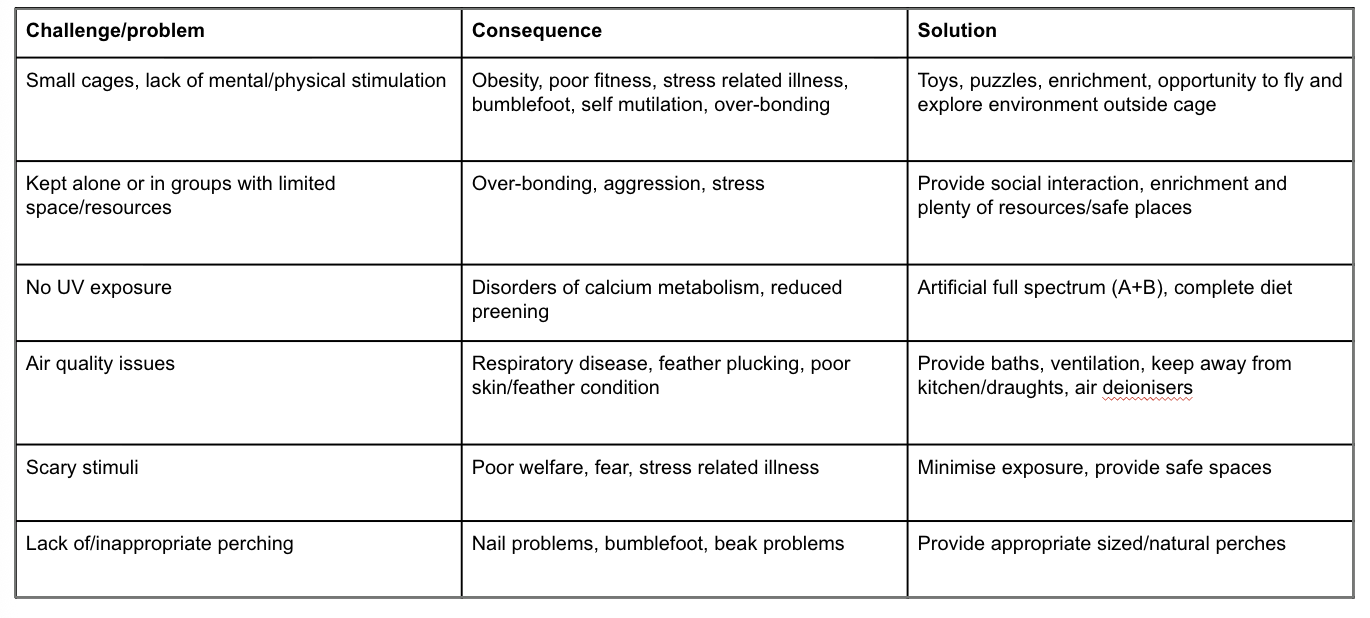
Describe the consequences and solutions of:
Small cages
Isolation
Lack of UV
Poor air quality
Scary stimuli
Lack of inappropriate perching
for indoor birds
Describe the triage process for wild birds
Initial Triage
Triage begins with a phone call to a practice
If appropriate, bring to practice with a dark covered box, no food, away from predators, water only, hot water bottle if young or injured
Fill out admission form with key details of reasons for rescue- location, finders contact number- for returning to wild if possible
Emphasise practice now has bird: some practices get MOP to formally sign over bird
Veterinary Triage and Treatment
Quiet, dark room with closed doors and no open windows
Wear PPE: small risk of zoonosis
Confirm species, categorise if alive, as alert > moribund, weight
Full clinical exam (consider stress- can take 4-6 hours to recover): feel keel bones, body condition score, oral/eye exam, feather condition, ability to perch, wounds
Warm, give fluids- tube feed or via injection
X-rays if required
What should you consider when seeing a wild bird in practice?
Age of bird (nestling, fledgeling, juvenile, adult)
What enclosure is best in the practice with what resources
What the bird eats in the wild: what to feed in practice
Disease risk in the practice
Are any medications/immediate interventions required
Urgency of transfer to rehabber
What are the husbandry standards for pet rabbits?
Somewhere enclosed to hide/sleep
Area to exercise
Should be able to take 3 consecutive hops, lie fully outstretched in any direction and stand up on their hind legs without their ears touching the roof
For 2 rabbits: single enclosed area of at least 3m x 2m x 1m high
Sleeping quarters
Should have access to both areas all the time
What are the husbandry standards for pet guinea pigs?
RSPCA minimum for a pair of guinea pigs should be 2m x 0.5m x25cm high, but ideally larger
RWAF recommend 4ft x 2ft and access to an exercise area of 6ft x 4ft
They do not dig like rabbits, but should be given tunnels to run through and hide in
What are the substrate, water and enrichment recommendations for keeping small pet mammals?
Substrates
Toilet area: absorbent, dust free substrate materials
Bedding: insulating materials
Toilet area should be cleaned every day and the whole home should be thoroughly cleaned regularly- approximately once a week
Water
Provide both a bottle and a bowl for rabbits and guinea pigs to give a choice
Check ball bearing is flowing smoothly
Change water daily
Enrichment
Toys
Food puzzles
Foraging
Describe the ideal diet for guinea pigs and rabbits, and give the reasons for this
Ideal Diet
Guinea pigs:
85% hay (not alfalfa)
12% vegetables
3% pellets
Rabbits:
85% hay (not alfalfa)
10% vegetables
5% pellets
Incorrect Diet
Dental disease → gut stasis
Obesity → arthritis/spondylosis → bladder disease
Excessive dietary calcium → bladder disease
Hypovitaminosis C → swollen joints → pain
Diet Basis
Herbivores
They metabolise calcium differently: do not feed excess calcium
Hind gut fermenters with continuously growing teeth- need lots of fibre for good gut and dental health
Muesli mix encourages selective feeding- complete pellets are best
Do not give alfalfa hay- but for some life stages, a limited quantity can be beneficial
What are the consequences of an incorrect diet in small mammals?
Incorrect Diet
Dental disease → gut stasis
Obesity → arthritis/spondylosis → bladder disease
Excessive dietary calcium → bladder disease
Hypovitaminosis C → swollen joints → pain
Gut Stasis
Causes: pain, stress, incorrect diet, gastrointestinal issues
Slowing or stopping of movement of material through the digestive tract: this can be fatal in hind gut fermenters
Describe the husbandry requirements for pet gerbils
Best in a gerbilarium: offering space to shelter, dig and exercise- with solid glass walls and a secure wire-mesh top (metal bars can cause them to slip and injure legs/feet)
Provide suitable bedding material: deep enough (20-30cm) so they can create a system of burrows. Non-toxic peat, wood chips and hay can be used (sawdust should NOT be used)
Nesting material: should always be accessible (e.g cardboard, egg containers, empty toilet rolls but NOT cotton wool or similar ‘fluffy’ materials)
Places to hide: dark nesting boxes with multiple entrances which do not allow light are ideal
Give the reasons for keeping small mammals
Pets
Breeding
Laboratory
Wildlife rehabilitation
Describe the behaviour of guinea pigs
Prey species
Crepuscular
Not burrowers, but hide in abandoned burrows/under structures
Live in social groups
Use their voice (high pitched squeals) to raise alarm when scared
‘Purr’ to each other when content, whistle when excited
Grinding/bruxism indicates pain
Guinea pigs should also be kept in pairs, but thrive in bigger groups
Never keep a guinea pig and a rabbit together
Give the critical values of guinea pigs
Temperature: 37.5-39.5℃
Heart rate: 230-380bpm
Gestation: 59-72 days
Respiratory rate: 40-120bpm
What should you first visually assess in rabbits?
Alert and responsive
Normal hopping
Nose constantly twitching
Coordinated
No abnormal breaths/open mouth breathing
Faeces normal, dry and round
Chest movement not excessive
Exploring environment and companions
No teeth grinding
No changes to eating/drinking etc
No facial/eye/whisker shape changes
No wounds, discharge, erythema or masses
Individually look at: ears, eyes, nose, mouth, feet, skin, coat and anogenital region
Describe the behaviour of rabbits
Prey species
Crepuscular
Burrowers
Live in social groups
Thumping with the hindleg is used as an alarm call
Fear causes immobility or a flight response
Bruxism indicates pain
Companion animals
Rabbits should be kept in pairs- neutered male and female
Give the critical values of rabbits
Temperature: 38.5-40℃
Heart rate: 130-325bpm
Gestation: 29-35 days
Respiratory rate: 30-60bpm
Describe how small enclosures affects small mammals
Lack of movement → arthritis → bladder disease
Poor ventilation → respiratory infections
Poor hygiene → pododermatitis and fly strike
Describe how dental disease affects small mammals
Teeth continuously grow
If rabbits/guinea pigs temporarily stop eating/have a dental malocclusion, their teeth overgrow
Dental disease can therefore be a consequence of many things
Describe how arthritis/spondylosis affects small mammals
Arthritis: painful inflammation of joints
Spondylosis: a type of arthritis that affects the spine
Arthritis can be caused or worsened by obesity and lack of movement
Spondylosis can be caused or worsened by lack of movement and the inability to stretch
Describe how bladder disease affects small mammals
Increased calcium in the diet causes calcium build up/precipitate in the urine
Arthritis can cause less movement and the inability to properly stance when urinating, and therefore rabbits do not fully void the bladder
These cause ‘sludgy bladder’ or bladder stones, and can block the bladder entirely
Describe how hypovitaminosis C affects small mammals
Guinea pigs only
Caused by out of date dry food or an incorrect diet
Greater requirement for vitamin C if pregnant so will need supplementation
Describe how pododermatitis affects small mammals
Also known as bumblefoot: painful inflammation of the footpads
Can progress to affect the bones in the feet
Causes: obesity, poor hygiene, incorrect flooring/substrates, lameness, lack of exercise, hypovitaminosis C
Describe how respiratory disease affects small mammals
Very common in rabbits and guinea pigs
Caused by poor biosecurity, poor ventilation, dusty environments, weakened immune systems
Describe how myiasis/fly strike affects small mammals
Dirty environments, urine staining or faecal accumulation can all attract flies
Flies lay eggs → maggots → eat flesh → emergency
What are the causes of:
Trauma
Pododermatitis
Respiratory disease
in small mammals?
Causes of Trauma
Fighting (inappropriate enclosure, incorrect social grouping, inappropriate resources)
Poor handling techniques
Enclosure design/maintenance
Causes of Pododermatitis
Enclosure surfaces
Enclosure design not supporting natural movement/behaviour
Hygiene
Obesity
Causes of Respiratory Disease
Poor ventilation and hygiene- ammonia levels
Inappropriate bedding (not dust free)
Mixed infections
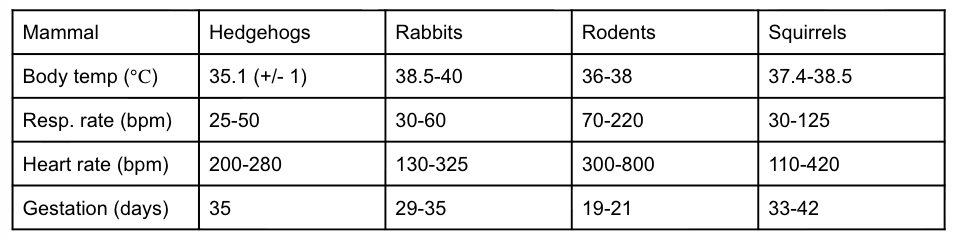
What are the critical values for:
Hedgehogs
Rabbits
Rodents
Squirrels
How should you manage nutrition of small wild mammals in practice?
Mimic natural diet where possible
Species-specific, pellet-based diet
Carnivores/omnivores should be given road-killed wildlife, earthworms, chicks or mice
Insectivores should be given earthworms, maggots or mealworms
Herbivores should be given weeds, salad, vegetables, seeds or grain
Should not be seed/muesli diet: causes selective feeding, nutritional deficiencies and obesity
Enrichment (nuts, seeds, fruit, vegetables) can be given
What are the commonly treated wild species and their issues
Commonly Treated
Hedgehogs
Rabbits
Rodents
Squirrels
Deer
Badgers
Foxes
Common Issues
Injuries: cat/dog attacks, strimmer wounds, broken legs, RTA, fighting, traps
Disease: myxomatosis, endoparasites, respiratory infection, renal disease
Kits/pups/cubs: genuine or assumed abandonment