Psych 275 Chapter 3 Midterm
 Call Kai
 Learn
Learn Practice Test
 Spaced Repetition
 Match
Match Flashcards
 Knowt Play
1/66

Earn XP
Description and Tags
The organization and functions of the nervous system
Name | Mastery | Learn | Test | Matching | Spaced | Call with Kai | Chat |
|---|
No analytics yet
Send a link to your students to track their progress
67 Terms
what does the central nervous system consist of
Brain and spinal cord
Neuron
a single neural cell
Nerve
A bundle of axons running together, outside the brain
Tract
a bundle of axons running together in the CNS
Nucleus
group of cell bodies in CNS
Ganglion
Group of cell bodies in PNS
Major structures of the forebrain
Two cerebral hemispheres, thalamus, hypothalamus
Cerebral hemispheres
Large, wrinkled structures dominating brains appearance
Longitudinal fissure
Division running length of the brain separating cerebral hemispheres
Gyrus
Bumpy ridges in the surface of the brain
Sulcus
Groove or space between two gyri
Fissure
Large groove or space between two gyri
Cortex
Outer surface of the brain, mostly made up of cell bodies and neurons
Dorsal
Towards the back
Ventral
Towards the stomach
Anterior
Towards the front
Posterior
Towards the rear
Superior
Above another structure
Inferior
below another structure
Lateral
Toward the side
Medial
toward the middle

What is separating the frontal lobe from the parietal lobe, and what is seperating the frontal lobe from the temporal lobe
central sulcus, lateral fissure
Where is the frontal lobe located
anterior to the central sulcus, and superior to the lateral fissure
What is another name for the Precentral gyrus
Motor cortex
What are the functions of the prefrontal cortex
Decision making, personality, most human parts of the brain
What are the functions of Broca’s area and what side of the brain is it located on
Controls speech production, left hemisphere
Psychosurgery
Use of surgical intervention to treat cognitive and emotional disorders
Lobotomy
Severing connections in the brains prefrontal cortex
Corpus Callostomy
Cutting the corpus callosum to limit spread of epileptic activity between hemispheres
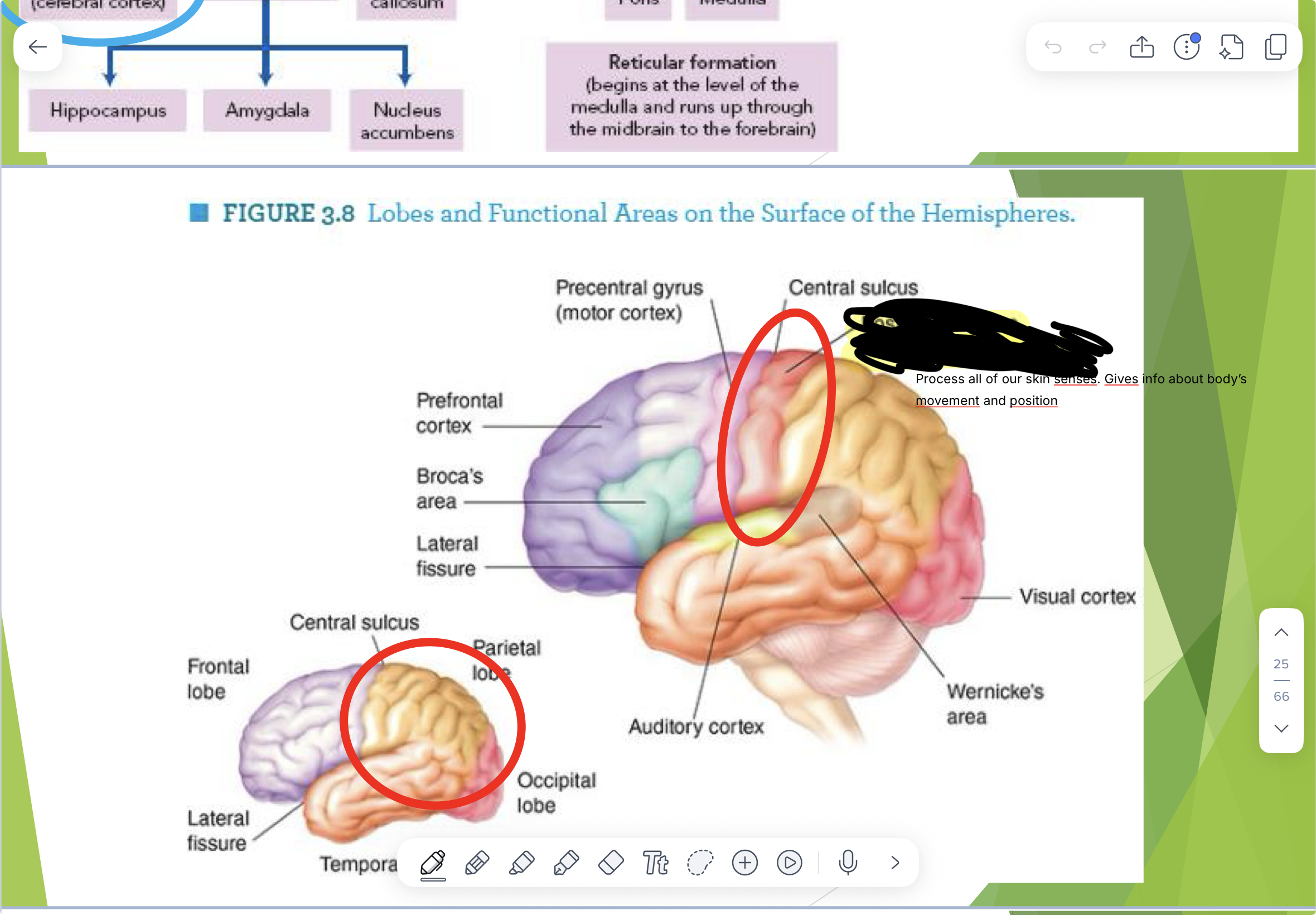
what is this part of the brain called (It has two names)
Postcentral gyrus, somatosensory cortex
What does the postcentral gyrus/somatosensory cortex do
Process all of our skin senses. Gives info about body’s movement and position

Name all of these parts of the brain (Starting in the left corner and working counter clock-wise
Primary motor cortex (Voluntary movement), Frontal lobe, Broca’s area (Speech formation), Primary auditory cortex (Surrounded by higher order auditory cortex (hearing)), Temporal lobe, Brain stem, Spinal cord, Cerebellum (Motor control), Primary visual cortex (Surrounded by higher-order visual cortex (sight)), occipital lobe, Wernicke’s area (Speech understanding), Parietal lobe, Somatic sensory cortex (Body sensations)
Association Areas
Areas that carry out further processing beyond what the primary area does, often combining information from other senses
Neglect
A disorder in which the person ignores objects, people, activity on the side opposite the damage
When does neglect occur most often
When the posterior parietal cortex is damaged, particularly if the damage occurs in the right parietal lobe
What is Wernicke’s area
The language area of the brain, it interprets language, and understanding what you’re reading, it is only on the left side of the brain
What are the Temporal lobes
Regions containing the auditory projection area, visual and auditory association areas, an additional language area, and structures important in learning and memory
What is the inferior temporal cortex
Plays major role in visual identification of objects
What is the function of the thalamus
receives information from all sensory systems except olfaction (Smell)
What is the hypothalamus
Plays major role in controlling emotion and motivated behaviours
What is the pineal gland
Secretes melatonin, a hormone that induces sleep
Corpus Callosum
Band of fibers that carry information between brain hemispheres

Label the pineal gland, thalamus, hypothalamus from the left side to the right in the right order
Hypothalamus, thalamus, pineal gland
What are ventricles
Cavities in the brain which develop from the hollow interior of the nervous system
Cerebrospinal fluid
Carries material from blood vessels to the CNS and transports waste materials in the other direction
Midbrain
Structures have secondary roles in vision, hearing, and movement
Superior colliculi
help guide eye movements and fixation of gaze
Inferior colliculi
Help locate the direction of sounds
Spinal cord
cable of neurons that carries commands from the brain to muscles and organs, and sensory information into the brain
Dorsal root
A region of each spinal nerve where sensory neurons enter the spinal cord
Ventral root
The region in which axons of motor neurons pass out of the spinal cord
What is a reflex
simple, automatic movement in response to sensory stimulus
Meninges
Protective three-layered membrane
Blood brain barrier
limits passage between bloodstream and the brain, provides constant protection from toxic substances and from neurotransmitters circulating in the blood
Afferent
Towards the CNS
Efferent
Away from the CNS
Cranial Nerves
Nerves which enter and leave the underside of the brain
Spinal Nerves
Nerves which connect to the sides of the spinal cord at each vertebra
Proliferation
The cells that will become neurons divide and multiply rapidly
Migration
Newly formed neurons move from the ventricular zone to their final location
What is circuit pruning
The elimination of excess neurons and synapses
Plasticity
Ability of synapses to be modified
Reorganization
Shift in connection that changes function of an area of the brain
Stroke
Condition caused by loss of blood flow to the brain
Regeneration
Growth of severed axons
Neurogenesis
Birth of new neurons
Stem cells
undifferentiated cells that can develop into specialized cells, such as neurons, muscle, or blood cells