Anatomy & Physiology Chapter 1
 Call Kai
 Learn
Learn Practice Test
 Spaced Repetition
 Match
Match Flashcards
 Knowt Play
1/75

There's no tags or description
Looks like no tags are added yet.
Name | Mastery | Learn | Test | Matching | Spaced | Call with Kai | Chat |
|---|
No analytics yet
Send a link to your students to track their progress
76 Terms
Anatomy
asks “where?” and focuses on structure
Physiology
asks “how” and focuses on function
What is the core principle connecting anatomy and physiology?
structure and function are inseparable
Alveolar
tiny air sacs located in smallest airways in the lungs
How does a structure support gas exchange?
1) Thin walls → short diffusion distance
2) Large surface area → more space for gas exchange
3) Dense capillaries → help maintain concentration gradients
What happens to gas exchange if alveolar wall thickens?
gas exchange becomes less efficient because diffusion distance increases
Capillary
smallest blood vessels in the human body
List the levels of organization in order
chemical → cell → tissue → organ → organ system → organism
Cells
specialized by gene expression and shape
Four primary tissues
epithelial, connective, muscle, and nervous tissue
Organs
two or more tissue types form a functional unit
11 Organ Systems
1) Integumentary (skin)
2) Skeletal
3) Muscular
4) Nervous
5) Endocrine (hormones)
6) Cardiovascular
7) Respiratory
8) Digestive
9) Lymphatic/Immune
10) Urinary
11) Reproductive
System principle
no organ works alone
Integumentary (Skin) System
barrier, temperature control, sensation (ex. skin, hair, nails)
Skeletal System
support, protection, mineral storage (ex. bones, cartilage, ligaments)
Muscular System
movement, posture, heat production (ex. skeletal muscles, tendons)
Nervous System
rapid control and communication (brain, spinal cord, nerves)
Endocrine (hormone) System
long-term control through hormones (pituitary, thyroid, adrenal glands)
Cardiovascular System
gas exchange and acid-base balance (ex. airways, lungs)
Digestive System
breaks down food and absorbs nutrients (ex. GI tract, liver, pancreas)
Lymphatic/Immune System
returns tissue fluid and defends against pathogens (ex. lymph nodes, spleen, lymph vessels)
Urinary System
removes nitrogenous wastes; regulates water, ions, and pH (ex. kidneys, ureters, bladder)
Reproductive System
produces gametes and sex hormones; supports development (ex. ovaries/testes, associated organs)
Homeostasis
keep variables within a functional range
Examples of homeostasis
body temperature, blood glucose, blood pressure, pH, and O2/CO2
Negative feedback
reverses/counteracts a change
Positive feedback
amplifies a change usually toward completion
What are the three homeostatic control components emphasized?
1) Receptor
2) Control center
3) Effector
Receptor
detects a change
Control center
processes information and coordinates the response
Effector
carries out the response
Explain the process of homeostasis
Change → Receptor → Control center → Effector → Response (negative/positve)
Explain the blood glucose example for negative feedback (counteracts)
Blood glucose rises → pancreas senses the change → insulin is released → cells take up glucose → blood glucose falls
Explain the childbirth example for positive feedback (amplifies)
cervical stretch → oxytocin (triggers contractions) → stronger contractions → more stretch
Explain the blood-clotting example for positive feedback (amplifies)
activated platelets recruit more platelets until the break is sealed
What is the common reference for anatomical positions for the body?
Standing upright
Head and eyes forward
Arms to the sides
Palms face forward
Feet flat and forward
Superior
above (ex. heart is superior to the diaphragm)
Inferior
below
Medial
toward midline (ex. nose is medial to eyes)
Lateral
away from midline
Anterior
front (ex. sternum—breastbone—is anterior to the heart)
Posterior
back
proximal
near point of attachment (ex. elbow is proximal to wrist)
distal
farther point of attachment
Superficial
nearer to surface (ex. skin is superficial to skeletal muscle)
Deep
farther from surface
Sagittal
left and right portions
Midsagittal
equal left and right halves
Frontal/Coronal
anterior and posterior portions; front and back
Transverse
superior and inferior portions; cross-section
Oblique
cut at an angle; not aligned to major planes
Ventral cavity (front)
thoracic + abdominopelvic cavities; houses the viscera
Dorsal cavity
cranial + vertebral cavities; protects the central nervous system
Diaphragm
separates thoracic and abdominopelvic cavities
Pleura
surrounds the lungs
pericardium
surrounds the heart
peritoneum
lines abdominopelvic cavity
Viseral
touches the organ
Parietal
lines the cavity wall
What separates the thoracic and abdominopelvic cavities?
the diaphragm
What does the pleura surround
the lungs
What does the pericardium surround?
the heart
What does the peritoneum line surround?
the abdominopelvic cavity
What’s the difference between visceral and parietal?
visceral touches the organ; parietal lines the cavity wall
Which is faster for clinical abdominal location?
quarants are faster; nine regions are more precise
Why is system thinking important?
physiological responses are usually coordinated across the whole body
Right Upper Quadrant (RUQ)
Liver
Gallbladder
First part of the small intestine
Head of pancreas
Right kidney and adrenal gland
Parts of the large and small intestine

Left Upper Quadrant (LUQ)
Stomach
Spleen
Left kidney and adrenal gland
Body and tail of the pancreas
Part of the liver
Parts of the large and small intestines

Right Lower Quadrant (RLQ)
Appendix
Start of the large intestine
Right ureter
Right reproductive organs
Parts of the small intestine

Left Lower Quadrant (LLQ)
Sigmoid colon
Left ureter
Left reproductive organs
Parts of the small intestine

Epigastrium (center)
Stomach
Pancreas
Duodenum
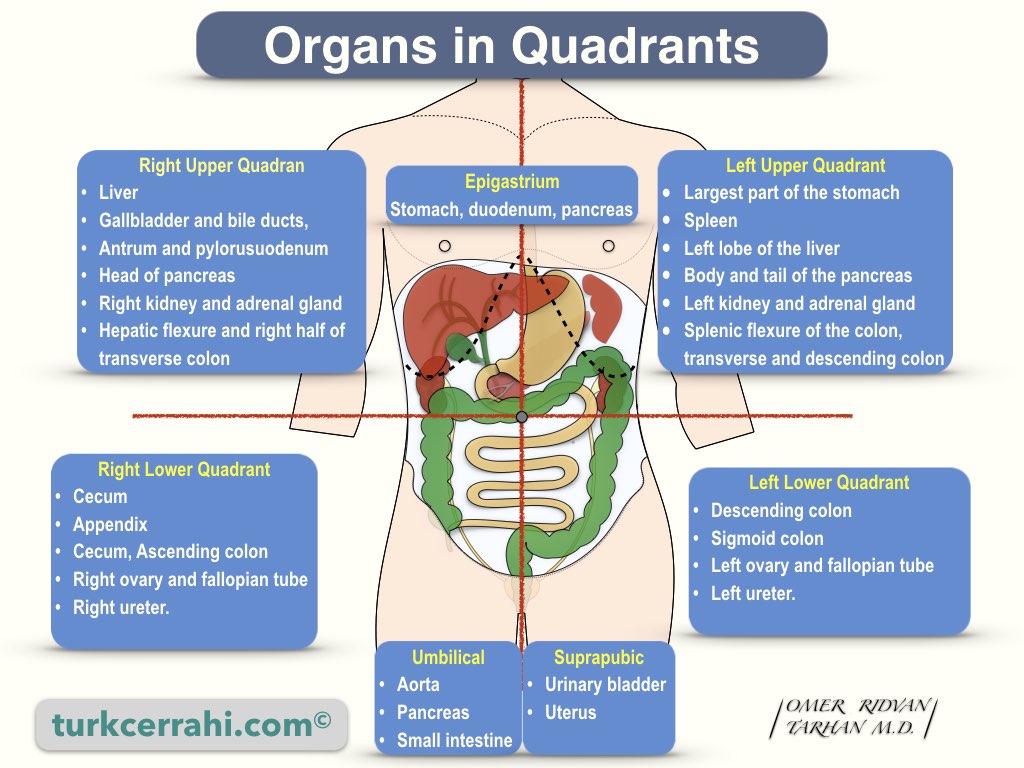
Umbilical (belly button)
Aorta
Pancreas
Small intestine
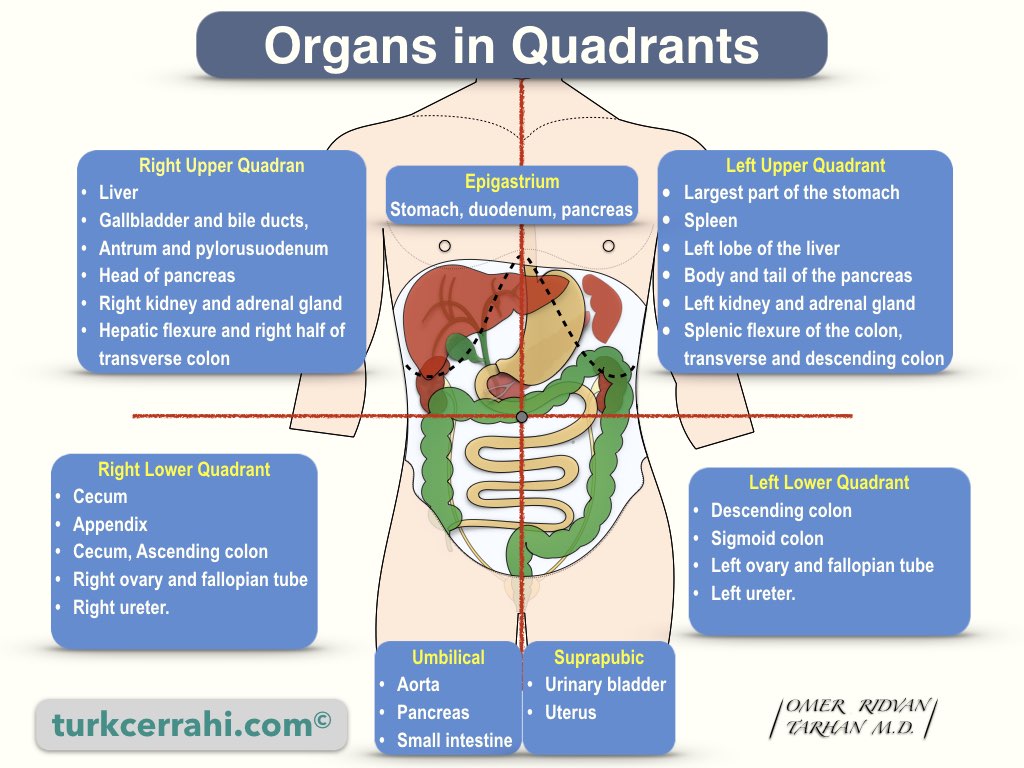
Suprapubic
Urinary bladder
Uterus

Hypochondriac Region
Upper left or right region, under the ribs
Lumbar Region
Middle side section, located on left or right side of the umbilical (navel/belly-button) region
Iliac Region
Lower section, left or right of the abdomen