3.6.2 Thermal physics
 View linked note
 Call Kai
 Learn
Learn Practice Test
 Spaced Repetition
 Match
Match Flashcards
 Knowt Play
1/28

There's no tags or description
Looks like no tags are added yet.
Name | Mastery | Learn | Test | Matching | Spaced | Call with Kai |
|---|
No analytics yet
Send a link to your students to track their progress
29 Terms
Properties of Gravity/Gravitational force
Acts on objects with mass
Always attractive
Newtons’s Laws of gravitation
Directly proportional to the product masses
Inversely proportional to the square of the distance between them
Gravitational Force Equation
F = (G * m1 * m2) / r²
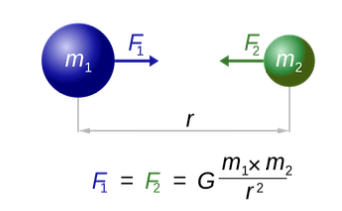
Relationship between Mass and gravitational force
Larger masses exert greater gravitational force
Relationship between distance and gravitational force
Greater distance results in weaker gravitational force
Uniform Field
Same gravitational force everywhere
Represented by parallel, equally spaced field lines

Radial Field
Force varies with position
Field lines spread out as distance increases
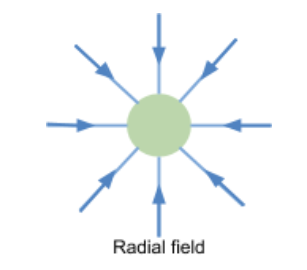
Field Lines
Direction of force on mass
Closer lines indicate stronger force
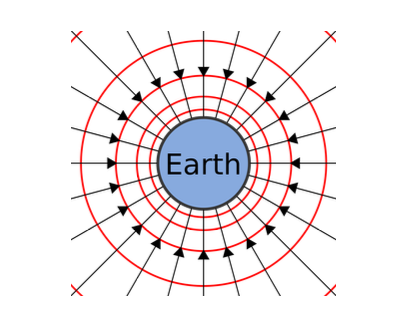
Earth's Gravitational Field
Radial in nature
Nearly uniform close to the surface
Gravitational Field Strength (g) (definition and variability)
Definition
Force per unit mass exerted by a gravitational field
Variability
Constant in uniform fields
Varies in radial fields
Formulas for Gravitational Field Strength
General Formula
g = F / m
Radial Field Formula
g = (G * M) / r²

Gravitational Potential
Work done per unit mass
Moving an object from infinity to a point
Gravitational potential at infinity
Zero
Is the Gravitational Potential positive or negative
Always negative due to energy release
Gravitational potential formula

Gravitational Potential Difference (ΔV)
Energy needed to move a unit mass between two points
Gravitational Potential Difference (ΔV) equation

Equipotential Surfaces
Surfaces of equal gravitational potential
Constant potential across the surface
No work done when moving along these surfaces
since gravitational potential difference = 0
Visual representation: red lines in this diagrams
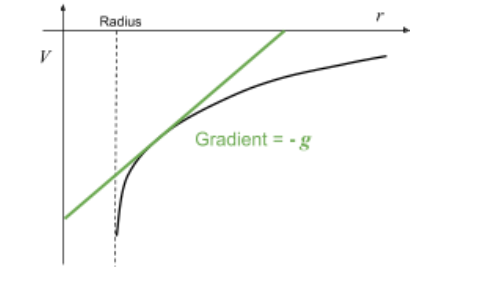
V vs r relationship
gravitational potential(V) Inversely proportional to the distance between the centres of the two objects (r)
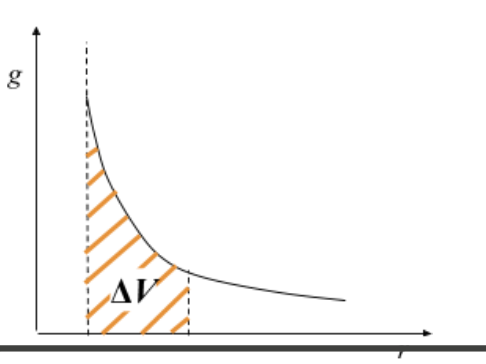
area under g vs r graph
gravitational potential difference
Typically shows a decrease as distance increases.
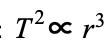
Kepler’s Third Law
Square of orbital period (T) is directly proportional to the cube of radius (r)
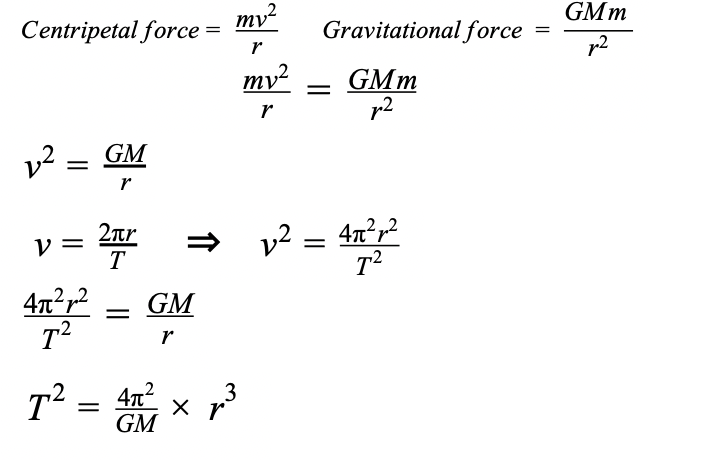
How would you derive the equation
Centripetal Force = Gravitational Force
(mv² / r) = (GMm / r² )
Rearrangement to find velocity (v)
v² = GM / r
Substitute v² into gravitational equation
v = 2πr / T
v² = 4π²r² / T²
4π²r² / T² = GM / r
Final equation: T² = (4π² / GM) * r³
(4π² / GM) is a constant
What is the total energy of a satellite
Kinetic Energy + Potential Energy
Constant total energy in orbit
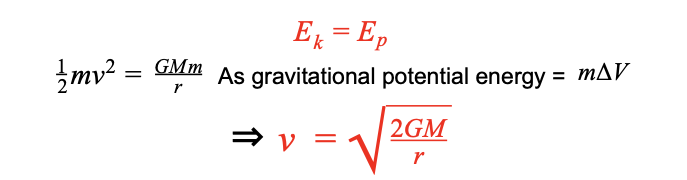
Escape velocity
Minimum velocity to escape gravitational field
Equation for escape velocity
Synchronous Orbit
Orbital period equals rotational period of the planet
Geostationary Satellites
Specific type of synchronous orbit
Always above the same point on Earth
Useful for communication (TV, telephone)
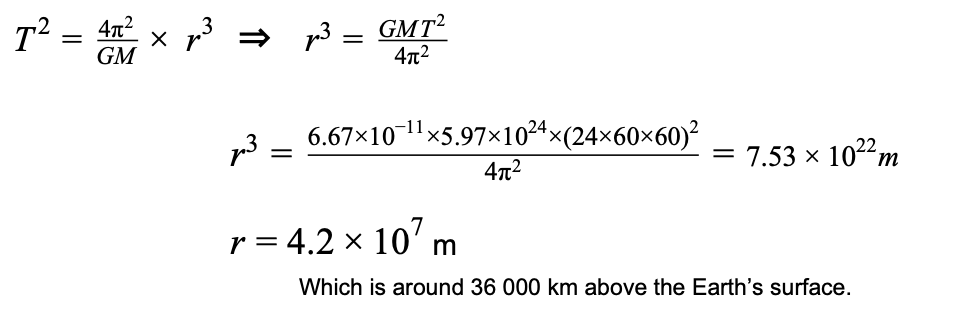
Calculating Geostationary Orbit
Low-Orbit Satellites features and uses
Lower orbits, faster travel
Smaller orbital periods
Require less powerful transmitters
Applications: Weather monitoring, scientific observations, military uses