Coherence and Gestalt Cortex
 Studied by 0 people
 Call Kai
 Learn
Learn Practice Test
 Spaced Repetition
 Match
Match Flashcards
 Knowt Play
1/27

There's no tags or description
Looks like no tags are added yet.
Name | Mastery | Learn | Test | Matching | Spaced |
|---|
No study sessions yet.
28 Terms
Proposition 1.5 in simple terms says what?
that we dont get integration and coherence without also getting consciousness at the same time.
How can we know if a brain region is involved in generating
coherence?
is the brain region associated with experienced coherence that has to be added by the mind? Is it associated with the experience of the more unifying than the less unifying
global construal of a stimulus array? Does damage to this region impair the generation and experience of
coherence of a stimulus array?
Illusory contours
imagined "boundaries" between one object and other; often created by the perception of "lines" that divide areas of color or texture
past studies on illusory contours only focused on early visual cortexes but activity was actually found in what part of the brain?
gestalt cortex
Illusory contours: If there was a triangle, then there'd be a coherent shape. wouldn't know if brain is generating or reflecting the world.
coherence experience is being brought by me and not what is objectively brought into the world.

was the gestalt cortex more active when a participant see an illusory contour or a real contour?
gestalt cortex activated more when people saw illusory contours. specifically lateral occipital complex and Posterior temporal cortex.
Lesion data showed that
damage in the gestalt cortex in participants led them to having trouble seeing illusory contours.
Gestalt cortex is associated with doing what in a quick span of time?
global perception detection of figures
Gestalt cortex is associated with doing what in a longer span of time?
shape recognition integration into global percept
visual cortex is associated with doing what in a quick span of time
local perception detection of edges
visual cortex is associated with doing what in a longer span of time
figure segregation reconstructing the missing contours
Amodal completion: star
The fifth point of a star is being blocked by a rectangle, even though there is no complete star shown.
how do you figure out if someone can see the 5th pointed star instead of this altered image?

amodal completion: adaptation paradigm
neurons involved in seeing an image work less hard the second time they are shown something.
give an example of adaptation paradigm
when someone sees a face, 100 neurons have to activate. the second time they see the face, only 70 neurons activate.
therefore, the system adapts in the amodal completion to be
more efficient for the brain.
Does your brain represent a circle bring covered by a square as a circle or as a pacman shape?
the Pacman shape is what is literally being presented to you and the full circle is the coherence that you are bringing to a situation that is not physically present.
after seeing the second round of the stimulus, either seeing an isolated circle of a Pacman, Regions show more adaptation for
a complete circle than a Pacman shape in gestalt if the second time they see the shape is a circle.
so what does it mean for regions to adapt when they saw the complete circle?
the brain didn't have to work as hard, less neurons firing and more efficient brain/understanding.
early visual cortex responds to what
is literally there not what we experience, the coherent thing that makes sense of the input.
hierarchical processing
how the brain organizes and interprets information in layers, with each layer handling more complex or abstract aspects of the input than the one before. Think top down processing
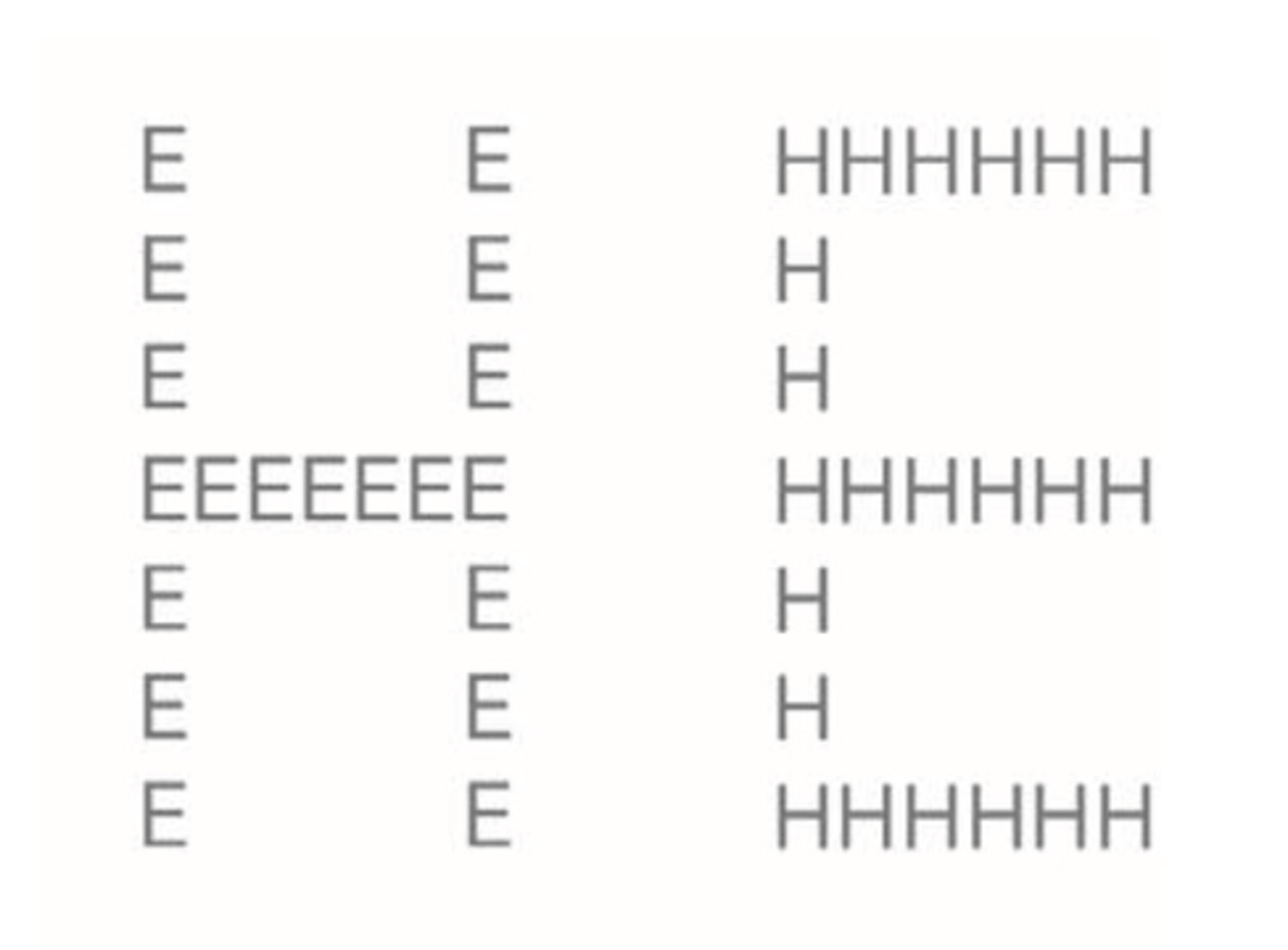
Global processing
Global processing refers to how the brain focuses on the "big picture" or the overall structure of something rather than its small details. It's like seeing the forest before noticing the individual trees. no one looks at a forest by looking at each individual tree. think top down processing
local processing
focusing on fine details or smaller parts of the whole. look at each tree instead of the whole forest. think of bottom-up processing
global interpretation is only represented in
the gestalt cortex
McGurk Effect
a perceptual phenomenon that demonstrates an interaction between hearing and vision in speech perception. The illusion occurs when the auditory component of one sound is paired with the visual component of another sound, leading to the perception of a third sound.
regions associated with experiencing the Mcgurk effect
is the gestalt cortex
what can alter the McGurk effect?
TMS (transcranial magnetic stimulation) on the spot in the gestalt cortex
multisensory integration such as the ________________________, occurs in the ______________
mcgurk effect, gestalt cortex
simultagnosia (Balint's syndrome)
A rare disorder associated with deficits in processing multiple objects or features of objects together. “a patients world unglued” cannot bring coherence to the world. they cannot see an A made up of E's, just a bunch of E's. cannot globally process When seeing a drawing of a bunch of different objects drawn on top of one another, they will only be able to see one of the objects. If they see a circle with a bunch of diagonal lines, they will only be able to see diagonal lines or a circle, not a circle with diagonal lines
these people have a majority of their brain damage in the gestalt cortex