BUS111 W10
 Call Kai
 Learn
Learn Practice Test
 Spaced Repetition
 Match
Match Flashcards
 Knowt Play
1/28

There's no tags or description
Looks like no tags are added yet.
Name | Mastery | Learn | Test | Matching | Spaced | Call with Kai |
|---|
No analytics yet
Send a link to your students to track their progress
29 Terms
creativity
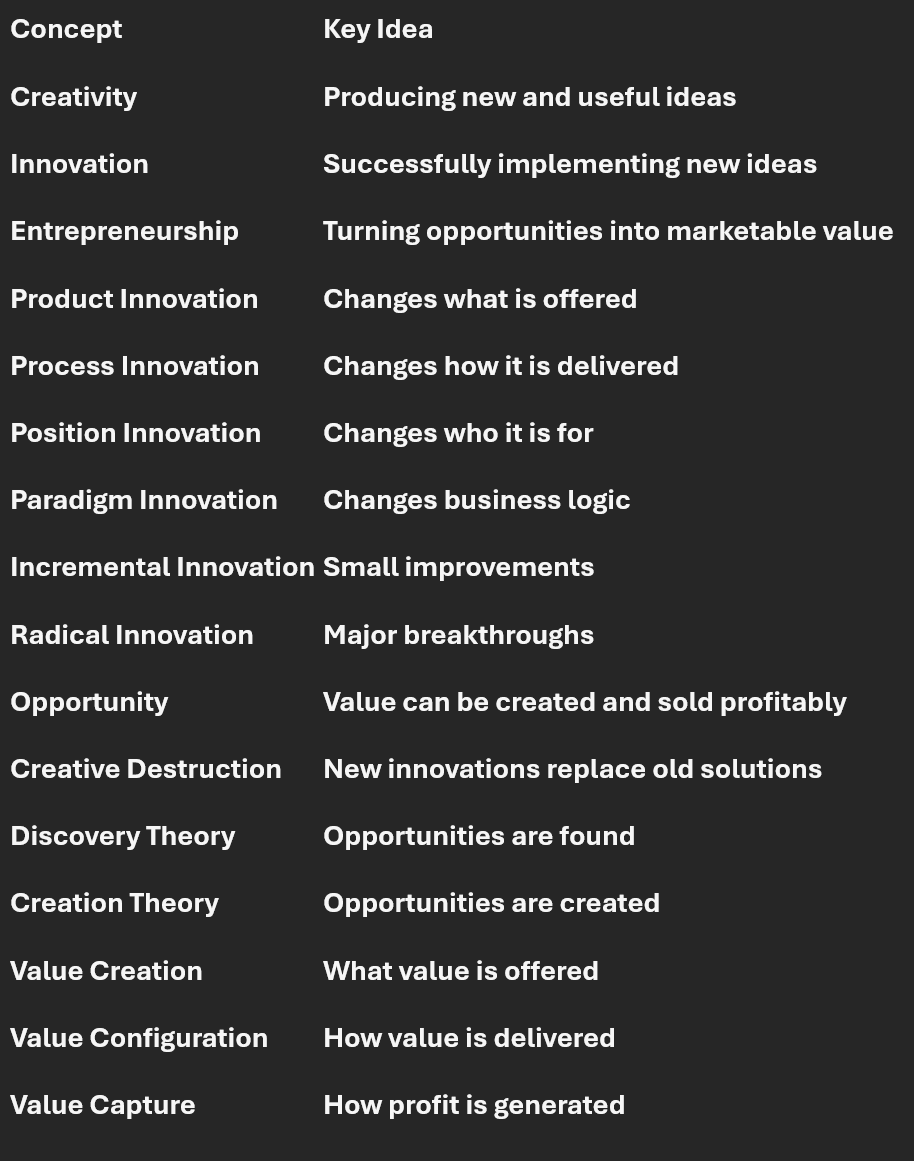
= prod of new and useful ideas
Gens original & valuable ideas.
Starting pt of innovation.
Provs initial spark for entrepreneurial opps
innovation
= successful exploitation of new ideas (UK Government White Paper, 2007).
Turning ideas into something valuable.
Can involve products, processes, positions, or business models.
Creates value thru change.
Key Idea: Creativity produces ideas; innovation implements them.
entrepeneurship
"process thru which inds identify entrepreneurial opps & transform them into marketable products/services" (Shane & Venkataraman, as cited in Schaper et al., 2014).
Focuses on recognising and exploiting opps.
Not limited to starting new businesses.
Can occur within existing organisations (intrapreneurship).
Key Idea: Entrepreneurs turn innovations into reality.
entrepreneurial mindset
Entrepreneurship is a mindset rather than personality type.
Entrepreneurs often:
Recognise opportunities
Combine resources
Create value
Accept uncertainty
Drive change
"Innovation is the specific tool of entrepreneurs" (Drucker, 2014).
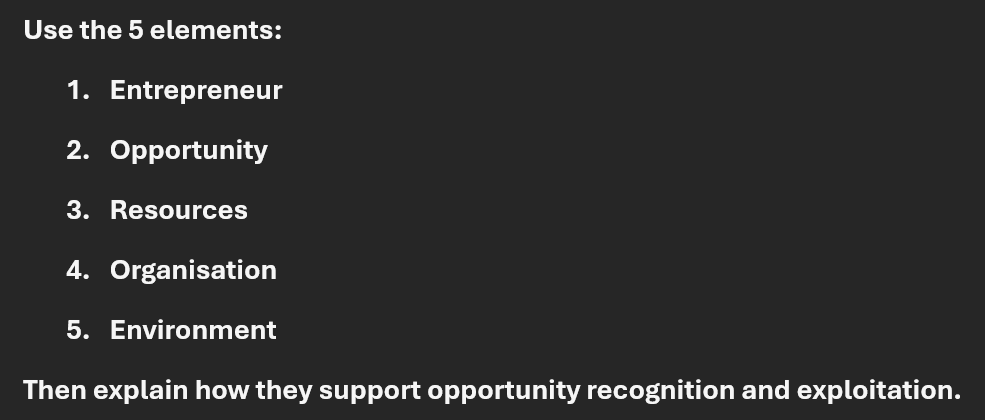
5 elements of entrepreneurship
entrepreneur, opportunity, resources, organisation, environment
1- entrepreneur
Individual who:
Identifies opportunities
Acquires resources
Creates value
Builds organisation
Factors Affecting Opportunity Recognition
- Active Search
- Deliberately looking for opportunities.
- Entrepreneurial Alertness
- Ability to notice unmet needs and opportunities.
- Prior Knowledge
- Past experiences help identify opportunities others miss.
- Social Networks
- Relationships provide information, resources and opportunities.
- Cognitive Perspective
Entrepreneurs connect changes in:
Technology
Markets
Demographics
Government policy
to identify opportunities.
2- Opportunity
exists when product, service,/process can be introduced & sold for more than its prod cost (Schaper et al., 2014).
market-pulled vs market-pushed opportunity
Market-Pulled Opp = Driven by customer needs.
(Ex: Customers want healthier drink options)
Market-Pushed Opp = Driven by unused resources/tech
(Ex: A new technology is developed before a market exists for it)
6 resource categories
Financial
Physical
Human
Technological
Social
Organisational
Key Idea: Entrepreneurs must gather resources to exploit opportunities.
4- organisation. Entrepreneurship can occur through:
Start-ups
Franchises
Joint ventures
Acquisitions
Corporate ventures (intrapreneurship)
Key Idea: Entrepreneurship is not limited to creating new businesses.
5- Environment
Opps arise from:
Political change
Regulatory change
Social change
Demographic change
Market inefficiencies
environmental influences: community vs societal level
Community Level
Industry density
Business networks
Societal Level
Culture
Government policy
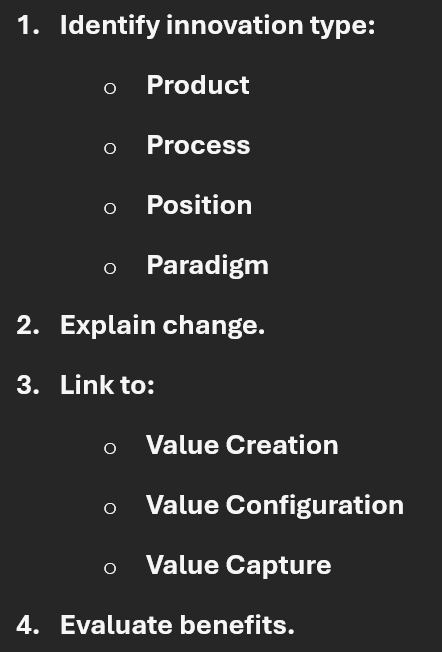
4 types of innovation (4Ps)
Developed by Bessant & Tidd.
product, process, position & paradigm
Product Innovation ("What") + business model link
= Changes to products/services offered.
Exs:
New smartphone
New insurance product
New beverage flavour
Business Model Link
Value Creation
Creates new or improved solutions for customers.
Process Innovation ("How") + business model link
= Changes how products/services are prod & delivered.
Exs:
Automation
Improved manufacturing
Chatbots
Business Model Link
Value Configuration
Improves efficiency and resource use.
Can also enhance value creation thru better service delivery.
Position Innovation ("Who" and "Where") + business model link
Changes how product is marketed/who it is marketed to.
Ex:
Lucozade repositioned from recovery drink to sports drink.
Business Model Link
Value Creation
Creates value by targeting new customers/uses.
4. Paradigm Innovation ("Why") + business model link
= Changes the underlying business logic or business model.
Ex: Netflix transforming video rental into streaming subscriptions.
Business Model Link
- Affects:
Value Creation
Value Configuration
Value Capture
Key Idea: Paradigm innovation is often called business model innovation.
incremental vs radical innovation
Incremental Innovation = Small improvements to existing products, services,/processes.
Exs:
Software updates
Product improvements
Faster manufacturing
Low novelty, continuous improvement.
Radical Innovation = Major breakthrough creating significant change.
Exs:
Automobiles replacing horse-drawn transport
Streaming replacing video rentals
High novelty, transformative change.
value creation + business model link
= What value is offered and to whom.
Most closely linked to:
Product Innovation
Position Innovation
value configuration + business model link
= How value is created and delivered.
Most closely linked to:
Process Innovation
value capture + business model link
= How revenue and profit are generated.
Most closely linked to:
Paradigm Innovation
discover theory vs creation theory
Discovery Theory = Opps alr exist & are waiting to be found.
Entrepreneurs:
Discover opps
Evaluate them
Develop plans
Launch ventures
Causation approach (goal-driven).
Creation Theory = Opps created thru action.
Entrepreneurs:
Act first
Experiment
Learn
Adapt
Effectuation approach (means-driven).
Sarasvathy's 5 Effectuation Principles
- Bird-in-Hand = Start with resources already available.
- Affordable Loss = Focus on what you can afford to lose.
- Crazy Quilt = Build partnerships.
- Lemonade = Treat surprises as opportunities.
- Pilot-in-the-Plane = Focus on what you can control.
creative destruction + exs
= process where new products, technologies, & businesses replace older ones
Exs:
Streaming replacing DVD rental
Smartphones replacing many standalone devices
Key Idea: Innovation drives eco growth by replacing outdated solutions.
Qs ab innovation
Qs ab entrepreneurship
SUM