A Microbial Planet
 Call Kai
 Learn
Learn Practice Test
 Spaced Repetition
 Match
Match Flashcards
 Knowt Play
1/49

There's no tags or description
Looks like no tags are added yet.
Name | Mastery | Learn | Test | Matching | Spaced | Call with Kai | Chat |
|---|
No analytics yet
Send a link to your students to track their progress
50 Terms
This experiment sought out to create a closed environment within an airtight enclosure
Biosphere 2
Which of the following reasons explains why the Biosphere 2 failed?
Microbial metabolism in soil wasn’t considered

What microbial cell shape is 1? (Click the photo to enlarge it)
Bacillus

What microbial cell arrangement is 2? (Click the photo to enlarge it)
diplobacillus

What microbial cell arrangement is 3? (Click the photo to enlarge it)
Streptobacillus

What microbial cell shape is 4? (Click the photo to enlarge it)
Coccus

What microbial cell shape is 5? (Click the photo to enlarge it)
Diplococcus

What microbial cell arrangement is 6? (Click the photo to enlarge it)
Streptococcus

What microbial cell arrangement is 7? (Click the photo to enlarge it)
Staphylococcus

What microbial cell arrangement is 8? (Click the photo to enlarge it)
tetracoccus

What microbial cell shape is this? (Click the photo to enlarge it)
Spirillum
What features do bacteria and archaea have that eukaryotes lack?
They have no membrane-bound nucleus or organelles and its DNA is contained in the nucleoid region.
What features do eukaryotes have that bacteria and archaea lack?
A membrane-bound nucleus and membrane-bound organelles
How much larger are eukaryotes compared to bacteria and archaea?
5 times larger
As surface area and volume increases, what decreases in relationship?
The surface to volume ratio
What must be true to have a chemically efficient cell?
A larger surface to volume ratio
Carl Woese
Proposed the tree of life model
What were Carl Woese’s thoughts on the kingdoms model?
Bacteria and archaea shouldn’t be considered the same
Lipid Micelle
A single phospholipid layer

Identify 1 on this protocell drawing (click to enlarge image)
Positively charged molecules
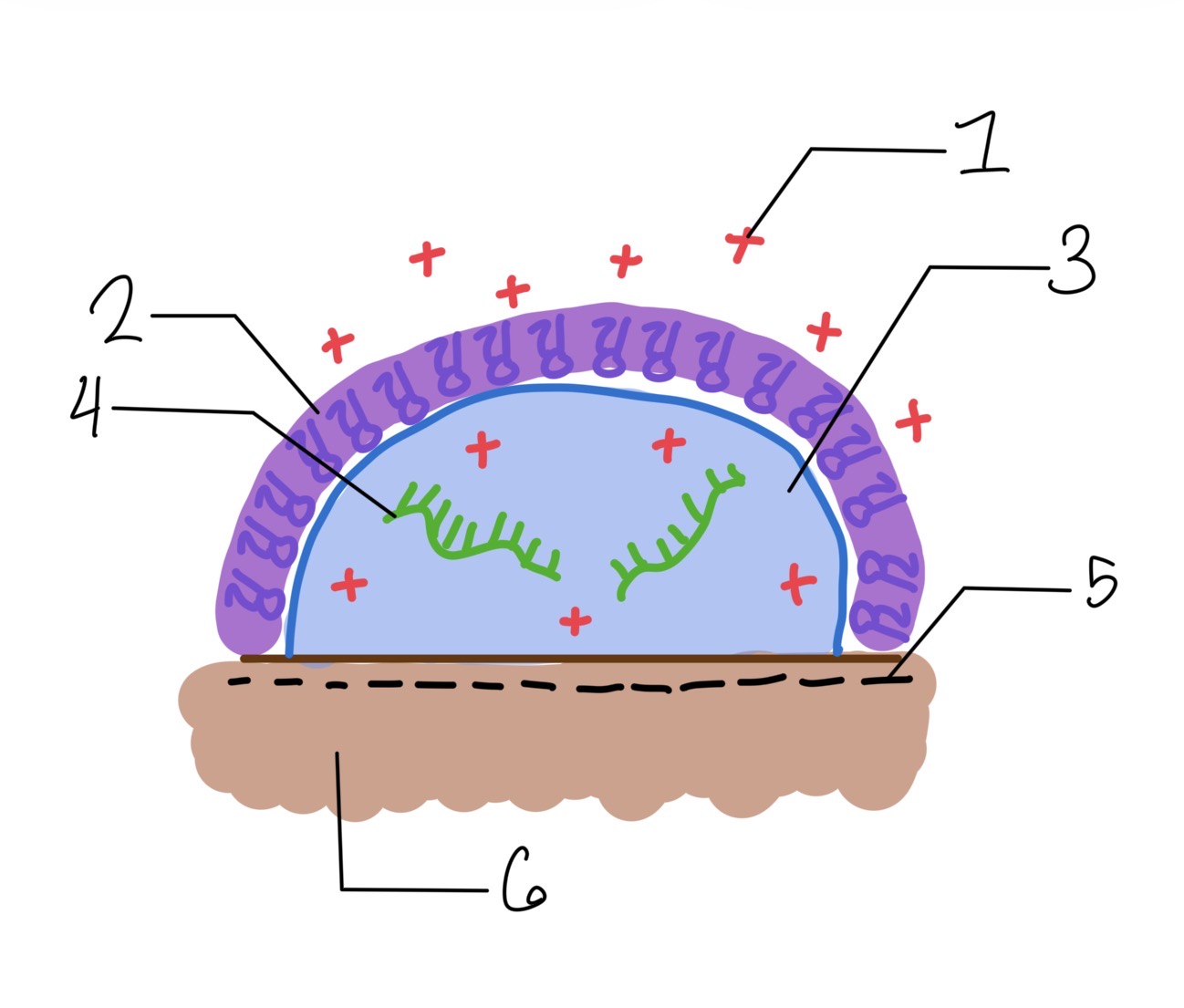
Identify 2 on this protocell drawing (click to enlarge image)
Lipid micelle

Identify 3 on this protocell drawing (click to enlarge image)
Water droplet

Identify 4 on this protocell drawing (click to enlarge image)
RNA

Identify 5 on this protocell drawing (click to enlarge image)
Negatively charged molecules

Identify 6 on this protocell drawing (click to enlarge image)
Clay surface
When was oxygen introduced on Earth?
~2.4 million years ago
Protocell
Cellular entity made of self-replicated RNAs that catalyze reactions surrounded by lipid micelle
Progenote
Cellular entity that can make proteins from amino acids, its proteins catalyzed DNA and RNA templates, and could take out primitive metabolisms
Last universal common ancestor (LUCA)
Considered the first living thing on Earth
Which of these list LUCA’s characteristics?
LUCA was anaerobic, archaea, and a thermophile

Identify 7 on this progenote drawing (click to enlarge image)
DNA

Identify 8 on this progenote drawing (click to enlarge image)
Protein
In which order did LUCA evolve into?
1st protocell, 2nd progenote, 3rd LUCA
Tree of life model
A model that represents a tree with its roots beginning at LUCA with bacteria, archaea, and eukarya branching from LUCA.
Kingdoms model
5 domains: Animal, plant, fungi, protozoa, and monerea (bacteria and archaea)
Euclidean distance
The measure of distance between two organisms on the three domain model
A large euclidean distance implies what?
The more genetically different two organisms are
Which of these models states that eukaryotes evolved from the bacteria and archaea groups?
Ring of Life
Thermophiles
Microbes that thrive in extreme temperatures
Extremophiles
Microbes that thrive in extreme environmental conditions ranging in pH, temperatures, and oxygen levels
Organotrophs
Microbes that live in organ systems of other organisms
Phototrophs
Photosythetic organisms
Lynn Marguiles
Proposed the endosymbiotic theory
Endosymbiotic theory
This theory explains how a eukaryote got its organelles
Under the endosymbiotic theory, an ancestral prokaryote undergoes what first?
Infolding of plasma membrane as the nucleus forms
Under the endosymbiotic theory, what happens after the infolding of the ancestral cell’s plasma membrane?
The ancestral cell engulfs bacterium for use as an energy source, but the bacterium aren’t metabolized.
According to the endosymbiotic theory, after the engulfing of the bacterium, what is formed?
Ancestral eukaryote

What is wall 33’s nature? (Click the photo to enlarge it)
archaic

What is wall 34’s nature? (Click the photo to enlarge it)
bacterial
To determine if life exists on other planets, what molecule(s) must be present?
Peptidoglycan