APES Unit 1 Biomes, Symbolsis, Cycles
 Call Kai
 Learn
Learn Practice Test
 Spaced Repetition
 Match
Match Flashcards
 Knowt Play
1/41

There's no tags or description
Looks like no tags are added yet.
Name | Mastery | Learn | Test | Matching | Spaced | Call with Kai | Chat |
|---|
No analytics yet
Send a link to your students to track their progress
42 Terms
1. What 4 organic compounds is carbon found in?
Carbohydrates, Lipids, Proteins, Nucleic Acids
2. Carbon dioxide comprises approximately what percent of tropospheric gases?
.004% of the atmosphere (greenhouse gas)
3. How is the relative amount (%) of CO2 significant in contributing to the Earth’s “natural thermostat”? What happens when the level of CO2 increases?
Sunlight enters atmosphere- earth’s surface absorbs energy and warms, Earth release some energy as infrared radiation, greenhouse gases such as CO2 absorb some of this infrared radiation. (CO2 increases, warmer Earth gets) (OCEAN ACIDIFICATION)
4. Identify the two processes done by living things which have the greatest influence on tropospheric concentrations of CO2 on a monthly or yearly basis.
Photosynthesis and Cellular Respiration
5. Name the three largest sinks (storage areas) for carbon (at least one must be terrestrial).
Oceans, Terrestrial biosphere (Plants, trees, soil), Geological reservoirs (fossil fuels, rocks, sediment)
6. Discuss how oceans play a major role in regulating CO2 levels in the troposphere
Oceans absorb CO2 from the atmosphere
Co2 moves between the atmosphere and ocean
Phytoplankton and algae use CO2 through photosynthesis
Carbon can be stored in marine organisms, sediments, and rocks
This helps regulate atmospheric CO2 levels
TO MUCH CO2 CAN LEAD TO OCEAN ACIDIFICATION 
7. Explain the process of ocean acidification
More CO2 - oceans absorb more CO2
CO2 forms carbonic acid
PH decreases, oceans become more acidic
Harms coral and organisms in ocean
8. Describe the two things humans do that directly interfere with the carbon cycle
Burning Fossil fuels, Deforestation
9. Explain how carbonates store carbon.
Marine organisms use carbonate to build shells and skeletons
They die settling on ocean floor
Over time, they form sediments and rocks, storing carbon for a long time
Main Idea- Carbonate helps store carbon in shells, sediments, and rocks
1. What 2 organic compounds is nitrogen found in?
Amino acids and nucleic acids
2. Identify the two major ways that nitrogen is “fixed”
Natural Fixation- Lightning, bacteria
Human made fixation- Industrial process, fertilizer production
3. Describe what takes place in each of the following processes or steps of the nitrogen cycle (include a description of the events and chemical transformations in each step):
nitrogen fixation- Nitrogen fixation is the natural or industrial process of turning unusable nitrogen gas from the air into useful chemical compounds, like ammonia, that plants can absorb and use to grow.
nitrification- 2- step aerobic process that converts toxic ammonia into nitrites then into nitrates (by soil bacteria)
assimilation-Plants and animals taking in inorganic nitrogen from soil (nitrites and ammonia) and turn into organic molecules (DNA, RNA)
ammonification- Process where bacteria, and fungi break down waste
denitrification- Conversion of soil N (NO3) into nitrous oxide (N20) gas which returns to the atmosphere
4. Describe two anthropogenic interventions in the nitrogen cycle
industrial production of fertilizers and the combustion of fossil fuels
5. Define Assimilation as it relates to the cycles and living organisms.
Assimilation is the process where living organisms take in nutrients from food or the environment and convert them into their own biological molecules, building living tissues and driving life cycles.
6. What is the primary nitrogen sink (storage area) on the planet?
Atmosphere
Biotic Fixation-
Certain bacteria that live in the soil, or in symbiotic relationship with plant root nodules convert N2 into ammonia (NH3)
Abiotic
Lightning converts N2 gas into nitrates (NO3) and FF combustion converts N2 gas into ammonia (NH3)
Assimilation: Plants and animals taking in inorganic nitrogen from soil, (nitrates and ammonia) and turn into organic molecules (DNA, RNA)
Ammonification: Process where bacteria, and fungi break down waste, dead plants, and dead animals
Nitrification:
2-step aerobic process that converts toxic ammonia into nitrites then into nitrates (by soil bacteria)
Denitrificaiton:
Conversion of soil nitrogen (NO3) into nitrous oxide (N2O) gas which returns to atmosphere
Climate (N2O (nitrous oxide))
greenhouse gas, warms earth’s climate. Produced by denitrification of nitrate in agriculture/soils (especially when waterlogged)
Nitrogen Fixation
Natural or industrial process of turning unusable N2 gas from the air into useful chemical compounds (helps plants grow)
Leaching
Downward movement of dissolved nitrate by water as it drains through the soil, carrying nutrients past the plant root zone into ground water or drainage systems.
Eutrophication:
Too much runoff water (nutrients) in an area
Enters water areas (dead zones)
Algae growth
No sunlight
Oxygen depletion
Bacterial surge
Dead xones
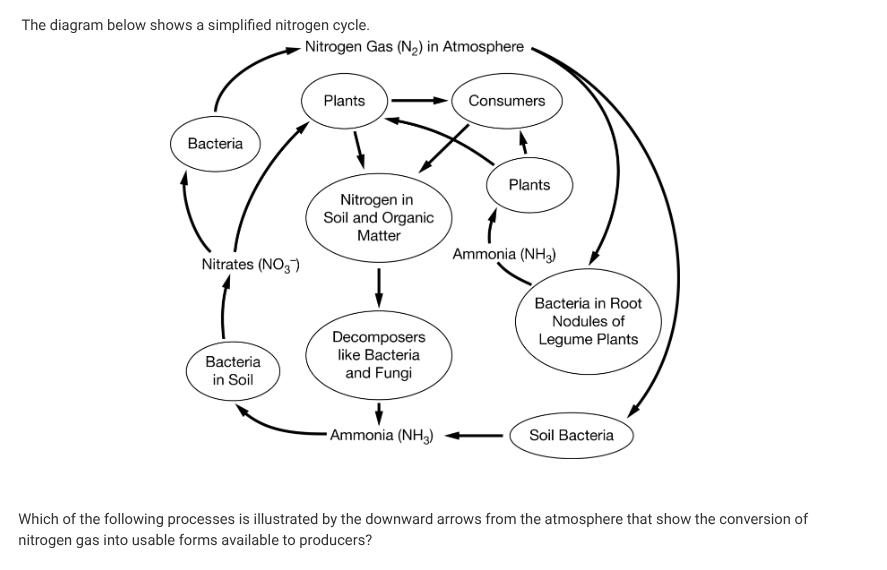
Weathering,photosynthesis, Nitrogen fixation, or assimilation-?
Nitrogen Fixation

Which of the following types of organisms are required to complete the nitrogen cycle, including the process of denitrification?
(Bacteria, Producers, Consumers, Fungi)
Bacteria
The majority of the nitrogen on Earth can be found in which of the following reservoirs?
A
Terrestrial plants
B
Soil bacteria
C
The atmosphere
D
Sedimentary rock
Atmosphere
Six white-tailed deer and six sika deer were enclosed in a pasture for observation during an eight-year study in central Texas. White-tailed deer are a native species to central Texas, while sika deer are a nonnative species to central Texas. White-tailed deer feed on flowering plants and the tips of trees and shrubs but do not eat grass. Sika deer feed on flowering plants, the tips of trees and shrubs, and grass. All other grazing animals were kept out of the pasture during the study. The number of sika deer more than doubled after the eight years, while the population of white-tailed deer decreased by 50 percent.
Which of the following statements best supports the results from the study?
A: The sika deer are generalists, while the white-tailed deer are specialists.
B
The sika deer out competed the white-tailed deer in consuming flowering plants and shrubs.
C
Parasites infected the sika deer population but did not infect the white-tailed deer population.
D
Change in the local climate reduced the availability of food resources for the white-tailed deer population.
The sika deer out competed the white-tailed deer in consuming flowering plants and shrubs.
Which of the following describes the most likely change to terrestrial biomes resulting from warmer average global temperatures?
A
The global distribution of midlatitude biomes, such as grasslands and temperate rain forests, would increase.
B
Deciduous trees found in temperate seasonal forests would flower later in the year.
C
The latitude range of tropical rain forests would narrow closer to the equator.
D
High-latitude biomes, such as the tundra, would experience a decrease in net primary productivity.
The global distribution of midlatitude biomes, such as grasslands and temperate rain forests, would increase.
Which of the following terrestrial biomes has the highest net primary productivity?
A
Desert
B
Tropical rain forest
C
Taiga
D
Savanna
Tropical Rain forest
Which of the following terrestrial biomes has the highest primary productivity per unit area?
A
Desert
B
Tropical rain forest
C
Boreal forest
D
Savanna
Tropical Rain forest
This biome contains a nutrient-rich environment created by falling leaves and trapped organic materials from the large trees, and it provides the ecosystem service of filtering pollutants from water.
A
Coral reefs
B
Freshwater wetlands
C
Open ocean
D
Rivers
Freshwater wetlannds
This biome is found in shallow waters off the coastline and is Earth’s most biologically diverse marine biome.
A
Coral reefs
B
Freshwater wetlands
C
Open ocean
D
Rivers
Coral Reefs
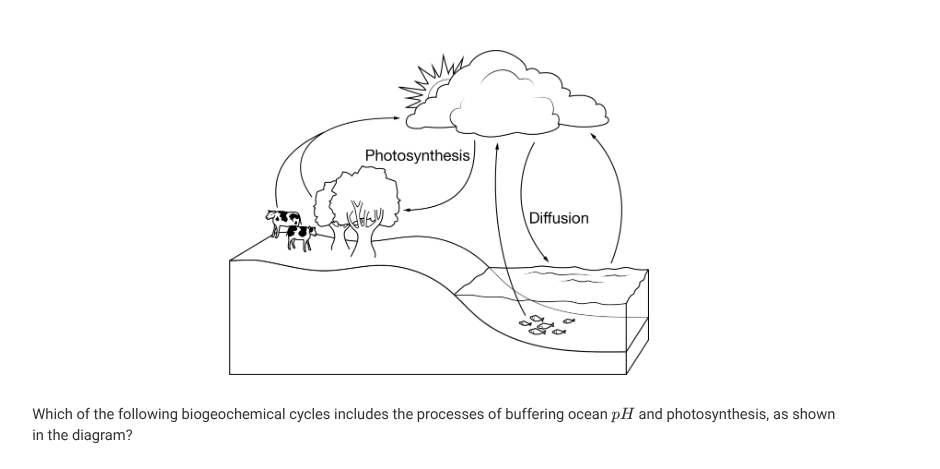
A
The carbon cycle
B
The nitrogen cycle
C
The phosphorus cycle
D
The potassium cycle
The carbon cycle
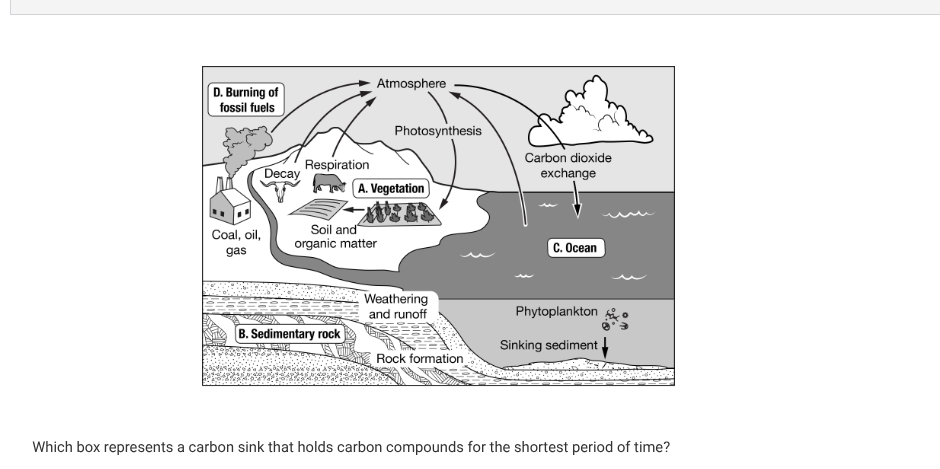
A (Vegetation)

A
The carbon cycle
B
The nitrogen cycle
C
The phosphorus cycle
D
The water cycle
Phosphorus