EQ2 Water Geo
 Call Kai
 Learn
Learn Practice Test
 Spaced Repetition
 Match
Match Flashcards
 Knowt Play
1/25

Earn XP
Description and Tags
What factors influence the hydrological system over short- and long-term timescales?
Name | Mastery | Learn | Test | Matching | Spaced | Call with Kai |
|---|
No analytics yet
Send a link to your students to track their progress
26 Terms
Drought
a shortage of water over an extened period of time
Causes of drought
Drought can have significant impacts on peoples lives and their livihood
Cna be difficult to predict when it will start and end- tend to be slow onset hazrads
Meteorological drought
means that theres less precipiation entering a local system
hydrological drought
means theres less water in groundwater stores, streams and rivers
short term droughts
Short term droughts that affect localized area - precipitaion deficit( lower than normal precip) lower levels caused by changes in frequency of frontal precip
Localised droughts can occur in areas of cool descending air created by high pressure weather system (anitcyclone)- blocks movement of warm ascending air, which would otherwise create rain clouds leading to less rainfall and drought conditons may happen.
Long term changes in drought frequency
Climate change- long term warming and cooling of oceans- changes infrequncy of droughts- recovery time between droughts may be shorter
Seasonal rains affected in tropics- rainy season shorter and more unpredictable- results in LT depletion of ground water and reservior stores
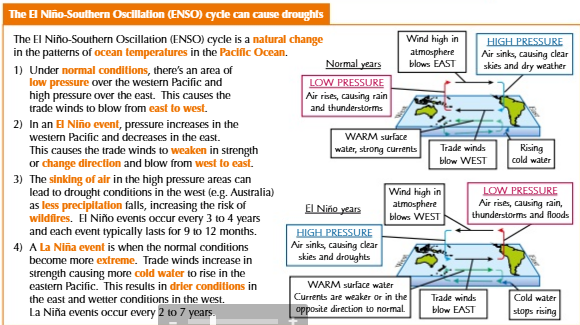
El Nino southern oscillation (ENSO) cause drought
El Nino and la nina
Human activity increase risk of drought
can make low rainfall more of an issue and intensify hydrological drought
if demand for water is greater than the supply by precipitaion, surface water resources dry up and humans often abstract water from aquifers- abstratcing water from aquifers at a faster rate then it recharges = over abrastcion
humans divert water out of natural systems into storage within homes and businesses- water isnt subjected to natural processes e.g evap , reducing supply of water to other stores in hydrological cycle
aquifer
a saturated layer of permable rock below the water table
Drought on ecosystem
capacity for a natural area to survive and recover from disturbance (ecological resillance)
Wetland- act as water purifers as reeds and rushes trap pollutants- hwr in drought conditons wetland areas can dry up causes vegeation dieback
Algae becomes more concentrated as water levels drop- reducing oxygen levels for aquatic life- animals that cna migrate will leave the area in search of deeeper water
Forest- under stress, even mid drought tree growth slows and young trees are vulnerbale to die back- as tree die land is exposed to warmer temps and wind erosion
Wetland areas
ecosystems that are very sensitve to droughts and have limited resilence- not only a water source for humans but for habitats for birds, fish and other water animals
wetlands act as water purifers as reeds and rushes trap pollutants- hwr in drought conditons wetland areas can dry up causes vegeation dieback
Metrological factors of floods
prolonged rainfall, intense storms, extreme monsoonal rainfal, snowmelt, other physical factors- shape of land, land elevation, geology, drainage density
When do floods occur
Floods occur when conditions are wetter than normal
After periods of prolonged or heavy rainfall, drainage basin systems may not be able to deal with the excess water. This means that water moves quickly as direct runoff.
During periods of heavy rainfall, river channels can reach bankfull capacity quickly and can overflow and inundate a flood plain. Lakes and reservoirs can also grow and flood new areas of land. This is a natural process and regular flooding of the flood plain can improve farmland as silt deposits in floodwater fertilise the land.
People's health and livelihoods are impacted by flooding. This is often made worse when humans interfere with the natural flow of the river or build on floodplains.
Metrological factors of floods- prolonged rainfall
Prolonged periods of heavy rainfall can cause slow-onset flooding.
This can occur when a series of low-pressure systems (depressions) continually move across the UK. If the time gap between different depressions is short, flooding is more likely to happen.
Metrological factors of floods- intense storms
An intense storm is a fast-onset event. Higher levels of rainwater combined with possible storm surges from the sea can leave high levels of standing water on the land. This is called flash flooding.
Metrological factors of floods- extreme monsoon rainfall
• In some parts of the world, prolonged rainfall may come from extreme monsoonal conditions.
A monsoon is a seasonal change in the prevailing wind. This change can bring wetter weather to some areas in subtropical regions. As the global climate changes, the seas in monsoon areas get warmer and often these seasonal rains get heavier and last longer.
If the monsoon rain is particularly intense (often linked to La Niña events, see p.171), increased runoff and saturated overland flow can inundate waterways and cause flooding.
Metrological factors of floods- snowmelt
• In upland glacial areas, flooding can occur in the valleys due to the snow and ice melting.
This increases overland flow,
which can flood upland reservoirs and swell river channels.
This might occur due to abnormally high temperatures in the spring or a sudden change in temperature.
It can also come from volcanic activity in glacial regions, which warms the ice.
A flood of glacial meltwater is called a jökulhlaup
Metrological factors of floods- other physical factors
• Shape of the land
- flat land is more likely to flood since there's no gradient to allow water to flow away
However, steep valley sides may also channel water into one area - increasing the likelihood of flooding.
Land elevation - low-lying land next to the coast is more likely to flood as a result of storm surges.
Geology of the land - if the lithosphere is made up of impermeable rocks, water will take longer to drain away and flooding is more likely. Soils of greater depths also have a greater capacity to store water so take longer to become saturated.
Drainage density - the more rivers and streams in an area, the higher the likelihood of flooding
Human actions increasing flood risk factors
floodplain use
Land use change
Hard engineering
Flood plain use - flood risk
Due to rising population levels, an increased number of floodplains are being built on.
Rapid urbanisation has increased the need for land to be used for housing and industry.Floodplains act as temporary natural stores for water and slow the movement of water in the drainage basin. However, when floodplains are built on, an impermeable layer covers the land adjacent to a river. The concrete and tarmac stop or reduce the rate of infiltration increasing the risk of flooding.
Hard engineering - flood risk
Humans frequently mismanage rivers. For example, removing meanders and creating straight and unnatural river channels by hard engineering can reduce the risk of flooding in some areas but increase the risk further downstream as the rate of flow increases.
Dredging rivers to make them deeper can cause river water to flow quickly through a built up area and prevent flooding there. However, it also increases the risk of flooding downstream beyond the dredged section.
Land use change- flood risk
Land use change
Removing vegetation or deforesting an area reduces the amount of water that is intercepted by vegetation as well as exposing the soil to the greater erosive power of the water. This can move soil sediment into river systems and reduce the channel's carrying capacity, making flooding more likely.
Construction of new buildings and roads creates an impermeable layer over the land, preventing infiltration. This means the water collects and floods, or it runs off and affects other areas.
Changing land use for farming practices can also increase the risk of floods. For example, agricultural land is more permeable than urban spaces, but the way it's used can still increase flood risk. Areas of bare soil have reduced levels of interception.
This means water moves more quickly into rivers and can allow it to build up in certain places.
Socio economic impacts of flooding
economic activity
Flooding can restrict the way that businesses operate. It may be unsafe to open to the public, or they may not be accessible to customers.
When farmland floods, the deep saturation of soil can be harmful to crops. They can drown due to a lack of oxygen and it's more likely they'lI be affected by diseases. This can lead to reduced incomes for farmers.
infrastructure
1) Transport and communication networks can be affected by floodwater:
Trains and vehicles may not be able to move through standing floodwater.
Telephone lines may be damaged by floodwater.
Road surfaces, bridges and tunnels can be damaged by floodwater, making them unusable by traffic.
2) Fresh water and wastewater pipelines can become inundated with floodwater and cross-contamination can occur. Water supplies might need to be cut off while the system is drained
settlements
1) Standing floodwater can cause extensive damage to property:
As water soaks into the walls and floors of a building, it can leave them structurally unstable and prone to collapse.
Flood sediment, pollutants and mould must be removed from buildings.
Walls, fences and trees can get washed away.
Few UK homeowners living on flood plains can get insurance against flooding.
This means they bear the cost of replacing and rebuilding after a flood.
2) Flooding can cause loss of life and injury. People can die through drowning and by contracting waterborne diseases, such as cholera.
Environmental impacts of flooding
Groundwater stores near urban areas can become contaminated with sewage water and oil from roads.
Eutrophication (see p.182) can affect aquatic ecosystems (e.g. lakes and ponds) due to runoff of fertilisers from fields. Algal blooms remove oxygen from the water, which can cause some aquatic life and insects to die.
Floodwater can cause extensive soil erosion as water flows over the land.
Soil can become contaminated and microorganisms may die.
The environment can also benefit from flood events:
Lakes, wetlands and groundwater stores can be recharged with water. making them a habitat tor an increased number of plant and animal species. This enhances their biodiversity.
Farmland can be fertilised by silt deposited after floodwaters have receded.
Uk floods 2007

