4.2 Cloud Models
 Call Kai
 Learn
Learn Practice Test
 Spaced Repetition
 Match
Match Flashcards
 Knowt Play
1/29

There's no tags or description
Looks like no tags are added yet.
Name | Mastery | Learn | Test | Matching | Spaced | Call with Kai | Chat |
|---|
No analytics yet
Send a link to your students to track their progress
30 Terms
Q: What is cloud computing?
A: Delivering computing resources (servers, storage, apps) over the internet with scalable, on-demand access.
Q: What is a key advantage of cloud computing over traditional infrastructure?
A: Rapid deployment—resources can be created or removed in minutes instead of buying and setting up hardware.
Q: What does “elasticity” in cloud computing mean?
A: The ability to quickly scale resources up or down based on demand.
Q: What is meant by “international scope” in cloud computing?
A: You can deploy services in data centers around the world close to users.
Q: What does “pay-as-you-go” mean in the cloud?
A: You only pay for the resources you use.
Q: What is a public cloud?
A: Cloud services available to anyone over the internet (e.g., AWS, Microsoft Azure).
Q: What is a private cloud?
A: A cloud environment dedicated to a single organization.
Q: What is a hybrid cloud?
A: A combination of public and private cloud environments.
Q: What is a community cloud?
A: A shared cloud environment used by multiple organizations with similar needs.
Q: What is Infrastructure as a Service (IaaS)?
A: Renting virtualized hardware (servers, storage) where you manage OS, updates, and security.
Q: What is another name for IaaS?
A: Hardware as a Service (HaaS).
Q: What are your responsibilities in IaaS?
A: Managing OS, applications, security, and updates.
Q: What is Software as a Service (SaaS)?
A: Fully managed applications delivered over the internet with no local installation.
Q: Give examples of SaaS.
A: Microsoft 365, Proton Mail.
Q: What is Platform as a Service (PaaS)?
A: A platform for developing applications without managing hardware or OS.
Q: What is your responsibility in PaaS?
A: Application development and data management.
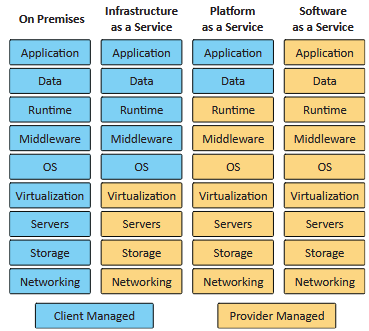
Q: What is a key difference between IaaS, PaaS, and SaaS?
IaaS: You manage most things
PaaS: You manage apps
SaaS: Provider manages everything
Q: What is a responsibility matrix in cloud computing?
A: A model that defines what the cloud provider manages vs. what the customer manages.
Q: What is multitenancy?
A: Multiple customers share the same cloud infrastructure securely.
Q: What is high availability in the cloud?
A: Systems remain accessible due to redundancy across multiple data centers.
Q: What is file synchronization in the cloud?
A: Data is duplicated across multiple locations for consistency and availability.
Q: What is metered cloud usage?
A: Billing based on actual usage (storage, uploads, downloads).
Q: What is non-metered cloud usage?
A: Paying a fixed amount for a set level of resources.
Q: What is ingress traffic?
A: Data uploaded to the cloud.
Q: What is egress traffic?
A: Data downloaded from the cloud.
Q: What is a key difference between private and public cloud?
Private: Owned and used by one organization
Public: Shared and managed by a provider
Q: Which cloud model gives you the MOST control?
A: IaaS
Q: Which cloud model gives you the LEAST control?
A: SaaS
Q: Which cloud model is best for developers?
A: PaaS
Q: Which cloud feature ensures systems stay online even if hardware fails?
A: Redundancy (high availability)