Molecular Bio Final Alphabet Soup "Translation"
 Call Kai
 Learn
Learn Practice Test
 Spaced Repetition
 Match
Match Flashcards
 Knowt Play
1/85

Earn XP
Description and Tags
Made this to help study those pesky proteins and RNAs that can get confusing with all the acronyms and what they do. Hope it helps.
Name | Mastery | Learn | Test | Matching | Spaced | Call with Kai | Chat |
|---|
No analytics yet
Send a link to your students to track their progress
86 Terms
What is an ORF and what do they do?
Open reading frames are regions of mRNA bound by a start codon and stop codon.
What are candidates for coding regions of mRNA?
long ORF’s
What is the start codon in eukaryotes?
AUG
What are the stop codons?
UAG, UGA, and UAA
What are UTR’s?
Untranslated regions in mRNA
What does it mean for an mRNA to be polycistronic?
Multiple proteins can be made from one mRNA
What does it mean for an mRNA to be monocistronic?
One protein made by that one mRNA
What is the RBS?
Ribosome binding site
What is the RBS in prokaryotes?
the Shine-Dalgarno Sequence
What is the RBS in eukaryotes?
The 5’ cap
What is tRNA?
transfer RNA
What are the parts of the tRNA?
Pseudo uridine (ΨU)-loop, Dihydrouridine (D)-loop, Acceptor arm, Anticodon loop, Variable loop
What part of the tRNA is charged with amino acid?
the 5’-CCA-3’ terminus in the acceptor arm
What are post-transcriptionally modified bases used by tRNAs?
Pseudouridine (ΨU), dihydrouridine (D), hypoxanthine, inosine, methylguanosine, and thymine
What charges the tRNA with amino acids?
Aminoacyl-tRNA synthetase
What are the two steps of tRNA amino acid charging?
Adenylylation (attachment of AMP) to tRNA
Secondary attachment of tRNA to amino acid
What are class I synthetases?
monomeric synthetases that add amino acid to 2’OH of AMP attached to tRNA.
What are class II synthetases?
multimeric synthetases that add amino acid to 3’OH of AMP attached to tRNA.
What is the issue with class I synthetases?
Aminoacyl groups are more stable on the 3’ carbon with an ester linkage, so added amino acids on 2’OH need to go through transesterification to te 3’OH
What must synthetases do for successful charging?
Recognize correct tRNAs and recognize correct amino acid
How do synthetases recognize correct tRNAs?
no common set of rules, various discriminator bases throughout the molecule
How do synthetases recognize correct amino acid?
Course recognition via size and chemical groups. They have two recognition sites to check for smaller amino acids.
What is the activity of the large ribosomal subunit?
Peptidyl transferase center
What is the activity of the small ribosomal subunit?
decoding center
What are the sizes in Svedberg units for prokaryotic ribosomal units?
Complete ribosome = 70S
Large = 50S
Small = 30S
What are the sizes in Svedberg units for eukaryotic ribosomal units?
Complete ribosome = 80S
Large = 60S
Small = 40S
What is the A-site for in the ribosome?
To accept “aminoacyl-tRNA”, incoming tRNAs charged with amino acid.
What is the P-site for in the ribosome?
To hold “peptidyl-tRNA“, tRNA being attached to the growing amino acid chain.
What is the E-site for in the ribosome?
It is the “exit“ site for tRNAs to leave after their job is done.
What breaks the tRNA-amino acid bond during translation?
The peptidyl transferase reaction
What is the catalyst for the peptidyl transferase reaction during translation?
The RNA molecule
Where do codon-anticodon interactions occur in the ribosome during translation?
The small ribosomal subunit
What allows for proper positioning of the small ribosomal subunit in prokaryotes when initiating translation?
Base-paring via the 16S rRNA that contains the complement to the ribosome binding site
What does the prokaryotic IF1 do?
Initiation factor 1 blocks tRNA from binding to A-site
What does the prokaryotic IF2 do?
Initiation factor 2 escorts an initiator tRNA to P-site and contains GTPase to break down GTP for later processes.
What does the prokaryotic IF3 do?
Initiation factor 3 blocks the large subunit from the small one until things are aligned.
What does eIF stand for?
eukaryotic initiation factor
What are the 4 steps of translation initiation in eukaryotes?
Binding of initiator tRNA
Auxiliary factors bind to mRNA
Bound ribosome scans for start
codonLarge subunit recruited
For the most part, initiation factors 1-3 are analogous between prokaryotes and eukaryotes, but what other eIF is analogous to IF2?
eIF5b
What is the purpose of eIF1, eIF1A, eIF3, & eIF5 association in initiation of translation in eukaryotes?
They associate with the small subunit to form the 43S preinitiation complex
What is the purpose of eIF2 in initiation of translation in eukaryotes?
Similar to IF2, it escorts initiator tRNA, but this time to the 43S preinitiation complex.
What is the purpose of eIF4E, eIF4A, and eIF4G association in initiation of translation in eukaryotes?
They recognize the cap of mRNA
What activates helicase activity of eIF4A to loosen mRNA?
eIF4B
What does the Ternary complex consist of?
Initiator tRNA + eIF2
What does the 43S preinitiation complex consist of?
The ternary complex + eIF1, eIF1A, eIF3, & eIF5 + small ribosomal subunit
What does the 48S preinitiation complex consist of?
The 43S preinitiation complex + the mRNA + the bound eIF4A, eIF4B, eIF4E, and eIF4G
True or false? The scanning for the first start codon in eukaryotic translation initiation requires ATP.
True
What releases eIF1, eIF2, eIF4B, eIF5eIF1, eIF2, eIF4B, and eIF5 after the anticodon on initiator tRNA recognizes the start codon?
Hydrolysis of eIF2-GTP to eIF2-GDP (see it came back)
What recruits the large ribosomal subunit in eukaryotic translation initiation?
eIF5B
What recruits eIF5B-GTP to the preinitiation complex?
eIF1A after removal of other initiation factors via GTP hydrolysis
What releases eIF5B and eIF1A from the preinitiation complex after the large ribosomal subunit has been recruited?
eIF5B-GTP hydrolysis to eIF5B-GDP
What are PABP’s?
Poly-A Binding Proteins
What circularizes the mRNA and why?
A protein bridge formed between PABP and eIF4G, which allows for continuous translation of the mRNA by the ribosome
What is EF-Tu and what does it do in prokaryotic elongation?
Elongation Factor-Tu escorts tRNAs to the A-site
What helps EF-Tu to be removed from tRNA once it has made it to the ribosome?
GTP hydrolysis on EF-Tu via GTPase activity of the ribosome or itself.
How does EF-Tu ensure correct pairing?
Incorrect base matching will not align the GTPase domain correctly for dissociation of EF-Tu and tRNA, so they get removed.
What is the process of accommodation?
rotation of the acceptor end of tRNA to put the amino acid into proximity with the growing peptide chain.
What does EF-G do?
Elongation factor-G drives translocation of tRNAs in the ribosome by entering a facotr-binding site and physically pushing tRNA from the A to P site after its GTP is hydrolyzed to GDP, causing it to block the A-site
What 3 factors combined act to ensure correct base pairing during elongation?
The 16S rRNA, EF-Tu GTP hydrolysis, and accommodation
What is the error rate for base pairing in translation?
10-3-10-4
How many ATPs and GTPs are consumed per amino acid added to the chain?
1 ATP and 2 GTPs
What are RF’s and what do they do?
Release factors help terminate translation.
What are eRF’s?
Eukaryotic Release Factors
What do Class I RF do?
recognize stop codons and trigger release of polypeptide
What are examples of Class I RF’s prokaryotes?
RF1 and RF2
What is an example of a Class I RF in eukaryotes
eRF1
What stop codons does RF1 recognize?
UAG and UAA
What stop codons does RF2 recognize?
UGA and UAA
What stop codons does eRF1 recognize?
all of them
What do class II RF’s do?
stimulate dissociation of class I factors.
What are the class II RF’s in prokaryotes and eukaryotes respectively?
RF3 and eRF3 respectively
What is RRF and what does it do?
Ribosome Recycling Factor recruits EF-G-GTP, and together with its GTP hydrolysis, rachets the ribosomal units apart to be used later.
What are exon junction complexes?
These are protein complexes that bind at the junction between two exons and are normally displaced by the ribosome upon binding. If not, these can indicate a nonsense strand that needs to be decayed.
What are Upf’s and what do they do?
Up-stream frameshift proteins work together with exon junction complexes in nonsense mediated decay to recognize nonsense mRNA and degrade the 5’ cap. These mRNA can then be targeted by endonuclease.
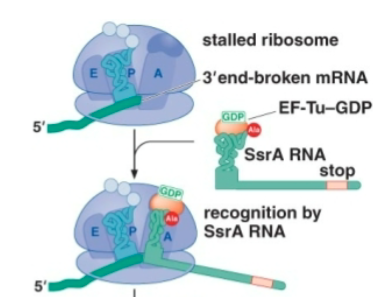
What is tmRNA?
transfer-messenger RNA is part tRNA part mRNA molecule
What is ssrA RNA and what does it do?
ssrA RNA is a type of tmRNA that tags proteins made from broken mRNA to be degraded
What is the structure of ssrA RNA?
Its is 457nt long and includes a tRNA-like region followed by 10 codons and a stop codon.
What does Ski7 do?
When a ribosome does not meet a stop codon and continues through the poly A tail, this leaves a poly-lysine peptide, and so Ski7 dissociates the stalled ribosome that made this and recruits exosome to target the protein for degradation.
List two ways RBS binding is inhibited to ensure the correct site is recognized at the right time.
RNA-binding proteins block small subunit binding
RNA folds mask second RBS in a polycistronic mRNA
How does the ribosome self-regulate its own production?
Production of ribosomal proteins parallel rRNA transcription, so excess protein leads to production slowing down.
Where are two prominent sites of regulation in trnaslation?
Phosphorylation to reduce elF2 GTP
binding(elF2-GTP)Phosphorylation regulates eIF4E cap binding
What is ferritin?
binds/releases iron in response to physiological conditions in eukaryotes
What is IRE and what does it do?
Iron Response Element in ferritin mRNA to bind iron and induce a secondary structure folding
What are IRP’s and what do they do?
Iron Regulatory Proteins control the translation of ferritin by binding to the IRE in the absence of iron and preventing secondary structure in ferritin mRNA
What does Gcn4 do?
regulates amino acid biosynthesis
How does translation Gcn4 work to regulate amino acid biosynthesis?
Its gene is preceded by 4 open reading frames. With high amino acid level, there is a lot of GTP binding and these ORF’s get translated first and keep Gcn4 from being translated. In low amino acid levels, low GTP lets the ribosome reach the Gcn4 gene to translate it and do its job of increasing amino acid synthesis.