1-3 PChem: Quantum-Thermodynamics Equations
 Call Kai
 Learn
Learn Practice Test
 Spaced Repetition
 Match
Match Flashcards
 Knowt Play
1/45

There's no tags or description
Looks like no tags are added yet.
Name | Mastery | Learn | Test | Matching | Spaced | Call with Kai | Chat |
|---|
No analytics yet
Send a link to your students to track their progress
46 Terms
1: Rayleigh-Jeans Law
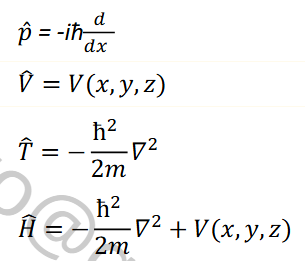
1: 4 Hermition Operators (Momentum, PE, KE, H)
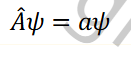
1: Eigenvalue
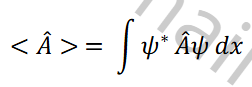
1: Expectation Value
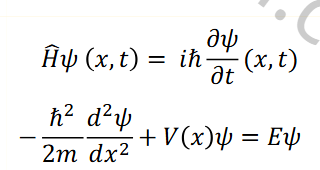
1: Schrodinger Equations (Time-independent and dependent)
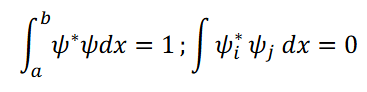
1: Normality and Orthogonality
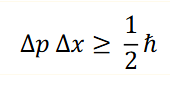
1: Heisenberg Uncertainty Principle
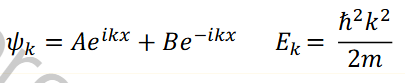
1: Free Particle
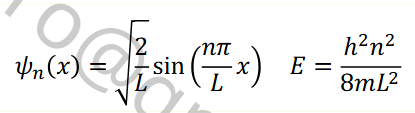
1: Particle in a Box
1: Harmonic Oscillator
<x> = 0 ; E(Ψ) = KE(1D) + ½ kx² Ψ

1: Vibrational Modes

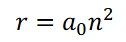
1: Bohr’s Radius of Electron Orbit
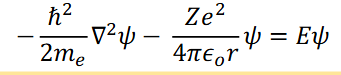
1: Schrodinger (1 e-)
1: Schrodinger (many e-, He)
Protons and Neutrons not included because of Born-Oppenheimer Approximation (nucleus is more big, too slow and can be assumed as stationary with comparison to electrons)

2: Work (Free Expansion, Cons. Pext, Isothermal Reversible)
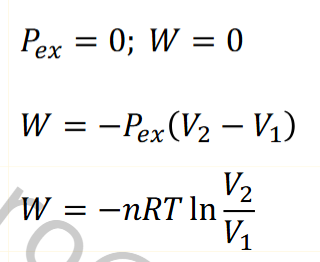
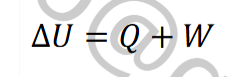
2: First Law of Thermodynamics
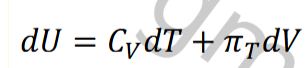
2: Partial Derivatives of U
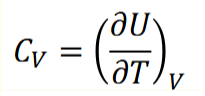
2: Heat Capacity at Constant V Derivatives
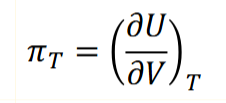
2: Internal Pressure Derivatives
2: Enthalpy

2: Enthalpy of Reaction

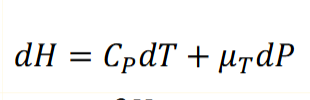
2: Partial Derivative of H
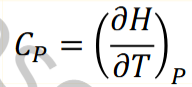
2: Heat Capacity at Constant P
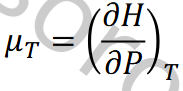
2: Isothermal Joule-Thomson Coefficient
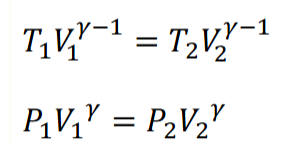
2: Ideal Gas in Adiabatic Process (constant TV PV)
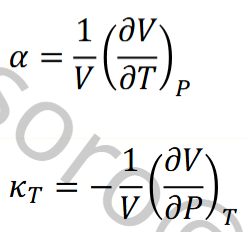
2: Thermal Expansion Coefficient (α) + Isothermal Compressibility (K)
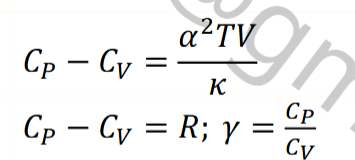
2: Cp - Cv Relation
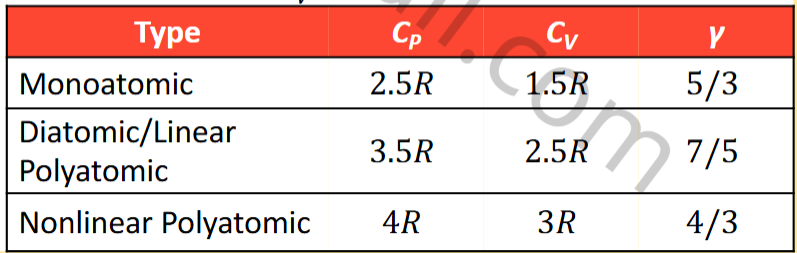
2: Cp, Cv, γ
2: Heat Capacity
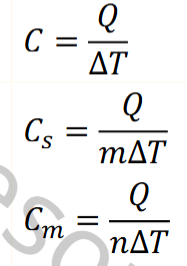
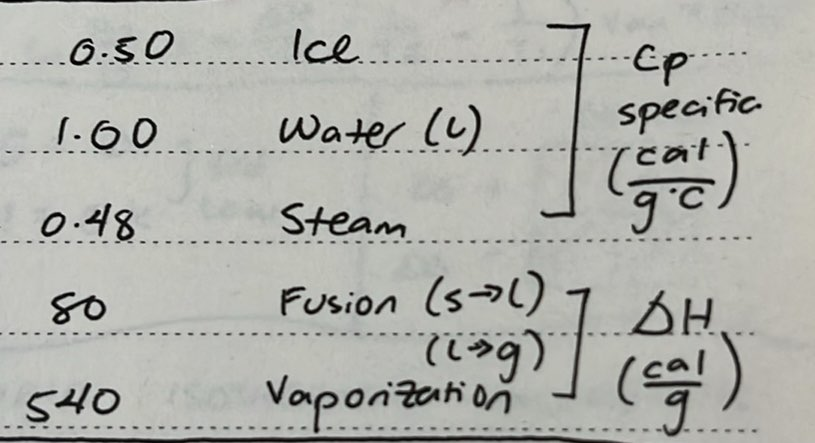
2: Sensible Heat, Latent Heat
Sensible Heat (temperature change), Latent Heat (phase change)

2: Kirchoff’s Law
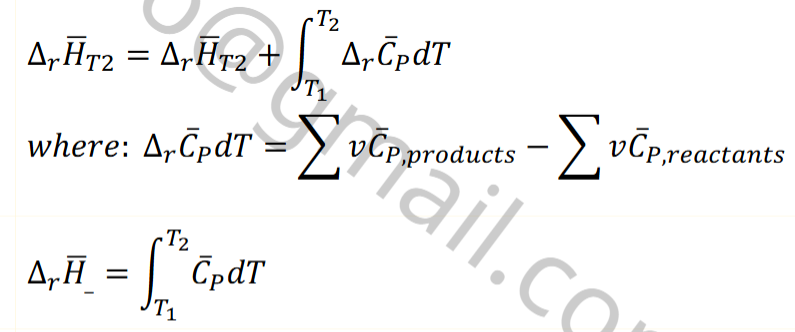
2: Enthalpy of Combustion Reactions

2: Heat Capacity Constants
3: Second Law of Thermodynamics (Entropy)

3: Entropy of Reactions

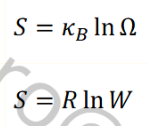
3: Boltzmann Entropy
Kb = constant; Omega = microstates; W = number of orientations
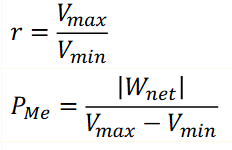
3: Carnot Engine (r Compression Ratio; PMe Mean Effective Pressure)
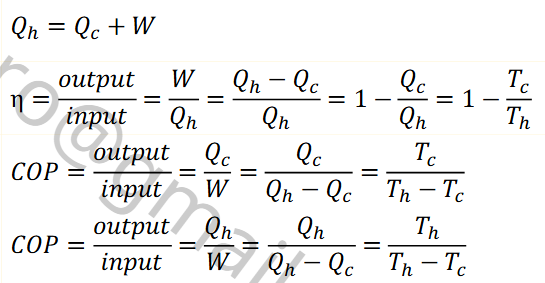
3: Carnot Efficiency (Heat Engine, Refrigerator, Heat Pump)
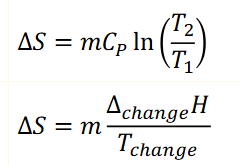
3: Entropy (Sensible Heat, Latent Change)
Sensible Heat (temperature change), Latent Heat (phase change)
3: Helmholtz, Gibbs Free Energy
A = constant T, V
G = constant T, P
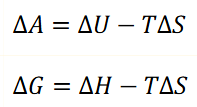
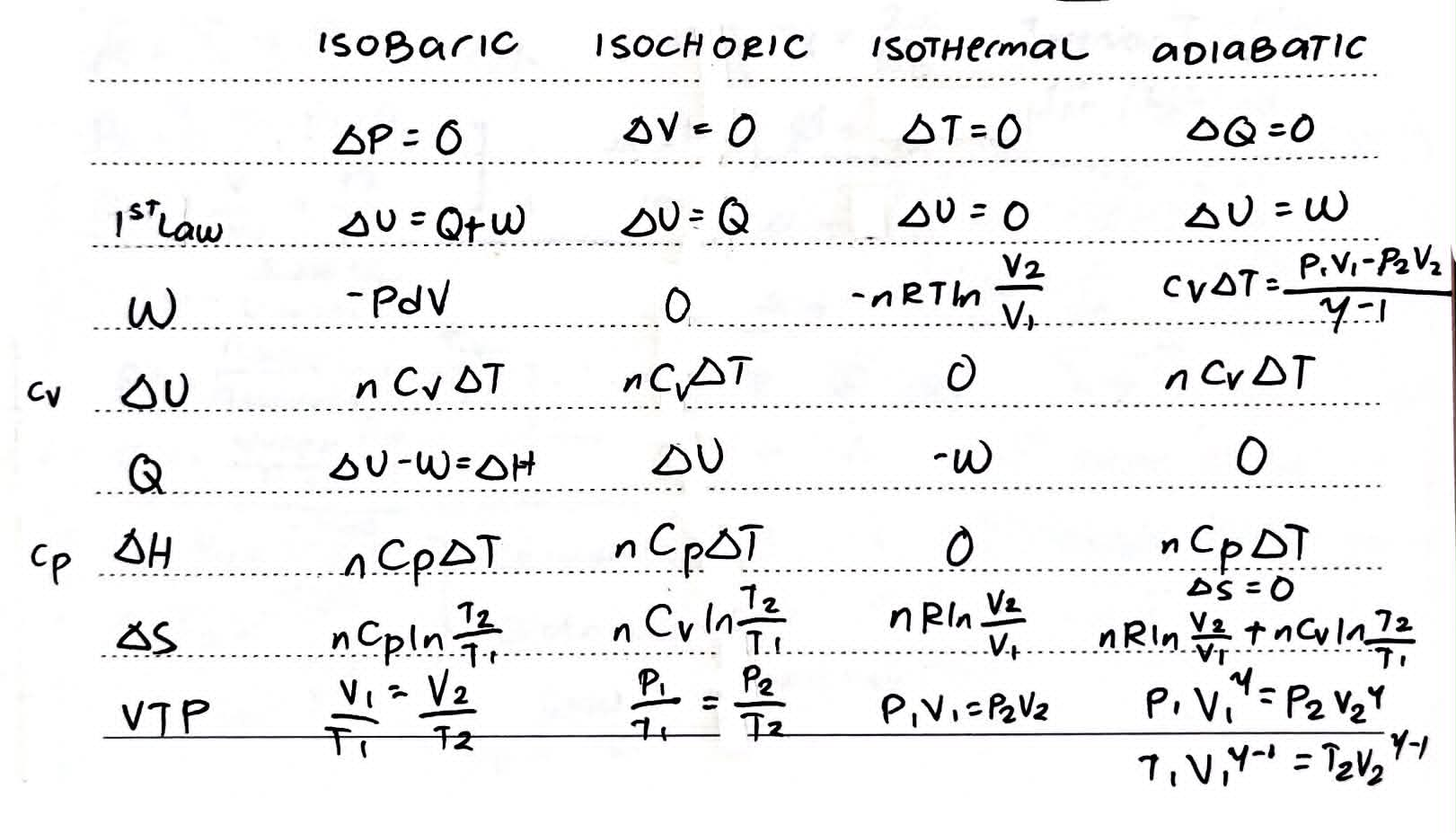
Table: 1st Law, W, U, Q, H, S, VTP (Isobaric, Isochoric, Isothermal, Adiabatic)
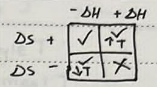
3: H S Relations Table
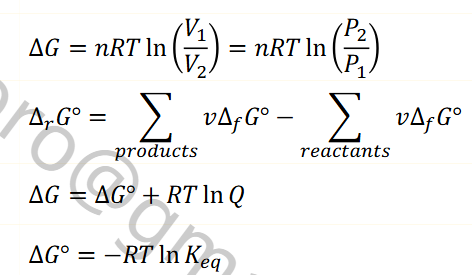
3: Entropy (Gibbs) Equations
3: Gibbs-Helmholtz Equation

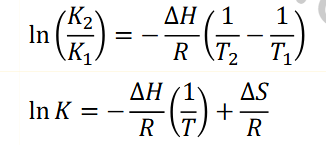
3: Van’t Hoff Equation
ln(y) = mx + b
y = B x + A
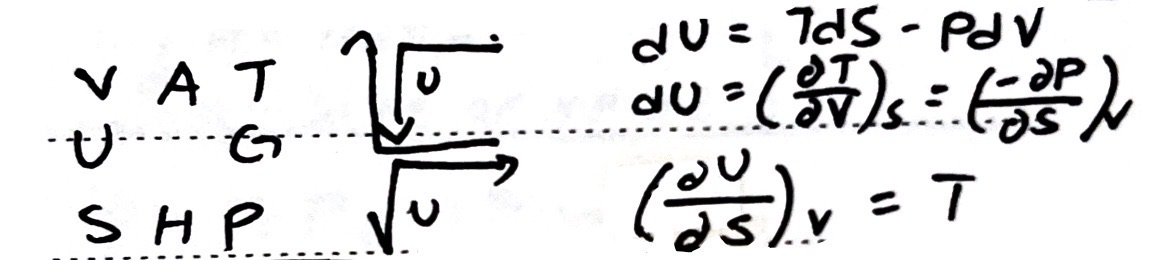
3: Maxwell Relations