B4.2 Ecological Niches
 Call Kai
 Learn
Learn Practice Test
 Spaced Repetition
 Match
Match Flashcards
 Knowt Play
1/18

There's no tags or description
Looks like no tags are added yet.
Name | Mastery | Learn | Test | Matching | Spaced | Call with Kai | Chat |
|---|
No analytics yet
Send a link to your students to track their progress
19 Terms
Define ecological niche
A unique role that a species plays in its ecosystem
What aspects of a species does an ecological niche include? [6]
Where it lives
What it eats & how it gets food
How it interacts with other species
When it is active (day/night, seasonal patterns)
How it reproduces
Its tolerance to abiotic factors
Define autotroph
An organism that uses external energy to synthesise carbon compounds from simple inorganic compounds
Define heterotroph
An organism that obtains energy and carbon by consuming other organisms or matter
Describe biotic interactions included in an ecological niche [4]
1) Food supply - What the organism eats & how it obtains it
Autotrophic
Heterotrophic
2) Predators - Who eats the organism
3) Competitors - Species competing for the same resources
4) Symbiosis - Mutually beneficial relationships
Describe differences & examples between organisms with different oxygen tolerances [3×3]
Obligate Aerobes | Obligate Anaerobes | Facultative Anaerobes | |
Oxygen requirement | Must have for survival | Cannot survive in presence of oxygen → damages enzymes & DNA | Can live with or without oxygen |
Type of respiration | Aerobic respiration to generate ATP | Anaerobic respiration or fermentation | Aerobic when oxygen available, switches to anaerobic/fermentation in low or no oxygen |
Examples | Humans, most animals | Minority of bacteria (e.g. Clostridium botulinum, some gut bacteria) | E. coli, some yeasts |
How is photosynthesis used as a mode of nutrition?
It involves using light energy to fix carbon dioxide into organic compounds, e.g. amino acids & sugars
What are the groups of organisms that use photosynthesis? [5]
Three groups of organisms use photosynthesis:
Plants - Mosses, ferns, conifers, & flowering plants
Eukaryotic algae - Seaweeds, unicellular algae
Photosynthetic bacteria - Cyanobacteria, purple bacteria
Hence, photosynthesis only occurs in two of three domains: eukaryotes & bacteria
Define holozoic nutrition
The process by which animals obtain energy and nutrients by consuming other organisms or matter
Describe the stages of holozoic nutrition [5]
Ingestion - Food is taken in through the mouth
Digestion - Food is broken down mechanically (chewing) & chemically (by enzymes) into smaller, soluble molecules
Absorption - Nutrients are absorbed into the bloodstream from the intestines
Assimilation - Absorbed nutrients are used by cells for growth, repair, & energy
Egestion - Undigested waste is eliminated from the body as faeces
Describe the exception to holozoic nutrition [3]
Some animals digest externally & are not holozoic
They absorb products of external digestion into their gut & assimilate them
Example: Spiders inject digestive enzymes into prey & suck out liquids produced
Define mixotroph
Organisms that can obtain energy and carbon through both autotrophic and heterotrophic modes of nutrition
What are the two types of mixotrophs?
1) Facultative
2) Obligate
Describe the features of a facultative mixotroph [2]
Can use entirely autotrophic/heterotrophic or both modes of nutrition
Switches based on conditions (e.g. light availability)
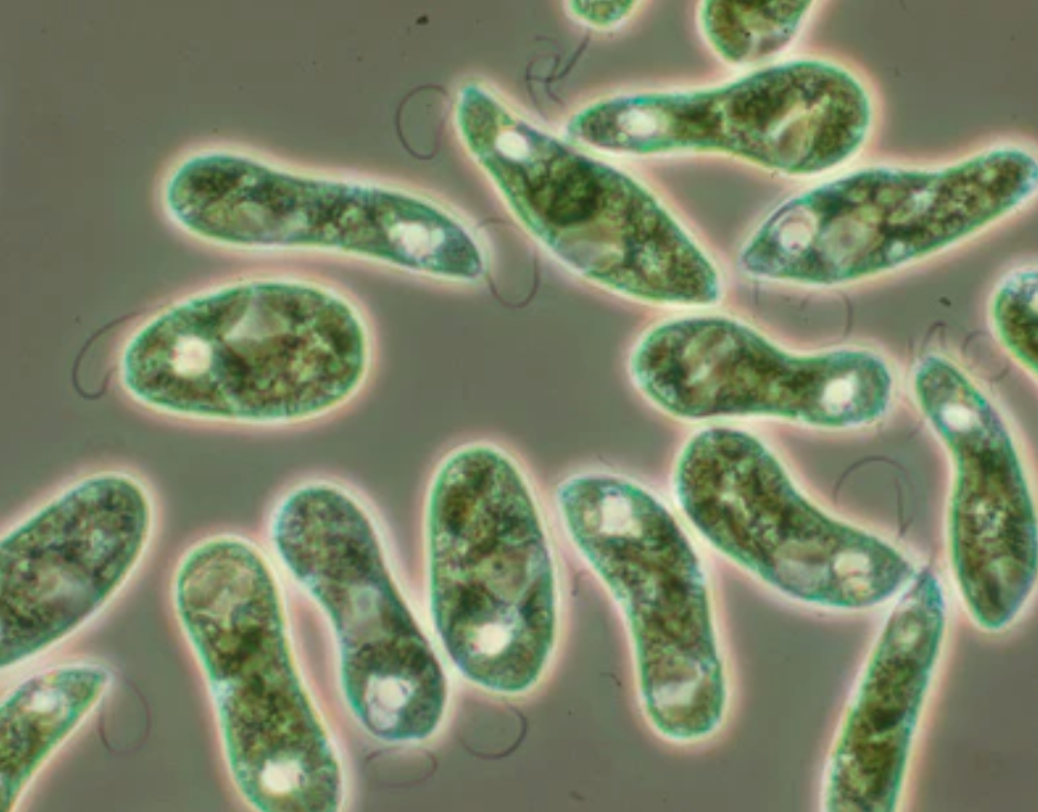
Example of facultative mixotroph - Euglena gracilis
Has chloroplasts & carries out photosynthesis when there is sufficient light
In the dark, it can feed on detritus or smaller organisms by endocytosis
Describe the features of an obligate mixotroph [3]
Cannot grow unless they use both autotrophic & heterotrophic modes
This is because they eat food to obtain carbon compounds that they cannot synthesise
Some go through kleptoplasty, where mixotrophs that lack their own chloroplasts take chloroplasts from algae they consume
Define saprotrophic nutrition
A type of heterotrophic nutrition where organisms (saprotrophs) feed on dead or decaying organic matter
How do organisms go through saprotrophic nutrition?
Saprotrophs digest food externally by secreting enzymes onto the material then absorb the nutrients
What are the two organism types that undergo saprotrophic nutrition and their roles?
Organism type | Role |
Bacteria | Break down leaf litter, wood, dead organisms |
Fungi | Decompose organic matter in soil & water |