AST101 Sun and its Neighbors
 Call Kai
 Learn
Learn Practice Test
 Spaced Repetition
 Match
Match Flashcards
 Knowt Play
1/98

There's no tags or description
Looks like no tags are added yet.
Name | Mastery | Learn | Test | Matching | Spaced | Call with Kai | Chat |
|---|
No analytics yet
Send a link to your students to track their progress
99 Terms
Solar System
consists of at least one star and includes any objects orbiting it (planets, asteroids, colts, etc) or any objects orbiting those objects
Star
ball of high energy plasma driven by nuclear fusion
produces its own energy
Sun
main source of energy in the solar system
produces energy by fusing hydrogen into helium in its core.
Sun spots
very magnetically active areas on the sun
dark because it prevents energy from reaching the sun
What is a planet?
orbits a star
mostly round
massive enough that it has cleared its neighborhood of massive objects
Inner planets/inner solar system
terrestrial: small and rocky
mercury, venus, earth, mars
have thin or no atmosphere
few or no moons
Outer planets/solar system
jovian: large and gassy
more distance
jupiter, saturn, uranus, neptune
massive systems of moons
main of light gasses
What are moons?
object orbiting a planet
the largest moons are bigger than planets
the smallest moons are <1km wide irregular objects
Our moon
rocky and heavily cratered
not geologically active
little atmosphere
Dwarf planets
objects massive enough to become approximately spherical
not massive enough to clear their orbit
ceres, pluto, eris, haumea, makemake
more elliptical orbits than planets, not always in the same plane
The Kuiper Belt
region of countless icy bodies in the outer solar system
contains most known dwarf planets
Comets
small bodies in the outer solar systems
rich in ices
elliptical orbits
The celestial sphere
the sky appears as a dome above our heads
north pole of the earth points at the north celestial pole - same with south
projection of the earth’s equator on the sky
Right ascension
analogous to longitude lines on the Earth
sky version of longitude
Declination
analogous to latitude lines on the Earth
sky version of latitude
Day-to-day sky motions
solar system objects and stars rise in the east and set in the west because of earth’s rotation
counter-clockwise in the north and clockwise in the south
circumpolar stars never set: altitude of the pole = your latitude
Ecliptic
the path travelled by the sun and planets
all planets orbit the sun in roughly the same plane
23.5 degrees from the celestial equator
Axial tilt
the angle between the ecliptic and equator is caused by this- Earth doesn’t spin in line with the plane of the solar systems
this causes seasons
Seasons
when the northern hemisphere towards the sun: more direct sunlight, longer days, summer
when the northern hemisphere is tilted away: less direct sunlight, shorter days, winter
earth points in the same direction throughout the year
causes by the tilt of our rotational axis
New moon
the moon is between the earth and sun
unlit side faces earth
solar eclipses can happen
rises and sets with sun
moon phases
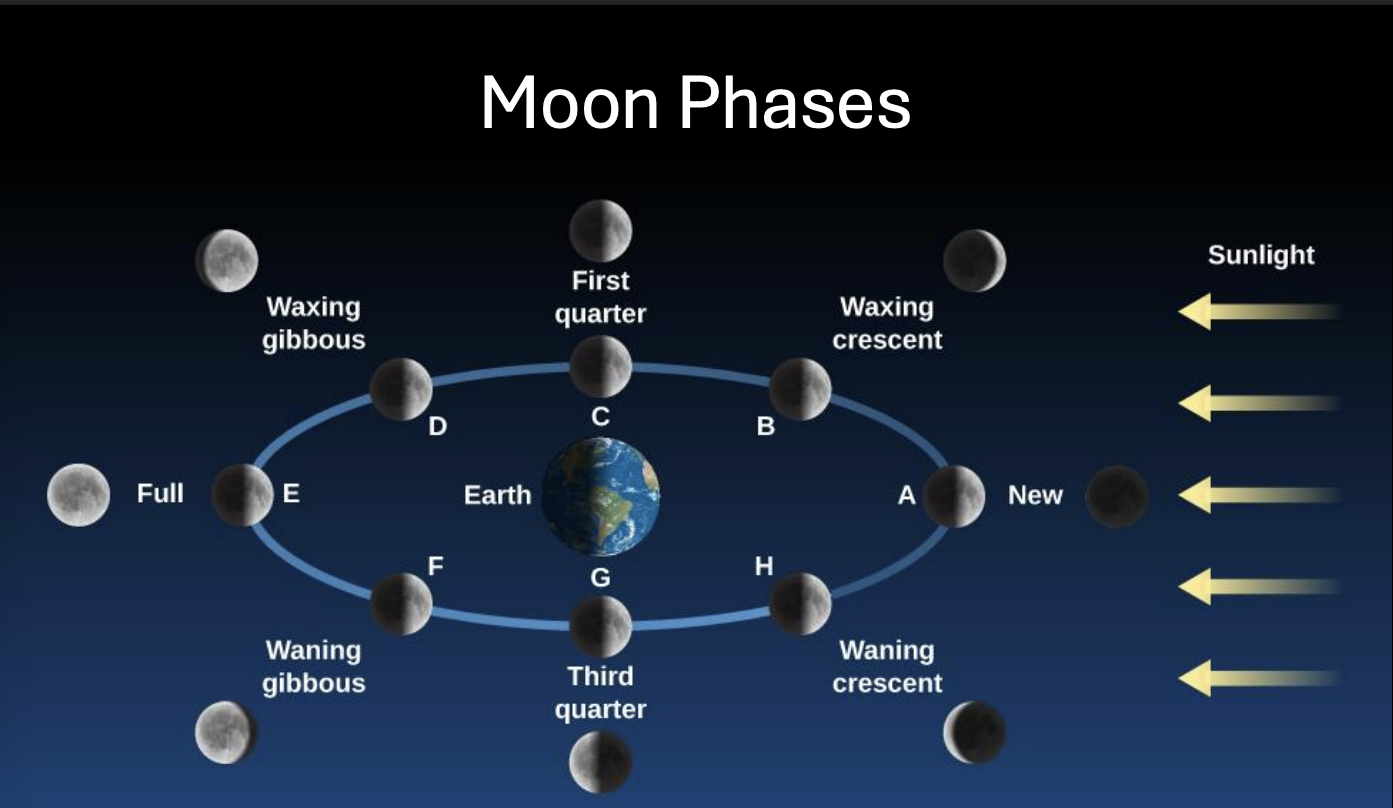
Waxing crescent
visible soon after sunset
happens a few days after new moon
sets a few hours after the sun
First quarter
at its highest point at sunset
happens 1 week after new moon
right half of the moon is lit
sets at midnight
waxing gibbous
at its highest point around 9pm
happens 10ish days after new moon
sets before sunrise
moon ~3/4 lit on right side
Full moon
rises around sunset and sets around sunrise
the only time lunar eclipses can happen
happens two weeks after new moon
visible almost all moon
Waning gibbous
happens 17-18 days after new moon
sets in late morning after sunrise
moon ~3/4 lit on left rise
Third quarter
at its highest point at sunrise
happens one week before new moon
sets at noon
left side of moon is lit
Waning crescent
rises right before the sun
happens a few days before the new moon
sets before sun
Tidal locking
the moon is tidally locked to the earth
same face is always pointing toward the earth
not rare in the solar system
Eclipses
occur when one object blocks the light of the sun from reaching another object
lunar and solar eclipses happen when the moon cross the ecliptic, aligning the earth, moon, sun
Solar eclipse
can happen during new moon
moon blocks the sun, cases shadow on the earth
Total eclipse
entire surface of the sun is blocked out
dim corona of the sun is visible
Lunar eclipse
often called blood moon
moon is covered by earth’s shadow
moon is lit by light filtered through the atmosphere all sunsets on earth projected on the moon
Geocentric model
the earth is at the center of the universe
everything revolves around it
planets move in circles within circles
Retrograde motion
The planets don't circle the earth consistently, they occasionally reverse, this is retrograde motion
issue with geocentrism
opposite to prograde: the direction in which the sun moves
The heliocentric model
sun is at the center of the universe
the planets orbit the sun in circles
the moon orbits the earth
predicts retrograde motion when earth overtakes outer planets in their orbits or the reverse for inner planets
Kepler and Brahe
Brahe used naked eye instruments to track positions of the stars and planets
Kepler collaborated and inherited Brahe’s data after his death made the three laws of planetary motion
Kepler’s First Law
all planets move in ellipses with the sun at one focus
sun is not at the center but rather at one focus of the ellipse
e = 0: perfectly circular
e>1: not in a bound orbit
Semimajor axis (A)
the major axis is the longest distance across the ellipse so semi major is half of that
usually represents the average distance from planet to sun
Semi-Minor Axis (B)
the minor axis is the shorter width of the ellipse so its half of that
tells you how “wide” the ellipse is
Circle vs Ellipse
a circle: major axis = minor axis
an ellipse: major axis = longer minor axis =shorter
Foci
ellipse has two focus points
sun sits at one
Keplers second law
a planet moves faster in the part of its orbit nearer the sun and slower when farther from the sun, sweeping out equal areas in equal times
Keplers third law
more distant planets orbit the sun at slower average speeds, obeying the relationship
Issac Newton
developed a unified physical framework that could explain planetary motions
explained tides, shape of the earth, and speed of sound
Newtonian physics: speed
The rate at which an object is moving. This does not consider direction – e.g. the car is moving at 45 km/h
Newtonian physics: velocity
The speed at which an object is moving in a specific direction – e.g., the car is moving at a rate of 45 km/h due north
Newtonian physics: acceleration
The rate of change of velocity – e.g. The car accelerated from 0 to 45 km/h moving north over 9 seconds - a change in direction is acceleration
Newtons first law
the law of inertia: an object in motion remains in motion unless acted upon by an outside force
centripetal force: force is needed to keep an object moving in a curved path
if the force making the object move in a curved path disappears, the object will continue with velocity it had when that force disappeared
Newton’s second law
acceleration is proportional to force and inversely proportional to mass
F = ma or a=F/m
more force means more acceleration, higher mass means less acceleration
Newtons third law
for each force, there is an equal and opposite reaction force
the force with which the gas leaves the rocket engines downwards is the same force that accelerates the rocket upwards
Momentum
defined as p=mv
m = mass
v= velocity
always conserved in a closed system
Momentum astronaut question: Let’s say our astronaut pushes away at 10 km/h. If the spacecraft weighs 100 times as much, how fast does it move away?
If initial momentum is zero, then they must have equal and opposite momentum after
Astronaut: 1*10 km/h = spacecraft: 100*x km/h Spacecraft moves away at 0.1 km/h
Angular momentum
L=mvr
angular momentum is momentum times distance from center of rotation
if a skater pulls their arms in, r decreases, so v must increase to conserve L
Universal law of gravitation
all objects in the universe experience and produce gravitational force
force increases with mass of each object
force decreases with distance squared
bigger masses stronger gravity/ larger distance weaker gravityt
Gravitational acceleration
combines newtons 2nd law and gravity
gravity causes the same acceleration for all objects at the same location
does not depend on the falling objects mass (ignoring air resistance)
Escape velocity
bigger object, higher escape velocity, surface further from center of mass, lower escape velocity
Tides
force of gravity is highest on the side toward the sun: near side of the earth drawn to it - gravity weakest on far side
two bulges: two high tides per day - water moves easier than rock
since earth rotates the tidal bulges lag - result is earth’s orbit is slowing down
Spring/neap tides
the sun can cause tides
if the sun and moon are aligned (full or new), forces add - spring
at first or third quarter moon, forces of sun and moon opposed each other so tides are smaller - neap
Tidal locking of the moon
the lag and pressure now has the moon only showing one face toward the moon through tidal locking
picture holding a pen while spinning in a chair
Kinetic energy
energy of motion/momentum
objects have this energy through their motion - faster = more energy
hot particles have more
Potential energy
stored energy/energy from gravity
objects higher up have more potential gravity
Nuclear energy - mass-energy equivalence
the nuclei of atoms store energy, when you combine or split them you release some of the energy
E=mc²
mass can be converted into energy without violating conservation of enerfy
nuclear reactions release an enormous amount of energy
Nuclear fission
splitting the atom
nuclear reactors use this as energy source
Nuclear fusion
combining atoms
extra mass is released as energy during fusion
Nuclear fusion in the sun
fusing hydrogen nuclei together to create helium releasing enormous amounts of energy
the sun squeezes hydrogen together that fuses into helium the tiny bit of mass converts into energy and energy moves outward
Conditions for nuclear fusion in the sun
the suns core is extremely hot and dense, gravity crushes the core inward creating conditions for fusion
gravity pulls inward and pressure from hot fusion gas pushes outward creating balance: hydrostatic equilibrium
The solar thermostat/Hydrostatic equilibrium
equilibrium state
density increases
fusion rate increases
temperature increases
pressure increases
core expands
density decreases
equilibrium restored
Sun’s core
nuclear fusion is active
dense
15 mill degrees
Sun convective zone
outermost layer of solar interior
hundreds of thousands degrees C
less dense air at the top of the convective zone
energy moves outward through convection
Sun photosphere
the surface of the sun we see
point where visible light can freely escape the sun
Sun chromosphere
extends 2000 km above the photosphere
normally only visible through solar eclipse
prominences: gas help up by magnetic activity
filaments: prominence seen in front of the suns surface
Sun corona
ultra hot gas above the photo and chromosphere
a million degrees but low density
only visible during eclipse
Light
the transport of energy through electromagnetic waves
Waves
oscillations that propagate outwards and carry away energy e.g. ripples in water, sound waves
Propagation of light
when you move a charge the electric field changes
the change propagates at the speed of light
a changing electric field induces a magnetic field
Light waves
light moves at a constant rate
crest and troughs - shorter wavelength makes the crest and troughs of the wave pass more often
distance=velocity*time
can be described in terms of wavelength or frequency
Visible light
light we can see
λ ~ 400 - 700nm
tiny portion of the EM spectrum
Ultraviolet
light with wavelengths too short for us to see
λ 10-400 nm
sources: the sun, black lights, tanning lamps
X-ray
even higher energy and shorter wavelength than UV
used for medical imaging
Chandra space telescope
Gamma rays
even higher energy and shorter wavelength than UV
λ<10nm
produced during fusion and fission
emitted during supernovae, neutron star mergers, high energy events
Infrared
light with wavelength too long for us to see
λ 700nm-1mm
sources: heat from most objects in this room including you
Microwaves
even longer wavelengths than infrared
λ 1mm-1m
sources: gas in space, residual heat from the formation of the universe
Radio
longer wavelengths than microwaves
λ> 1m
telecommunications, radio galaxies, gas emission
Emission
an object produces its own light
Reflection
light bounces off an object and does so at a consistent angle
reflection lets us see a complete image of objects in the reflecting surface
Scattering
light hits an object and is reflected in many different directions
because the angles are not consistent, scattered light does not form an image
Absorption
light from one object hits another object and is captured by that object
objects that absorb the most light are dark
Transmission
light from one object travels through another object
light interacts differently in different wavelengths
Light through a prism
some colors are bent more than others passing through glass so white light splits into a rainbow
Thermal radiation
moving particles or charges produces light
idealized form of this is blackbody radiation: object is in equilibrium, it only absorbs energy and re-emits it as thermal radiation
Kelvin Scale
same as celsius scale but at 0K objects have no thermal enerfy
0 K is also called absolute zero
Blackbody radiation
for a hotter blackbody more energy at all wavelengths
peak intensity at shorter wavelengths
sun isn’t a perfect one but its close
The Bohr Atom Model
a model where electrons orbit the nucleus in fixed energy levels
Nucleus
positively charged nucleus containing protons and neutrons
Electrons
orbiting the nucleus in specific energy levels
Quantized energy
electrons can only exist at certain energy levels, not between them
Emission lines
extra light at the same wavelengths
common in hot low density gas
Absorption lines
dark lines that appear in a spectrum when atoms absorb specific wavelengths of light.
A hot object produces a continuous spectrum
(like the Sun)Light passes through cooler gas
The gas absorbs specific wavelengths
Dark gaps appear in the spectrum