Vision Science: Light Adaptation
 Call Kai
 Learn
Learn Practice Test
 Spaced Repetition
 Match
Match Flashcards
 Knowt Play
1/98

There's no tags or description
Looks like no tags are added yet.
Name | Mastery | Learn | Test | Matching | Spaced | Call with Kai | Chat |
|---|
No analytics yet
Send a link to your students to track their progress
99 Terms
light adaptation
process that occurs when our visual system adjusts to ambient lighting, like when stepping outside
light adaptation
Does the following example describe light or dark adaptation?
Seeing a movie in the theatre and stepping out to daylight
dark adaptation
Does the following example describe light or dark adaptation?
Being outside and moving into a dark room
light
Light/Dark adaptation occurs very quickly
dark
Light/Dark adaptation occurs very slowly
to maintain stable perception of objects in the environment when moving from a dark area to a light area
What is the purpose of light adaptation?
measure how the threshold changes after adapting to a different light level
What is the main goal of measuring light adaptation?
increment threshold procedure
What study was conducted to study light adaptation?
increment threshold
the increment brightness threshold against a given background light intensity
project brightness to a background and present a more intense light within the center
How do we measure increment brightness threshold?
the minimum addition of light needed to discriminate the target from the background
What is the foal of increment threshold procedure
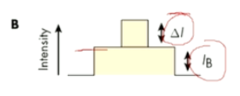
increment threshold procedure
What procedure is depicted from the following graph?
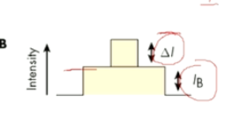
IT = IB + I (increment)
Based on the following graph, how do we calculate increment threshold?
luminance intensity
Increment Threshold Procedure 1: Select a background ___________ __________
probe
Increment Threshold Procedure 2: After selecting a background luminance intensity, present a _______ at the center of the background aperture
background
Increment Threshold Procedure 3: After selecting a background luminance intensity, present a probe at the center of the background aperture. Measure the increment threshold of the probe against the _________
MOL, MCS, MOA, Staircase
What are the four psychophysical techniques that can be used to measure light adaptation?
staircase
Automated perimetry (visual field test) measures increment threshold using the ___________ procedure
1, 2, 3, and 4
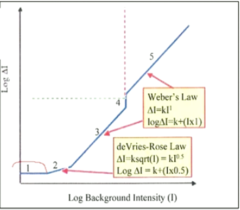
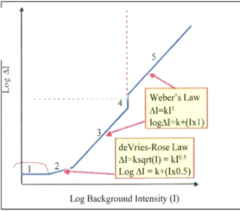
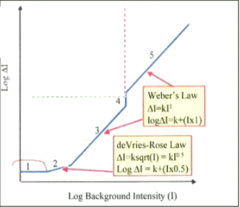
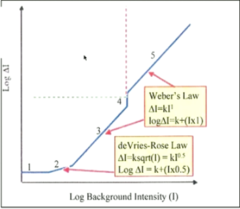
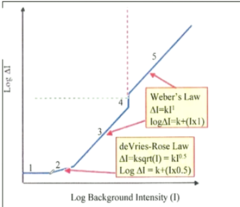
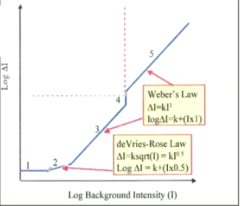
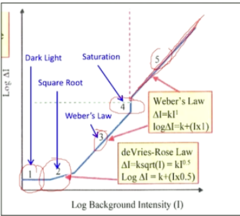
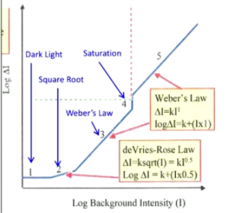
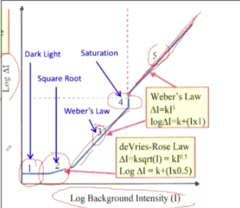
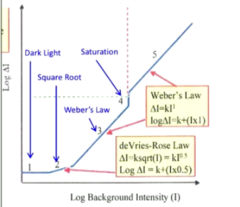
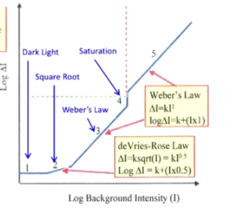
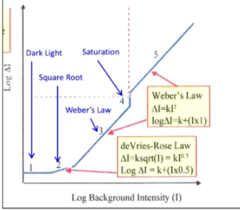
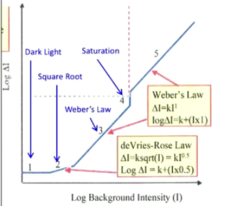
The Light Adaptation Function: The light adaptation curve that shows increment threshold (delta I) as a function of the background adapting (Ib) intensity. It is also called a threshold-versus-intensity (tvi) curve. What areas on the curve correspond to scotopic light adaptation?
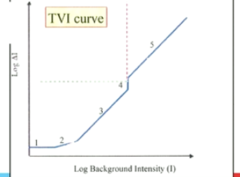
5
The Light Adaptation Function: The light adaptation curve that shows increment threshold (delta I) as a function of the background adapting (Ib) intensity. It is also called a threshold-versus-intensity (tvi) curve. What areas on the curve correspond to photopic light adaptation?
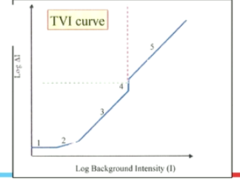
log background intensity (I)
The Light Adaptation Function: The light adaptation curve that shows increment threshold (delta I) as a function of the background adapting (Ib) intensity. It is also called a threshold-versus-intensity (tvi) curve. What is on the x-axis of this function?
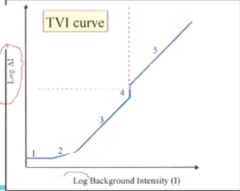
log delta I
The Light Adaptation Function: The light adaptation curve that shows increment threshold (delta I) as a function of the background adapting (Ib) intensity. It is also called a threshold-versus-intensity (tvi) curve. What is on the y-axis of this function?
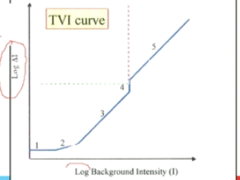
threshold-versus-intensity (tvi) curve
The Light Adaptation Function: The light adaptation curve that shows increment threshold (delta I) as a function of the background adapting (Ib) intensity. What is this function also called?
scotopic light adaptation
The Light Adaptation Function: The light adaptation curve that shows increment threshold (delta I) as a function of the background adapting (Ib) intensity. When considering areas 1, 2, 3, and 4, what do they correspond to?
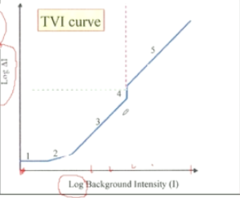
photopic light adaptation
The Light Adaptation Function: The light adaptation curve that shows increment threshold (delta I) as a function of the background adapting (Ib) intensity. When considering area 5, what do they correspond to?
dark light
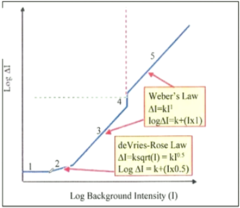
When looking at one on the following graph, what is this region called?
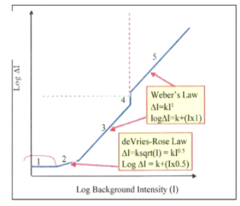
square root law/deVries-Rose Law
When looking at two on the following graph, what is this region called?
Weber's Law
When looking at three on the following graph, what is this region called?
Saturation
When looking at four on the following graph, what is this region called?
1
Dark Light Region: What region is the dark light region apart of?
0
Dark Light Region: What is the slope of the dark light region?
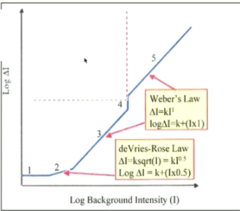
the increment thresholds are independent of background intensity; basically does not change with change in intensity
Dark Light Region: Why is the slope of the dark light region 0?
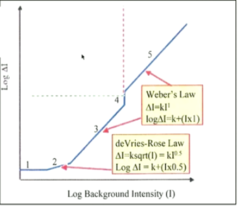
internal neural noise
Dark Light Region: Because the background is so dark within the dark light region, what is the vision mainly influenced by in the visual system?
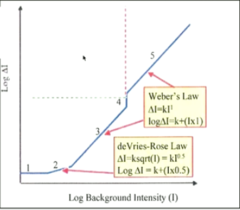
No!
Dark Light Region: Does the dark light change with background intensity
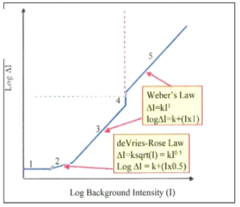
2
Square Root Law Region: What region is associated with the square root law region?
Yes!
Square Root Law Region: Does the background light start to influence the increment threshold?
log (delta I) = 1/2 log (Ib) + K
Square Root Law Region: How do we calculate the increment threshold in this region?
to determine increment threshold in the square root law region
Square Root Law Region: What is this equation used for?
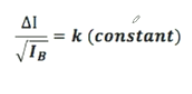
square root of the background light
Square Root Law Region: How is the threshold determined in this region?
fluctuations in background light
Square Root Law Region: What is the main influence of vision at this region?
neural noise
Review: How is vision influenced in the dark light region?
fluctuations in background intensity
Review: How is vision influenced in the square root law region?
4
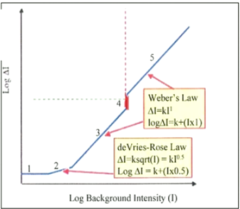
Saturation Region: What number does the saturation region correspond to on the graph?
infinity
Saturation Region: What is the slope at the saturation region?
No! Once saturation is reached, cones will take over
Saturation Region: Are we able to measure the saturation region of an individual with normal rods and cones?
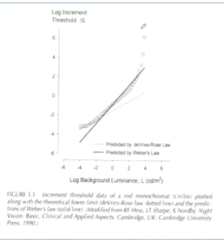
patients with rod monochromatic (patients with only functioning rods)
Saturation Region: Who can the the saturation region be tested on?
rod monochromats
Saturation Region: What individual was tested when looking at the saturation region?
No
Saturation Region: When rods are saturated can they detect increased intensities in light?
3, 5
Weber's Law Region: What two regions follow Weber's Law in the following function?
delta I = k x IB
Weber's Law Region 3: What is the equation to measure threshold of this region?
1
Weber's Law Region 3: What is the slope of this region?
0.14
Weber's Law Region 3: What is the weber fraction for scotopic vision?
delta I = k x IB
Weber's Law Region 5: What is the equation to measure threshold of this region?
1
Weber's Law Region 5: What is the slope of this region?
0.015
Weber's Law Region 5: What is the weber fraction for photopic vision?
Intensity level for region 3 compared to 5 is less intensity, and the k of scotopic is 0.14, whereas the k of photopic is 0.015
What are the two main differences between weber's law region 3 and 5?
larger
The k under scotopic conditions is about 10 x smaller/larger than the k under photopic conditions.
weber contrast
the difference between a target to a background
k, weber contrast
What is the constant coefficient of weber's law?
1.5 units
Light Adaptation and Weber's Law: When we take into account the photopic system using k = 0.015, when IB = 100 unity, what does increment threshold equal?
15 (delta I = k x IB)
Light Adaptation and Weber's Law: When we take into account the photopic system using k = 0.015, when IB = 1000 unity, what does increment threshold equal?
increases
Light Adaptation and Weber's Law: When we take into account the photopic system, the increment threshold decreases/increases as the background illumination increases.
decrease
Light Adaptation and Weber's Law: When we take into account the photopic system, the increment threshold increases as the background illumination increases. This indicates a increase/decrease in sensitivity of the visual system as illumination increases.
decreases
Review: As threshold increases, sensitivity _________
increases, decreases
As we go to brighter environments, our threshold _________ and our sensitivity ___________.
True
True of False: With photopic weber's fraction, no matter what the background is the k will always remain the same.
weber contrast
k is called weber's fraction. What is another term for this k?
as a percentage
How is contrast typically documented?
contrast threshold
k is a ________ _______ of the visual system
1.5%
Under photopic conditions, the k (weber's contrast) is about what percentage?
minimum contrast
Under photopic conditions, the k (weber's contrast) is 1.5%. This percentage tells the __________ __________ for us to differentiate the target from the background.
percent contrast increment
Under photopic conditions and when we are doing increment threshold, we ask ourselves what __________ _________ ___________ is needed to differentiate the background from the target
1.5% contrast
Photopic k = 0.015; the visual system can barely discriminate a target light that has ____ __________ against a background illumination in the photopic light range
yes
Does the increment threshold (delta I) change as illumination changes?
absolute sensitivity
The increment threshold of the visual system is considered as the __________ ___________ of the visual system during light adaptation
decreases
As the background illumination increases, the absolute sensitivity _________.
relative sensitivity (k does not change)
The contrast threshold of the visual system does not change; i.e. the _________ __________ of the visual system does not change as the illumination changes
increment threshold
Review: What variable in weber's law represents absolute sensitivity?
k
Review: What variable in weber's law represents relative sensitivity?
sensitivity regulation
trade-off that occurs during light adaptation where the absolute sensitivity of the visual system decreases with increasing illumination while relative sensitivity remains the same
decreases, remains the same
A trade-off that occurs during light adaptation is sensitivity regulation, which is where the absolute sensitivity of the visual system decreases/remains the same with increasing illumination while relative sensitivity decreases/remains the same
14%
Under scotopic conditions, the k (weber's contrast) is about what percentage?
minimum contrast
Under scotopic conditions, the k (weber's contrast) is 14%. This percentage tells the __________ __________ for us to differentiate the target from the background.
photopic (very low threshold means high sensitivity!)
In photopic conditions, the contrast threshold is 1.5%. Under scotopic conditions, the contrast threshold is 14%. Which system is better at discriminating contrast?
helps us maintain a stable perception when moving from one lighting condition to another
Why is it important that the relative sensitivity (k) of the visual system remains constant?
rods
When considering absolute sensitivity, which visual system is more sensitive?
cones (better at contrast; 1.5% compared to the 14% of the scotopic system)
When considering relative sensitivity, which visual system is more sensitive?
contrast
Sensitivity regulation also means that the visual system does not work like a light meter to accurately signal the absolute level of illumination in the surround. Instead, it signals the _________ of an object with respect to the illumination
lightness constancy
phenomenon that occurs when the contrast of an object remains the same under different illumination; basically an object's appearance looks stable under a range of different levels of illumination
false, remains the same
True of False: Under different illumination conditions the contrast of an object will change
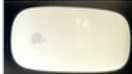
less (measured to be 100 cd/m2; contrast remained the same by the physical visual environment changed)
One a bright sunny day, the mouse in the picture had a luminance value of 600 cd/m^2. Based on the lightness constancy phenomenon, what would we expect the indoor luminance to be?
increase
When Stepping Outside from Indoor: The amount of light entering out eyes will _________ dramatically
light constancy (contrast remains the same despite the luminance changing)
When Stepping Outside from Indoor: The amount of light entering out eyes will increase dramatically but the objects remain stable. What phenomenon describes this?
B
Adelson's Checker=Shadow Illusion: When looking at the following image, what square do you perceive to be brighter?
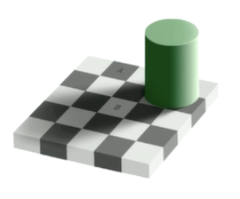
luminance
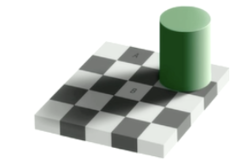
Adelson's Checker=Shadow Illusion: When looking at the following image, we know that square B is perceived to be brighter. However the __________ of both objects is the same.
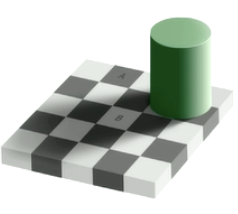
our brain incorrectly takes into account the shadow from the cylinder, making it conclude that it is slightly brighter despite receiving the same visual stimulus
Adelson's Checker=Shadow Illusion: When looking at the following image, we know that square B is perceived to be brighter. However the lumiance of both objects is the same. Why do we perceive square B to be lighter?
left
Cornsweet Illusion: Based on the following picture, what side is perceived to be brighter?

both look equal
Cornsweet Illusion: Now looking at the picture, what side appears to be brighter?

the contrast between the two regions, leading to misinterpretation
Cornsweet Illusion: What causes the left side to appear so much brighter than the right?