Eye & Ear Things!
 Call Kai
 Learn
Learn Practice Test
 Spaced Repetition
 Match
Match Flashcards
 Knowt Play
1/232

There's no tags or description
Looks like no tags are added yet.
Name | Mastery | Learn | Test | Matching | Spaced | Call with Kai | Chat |
|---|
No analytics yet
Send a link to your students to track their progress
233 Terms
limbus
The junction between the substantia propria and the sclera (at the edge of the cornea) is referred to as the ________.
bulbar
The conjuctiva that lines the outer part of the eye, up to the limbus, is referred to as the _______ conjuctiva.
one resides in the dorsolateral aspect of eye
the other is in the third eyelid
The two major lacrimal glands of the eye are located where?
Entropion
Ectropion
*________________ is rolling in of the eyelids and _________________ is a slack or everted lower eyelid and both are most common in dogs.
entropion
*What conformational abnormality of the eyelid is shown in this dog?
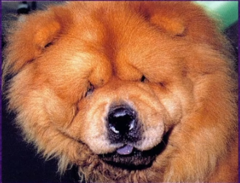
ectropion
*What conformational abnormality of the eyelid is shown in this dog?

Distichiasis
__________________ is the presence of additional cilia growing from the Meibomian gland ducts. These hairs are fine or quite stout

irritation
inflammation
*Entropion, ectropion, and distichiasis can all potentially lead to __________ and ___________ of the conjunctive and cornea.
Coloboma
A notch-like defect in the eyelid, or where part of the eyelid is missing, is called a ___________________. This term can also be applied to similar defects in the ciliary body, iris, lens, or posterior segment.

blepharitis
*Inflammation of the eyelids is called ____________

hordeolum
*Abscessation of a Meibomian gland is called a ___________, commonly referred to as a stye.

Dacryoadenitis
*______________, or inflammation of the lacrimal gland, occurs secondary to coronavirus infection in rats (sialodacryoadenitis) and in keratoconjunctivitis sicca (dry eye) in dogs.
rats: occurs secondary to coronavirus infection (sialodacryoadenitis)
dogs: keratoconjunctivitis sicca (dry eye)
Dacryoadenitis, aka inflammation of the lacrimal gland occurs secondary to what infection in rats? and secondary to what condition in dogs?
autoimmune
keratoconjunctivitis sicca (dry eye) in dogs is believed to have an ______________ pathogenesis. Autoimmune destruction of the lacrimal gland leads to dessication of the cornea and secondary inflammation of the cornea and conjunctiva. Corneal ulceration may ensue.
Autoimmune destruction of the lacrimal gland leads to dessication of the cornea and secondary inflammation of the cornea and conjunctiva. Corneal ulceration may ensue.
Keratoconjunctivitis sicca (dry eye) in dogs is believed to have an autoimmune pathogenesis. Describe this pathogenesis.
Eyelid
________ edema is a classic lesion of edema disease in swine, which is caused by toxins produced by E. coli.
"cherry eye"
*Protrusion of the gland of the third eyelid, called _____________________, is common in dogs

likely the result of congenital laxity in the connective tissue anchoring the gland to the third eyelid cartilage. It occurs as a pink fleshy mass at the medial canthus.
*What likely causes protrusion of the gland of the third eyelid in dogs?
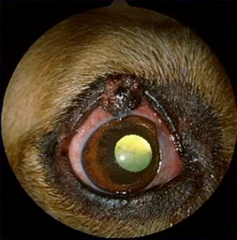
meibomian gland adenoma
What is a common benign neoplasm of the canine eyelid?
skin
As a rule of thumb, any tumor that occurs in _______ can occur on the eyelid.
stratified squamous to pseudostratified columnar epithelium
goblet cells
What type of epithelium makes up the conjunctiva? What specialized mucus secreting cells does it possess?
conjunctivitis
*What is inflammation of the conjunctiva called?
red/hyperemic
swollen/edematous
*Acute conjunctivitis often results in a _________ and _________ conjunctiva.
chemosis
*Edema of the conjunctiva is called what?
- epithelial hyperplasia
- squamous metaplasia
- goblet cell hyperplasia
- lymphoid hyperplasia
Chronic conjunctivitis results in what four changes?
Moraxella bovis
Infectious bovine keratoconjunctivitis (pinkeye) is caused by the bacterium ____________ ________.
Habronema spp.
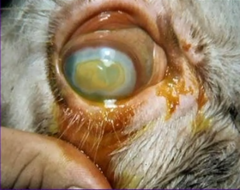
What is the name of the nematode larvae that is commonly deposited in the medial canthus of horses by flies?

granulomatous
eosinophilic
Habronemiasis typically results in masses composted of _____________ and ___________ inflammation.
pale
Anemia in an animal may be indicated by ______ mucous membranes.
icterus
Hemolysis and liver disease may result in _______ in the conjunctiva of the eye.
Hemorrhage
__________ of the conjunctiva can occur in cases like rodenticide poisoning.
Petechiation
____________ from thombocytopenia can appear in the bulbar conjunctiva.
cornea
lens
*What two structures of the eye are normally avascular?
1) surface epithelium
2) substantia propria
3) descemet's membrane
4) endothelium
From external to internal, name the four layers of the cornea.
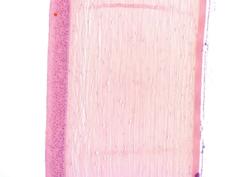
(a) non- keratinized, and non-pigmented surface epithelium
(b) avascular, cell poor stroma (substantia propria) with lamellated collagen fibers
(c) Na-K-dependent ATPase pump located in the cell membrane of the corneal endothelium
(d) glycosaminoglycans present that maintain the hydration of the cornea and help keep regular spacing between the collagen fibrils.
What four specialized physiologic and anatomic features of the cornea help maintain it's transparency? (i.e. keeps it clear)
It helps maintain a high degree of stromal dehydration by pumping sodium out of the cornea, so that water follows
How does the Na-K-dependent ATPase pump located in the cell membrane of the corneal endothelium help maintain the transparency of the cornea?
via aqueous humor
*If the cornea is avascular, how does it receive proper nutrients?
it is a congenital defect characterized by a patch of haired skin on the surface of the cornea and/or conjunctiva.
What is a corneal dermoid?

keratitis
What is inflammation of the cornea called?
Epithelial
____________ keratitis is when a mild injury erodes the epithelium and results in transient edema
Superficial stromal
___________ ________ keratitis is when a epithelial keratitis progresses and with chronicity, neovascularization, fibrosis, and sometimes pigmentation occurs.
Deep stromal
___________ ________ keratitis involves deeper lamellae and may encroach on Descemet's membrane.
neovascularization of cornea
What's happening here?

this is pigmentation - always melanin
a superficial stromal keratitis would precede this lesion
What's happening in this cornea? what sort of inflammation can cause this?

nope!
Can fibrosis of the eye (as a result of keratitis) ever fully resolve?

edema
The initial lesion in keratitis is _________ of the substantia propria
leukocytes
(cellular infiltration)
After edema, the next lesion of keratitis (in chronologic sequence) involves migration of __________ into the cornea.
first: neutrophils
second: macrophages, lymphocytes, and plasma cells
When it comes to cellular infiltration of leukocytes into the cornea as a result of keratitis - which cells arrive first? what about second?
neovascularization
In cases of keratitis, if the edema persists, or there is some destruction of lamellae, _______________ occurs
fibroblasts
fibrosis
In cases of keratitis, once vascularization has occurred, the inflammatory reaction is similar to that of other connective tissue. Stromal cells become __________ and secrete collagen fibrils, thus leading to __________ of the cornea.
melanin pigment
In cases of keratitis, if the neovascularization is superficial and close to the surface epithelium, __________ may accumulate and remain in the cornea to indicate the site of previous vascularization.
ulcer
*A lesion that extends below the basement membrane of the corneal epithelium into the underlying substantia propria, is a corneal _______.
descemetocele
*Ulcerations that extend to Descemet's membrane can result in bulging of Descemet's membrane out through the corneal defect; this is called a ____________.
Staphyloma
Following corneal perforation, aqueous humor flows out of the eye, and the globe collapses to varying degrees. The iris can be displaced into the defect, producing a lesion referred to as corneal ______________.

melting ulcer/keratomalacia
*The term ___________ ________ refers to a corneal ulcer that does not heal and is characterized by severe stromal necrosis from collagenases.

anterior synechia
*Deep stromal keratitis, with or without corneal ulceration, may lead to adherence of the iris to the posterior cornea, termed __________ ________

purulent exudate in the anterior chamber
seen in animals with sepsis
*What is hypopyon? What is it usually the result of?

dendritic
Feline herpesvirus 1 can produce branching, ____________ ulcers or larger geographic ulcers, primarily in young cats.

Mycotic
__________ keratitis is typically the result of a corneal abrasion that is treated with an antibiotic or antibiotic/corticosteroid combination, which allows normal conjunctival fungi, especially Aspergillus spp., to colonize the damaged cornea.

horses
Mycotic keratitis is most common in _________ (species).
squamous cell carcinoma
*What is the most common corneal tumor in cows?
limbus
*In cattle, especially the Hereford breed, ocular squamous cell carcinoma is an important disease. The tumors typically arise at the __________.

anterior
Epithelium is present on the lens, only on its ___________ side.
nuclear sclerosis
Since the lens cannot shed aging fibers, as does skin or intestine, these cells are compacted into the oldest, central part of the lens, the nucleus. The continued accumulation of these old, desiccated fibers results in the common, but visually insignificant, aging change of ____________ ___________.

circulation of aqueous humor
Nutrition of the lens is dependent on what?
- high protein content
- lack of nuclei and organelles
- Na/K ATPase (osmotic) pump
What three features of the lens help it to maintain its transparency?
it is a permanent opacity of the lens caused by increased hydration resulting from alteration in nutrition, metabolism, or osmotic balance
What is a cataract?
cataract formation
*What is the most common and important disorder of the lens?
Congenital
*____________ cataracts tend to be bilateral and are frequently hereditary. Other causes include in utero viral infection, teratogenic drugs, and nutritional deficiencies.
(a) inflammation
(b) ocular trauma
(c) irradiation
(d) increased intraocular pressure (glaucoma)
(e) toxins
(f) nutritional excesses and deficiencies
(g) metabolic diseases such as diabetes mellitus.
What are a few general cause of acquired cataracts?
- major source of energy for the lens is glucose - to fuel anaerobic glycolysis.
- glucose levels are increased in unmanaged diabetic patients
- hexokinase, the rate-limiting step of this metabolic pathway, becomes saturated, glucose is shunted to alternate pathways. - major alternative pathway is the sorbitol pathway.
- When glucose is converted to sorbitol, the sorbitol accumulates and osmotically pulls water into the lens, resulting in cataract formation.
How is it that a dog with diabetes mellitus can develop cataracts? explain the mechanism.
subluxation
luxation
Dislocations of the lens may be primary or secondary. If dislocation is incomplete, _____________, the lens may be only movable within its fossa (hyaloid fossa). If the rupture is complete, _____________, the lens may be displaced out of its fossa
aphakic crescent
On ophthalmic exam, a subluxated lens is visible as an ____________ __________.

primary
secondary
A luxated lens can be a ___________ process, which is present in certain dog breeds, or it may be ____________ to trauma or inflammation.
phacolytic
phacoclastic
*Leakage of lens protein is termed ______________ Rupture of the lens capsule is termed ______________
if rupture of the lens capsule occurs
(the lens is an avascular structure, so inflammation cannot occur unless its capsule is ruptured)
Only in what circumstance is the lens susceptible to inflammation?
iris, ciliary body (and processes), and choroid
What structures compose the uvea?
it includes the remnants of the vascular network that surrounds the lens during embryologic development
What is a persistent pupillary membrane?

uveitis
*What is inflammation of the uvea called?
iritis
*What is inflammation of the iris called?
Cyclitis
*What is inflammation of the ciliary body called?
Iridocyclitis
*What is inflammation of the iris and ciliary body called?
Choroiditis
*What is inflammation of the choroid called?
anterior uveitis
*What is another term for iridocyclitis?
Panopthalmitis
*What is inflammation of the entire eye, including the sclera called?
Endophthalmitis
*What is inflammation of the entire eye, excluding the sclera called?
Panuveitis
*What is inflammation of the entire uvea called? (iris, ciliary body, choroid)
- hyperemia - increased blood flow
- protein rich fluid, neutrophils move into the chambers of the eye
How do lesions develop during uveitis? from inflammation to aqueous flare, to hypopyon
aqueous flare
*Protein in the anterior chamber is clinically detectable and known as an _________ _______

hyphema
*Blood and neutrophilic exudate in the anterior chamber are called __________________
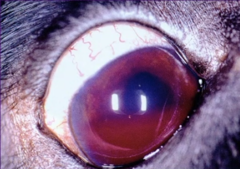
protein rich fluid - aqueous flare
blood - hyphema
purulent exudate - hypopyon
*Following uveitis, what are three possible lesions in the anterior chamber that can develop - or what three substances can leak into the anterior chamber?
- Anterior synechia
- Posterior synechia
- Cyclitic membrane
- Atrophy of uveal tissue
What are four sequelae of uveitis?
keratitis
uveitis
*Anterior synechia can occur as the result of _________ and/or ________
iris bombe
If in posterior synechia, the attachment is circumferential, the movement of aqueous humor through the pupil is blocked and the iris will bow anteriorly, which is called __________ ________.
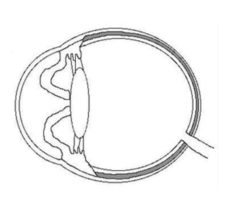
granulation (fibrovascular)
Cyclitic membrane is a band of ______________ tissue that extends along the posterior surface of the lens, from the ciliary body on one side of the eye to the other.

hypotony
Atrophy of the ciliary processes leads to reduced production of aqueous humor, which leads to ___________ (reduced intraocular pressure)
cataract
*Atrophy of uveal tissue, a sequelae of uveitis, can lead to ___________ formation due to the lack of aqueous humor being supplied to the lens.
equine recurrent uveitis
leptospira
What is a common examples of uveitis in the horse? This condition is likely associated with what infection?

keratic precipitates
Feline infectious peritonitis
What is this lesion in a cat that is composed of macrophages and neutrophils adherent to the corneal endothelium?
What infection is it associated with?

ectropion
*What's going on here?
