NEURO2020 WEEK 12
 Call Kai
 Learn
Learn Practice Test
 Spaced Repetition
 Match
Match Flashcards
 Knowt Play
1/25

There's no tags or description
Looks like no tags are added yet.
Name | Mastery | Learn | Test | Matching | Spaced | Call with Kai | Chat |
|---|
No analytics yet
Send a link to your students to track their progress
26 Terms
NEUROPLASTICITY
The ability of the brain and nervous system to reorganise itself following damage or environmental change
Adult plasticity = reorganisation, not regrowth of neurons
BRAIN DEVELOPMENT - Ontogenetic Period
Early development from birth through childhood and adolescence
Newborn brain approx. 350g, adult brain approx. 1,200-1,400g
Growth is driven by synapse formation and pruning, myelination, and glial cell development – not merely by adding neurons
Extensive flexibility during this phase
Ex. Switch hemisphere of language function
Normal behaviour with just one hemisphere
CAUSES OF BRAIN DAMAGE - Tumors
Meningiomas
Grow between layers of the meninges
Encapsulated and benign
Often surgically removed with good outcomes
Gliomas
Abnormal glial cells
More serious
Infiltrative types spread throughout brain tissue and must be managed over a lifetime
Metastatic tumours
Spread to brain from cancers elsewhere in the body
CAUSES OF BRAIN DAMAGE - Strokes
Cerebral haemorrhage
Blood vessel ruptures and blood seeps into the surrounding neural tissue causing damage
Aneurysm – a balloon-like dilation that forms on the wall of an artery where the elasticity is defective
Cerebral Ischemia
A blockage in a blood vessel that disrupts blood supply to part of the brain
Thrombosis – a blood clot
Embolism – a blockage movs from a large to small blood vessel where it becomes lodged
Arteriosclerosis – thickening of artery wall, restricting/blocking blood flow
ISCHEMIA CAUSES..
Glutamate release
STROKE BEFAST ACRONYM
Balance – loss of balance
Eyes – blurred, double vision
Face – dropping of one side, asymmetry in a smile
Arms – weakness on one side
Speech – slurred speech
Time – call for help quickly
CAUSES OF BRAIN DAMAGE - Traumatic brain Injury
Closed head TBI
Contusions – bruised brain
Subdural hematoma – collection of blood between Dura Mater and Arachnoid Membrane
Mild TBI
No physical evidence of injury
Loss of consciousness
Confusion
Chronic Traumatic Encephalopathy
Progressive dementia and cerebral scarring from repeated mTBIs
CAUSES OF BRAIN DAMAGE - Infections and Neurotoxins
Encephalitis – inflammation in the brain
Bacterial encephalitis – cerebral abscess
Antibiotics can cure abscess but not restore brain function that was damaged
Ex. Bacterial meningitis (30% fatal)
Ex. Syphilis (STI that leads to dementia)
Viral infections
Rabies has an affinity for neural tissue
Fatal if untreated
Neurotoxins – chemicals that specifically harm the brain
Mercury
Lead
Endogeneous neurotoxins (cortisol – stress hormone)
MAD AS A HATTER REFERS TO…
Neurotoxins
PROGRAMMED CELL DEATH - Apoptosis
Genetically encoded
Slow process (1-2 days)
Cells shrink, dying parts are packaged into vesicles for disposal (blebbing)
PROGRAMMED CELL DEATH - Necrosis
Passive cell death resulting from injury
Fast and disordered
Neurons swell and break apart
The dead parts scatter and harm neighbouring cells
NEUROLOGICAL DISEASES - Epilepsy
Focal seizures
one brain region
Epileptic neurons fire synchronously
Characteristic EEG spikes
Generalised (tonic-clonic) seizures
Entire brain
Cause loss of consciousness
Violent convulsions, tongue-biting and hypoxia
Absence seizures
No convulsions
Loss of consciousness and blank stare
Common in children, usually resolving at puberty
NEUROLOGICAL DISEASES - Parkinson’s
Affects 1-2% of people over 65 years
Due to degeneration of dopaminergic neurons
Treatment
L-Dopa
Deep brain stimulation
Full symptoms
Muscular rigidity
Marked tremor at rest
Slowness of movement
Mask-like face
NEUROLOGICAL DISEASES - multiple sclerosis
Attacks myelin of axons in the CNS
Leaves behind hard scar tissue
Treated with L-Dopa
Full symptoms
Myelin degrades to point where axon is non-functional
NEUROLOGICAL DISEASES - alzheimers
Preclinical
Brain changes with no outward symptoms
Prodromal
Mild cognitive impairment
Anxiety
Reduced autonomy
Dementia
Progressive memory loss
Attention deficits
Personality changes
THE KINDLING MODEL OF EPILEPSY
Repeated mild electric shocks given to rat's amygdala eventually generating convulsive response
Is permanent, therefore, a form of neuroplasticity
Kindling is similar to epileptogenesis
THE MPTP MODEL OF PARKINSON’S
Young drug users presented with classic Parkinson's symptoms
MPTP, a neurotoxin in synthetic heroin was the cause
Led researchers to use it to help develop treatments
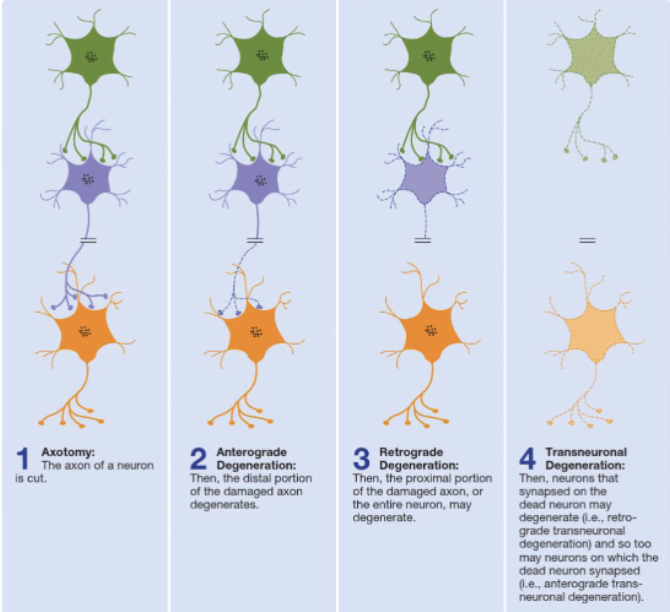
RESPONSE TO N.S DAMAGE - Degeneration
Axons and dendrites of damaged neuron break down
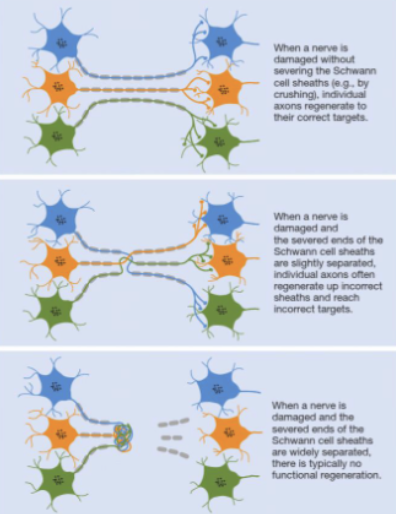
RESPONSE TO N.S DAMAGE - Regeneration
Axons can regrow along remaining Schwann cell sheaths
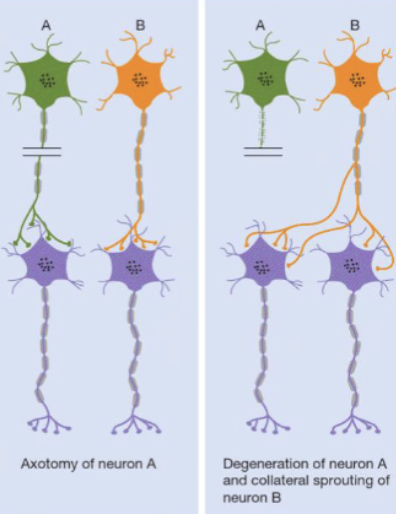
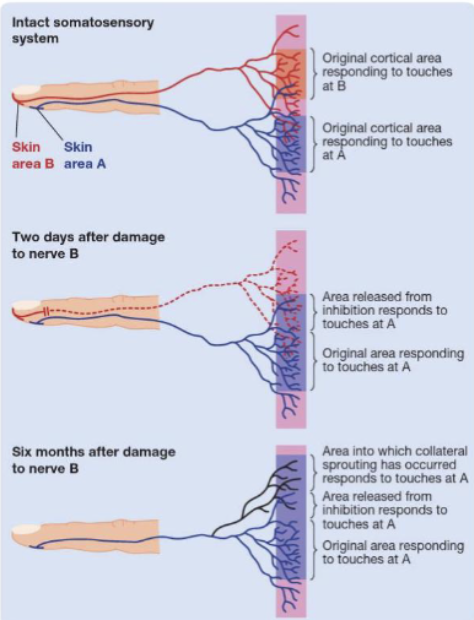
RESPONSE TO N.S DAMAGE - Collateral Sprouting
Surviving axons send out new branches that innervate targets left vacant by dead neurons
RESPONSE TO N.S DAMAGE - Neural reorganisation
Cortical maps can shift
Regions that previously served one function are taken over by adjacent areas
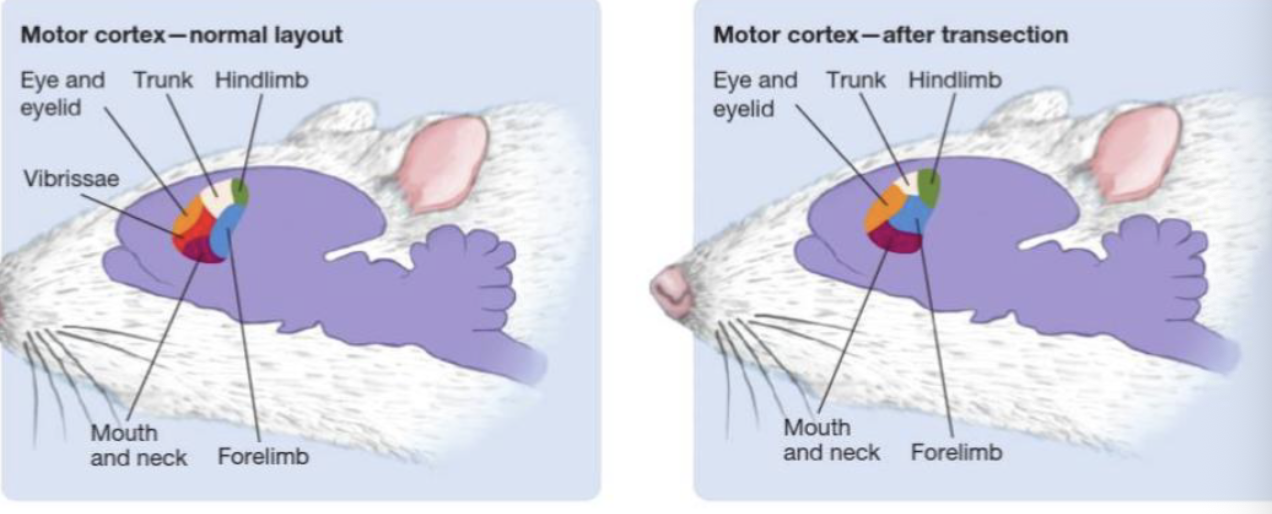
RESPONSE TO N.S DAMAGE - Release from inhibition
Removing a damaged inhibitory pathway can unmask latent connections in spared tissue
RECOVERY AFTER TBI
Recovery after TBI is often in the immediate post-injury period
Due to reduction in brain swelling and dispersal of blood
Slow progress seen in later months
Difficult to distinguish physical improvements from newly learned compensatory strategies
COGNITIVE RESERVE
The cognitive capacity built up through education and intelligence, enabling the brain to accomplish tasks via alternative neural pathways when primary pathways are damaged.
Outcomes after brain injury are generally better for younger patients, those with higher IQ and more education
COGNITIVE AND PHSYICAL EXERCISE
Importance of active rehabilitation, not just rest
Both cognitive and physical exercise promote neurogenesis and support broader brain health
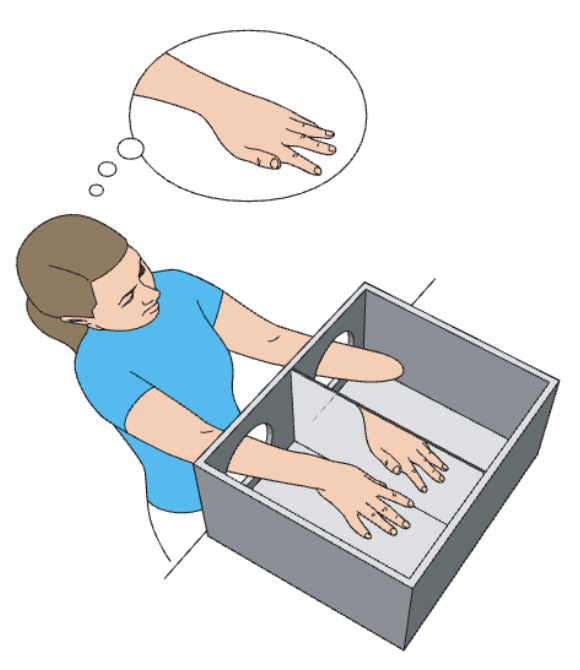
PHANTOM LIMBS
The continued experienced sensations from removed limbs
Patients who practised with the mirror box for several weeks reported significant reduction in phantom limb pain
Demonstration of how visual feedback can retrain cortical circuits