Lecture Two and Three
 Call Kai
 Learn
Learn Practice Test
 Spaced Repetition
 Match
Match Flashcards
 Knowt Play
1/44

There's no tags or description
Looks like no tags are added yet.
Name | Mastery | Learn | Test | Matching | Spaced | Call with Kai | Chat |
|---|
No analytics yet
Send a link to your students to track their progress
45 Terms
Weather
Condition of the atmosphere at a particular location and moment
What are some atmospheric conditions of weather?
Temperature, humidity, pressure, wind speed and direction, cloud cover, and precipitation
What causes weather?
The effect of the Sun on the Earth
What is climate?
Region in the condition of the atmosphere over many years
What is climate described by?
Long term averages of atmospheric conditions such as temperature and precipitationW
What is the study of climate?
Climatology or climate science
What is the study changes of climate in the past and for the future?
Climatologists or climate scientists
What is meteorology?
Study of weather variables, processes that cause weather, interaction of the atmosphere with the Earth’s surface and ocean
What is the difference between meteorologist and atmospheric scientist?
Meterologist: Those forecasting the weather
Atmospheric scientist: Someone who boadly studies weather, climate, or atmospheric chemistry
What is the atmosphere?
Fluid, thin layer surrounding the Earth, a mixture of invisible gas with solid and liquid particles that stay in place on account of the gravitational forces
What is the Earth’s diameter and atmosphere?
Diameter: 8000 miles
Atmosphere: 100 miles
Describe the evolution of the Earth’s atmosphere
4.5 billion years ago: hydrogen, helium
Volcanic eruptions: Water vapor, carbon dioxide, nitrogen
Earth’s cooling to clouds to surface water
CO2 dissolved and accumulated in oceans
Bacteria in water then vegetation, which produces oxygen (photosynthesis)
Nitrogen chemically stable and accumulated in the atmosphere
What is vital to meterology and climatology?
Variable gases
How can we understand atmospheric concentrations of trace gases?
Sources and sinks need to be investigated
What percent of oxygen, sources, sinks
20.95%
Sources: photosynthesis, ocean phytoplankton
Sinks: decay of organic matter, oxidation, combustion, respiration
What percent of nitrogen, sources, sinks
78.08%
Sources (denitrification): Decaying plant and animal
matter
Sinks (“nitrogen fixation”):
• Soil bacteria
• Ocean phytoplankton
• Lightning – hot enough to break
N2 and form nitrous oxides (NOx)
Water Vapor (0-4%)
Greenhouse gas!
Sources:
• Evaporation (liquid to vapor)
• Sublimation (ice to vapor)
• Transpiration
Sinks:
• Condensation (vapor to liquid)
• Deposition (vapor to ice)
Precipitation
Carbon Dioxide
Greenhouse gas!
Sources:
• Biomass decay - Deforestation
• Respiration - Volcanic eruptions
• Combustion
Sinks:
• Photosynthesis
• Ocean phytoplankton
• Dissolved directly into ocean surface
Methane (1.9 ppm)
Greenhouse gas!
Sources:
• Anaerobic environments
Wetlands, rice paddies
Cows and other livestock animals
Termites
• Biomass burning
Sinks:
• Interaction with OH in atmosphere
Nitrous Oxide (N2O)
Greenhouse gas!
Sources:
• Bacteria in soils/oceans
• Combustion (cars, biomass)
• Fertilizers
Sinks:
• Stratospheric photochemistry
Ozone (O3)
O3 layer forms in the stratosphere 600 million years ago (required sufficient O2)
UV light is harmful to organisms and formation of stratospheric O2 allowed life to move from the oceans where they are protected from UV light, to land
Photosynthesis becomes largest source of O2
O2 levels stabilize at 20% from balance between photosynthetic O2 production and removal through respiration and decay of organic material
What did the Chapman Mechanism propose?
Ozone layer originates from the photolysis of atmospheric O2
O2 + light (240 nm) O + O
2. O2 + O O3
3. O3 + UV O2 + O
R3 is not a terminal sink for O3 since the O atom product may recombine with O2 by R2 to regenerate O3
What is the result of the Chapman Mechanism?
Reproduces the shape of the O3 through the stratosphere but overestimates the observed O3 mixing ratio by a factor of two or more thus the source is too big or the sink is too small
What is well constrained with spectroscopic data?
R1, so we know the source. Therefore, there must be additional sinks
Stratosphere
Troposphere
Troposphere O3: photochemical smog
What are the three stratospheric O3 sinks?
Hydrogen oxide radical
Nitrogen oxide radicals
Chlorine oxide radicals
What is an atmospheric sink?
Natural/chemical process that removes greenhouse gas + pollutant from the atmosphere
What is an important characteristic of sink 3?
Highly catalytic, actively destroying ozone, not particularly fast
What do CFC’s stand for?
Chloroflurocarbons
What are greenhouse gasees
Artificial, chemically inert, nontoxic, deplete ozone in the stratosphere
What is an ozone hole
Rapid depletion of stratosphere ozone layer with presences of CFC’s, cold temperature, and sunlight
What is an example of this?
Polar stratospheric clouds form which encourages fast O3 depletion through photolysis
What are sources of chloroflurocarbons?
Propellants in aerosol cans, refrigerants, blowing of plastic foam insulation, cleaning for electronics
What is the issue with CFC’s?
Can upset balance between ozone production and destruction
INTRODUCTION TO WEATHER MAPS
Continue to the next section
What is the Coordinated Universal Time?
The reference clock adopted by weather organizations around the world
What is a front?
Boundaries between air masses
Define isotherms
Connect observations of the same temperature
Define isobars
Connect observations of the same pressure
What is a station model
Model that is used with data from specific locations coded
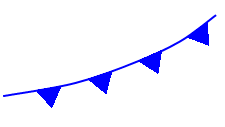
What is this?
Cold front

What is this?
Warm front

What is this?
Stationary front

What is this?
Occluded front
How to describe the direction of movement for each of the fronts?
Cold: Dense cold air mass advances and replaces warmer air mass
Warm: Move slowly as lighter warm air mass advances and glides up over a retreating cold air mass
Occluded: Move forward as a fast moving cold front overtakes a slower warm front
Stationary: Do not move significantly, because cold and warm air masses meet with equal force and stall out. Surface winds blow parallel to the front rather than pushing it forward