Geology final
0.0(0)
Studied by 3 people Call Kai
 Learn
Learn Practice Test
 Spaced Repetition
 Match
Match Flashcards
 Knowt Play
Card Sorting
1/103

Earn XP
Description and Tags
Last updated 2:42 AM on 12/14/22
Name | Mastery | Learn | Test | Matching | Spaced | Call with Kai | Chat |
|---|
No analytics yet
Send a link to your students to track their progress
104 Terms
1
New cards
earthquake
vibrations caused by the rupture and sudden movement of rocks along a break or a crack in Earth's crust
2
New cards
What happens during an earthquake?
Before deformation rock layers are not bent
Before an earthquake, rock bends elastically, like a stick that you arch between your hands
Eventually the rock breaks and sliding suddenly occurs on a fault. This break generates vibrations.
Before an earthquake, rock bends elastically, like a stick that you arch between your hands
Eventually the rock breaks and sliding suddenly occurs on a fault. This break generates vibrations.
3
New cards
displacement
the amount of movement or slip across a fault plane
4
New cards
fault scarp
a small step on the ground surface where one side of a fault has moved vertically with respect to the other
5
New cards
normal faults
form during an extension of the crust. The hanging wall moves down. the Fualt scarp is a slope down-\-
6
New cards
reverse faults
reverse faults for during the shortening of the crust. The hanging wall moves up and the fault is steep -/-
7
New cards
Thrust faults
low angle reverse faults
8
New cards
strike-slip fault
a type of fault where rocks on either side move past each other sideways with little up or down motion
9
New cards
elastic rebound theory
earthquakes happen because stress builds up, causing the rock that is adjacent to the fault to bend elastically until breaking and slipping occurs: the slip relaxes the elastic bending and decreases stress
10
New cards
stick-slip behavior
alternation between stress buildup and earthquake-generating slip events on an existing fault.
11
New cards
Focus (hypocenter)
the point within the earth where an earthquake rupture starts
12
New cards
epicenter
Point on Earth's surface directly above an earthquake's focus
13
New cards
body waves
seismic waves that travel through the Earth's interior
14
New cards
surface waves
seismic waves that travel along the Earth's surface
15
New cards
Compressional Waves (P waves)
waves that cause particles of material to move back and forth parallel to the direction in which the wave itself moves like a slingky
16
New cards
Shear Waves (S waves)
waves that cause particles of material to move back and forth perpendicular to the direction in which the wave itself moves like a rope being moved up and down
17
New cards
L waves (surface waves)
surface waves that cause the ground to shimmy back and forth
18
New cards
R-waves
surface waves that cause the ground to undulate up and down
19
New cards
earthquake intensity
Measure of damage; energy absorbed; changes from location to location used the Modified Mercalli Intensity Scale I-XII
20
New cards
Richter scale
A scale that rates an earthquake's magnitude based on the size of its largest seismic waves.
21
New cards
earthquake magnitude
measure of ground shaking during and earthquake, which depends of distance from epicenter and the geological material.
22
New cards
What four factors effect the severity of the earthquake
1. magnitude of earthquake
2. the distance from the focus
3. the natural substrate at the location
4. the frequency of the waves
23
New cards
how can earthquakes cause damage
shaking of the ground causing infrastructure to collapse
landslides
sediment liquidation
fire
tsunamis
disease
landslides
sediment liquidation
fire
tsunamis
disease
24
New cards
mass movement (mass wasting)
the downslope movement of rock or regolith under the influence of gravity
25
New cards
creep
the slow downhill movement of weathered rock material
26
New cards
Solidfluction
slow (permafrost moves over frozen surface below)
27
New cards
slumping
A type of mass movement involving material moving downhill under its own weight. Spoon shaped
28
New cards
mudflow
Quickly moving downhill flow of soil and rock fragments containing a large amount of water
29
New cards
rock slide
A sudden downslope movement of rock.
30
New cards
downcutting
the process in which water flowing through a channel cuts into the substrate and deepens the channel relative to its surroundings
31
New cards
headwater erosion
lengthening and widening of a stream
32
New cards
drainage network
an array of interconnecting streams that together drain an area
33
New cards
discharge
the total volume of water passing a point along the bank in a second.
34
New cards
capacity
the total quantity of sediment carried by a stream
35
New cards
competence
the maximum particle size a stream can transport
36
New cards
delta
A landform made of sediment that is deposited where a river flows into an ocean or lake
37
New cards
Porosity
the amount of open space in a rock or sediment
38
New cards
permeability
Ability of rock or soil to allow water to flow through it
39
New cards
groundwater drawdown
caused when water is pumped out of well too fast creates a cone of depression too much pumping can also cause a saltwater intrusion
40
New cards
desert
a region that is so arid (dry that it supports vegetation on no more than 15% of its surface, less than 25 cm of rain fall per year on average
41
New cards
subtropical deserts
form do to the global-scale pattern of air circulation where it flows downward in the subtropics warms and absorbs water as it sinks
latitudes of 20-30 degrees
latitudes of 20-30 degrees
42
New cards
rain-shadow deserts
moist air rises and drops rain on the coastal side of the mountain range. By the time the air has crossed the mountains it is dry.
43
New cards
costal desert
formed along cold ocean currents. rain clouds don't form due to the cold water cooling the air making it dense and not allowing it to rise
44
New cards
continental-interior deserts
desert regions that are dry because they are located so far from the sea that rain might fail to reach them
45
New cards
polar deserts
Cold air at or near the poles can't hold much moisture, so precipitation is low
46
New cards
desert varnish
A dark, rusty-brown coating of iron oxide and magnesium oxide that accumulates on the surface of the rock.
47
New cards
petroglyphs
Rock art carvings made by scratching or pecking the surface of exposed stone.
48
New cards
water erosion in deserts
flash floods can radically alter the landscape in minutes
49
New cards
saltation
the process of rolling or bouncing along the ground wind transports desert sediment as suspended load and surface load
50
New cards
dust storm
haboob
51
New cards
ventifacts
rocks shaped by wind blown sediments
52
New cards
yardangs
ridges that are sculpted and streamlined by wind abrasion and deflation
53
New cards
deflation
the process of lowering the land surface
54
New cards
lag deposit
the coarse sediment left behind in a desert after wind erosion removes the finer sediment
55
New cards
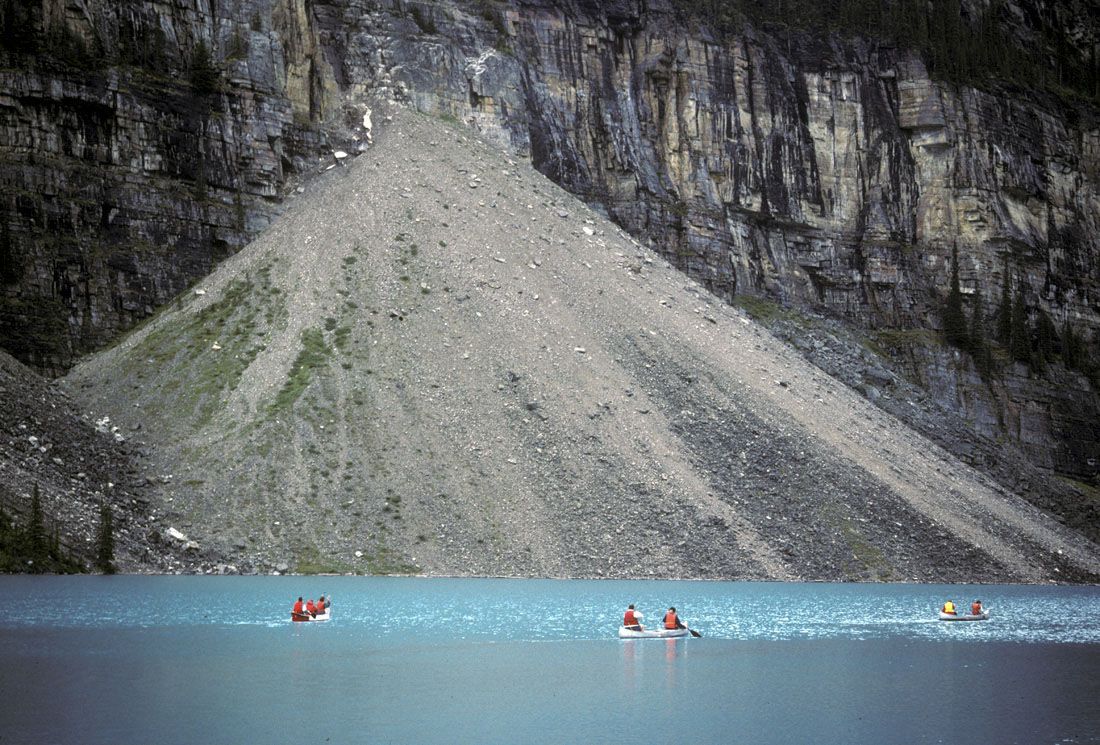
talus
a pile of angular rocks and sediment from a rockfall at the base of cliff
56
New cards
alluvial fan
formed when sediment-laden water flows out onto a plain at the mouth of a canyon, it spreads out over a surface with a gentle slope.
57
New cards
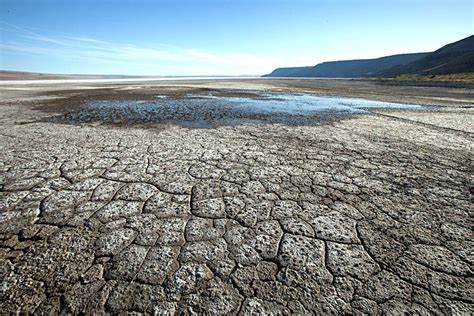
playa
dry, flat, exposed lake bed crust of clay and various salts accumulate on the surface
58
New cards
dunes
mounds of wind-deposited sand
59
New cards
cliff retreat
The change in the position of a cliff face caused by erosion.
60
New cards
mesas, buttes, chimneys
broad, flat-topped erosional remnants bounded on all sides by steep slopes mesas (large) butte (small) chimneys (skinny and tall)
61
New cards
natural arches
a curved formation in rock caused by weathering and erosion through a fin
62
New cards
desert pavement
A mosaic-like stone surface forming the ground in a desert.
63
New cards
cuestas
a ridge with one steep slope and one soft slope
64
New cards
inselbergs
isolated, steep-sided erosional remnants that rise above desert plains
65
New cards
types of sand dunes
barchan (u shaped and goes with the wind), parabolic (u shaped and tails go against the wind), transverse (triangular ridges, perpendicular to wind), longitudinal (longways with the wind), star (middle circle with lines coming out of it)
66
New cards
Desertification
the process by which fertile land becomes desert, typically as a result of drought, deforestation, or inappropriate agriculture.
67
New cards
mountain glaciers (alpine glaciers)
exist in or adjacent to mountainous regions and are make entirely of freshwater.
68
New cards
continental glaciers (ice sheets)
Large, broad, slow-moving glaciers that cover large portions of continental areas.
69
New cards
How do glaciers form?
Glaciers begin to form when snow remains in the same area year-round, where enough snow accumulates to transform into ice. Each year, new layers of snow bury and compress the previous layers. This compression forces the snow to re-crystallize, forming grains similar in size and shape to grains of sugar.
70
New cards
firn
A dense, icy pack of old snow
71
New cards
basal sliding
the movement of a glacier that depends on the pull of gravity and on a thin layer of water between glacier and land
72
New cards
plastic deformation
existing grains slowly change shape without breaking or new grains grow while the old ones disappear. They become flattened and elongates without breaking
73
New cards
crevasse
A deep crack or fissure in the ice of a glacier.
74
New cards
ablation zone
the lower portion of a glacier where there is a net annual loss of ice due to melting and sublimation
75
New cards
glacial striations
Scratches and grooves on bedrock caused by glacial abrasion
76
New cards
ice shelves versus sea ice
continental glaciers that flow into the saw along the coast make ice shelves. Sea ice forms when the ocean surface freezes
77
New cards
Fjords
glacial valleys flooded by seawater
78
New cards
Milankovitch cycles
periodic changes in Earth's rotation and orbit around the sun, could have caused some glacial advances and retreats
79
New cards
what forms oil and gas
organic remains of planktons which settle out and become black organic shale. chemical reactions at elevated temperatures convert the organic matter to kerogen and then to oil
80
New cards
source rock
A rock rich in organic matter which, if heated sufficiently, will generate oil or gas.
81
New cards
reservoir rock
A rock that is sufficiently porous and permeable to store and transmit petroleum.
82
New cards
oil trap
a geologic structure that allows for significant amounts of oil and gas to accumulate
83
New cards
directional drilling
The process of controlling the trajectory of a drill bit to make sure that the drill hole goes exactly where desired.
84
New cards
Hydrofracturing
a well drilled to break open rock to get natural gas, where fluid and other chemicals are injected into rocks containing natural methane gas in order to use the water pressure to fracture the rock and allow the gas to be extracted
85
New cards
coal formation
prehistoric plants buried un-decomposed in oxygen-depleted water of swamps/bogs converted by heat and pressure and compaction changes the debris into peat that wen buried deeply and heated, transforms into coal
86
New cards
strip mining
the removal of strips of soil and rock to expose ore
87
New cards
underground mining
involves the sinking of shafts to reach underground deposits. In this type of mining, networks of tunnels are dug or blasted and humans enter these tunnels in order to manually retrieve the coal.
88
New cards
nuclear power plants
convert the heat produced by nuclear fission of uranium into electrical energy. difficult to dispose of nuclear waste
89
New cards
metal ore
A mineral that contains a compound of the metal and from which the metal is extracted.
90
New cards
magmatic ore deposits
when minerals grow during solidification of melt. In hydrothermal deposits ore minerals precipitate from hot-water solutions
91
New cards
nonmetalic resources
dimension stone, crushed stone, cement (from roasted limestone), evaporites, and clay
92
New cards
what is the layers of hydrocarbons
natural gas, oil, water
93
New cards
volatility
ability to evaporate
94
New cards
fossils
the remains or impression of a prehistoric organism preserved in petrified form or as a mold or cast in rock.
95
New cards
relative age
The age of a rock compared to the ages of rock layers strata, sedimentary rocks
96
New cards
isotopic (radiometric dating)
uses half-lives to determine the ages of igneous and metamorphic rocks
97
New cards
the Haden Eon (unoffical)
molten, lots of debris from space debris, off gassing, temporary/ unstable atmosphere
98
New cards
Archean Eon (4000-2500 MYA)
the oldest rock form
continental cores form
1st atmosphere
1st sign of life (bacteria and archaea)
continental cores form
1st atmosphere
1st sign of life (bacteria and archaea)
99
New cards
Proterozoic Eon (2.5 BYA- 542 MYA)
90% of continental crust formed
photosynthesis adds oxygen to the atmosphere
1st supercontinent Rodinia
photosynthesis adds oxygen to the atmosphere
1st supercontinent Rodinia
100
New cards
Rodinia Supercontinent
during the late Precambrian, a large land mass formed that connected all the major continents of today approximately 1 billion years ago
second part of ohio is attached
second part of ohio is attached