L19 - Ammonia Assimilation and Toxicity
 Call Kai
 Learn
Learn Practice Test
 Spaced Repetition
 Match
Match Flashcards
 Knowt Play
1/11

There's no tags or description
Looks like no tags are added yet.
Name | Mastery | Learn | Test | Matching | Spaced | Call with Kai | Chat |
|---|
No analytics yet
Send a link to your students to track their progress
12 Terms
Normal level of ammonia in the body; Too much ammonia causes what?
Between 10-30µM
Too much causes hyperammonemia:
80µM in infants up to 1 months
55µM in older children
30µM in adults
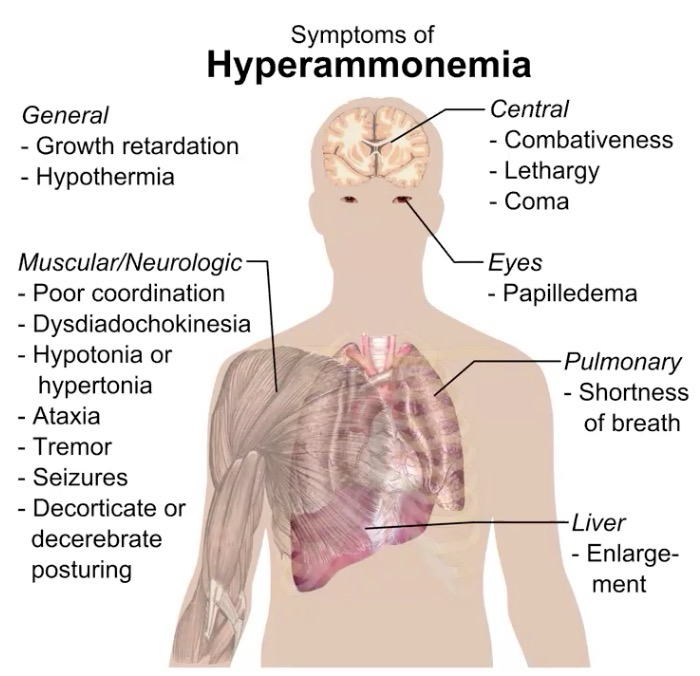
Hyperammonemia Causes
Urea cycle disorders are congenital conditions but depending on deficient enzyme, ammonia may build up and trigger due to stress/illness
Liver damage causes impairment to ammonia processing, occurs in severe liver diseases, and can also occur due to triggering events such as gastrointestinal bleeding or electrolyte imbalance.
Kidney failure
Blood disorders like myeloma or acute leukemia
Strong treatments such as chemotheraputics
Infection of urease-producing organisms
Hyperammonemia Treatments
Aromatic acid benzoate or phenylbutyrate can assimilate excess ammonia
Other therapies target specific enzyme deficiencies
Deficiencies in NAGS affects CPS-I, can be treated with carbonyl glutamate, a NAG analog that can activate CPS-I
Ornithine Transcarbamylase (OTC) Deficiency
Causes hyperammonemia and orotic aciduria
Type of UCD; CPS-I assimilates ammonia, but OTC enzyme is deficient and can’t catalyze the first reaction of Urea cycle, causing carbamoyl phosphate and ammonia buildup. This buildup causes leakage into the cytosol, where carbamoyl phosphate turns into orotic acid and causes orotic aciduria
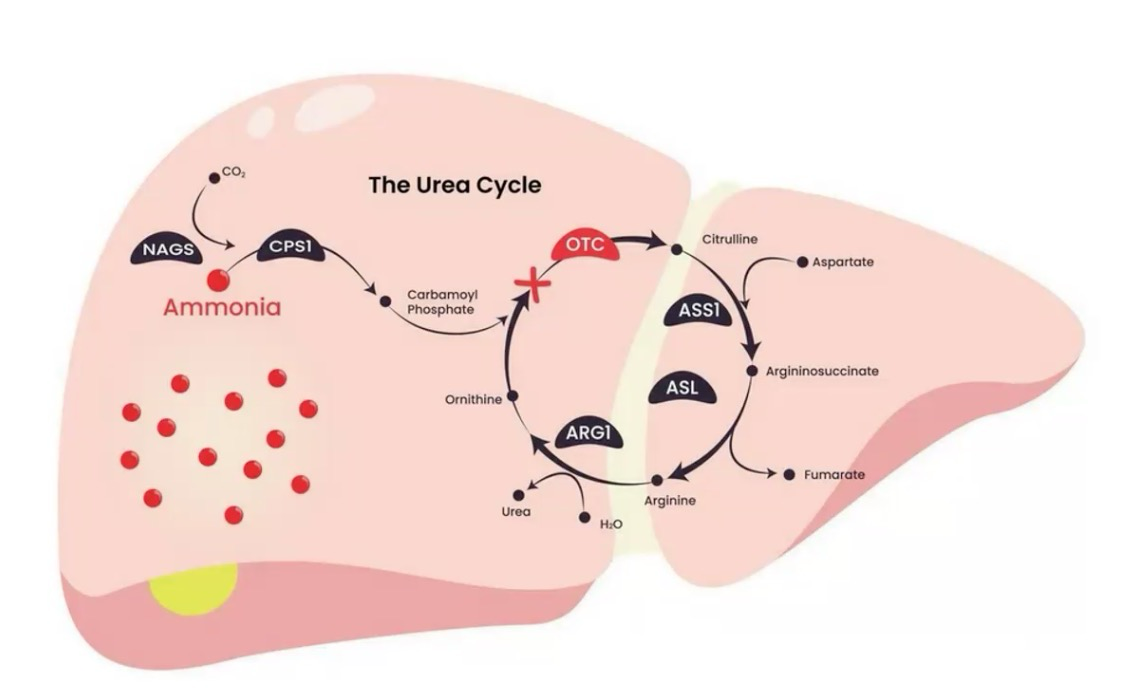
Arginase Deficiency
Type of UCD: Causes episodic hyperammonemia, usually non-life-threatening
Individuals with this are typically fine at birth and early childhood, when excess arginine is needed anyway
Ammonia buildup isn’t as drastic here

Liver Acinus
Vascular system within the liver that helps to filter ammonia; Double-filtering system
Separated into zones:
Zone 1: Portal vein, CPS-I and glutaminase is active here; low affinity, high capacity
Zone 3: Glutamine synthetase is active here ; high affinity

Ammonia Assimilation
NOT transamination bc it does not decrease ammonia levels
Ammonia assimilation reactions are those that causes ammonia release/uptake
Glutamate dehydrogenase can both deaminate and assimilate ammonia; forward is called oxidative deamination and reverse is reductive amination
Glutamine synthetase: Uses E to form Q; assimilates; important in distant tissues
Glutamine synthetase
Catalyzes two-step reaction of NH4+ with E to produce Q
Requires ATP; traps ammonia in the cytosol
Glutamine synthetase regulation
Allosterically inhibited by several end-products of glutamine
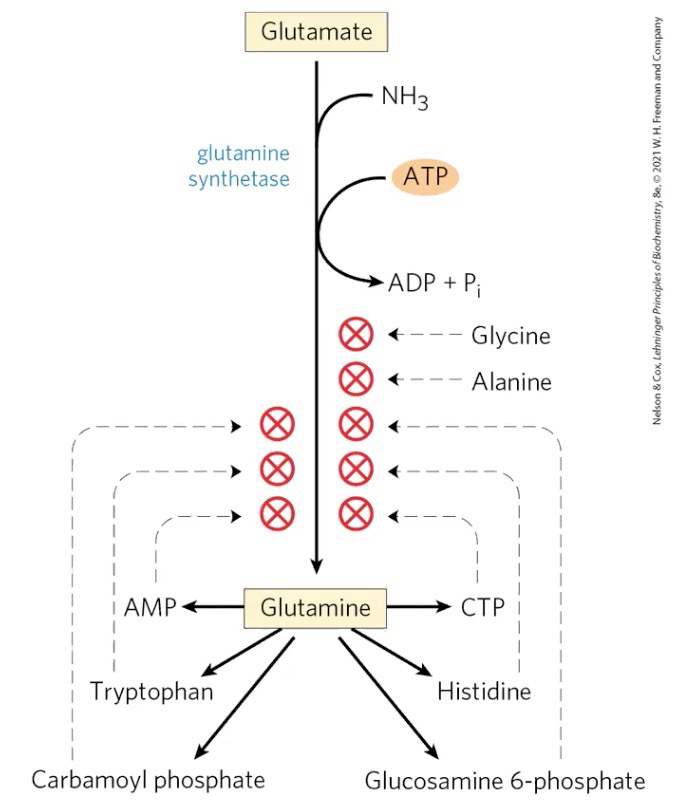
Importance of glutamine
Carries ammonia from muscles and brain to kidneys and liver
Very important in the brain
Essential for proteins and AA synthesis
Makes up 20% of total AA in body
Inter-organ nitrogen shuttle
Very important balance is needed. During hyperamonemia, glutamine formation may cause it to travel to the neuron, be processed back into ammonia, and cause problems.
Glutamate dehydrogenase and alanine aminotransferase can also help detoxify ammonia; Traps ammonia in the form of alanine.
Excitotoxicity
Occurs when excessive glutamates over stimulates neurons; leading to dysfunction; shows importance of glutamine synthetase
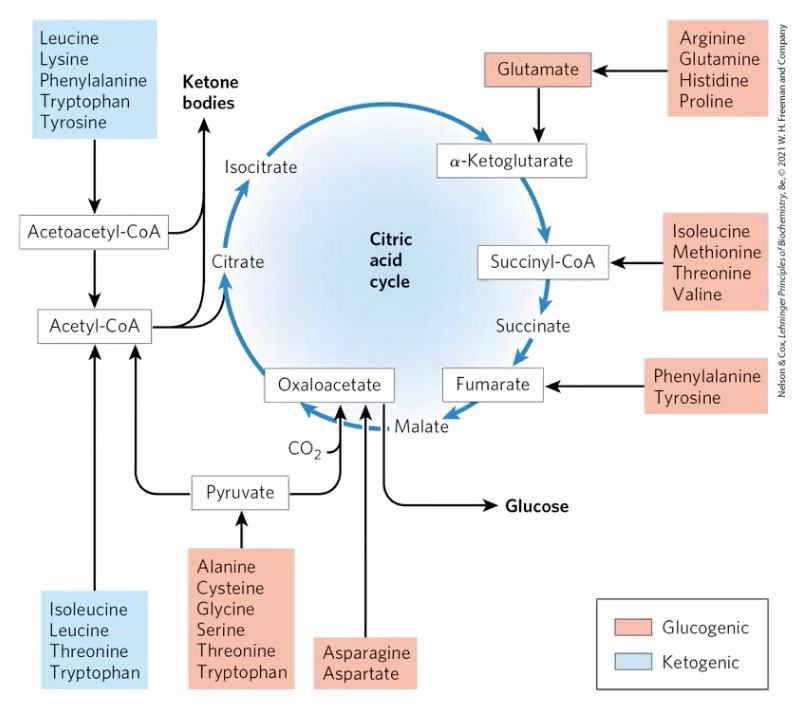
Disposition of AA carbon skeletons
Glycogenic/gluconeogenic AAs can be converted into intermediates in the TCA cycle and gluconeogenesis (A, D, N, E, & Q)
Ketogenic AAs can be converted to ketone bodies (K & L) (A, C, G, & S are potentially ketogenic)
AAs that are both keto and glycogenic: I, F, Y, W, T